
- 1Ecobalyse, the official French calculator developed by ADEME and the CGDD, gives a garment's environmental cost in minutes.
- 2The durability coefficient (0.67 to 1.45) judges a brand's business model, not only the product.
- 3Default values are unfavourable. Where supplier data is missing, they penalise the score by design.
- 4From 1 October 2026, a third party may publish your score if you do not.
Before looking at how Ecobalyse works, here is what the environmental cost of a garment looks like when a brand displays it, in store or online, as brands have been able to do since 1 October 2025. The official label has 3 elements: the heading "Environmental cost", the product's number of impact points and the same number expressed per 100 g.
What the "Environmental cost" label shows
The official label gives neither a letter nor a class: it shows a number of impact points for the whole product, and that same number expressed per 100 g. The higher the number, the greater the impact.Compare the 2 fictional garments below: the total and the value per 100 g do not tell the same story.
Behind this single figure lies a dense calculation. It draws on 16 indicators from the European Product Environmental Footprint (PEF) method, supplemented by 2 French indicators, and applies a durability coefficient specific to France together with default values that overstate impacts where supplier information is missing. The indicators follow the European EF 3.1 characterisation method. The calculation data come mostly from ecoinvent 3.9.1 and are published in the Base Empreinte database of ADEME (the French Agency for Ecological Transition). The only regulatory version in force is v7.0.0, regardless of the move to new life cycle assessment (LCA) databases (in French) under way at European level.
1What Ecobalyse is: the French government's free calculator
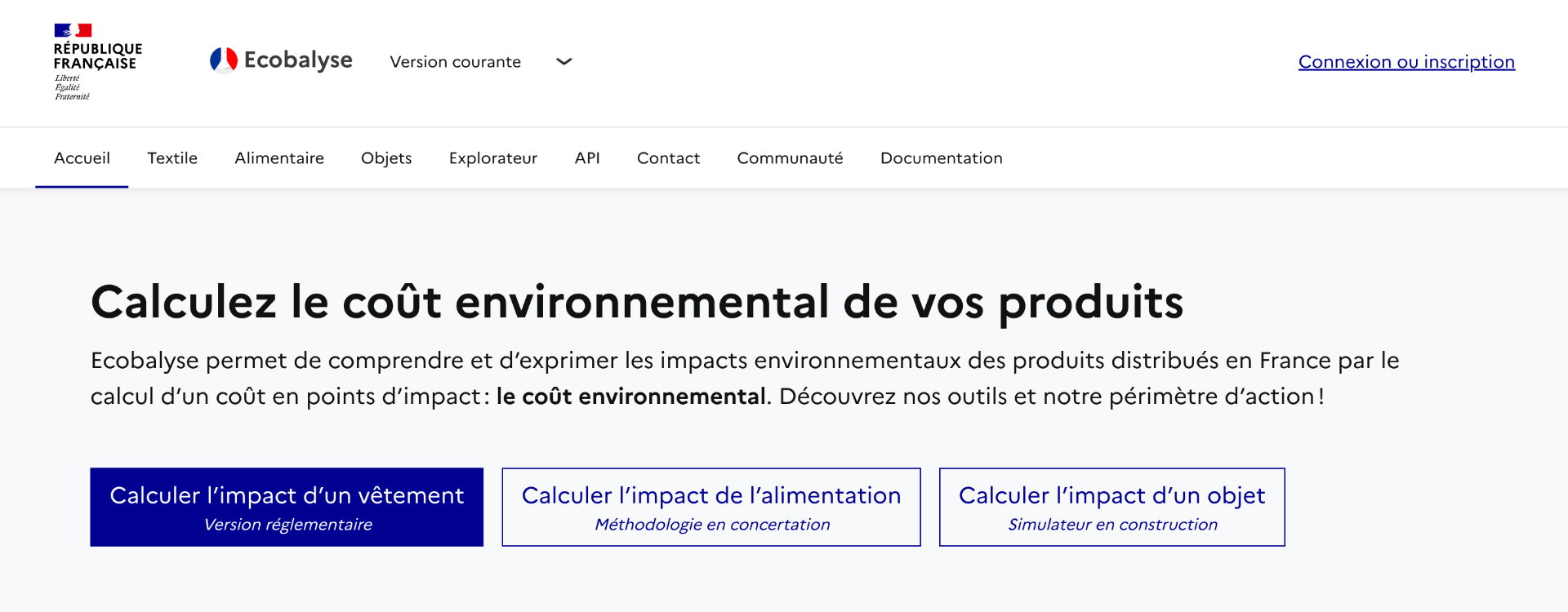
Ecobalyse is the official French tool for calculating the environmental cost of a garment. Developed by ADEME and the CGDD (the French General Commission for Sustainable Development) and hosted by beta.gouv (the French government's digital services incubator), it is free and available online at ecobalyse.beta.gouv.fr. Its source code is public on GitHub, so anyone can check the formulas. The home page illustrates the result with an "Environmental cost" label in impact points (930 Pts in the example image), the kind of figure that brands have been able to display on their garments since 1 October 2025.
Ecobalyse at a glance
The French government's official tool for calculating the environmental cost of a garment sold in France.
16 PEF indicators and 2 French supplements, not just carbon
Open to any brand, with no size threshold, from fashion designers to multinationals
Publication by a third party possible without the brand's consent
€15k to €80k to make supplier data reliable
Anyone who knows Yuka, the French app that scores food products, will recognise the logic, with one difference: Ecobalyse is a government tool, and the score it produces has regulatory standing.
Why it exists
The starting point is France's Climate and Resilience Act of 2021, which provides for environmental labelling of garments sold in France, a world first. Ecobalyse was built between 2021 and 2025 to calculate this score. Notified to the European Commission in February 2025, Decree No. 2025-957 and the ministerial order of 6 September 2025 set the regulatory framework, in force since 1 October 2025.
The stakes extend beyond France. Under the Ecodesign for Sustainable Products Regulation (ESPR) (in French), adopted in 2024, the European Union is preparing a delegated act for textiles, with adoption planned around 2027. It could lead to harmonised environmental information EU-wide, but no text currently sets a labelling obligation or a deadline. No European method has been chosen yet, and several sources agree that Ecobalyse is the front-runner to become the reference model. For a detailed account of the labelling rules in France, see our complete guide to textile environmental labelling.
Who is affected
Any brand that sells new or remanufactured garments to consumers in France may display this score voluntarily, whether it is a large international brand or a small French one, an online-only retailer or a store chain. There is no turnover threshold and no exemption for micro-businesses and SMEs, which is unusual for an environmental scheme.
From 1 October 2026, if a brand does not publish its products' scores itself, anyone may calculate them with Ecobalyse and publish them in its place. The result is often unfavourable, because default values fill in the missing data, as explained below.
2What you enter and how the score is calculated
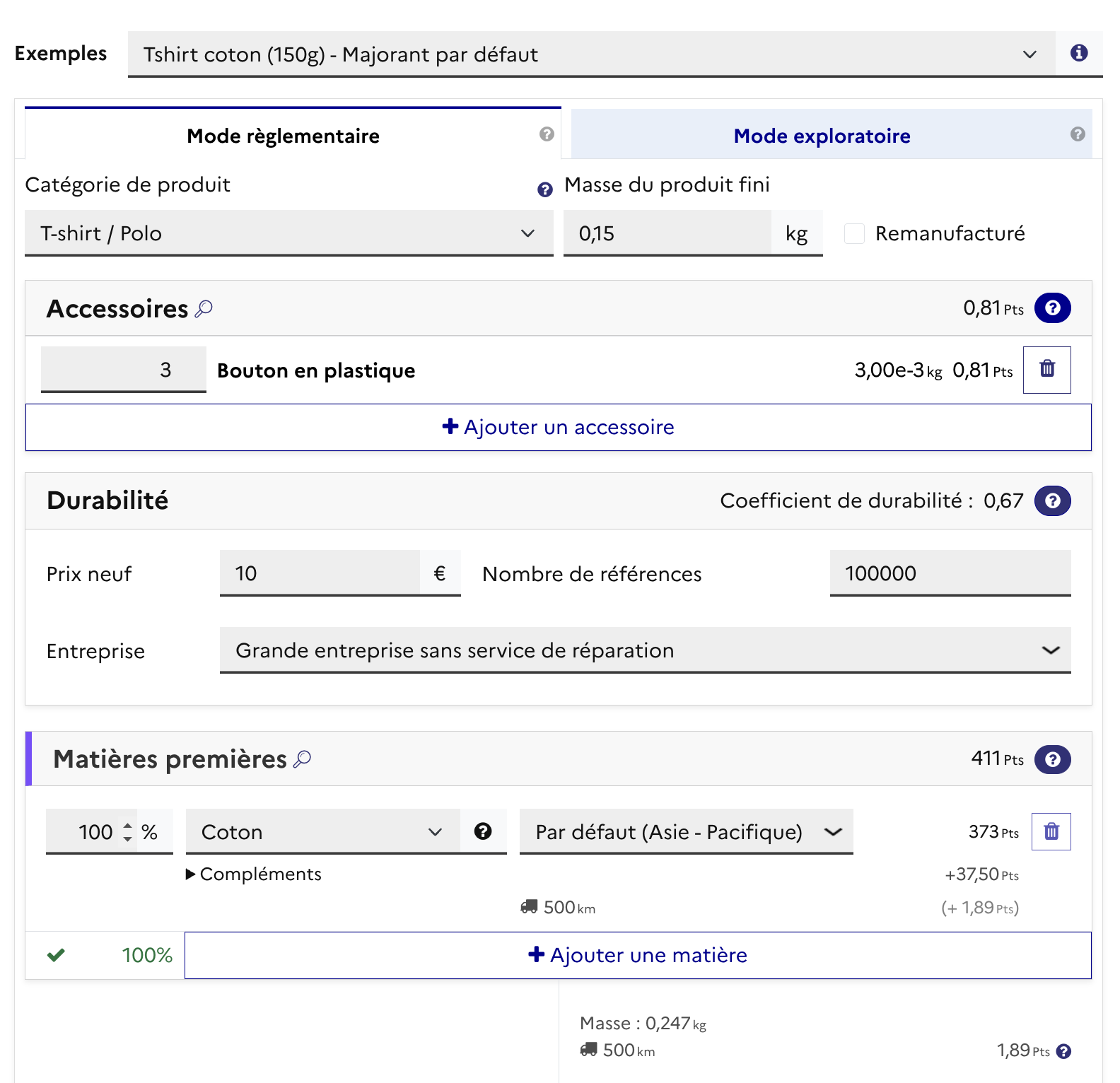
The simplest way to understand Ecobalyse is to follow an entry through. On the home page, click "Simuler un produit textile" (Simulate a textile product). The interface offers 2 modes: regulatory (the score that complies with the decree) and exploratory (for testing scenarios). Take a French brand that wants to calculate the score of its cotton T-shirt made in Portugal. The tool always asks the same 4 questions.
The Ecobalyse simulator in action
Entering a 150 g cotton T-shirt - ecobalyse.beta.gouv.fr
The 4 questions
- Garment type and weight: T-shirt, jeans, shirt, jumper, dress, coat. Ecobalyse covers clothing only; footwear, household linen, bags, scarves and hats are out of scope, with no published timetable for extending it
- Fabric composition: cotton, organic cotton, polyester, recycled polyester, wool, linen, viscose, hemp and some fifty other materials. For a blended fabric, you enter the percentages. This step looks harmless but has a large effect on the final score
- Where it is made: the country of weaving or knitting, of finishing and of garment making (all mandatory), plus the country of spinning if you know it. Ecobalyse holds each country's energy mix and uses it to calculate the footprint: dyeing done in France (in French) has a different impact from the same dyeing done in China
- Transport: Ecobalyse works out the journeys between stages from the countries entered. You can specify only the share of air transport; if you do not, it is set at 0% where garment making takes place in Europe or Turkey and at 33% or 100% elsewhere, depending on the durability coefficient
What you get
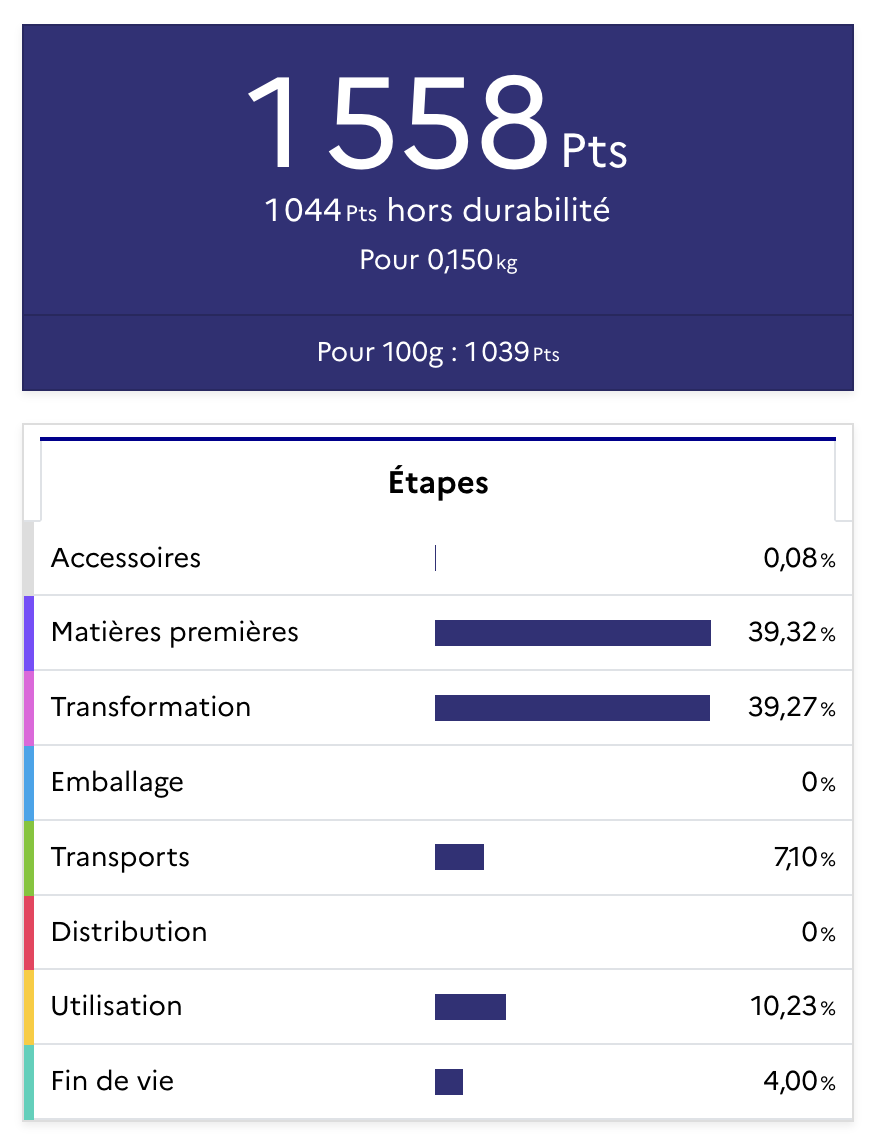
Ecobalyse displays the result within seconds: a total score (for example 1,558 Pts for a cotton T-shirt with default values) and a breakdown by life cycle stage, shown as bars, covering raw materials (about 39%), processing (about 39%), transport, distribution, use and end of life. The total is the figure a brand may display on the label. Entering a first product in full takes 30 minutes to 2 hours, depending on what you know about your suppliers.
Materials call for one qualification. Recycled cotton clearly improves the score (the material is recovered without new cultivation), whereas recycled polyester improves it less than you might expect, because the reprocessing consumes a lot of energy. This is one of the first surprises for brands discovering the tool, and a good example of what LCA (in French) can quantify where intuition may mislead.
A score based on 16 indicators
Take a score of 1,200 Pts. To judge whether that is good or bad, you first need to know that it reads in the opposite direction to a mark out of 100: Ecobalyse counts impact points, and the lower the total, the better the product.
The score is a weighted sum of 16 environmental indicators, including climate change, water use, resource depletion and ecotoxicity, plus 2 French supplements. You do not need to understand the formula to use the tool; it is enough to remember that carbon is only one of the dimensions measured. For more on the PEF methodology behind these indicators, see our guide to PEF, LCA and product carbon footprints (in French).
France has also adapted the method. For freshwater ecotoxicity, it doubles the modelled impact of organic molecules (dyes, finishing products), since textiles are one of the world's largest sources of water pollution. It also adds 2 supplements that the PEF does not include: the release of plastic microfibres during washing and the export of textile waste outside Europe. These 2 criteria reflect issues specific to fast fashion.
3Illustrative orders of magnitude for common garments
These orders of magnitude are purely illustrative: we noted them on Ecobalyse without specifying the weight. There is no official reference value by category, and the score depends heavily on the weight and on the assumptions entered:
Illustrative orders of magnitude: where a product sits
Illustrative Celsius values, weight not specified. This is not an official scale: the label has no class or colour. The higher the number, the greater the impact.
Illustrative examples: a spread of about 1 to 4 between the best and the worst T-shirt.
- Organic cotton T-shirt made in Portugal: 350 to 500 Pts
- Conventional cotton T-shirt made in India: 800 to 1,100 Pts
- T-shirt made in China by an ultra-fast fashion brand (mode ultra-express in the French fast-fashion law): 1,500 to 1,800 Pts
- Jeans: 700 to 2,500 Pts depending on how they are made
- Wool jumper: 1,200 to 3,000 Pts
The ratio between the best and the worst T-shirt is about 1 to 4. These orders of magnitude help put a score in context when you read one, and show that there is considerable room for manoeuvre.
4The durability coefficient: how range width and repairability change the score
In the simulator, a "Durabilité" (durability) line displays a coefficient, for example 0.67. This is the durability coefficient, a decisive parameter in a brand's score. Once the raw score has been calculated, the French method divides it by this coefficient, which lies between 0.67 and 1.45 and is set by a public formula:
The durability coefficient
The Ecobalyse formula parameter that penalises fast fashion
Same T-shirt, same factory: the coefficient can double the score
Environmental cost = Sum of impacts / C_durability, where C_durability = 0.67 + (1.45 - 0.67) × (0.5 × I_repair + 0.5 × I_range).
A coefficient close to 1.45 reduces the environmental cost by about 30% and favours the brand; a coefficient close to 0.67 increases it by about 50%. As a result, 2 brands selling exactly the same T-shirt, with the same materials and the same factory, can obtain scores that differ by a factor of 2, purely because of their profile.
Range width (50% of the coefficient)
The measure is the number of different new product references that the brand offers for sale on the same day in a given segment (women, men, children, babies, underwear), taking the maximum observed. The thresholds are public and set on a sliding scale:
- Fewer than 1,000 product references: maximum bonus (index at 100%)
- 7,000 product references: midpoint (index at 50%)
- More than 16,000 product references: maximum penalty (index at 0%)
What is counted is the product references offered simultaneously, not the new items put online each day. A craft brand offering 200 product references at a time sits at the opposite end of the scale, and the scheme is explicitly calibrated to penalise the constant turnover of collections.
Repairability (50% of the coefficient)
This criterion measures the extent to which the brand makes repair easy. The calculation compares the average cost of a repair with the selling price of the new garment: the lower the ratio, the higher the bonus. Average repair costs are set by category:
- Shirt / T-shirt: €10
- Trousers: €14
- Jumper: €15
- Skirt: €19
- Jacket: €31
- Socks / underwear: €9
When the ratio of repair cost to selling price is below 33%, the bonus is at its maximum. Above 100% (a repair that costs more than the new garment), the bonus falls to zero. For large companies, a second criterion comes into play: whether the brand has a repair service labelled by Refashion, the producer responsibility organisation (PRO, éco-organisme in French). The weighting is then 66% for the cost/price ratio and 33% for the service. For SMEs and micro-businesses, only the cost/price ratio counts, and the absence of a repair service carries no penalty.
The durability coefficient judges the business model of the brand selling the garment, an approach without precedent in environmental regulation.
This mechanism, designed explicitly to penalise ultra-fast fashion, makes Ecobalyse both unique and controversial. The brands targeted have contested it, and when the scheme was notified to Brussels in 2025, the Commission asked that it remain voluntary and challenged the traceability criterion, which has since been withdrawn.
5Default values: unfavourable by design
When you enter a product, you will soon come across questions you cannot answer, such as the exact country of spinning, the origin of the materials or the share of air transport. Most brands do not know this information.
Same T-shirt, two possible scores depending on the quality of your data
Switch between the two modes: what a third party may publish if you leave the fields empty, vs what you get after collecting your supplier data.
What happens when you leave a field empty
Ecobalyse accepts an empty box for optional fields and replaces it with a default value. These values are not neutral, however: the method adopts unfavourable assumptions:
- Default country of spinning: an unknown country (India's energy mix and the least favourable water pollution)
- Default range width: 100,000 product references
- Default share of air transport: 33% or 100% if garment making takes place outside Europe and Turkey, 0% otherwise
This is the profile of an ultra-fast fashion brand, chosen so that no brand can obtain a good score by hiding its worst suppliers.
Each empty field therefore raises the score, often markedly: a product entered with default values only can score 30 to 60% higher than the same product entered with specific data, a gap that comes down solely to whether the brand has gone looking for the data.
For every optional field left empty, Ecobalyse adopts an unfavourable assumption: a range of 100,000 product references, spinning in an unknown country, frequent air transport outside Europe.
What changes on 1 October 2026
The decree provides for 2 phases:
- Since 1 October 2025, labelling has been voluntary: brands that wish to may publish their score
- From 1 October 2026, any third party (journalist, NGO, competitor, engineering consultancy) may calculate a garment's score in place of the brand, from available or estimated data, and publish it subject to the same rules as the brand, including filing the data on the official portal
Because the default values are unfavourable by design, the published score is likely to be poor. The brand may publish its own calculation at any time, and the third party must then adopt it within one month, but this still requires the brand to have obtained supplier data, which it sometimes knows little about.
6Beyond France: Ecobalyse as a possible model for the European method
Ecobalyse is French, but 3 signals suggest that its reach extends beyond France.
First signal: the ESPR (in French), adopted in 2024, provides for a delegated act on textiles, expected around 2027, with a later application date. This delegated act will set eco-design requirements and a digital product passport (DPP) (in French) for every garment sold in Europe. The DPP will have to contain environmental data calculated using a standardised method, which has yet to be chosen.
Second signal: the PEFCR Apparel & Footwear v3.1 (Product Environmental Footprint Category Rules), the European reference for calculating the environmental footprint of textiles, was validated in May 2025. Ecobalyse adopts the PEF categories without applying this PEFCR: it has its own weightings (ecotoxicity raised to 21%, human toxicities set to 0), and it adds microfibres, waste export and the durability coefficient while excluding footwear. Industry players who already work with Ecobalyse will therefore be on familiar ground when the European method is finalised.
Third signal: the EU Batteries Regulation, which serves as a full-scale pilot for the ESPR, has shown the way. For the carbon footprint declaration, a methodological delegated act (the CFB-EV rules of the JRC, the Commission's Joint Research Centre) was awaiting formal adoption as of 20 July 2026, and the obligation is expected to take effect in mid-2027. The battery DPP is set for February 2027, a fixed date. The same pattern should repeat for textiles, with Ecobalyse the probable methodological basis. Brands that already know the tool well will start with an advantage measured in years of preparation.
7Where to start: a pilot product, supplier data, then publication
We recommend the following sequence, which is realistic even with limited resources. It takes several months, so it is worth starting without waiting for a third party to publish your score.
3 steps to publish the environmental cost of your garments
Click each step to see the concrete deliverable and the typical obstacle to plan for.
Step 1: Pilot product
2 hTry the tool without commitment, identify what you are missing
Enter your best-selling product on ecobalyse.beta.gouv.fr in demo mode, even with the default values. The aim is not to get an accurate score, but to map the empty fields you will need to fill in.
Step 1: open the tool and enter a pilot product
Go to ecobalyse.beta.gouv.fr, click "Simuler un produit textile" (Simulate a textile product) and choose a product representative of your catalogue, for example your best seller. Complete the entry in full, even if you have to accept many default values: at this stage the aim is to discover the questions the tool asks rather than to obtain the right score. Allow 2 hours for this first pass, at the end of which you will know exactly which data you are missing.
Step 2: collect the actual supplier data
This is the longest workstream. For each stage (spinning, weaving, dyeing, garment making), you need to identify the actual supplier and collect the missing data: the country of each stage, the origin of the materials, printing or garment washing and the share of air transport. At this point many brands discover that they do not know their supply chain beyond the final garment maker.
Gathering this data takes 3 to 6 months, depending on the complexity of the sourcing. This is typically when a brand turns to a specialist consultancy for support. Industry shows the same pattern: when a battery (in French) assembler launches its first product LCA (in French), supplier data collection accounts for 80% of the effort.
Step 3: re-enter the data and publish
Go back into Ecobalyse and replace the default values with the actual data. The score falls, often by 20 to 40% and sometimes by much more when the brand also fills in its range width and its country of spinning: in our illustrative example, the cotton T-shirt made in Portugal goes from 1,558 Pts with default values to 650 Pts. This is the score worth publishing. Before any communication, it must be filed on the official portal affichage-environnemental.ecobalyse.beta.gouv.fr, then displayed using the signage set by the ministerial order, and the supporting evidence must be kept.
The cost of a first implementation (in French) ranges from €15,000 to €80,000, depending on the size of the catalogue and the complexity of the sourcing. For companies with fewer than 250 employees and turnover below €50 million, the eco-design diagnostic Diag Éco-conception (in French) (in French) of Bpifrance (the French public investment bank) and ADEME funds 60 to 70% of an 18-day support engagement, leaving €5,400 to €7,200 excl. VAT to pay. It covers only part of the process but remains an underused lever.
8Key takeaways
Ecobalyse makes the footprint of garments sold in France visible. The score can be calculated, voluntary labelling has been running since October 2025 and, from 1 October 2026, a third party may publish your score in your place. A brand that does nothing leaves the default values, unfavourable by design, to speak for it.
The durability coefficient is the most original element of the scheme: for the first time, a regulation assesses a product by the business model of the brand that sells it as well as by what it contains. Calibrated to penalise fast fashion, it could foreshadow what Europe will do by 2030. Brands that invest now in collecting supplier data are getting ahead.
This work has other uses: the supply chain mapping carried out for Ecobalyse will feed the textile DPP (in French), the scope 3 (in French) requests from your clients and any serious eco-design (in French) approach.