
Skip to content
Get in touchFR
Updated in July 2026
Explained

Which method should you choose to measure a product’s carbon footprint (LCA, PEF, CFP)?

We talk about carbon accounting for an organisation, a product footprint for a product. Three methods coexist, and the requirement dictates the choice.

Sébastien Pierfederici
By Sébastien Pierfederici, LCA and eco-design specialist at Projet Celsius, PEF expert and IFC trainer. He helps manufacturers assess product environmental footprints.
April 2026
Updated July 2026 · 9 min
We talk about carbon accounting for an organisation and a product carbon footprint for a product, and there are three methods for measuring the latter: LCA (a flexible ISO standard), PEF (a European version with fixed rules for comparison) and CFP (a single indicator, kg of CO₂e). It is not always obvious which applies, and the regulatory requirement generally dictates the choice. This guide sets out the differences, prices and 2025-2027 timetable.
Key takeaways
  • 1The regulatory requirement dictates the method: textiles in France = Ecobalyse environmental cost, derived from PEF, batteries = JRC CFP, internal eco-design = ISO LCA. For the specific case of the digital product passport (DPP), the method depends on the category’s delegated act.
  • 280% of the work is shared by the three methods: a 2nd study costs 30 to 50% less than the first.
  • 3The limiting factor is supplier data, rather than modelling: three to six months that cannot be shortened.
  • 4Diag Eco-conception funds 60 to 70%: €5,400 to €7,200 excl. VAT remaining cost for SMEs with fewer than 250 employees.

1What does analysing a life cycle mean?

Before discussing methods and acronyms, we need to establish the common foundation. The three approaches rest on the same idea: a product has environmental impacts at every stage of its life, material extraction, manufacturing, transport, use and end of life, and we add them together to obtain a total score.

At a glance

Three methods for measuring a product’s impact

LCA, PEF, CFP: 80% of the work is identical. Hover over each method to discover what changes.

PEF ·Everything is fixed to compare products within the same category. Rigid by design.
80%of the work is identical across the 3 methods (collection, inventory, modelling). The 20% remaining determine admissibility.
À retenirThe requirement dictates the method -not the other way round
ISO 14040/14044 · PEFCR v3.1 · JRC EUCAR · Celsius summary 2026

In practice, analysing a life cycle means modelling a product’s entire journey from raw material extraction to end of life. For each stage, we collect incoming flows (materials, energy, water) and outgoing flows (emissions, waste), then calculate impacts using scientific factors.

  • Data collection from suppliers, the longest part of the work
  • Flow inventory: materials, energy, emissions at each stage
  • System modelling and boundary selection
  • Impact calculation using recognised databases (Ecoinvent, EF, ADEME’s Base Empreinte)

This work takes 3 to 6 months for a first study, and is the same whichever acronym is selected. Where the methods diverge is what happens after this foundation.
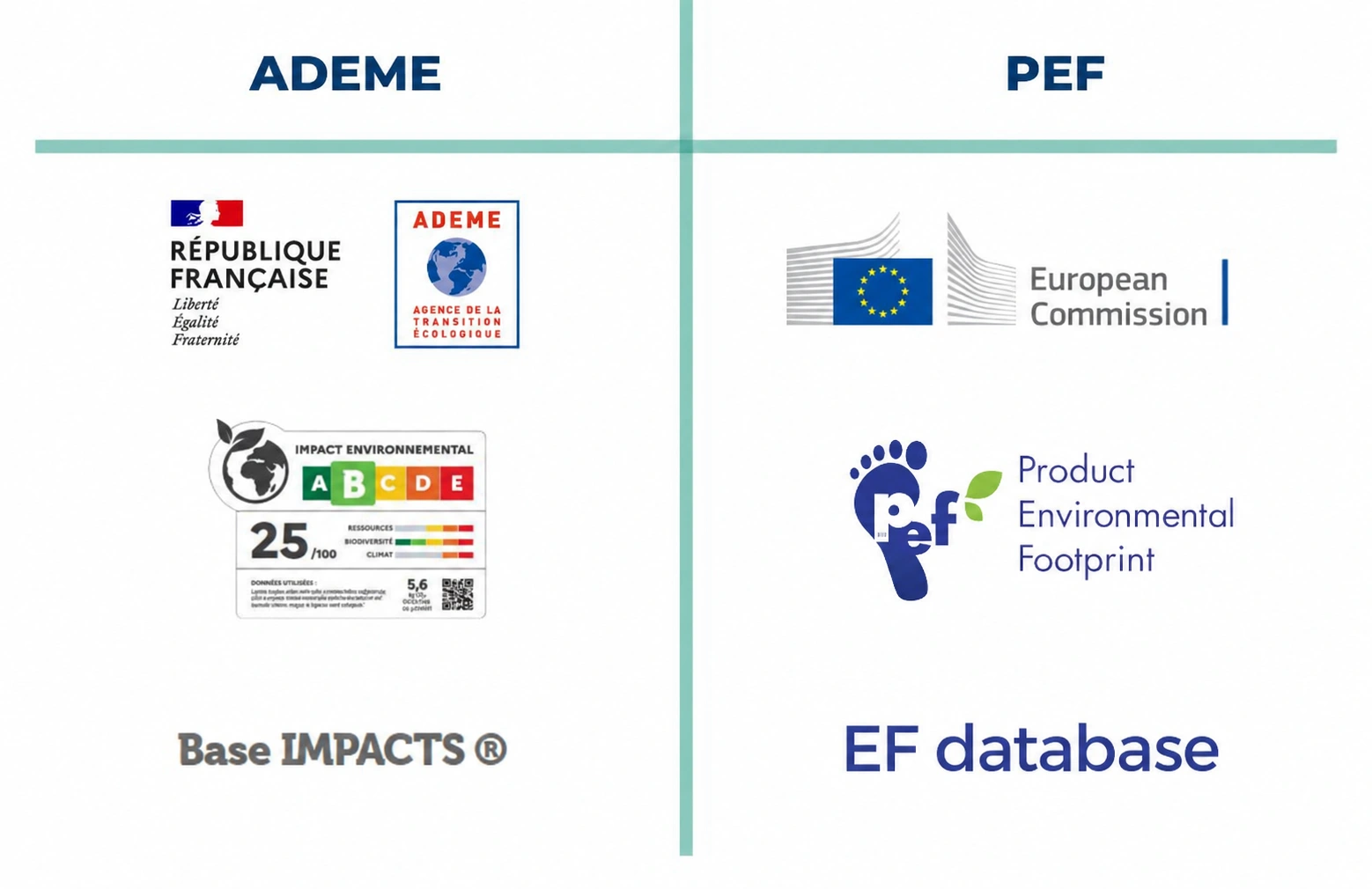
Database comparison: Base IMPACTS (ADEME) and EF database (European Commission / PEF)
The two reference databases for calculating product environmental impact. Source: Waro.io

2LCA, PEF, CFP: where the real differences lie

The same underlying work, three different frameworks. The best way to understand what distinguishes these methods is to see which question each seeks to answer.

Instructions by category

Active PEFCRs in 2026

PEF is only a framework. PEFCRs make it usable on an actual product.

Textiles & footwear
Active
13 subcategories covered
v3.1
May 2025
Separate from the French environmental labelling method.
Overview
4 active PEFCRs under the EF 3.1 standard · 1 group to update for the EF 4.0 switch.
À retenirWithout an approved PEFCR for your category -no comparable PEF score
European Commission · JRC · Celsius monitoring April 2026

ISO LCA: the established, flexible method

Life Cycle Assessment (ISO 14040 and 14044) has been the international reference since the 90s. Its founding principle: allowing the practitioner to make explicit, justified methodological choices (impact allocation, system boundaries, database). Its strength is flexibility: it can be adapted to any product, sector or scale.

Its downside is that same flexibility. Two LCAs of the same product carried out by two different consultancies can produce results differing by 20 to 30% on some indicators, without anyone making an error, simply different methodological choices. This is why LCA is unbeatable for internal eco-design, but unsuitable for comparisons between brands.

PEF: the European method with fixed rules

The Product Environmental Footprint emerged precisely because Europe wanted comparison. Developed by the European Commission’s JRC, it is to LCA what a standardised dish is to a chef’s recipe: everything is fixed. A mandatory EF database, fixed allocation, 16 mandatory indicators plus an aggregated score out of 100, category-specific rules through PEFCRs.

The price of comparability is rigidity. A manufacturer using an innovative recycled material not yet included in PEF databases is treated by default as if using virgin material: the penalising scenario. PEF rewards those who do standard work well, rather than those innovating at the margins.

In practice, PEF cannot be used alone: it relies on PEFCRs (Product Environmental Footprint Category Rules), the category-specific rules. Without an approved PEFCR, an official score cannot be calculated.

  • Textiles and footwear (v3.1, May 2025), 13 subcategories, not to be confused with the French environmental labelling method, which uses Ecobalyse
  • Dairy products (updated Feb. 2025), milk, cheese, yoghurt
  • Animal feed and pet food (Feb. 2025)
  • Coffee and bottled water (v1, to be updated for EF 4.0)
  • Wines and spirits, detergents, leather: in preparation

LCA is not more precise than PEF, it is freer. PEF is not more rigid, it accepts that comparability is the only product it sells.

Product carbon footprint (CFP): one indicator, the same work

The product carbon footprint (Carbon Footprint of Product, ISO 14067) retains only one of PEF’s 16 indicators: kg of CO₂ equivalent per functional unit. This is what the Batteries Regulation requires, through a dedicated JRC sector methodology.

  • Collection is the same: the entire value chain must be traced, stage by stage, supplier by supplier
  • Modelling is shorter (a single output flow to calculate), saving 1 to 2 months
  • But no information about other indicators: water, toxicity, resources, eutrophication. A battery can be good for CO₂ and catastrophic for water consumption, and CFP will not tell you

3Which method for which requirement?

This is the question that separates successful study scoping from failed scoping. The answer is less open than we think: the regulatory requirement dictates the method, not the other way round.

Decision tree

Which method for which requirement?

Four situations, four methods. Click yours to see the exact applicable framework.

Required method: Ecobalyse (environmental cost)
Environmental cost calculated with Ecobalyse, to be submitted to the portal before any communication (voluntary).
Textile environmental labelling · voluntary since Oct. 2025
À retenirRead the delegated act before commissioning:5 minutes that avoid 3 months
ESPR · EU Batteries Regulation 2023/1542 · PEFCR v3.1

For most battery assemblers we meet at Celsius, the classic mistake is the same: commissioning an ISO LCA thinking it covered the regulation, and discovering six months later that the JRC battery methodology differs on crucial points (boundaries, allocation, permitted databases). Result: the study is unusable as it stands and everything must be redone.

Requirement → method mapping

  • Textile environmental labelling (France) → environmental cost calculated with Ecobalyse, the state’s method derived from PEF (its own weighting, 2 criteria outside PEF). Voluntary labelling in force since October 2025.
  • EU Batteries Regulation 2023/1542 → CFP using the JRC battery methodology. JRC CFB-EV methodology: delegated act awaiting formal adoption as at 20 July 2026, effective requirement expected in mid-2027 (12 months after adoption). Industrial batteries >2 kWh: subsequent timetable.
  • Digital passport DPP → method required by the sector’s delegated act. For batteries: CFP. For textiles: PEF.
  • CSRD product scope 3 → LCA or carbon footprint by product reference, to be included in the sustainability report.
  • Internal eco-design (R&D, material choices) → ISO LCA by default, with greater methodological freedom.

If several requirements apply together

Start with the one imposing the strictest rules, then extend the model to cover other needs. An assembler manufacturing batteries and also selling textiles starts with the JRC battery methodology (the most restrictive in terms of databases and allocation), then reuses primary data to produce a textile PEF.

Two professionals analysing data on a screen, the method choice depends on the requirement

4How much does it cost, how long does it take?

Budgets vary, but they vary around a factor that is almost never modelling: the quality of data available from suppliers. The more the supply chain is documented beforehand, the less the study costs.

2026 budgets and timeframes

How much does it cost, how long does it take?

The factor that matters is the quality of data available from your suppliers, rather than the method.

ISO LCA
16 indicators
€12,000 - €40,000
3 to 6 months
Upper end of the range for long chains (batteries, electronics).
PEF
16 indicators · mandatory framework
€15,000 - €30,000
3 to 5 months
Lighter scoping, PEFCR compliance added.
CFP
1 indicator (kg CO₂e)
€10,000 - €20,000
2 to 4 months
Same collection, shorter final modelling.
The measure that changes everything: Diag Éco-conception
The Bpifrance’s Diag Éco-conception funds 60 to 70% of a first LCA for SMEs and mid-sized companies. The remaining cost falls to €5,400 - €7,200 for a standard LCA. Activate before signing with the consultancy, rather than during the process.
À retenir2nd study on a similar product:30 to 50% less
Celsius summary · benchmarks 2024-2026 · Bpifrance

Ranges by method

  • Complete ISO LCA (16 indicators): €12,000 to €40,000 excl. VAT per product, 3 to 6 months. The upper end for complex chains (batteries, electronics).
  • PEF (mandatory framework, PEFCR compliance): €15,000 to €30,000 excl. VAT, 3 to 5 months. Less variable than ISO LCA because the scope is fixed.
  • CFP (one indicator): €10,000 to €20,000 excl. VAT, 2 to 4 months. Same collection, shorter modelling.
  • Second study on a similar product: €5,000 to €15,000 excl. VAT, 1 to 3 months. Data and model already in place, only the difference is reworked.

Our How much does an LCA cost guide explains the ranges by company profile and the measures that lower the bill without reducing quality.

The limiting factor is never modelling. It is supplier data. They take three to six months to arrive, whatever the budget devoted to them.

5The 2025-2027 timetable that changes the situation

The landscape is changing fast and the next deadlines are tightening the pressure. Three dates matter more than the others.

Regulatory timetable

The 2025-2027 milestones that determine your method

Hover over each milestone to see what it triggers.

In progressIndustrial battery CO₂ declaration
Mandatory CFP for industrial batteries >2 kWh.
Done
In progress
Upcoming
Official Journal of the EU · European Commission · Celsius monitoring April 2026

What is already in force

  • October 2025: textile environmental labelling (France), voluntary and calculated with Ecobalyse, more than 30,000 product references registered
  • February 2025: initial date for the carbon footprint declaration of EV batteries, postponed because the methodological delegated act was missing (requirement expected in mid-2027 at the earliest)
  • February 2026: initial date for industrial batteries >2 kWh, also postponed to 18 months after their delegated act

What is coming

  • 2025-2028: transition period opened by the Commission because insufficient EF 3.1 datasets are available. Its July 2026 guidance governs the use of other databases, and existing PEFCRs remain valid until EF 4.0.
  • 19 July 2026: deadline set by the ESPR for the European DPP registry, whose technical infrastructure the Commission is still preparing.
  • February 2027: mandatory battery DPP. The first sector to go into production.
  • Around 2028: the EF 4.0 database, which will replace EF 3.1. PEFCRs, including textiles, and PEF studies will then have to be updated.

6Where to start in practice

Before even discussing the sector, two pitfalls to avoid.

Where to start

Your roadmap in 3 steps

Three moves, in this order. The first secures the method, the second the budget, the third the timeframe.

01
Identify the applicable requirement
Week 1
Textile PEF, battery CFP, ESPR in preparation or no requirement? This step takes half a day of reading and saves months afterwards.
02
Activate Bpifrance’s Diag Éco-conception
Weeks 2 - 4
Funds 60 to 70% of a first LCA’s cost for SMEs and mid-sized companies. A few weeks of application processing: start before signing with the consultancy, rather than during the process.
03
Start supplier collection without waiting
Months 1 - 6
This is the only timeframe that cannot be shortened. 10 to 15 data points per critical supplier, almost the same whichever target method is used.
À retenirSupplier data take 3 to 6 months to arrive -start now
Celsius support methodology · Bpifrance Diag Éco-conception
  • Commissioning a general ISO LCA when you know a PEF or CFP requirement is coming within 12 months. The data collected will remain usable, but modelling will have to be redone under a different framework. Six months and a budget lost.
  • Starting with the IT tool (DPP platform, LCA SaaS) before scoping the method and starting supplier collection. The platform is the output of the work, rather than its starting point.

The golden rule of scoping: where a requirement is identified or likely within 18 months, start with the target method (PEF, CFP or a sector-specific derivative). Otherwise, ISO LCA provides a flexible foundation, with data collection that will remain valid for any future requirement. Scoping an LCA with Celsius clarifies the use of results, method, scenarios and required data before calculations begin.

Step 1: identify the applicable requirement

Textiles sold in France? Environmental cost calculated with Ecobalyse. Batteries >2 kWh? JRC battery methodology. A sector in the first ESPR wave (steel, aluminium, furniture)? Delegated act in preparation. No requirement within 18 months? ISO LCA targeting CSRD scope 3 compliance.

Step 2: activate Diag Éco-conception before starting

For SMEs with fewer than 250 employees, Bpifrance’s Diag Éco-conception is the first grant to use. It covers 60 to 70% of a first LCA’s cost, but requires a few weeks of application processing. We always activate it before signing a private quote, never afterwards.

Step 3: start supplier collection without waiting

This is the only timeframe that cannot be shortened, and the one that kills projects started too late. We send a questionnaire to critical suppliers as soon as methodological scoping is settled, even before signing with the consultancy if possible. Three to six months for suppliers to respond cannot be shortened.

7Key takeaways

The real determinant in scoping an impact study is the regulatory requirement applicable to the product, rather than a methodological preference.

  • The requirement dictates the method. Textiles in France: Ecobalyse environmental cost, derived from PEF. Batteries: JRC CFP. Internal eco-design: ISO LCA. CSRD: LCA or CFP by product reference.
  • 80% of the work is shared by the 3 methods. Data collected for one serve the others. A 2nd study costs 30 to 50% less than a 1st.
  • The limiting factor is supplier data, rather than modelling. Three to six months that cannot be shortened, whatever the budget.
  • EF 4.0 is expected around 2028: until then, existing PEFCRs remain valid and transitional guidance governs datasets.
  • Bpifrance’s Diag Éco-conception funds 60 to 70% of a 1st LCA for SMEs with fewer than 250 employees. Remaining cost €5,400-€7,200 excl. VAT.

Further resources

Frequently asked questions

LCA (ISO 14040/44) is flexible: the practitioner makes explicit methodological choices, allowing the study to be adapted to any product but permitting differences of 20-30% between two studies of the same product. PEF (the European method) fixes all these choices, database, allocation and boundaries, to enable comparison between products or brands. LCA is unbeatable for internal eco-design, PEF for public labelling and comparability.
Not as such. But several schemes rely on an LCA or a derived method, some mandatory for placing products on the European market, others voluntary: textile environmental labelling (Ecobalyse environmental cost, derived from PEF), Batteries Regulation (CFP), DPP (depending on the delegated act), CSRD product scope 3. By 2030, almost all manufactured products sold in Europe will carry an impact declaration based on a life cycle methodology.
A complete ISO LCA costs €12,000 to €40,000 excl. VAT per product, over 3 to 6 months. A PEF between €15,000 and €30,000, a CFP between €10,000 and €20,000. The second study on a similar product costs 30 to 50% less. Bpifrance’s Diag Éco-conception funds 60 to 70% of a first LCA (remaining cost €5,400-€7,200 excl. VAT for SMEs with fewer than 250 employees).
PEFCRs (Product Environmental Footprint Category Rules) are the rules specific to each product category within the PEF framework. Without an approved PEFCR, an official PEF score cannot be calculated. Each PEFCR defines the functional unit, system boundaries, permitted databases and priority indicators for the category. Six PEFCRs are active in 2026, including textiles/footwear (v3.1), not to be confused with the French environmental labelling method.
Yes. European Batteries Regulation 2023/1542 requires CFP (kg CO₂e per kWh) calculated under the dedicated JRC methodology, and only this indicator. The JRC methodology is nevertheless demanding on permitted databases and allocation of impacts between co-products. A conventional ISO LCA carried out without knowing the JRC methodology is rarely usable as it stands: modelling often needs to be redone with JRC parameters.
Bpifrance’s Diag Éco-conception is the main scheme for SMEs with fewer than 250 employees. It funds 60 to 70% of a first LCA’s total cost for a fixed cost of €18,000 excl. VAT. Remaining cost: €5,400 excl. VAT (<50 employees, 70% funding) or €7,200 excl. VAT (50-249 employees, 60% funding). Application processing takes 4 to 6 weeks, to be activated before signing with the private consultancy.
PEF (Product Environmental Footprint) is the European life cycle assessment method, developed by the European Commission’s Joint Research Centre (JRC) to enable products to be compared with each other. It relies on ISO 14040/14044 but fixes the choices that ISO LCA leaves to the practitioner: mandatory EF database, fixed allocation rules, 16 mandatory indicators and an aggregated score. Product category rules, PEFCRs, complement it, and Recommendation (EU) 2021/2279 establishes its framework. It forms the basis of French textile environmental labelling.
The 16 PEF impact categories are: climate change, ozone depletion, human toxicity (cancer effects), human toxicity (non-cancer effects), particulate matter, ionising radiation, photochemical ozone formation, acidification, terrestrial eutrophication, freshwater eutrophication, marine eutrophication, freshwater ecotoxicity, land use, water use, mineral and metal resource depletion, fossil resource depletion. Each has a unit and characterisation method fixed by Recommendation (EU) 2021/2279. Results can be weighted and aggregated into a single score to compare products in the same category.
Largely: for textiles, the first sector with an operational framework, environmental cost uses the 16 PEF impact categories defined by Recommendation (EU) 2021/2279, with specific normalisation and weighting coefficients. France adds 2 criteria absent from PEF, microfibre release and textile waste exports outside Europe, then applies a durability coefficient between 0.67 and 1.45. Calculation uses the public Ecobalyse tool. Labelling has been voluntary since October 2025, and brands present throughout the EU could have to manage 2 systems during a transition.
Yes, especially for internal eco-design: ISO 14040/14044 LCA leaves explicit methodological choices to the practitioner, allowing it to be adapted to any product to decide between a material or process. In the absence of an identified or likely requirement within 18 months, it is the recommended flexible foundation, and supplier data collected will remain valid for a future requirement, since 80% of the work is shared by LCA, PEF and product carbon footprint. If a PEF or CFP requirement is coming within 12 months, it is better to start directly with the target method to avoid redoing modelling.
or: [email protected]

More articles to read

View all →
French environmental cost label for clothing: what changed on 1 October 2026
Regulation

French environmental cost label for clothing: what changed on 1 October 2026

6 min read
Removable batteries and battery passports: who is affected in 2027?
Regulation

Removable batteries and battery passports: who is affected in 2027?

14 min read
BEGES France: mandatory GHG emissions report in 2026
Regulation

BEGES France: mandatory GHG emissions report in 2026

9 min read

No two situations are exactly alike.

Tell us about yours: your situation, deadline and budget. A senior consultant will reply within 24 working hours with an honest assessment.

Let us discuss it within 24 hours →
Our toolkit

A full range of free assessment tools

Cost estimator, obligation and eligibility checkers, footprint calculator.

Estimate costs and impacts
Ref. 2026·BC·0184REPORT · FINANCIAL YEAR 2026Bilan Carbone®complete 1·2·3Presentation to the Executive Committee · 2027 action planCONTENTS01Executive summaryp. 402Scope and methodologyp. 1203Emissions by scopep. 24042027 action planp. 5605Methodological appendicesp. 78VOLUME84 pages · ConfidentialSTANDARDISO 14064 · GHG ProtocolQUOTATION · BC.2026.0184Issued 05·05·2026 · Valid for 30 daysCelsius consultancy · Paris 3rd arrondissementINDICATIVE COST ESTIMATEYour companyMid-sized company · 180 employees · CSRD 2027SERVICEBilan Carbone®Scope 1·2·3 · 13 weeksBPIFRANCE FUNDING · - 60%INDICATIVE RANGE EXCL. VAT€16,800to €22,400PROJECT DETAILS01 · SCOPING3 weeks~€4,20002 · MODELLING8 weeks~€9,80003 · PRESENTATION2 weeks~€4,800Indicative estimate · Refined after scopingSIRET 891 234 567 00012

Bilan Carbone® cost estimator

Your price range in 1 minute, based on 2026 market rates and public funding.

1 minStart
Estimate costs and impacts
AI FOOTPRINT · MONTHLY USEYOUR TOTAL FOOTPRINT4.2 kgCO₂eq for 1,000 typical prompts · May 2026MODEL COMPARISON · 1,000 TYPICAL PROMPTSGPT-4oOpenAI6.8 kgClaude OpusAnthropic2.1 kgGemini ProGoogle4.5 kgMistral LargeMistral AI · FR1.6 kg

AI carbon footprint calculator

The climate impact of your AI queries, by model and task. Ecologits methodology.

3 minStart
Check an obligation
DIAGDÉCARBON'ACTIONACCELERATE THETRANSFORMATIONOF YOUR COMPANYIN ENERGY ANDTHE ENVIRONMENTOFFICIAL SCHEME · BPIFRANCE × ADEMECHECKER · ELIGIBILITYELIGIBLEYou meet the 3 Diag Décarbon'Action criteria.YOUR FUNDING€10,000 excl. VAT€6,000excl. VATAmount payable by you after the Bpifrance subsidyFUNDING BREAKDOWNBPIFRANCE 40%YOU 60%€4,000€6,000SCHEME SUBSIDISED BY

Diag Décarbon'Action eligibility

Check in 30 seconds whether your business is eligible for Bpifrance funding covering 40% of a Bilan Carbone® assessment.

30 secStart
Check an obligation
FRENCH REPUBLICMinistry for the Ecological TransitionLEGAL REQUIREMENTGreenhouse GasEmissions AssessmentArticle L.229-25 of the French Environmental CodeDecree 2022-982 · published 1 July 2022FREQUENCY · 4 YEARSFILING · ADEMECHECKER · BEGES REQUIREMENTREQUIRED720 employees · BEGES requirementPOTENTIAL PENALTY€50,000maximum fine for failing to complete itart. R.229-50OFFICIAL REFERENCE

BEGES checker

Does the BEGES requirement apply to you? An immediate answer, with the deadline and penalty.

30 secStart
Check an obligation
9:42SCANSCANNING DPP...DPP IDENTIFIEDOrganic cotton T-shirtSKU TX-CB-220 · Batch L-26-04781ESPR COMPLIANT42 DATA POINTS · 5 SECTIONSORIGINIndia · GOTSOrganic cottonFOOTPRINT5.2 kg CO₂eqLCA ISO 14040RECYCLABILITY85%Cotton recycling schemeREPAIRABILITY7.5 / 10Accessible partsEND OF LIFETextile recycling scheme (TLC) · Bordeaux/FRRefashion-approved recovery operatorEU · ESPR 2024/178112.05.2026

DPP checker

Is your product covered by the Digital Product Passport?

1 minStart
Check an obligation
COSTENVIRONMENTAL386POINTS257PER 100 GOfficial methodEcobalyse, v7.0.0CHECKER · ENVIRONMENTAL LABELLINGELIGIBLETextiles · voluntary labellingENVIRONMENTAL COST386 ptsT-shirt 150 g · 257 pts per 100 gExample: Ministry for the Ecological Transition FAQ

Textile environmental labelling 2026

Voluntary labelling, but third parties can publish it from October 2026: where do you stand?

1 minStart