
- 1Bilan Carbone® measures the organisation over a year, LCA measures the product across its full life cycle.
- 2BEGES is mandatory above 500 employees; LCA underpins environmental labelling and DPP depending on the products.
- 3Start with the footprint assessment for an industrial SME, with LCA for an imminent product deadline.
- 4€11,400 to €13,200 excl. VAT payable for the 2, after Bpifrance funding that can be combined.
Confusion between LCA and Bilan Carbone® is among the most common in environmental strategy. A simple rule resolves it: if you are talking about your company, it is a Bilan Carbone®; if you are talking about your product, it is an LCA (which can also, more rarely, apply to an organisation). This guide draws on LCA conducted under the European PEF method, the reference for products. The footprint assessment provides the overview, LCA the detail of a product, and the 2 are eligible for Bpifrance funding: 40% for the footprint assessment through Diag Décarbon'Action, 60 or 70% for a first LCA through Diag Éco-conception.
Bilan Carbone® or LCA: 3 questions, 3 answers
The 2 tools do not answer the same question or address the same object. What distinguishes them, before going into detail.
Start with Bilan Carbone® to map the picture, then focus with an LCA on the products accounting for the largest share.
1What Bilan Carbone® measures
Bilan Carbone® answers a single question: how much greenhouse gas does my organisation emit over a year? It provides an overview, expressed in tonnes of CO₂ equivalent, and forms the foundation for the company's climate management.
- ObjectAn organisation
- IndicatorGHGs only (tCO2e)
- Period1 year of activity
- ScopeScopes 1, 2 and 3
- StandardABC v9 / GHG Protocol
- SME cost€10k - €30k excl. VAT
- It distinguishes 3 boundaries, called scopes: scope 1 (direct combustion: boilers, vehicles), scope 2 (purchased electricity), scope 3 (purchases, freight, travel, fixed assets).
- Scope 3 accounts for an average of 88% of the total - this is almost always where most emissions are concentrated.
- A single-criterion tool: it measures GHGs, excluding water, biodiversity and toxicity. It therefore provides a readable, actionable figure, but for only one dimension of environmental impact.
2What LCA measures
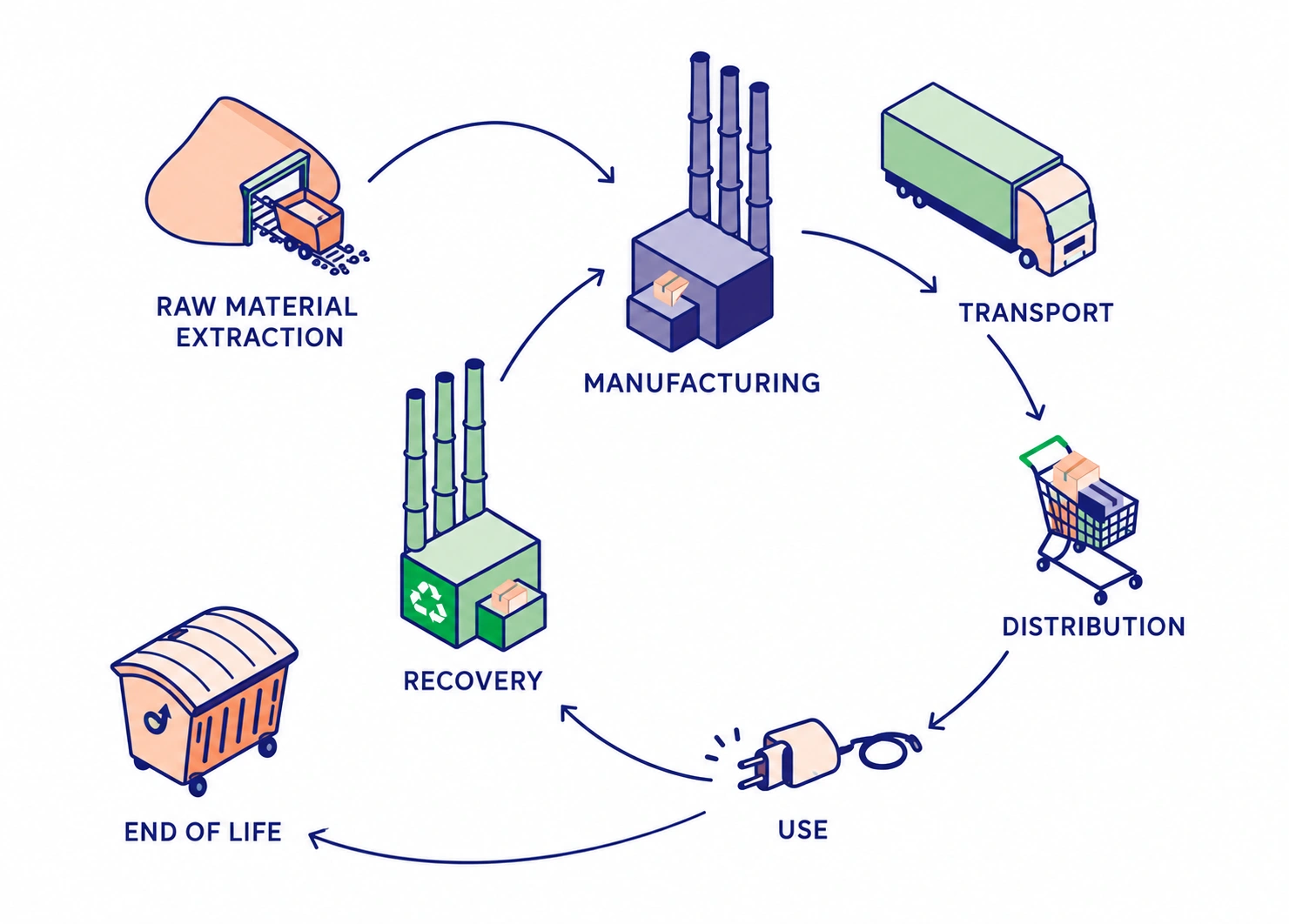
Life Cycle Assessment answers a different question: what is a product's environmental impact, from raw material extraction to end of life? The object of study is no longer an organisation and a year, but a product (or service) followed from end to end, expressed per functional unit ("a T-shirt worn 50 times", "10,000 km travelled by electric bicycle").
- ObjectA product or service
- Indicators16 impact categories (PEF)
- ScopeCradle → grave
- CoversClimate, water, soils, toxicity…
- StandardISO 14040 / 14044 - PEF
- SME cost€12k - €25k excl. VAT / product
- 16 indicators in parallel, defined by the European PEF method: climate change, water, human toxicity, eutrophication, mineral resources, fine particles, etc.
- Full life-cycle coverage: extraction, manufacturing, transport, distribution, use, end of life.
- This multicriteria approach identifies impact shifting: a product improving on carbon but worsening on water consumption, for example.
3The differences between LCA and Bilan Carbone®
The difference between the 2 tools comes down to 3 distinctions.
Bilan Carbone® vs LCA: all criteria at a glance
9 criteria, 2 tools. Read vertically, column by column.
The 2 complement each other: Bilan Carbone® identifies the company's emissions, LCA details a product's impact.
Organisation versus product
Bilan Carbone® analyses an organisation (company, site, local authority) over a year, using one indicator: GHG emissions in tCO2e. LCA analyses a product or service across its full life cycle, using 16 impact categories under the PEF method. This is the most fundamental difference, from which the others follow.
One indicator versus sixteen
Bilan Carbone® follows the ABC methodology (version 9 since January 2025), compatible with the GHG Protocol and ISO 14064. It mainly uses ADEME's Base Empreinte and monetary ratios for scope 3. LCA follows ISO 14040/14044 and, for Europe, the PEF (Product Environmental Footprint) method. It uses physical databases such as Ecoinvent or GaBi - more precise data, but also more costly to collect.
One year versus a full life cycle
Bilan Carbone® captures a year of activity: it is repeated every 2 to 4 years to track a trajectory. LCA models a product's full life cycle, from material extraction to end of life, and remains valid while the design stays unchanged. Two different time horizons, therefore two different renewal frequencies. The associated budgets are detailed below, and in depth in our guides to the cost of Bilan Carbone® and the cost of LCA.
Bilan Carbone® shows where the company's emissions are concentrated; LCA shows how to reduce a particular product's impact.
4How much it really costs
Here are the 2026 market ranges, observed across dozens of assignments. The comparison below summarises the essentials; the following list details each line.
Scope, price and grants: the 2 tools side by side
Switch between the two cards to see what each measures, its price and the associated grant.
- The scope: Bilan Carbone® covers the entire organisation over a year, LCA a single product across its full life cycle. Quotes are therefore not comparable and one does not replace the other.
- Gross prices: €10k to €15k excl. VAT for an SME Bilan Carbone®, €12k to €25k excl. VAT for a full product LCA. For a mid-sized company, the footprint assessment reaches €20-40k; for an LCA covering multiple product references, budget per product.
- The amount payable after Bpifrance funding: Diag Décarbon'Action reduces the footprint assessment to €6,000 excl. VAT; Diag Éco-conception reduces a first LCA, with its eco-design recommendations, to €5,400 excl. VAT (fewer than 50 employees) or €7,200 excl. VAT (50 to 249 employees). The 2 schemes can be combined.
- The full programme: footprint assessment and LCA in sequence over 12 to 18 months cost €11,400 to €13,200 excl. VAT payable, for a complete view of the organisation and product.
The complete overview of funding (PACTE Industrie, ACT Pas à Pas, regional funding) is in our dedicated article.
5The tools and methods behind them
For Bilan Carbone®, the reference method in France is the Bilan Carbone® method run by ABC (Association pour la transition Bas Carbone), in version 9 since January 2025. It is compatible with international GHG Protocol and ISO 14064 standards. Emission factors (how many tCO₂e per litre of diesel, per MWh of electricity, per tonne of steel…) mainly come from ADEME's Base Empreinte®, a free public database. For scope 3 purchases, monetary ratios are often used (how many tCO₂e per euro spent in a given sector), quicker to use but less precise.
For LCA, the foundational standard is ISO 14040/14044. In Europe, the harmonised method is called PEF (Product Environmental Footprint), run by the European Commission. The databases used are Ecoinvent (the most comprehensive, paid) or GaBi; for French textiles, the state developed the Ecobalyse tool with ADEME to simplify the official score calculation. This is physical data (kg of material, kWh actually consumed, etc.) - more precise than the footprint assessment's monetary ratios, but also far more time-consuming to collect.
6What the law requires for companies and products
Regulation is pushing on the 2 fronts, organisation and product, with approaching deadlines.
For organisations: BEGES and CSRD
BEGES (greenhouse gas emissions assessment) is mandatory for companies with more than 500 employees (250 in overseas territories), renewed every 4 years. The fine reaches €50,000 for a first offence, €100,000 for repeat offences. Scope 3 is mandatory only for companies required to publish a sustainability report (CSRD), which are themselves exempt from BEGES under the Act of 30 April 2025 when that report contains their emissions assessment and transition plan. The CSRD, limited since the Omnibus I Directive to companies with more than 1,000 employees and €450 million in turnover, requires detailed climate reporting (scopes 1, 2 and 3, reduction trajectory), for which Bilan Carbone® is the natural foundation.
For products: environmental labelling, DPP, ESPR
No law requires LCA as such, but several legislative texts draw on it. Textile environmental labelling is based on an environmental cost calculated using the official method (Ecobalyse tool), derived from LCA: voluntary since October 2025, it can be calculated and published by a third party without the brand's agreement since 1 October 2026. The battery DPP arrives in February 2027, and the carbon footprint declaration it must contain is expected no earlier than mid-2027 for EV batteries. The ESPR extends this movement to most manufactured products. Finally, since August 2026, the Climate and Resilience Act has required at least one environmental criterion in all public contracts.
7Which to do first: the decision tree
The answer depends on the company's profile. Four cases cover the vast majority of situations.
3 questions to choose between Bilan Carbone®, LCA, or both
There is no universal method: your starting point depends on what you have already measured and the approaching product deadline.
Follow the thread: with each answer, the tree guides you towards the next useful step.
Industrial SME with no imminent product deadline
Start with Bilan Carbone®. It provides an overview within a contained budget, identifies the main sources and guides your action plan. If the assessment reveals that your products account for a large share of the footprint (almost always the case for manufacturers), an LCA of the leading product becomes the natural next step, 12 to 18 months later.
Brand covered by textile labelling, batteries or medicines
Start with LCA. The product deadline dictates the timetable; for textiles, it first involves calculating the environmental cost with Ecobalyse. Bilan Carbone® remains useful, but can wait another 6 to 12 months: there is no reason to delay a 2026-2027 deadline to follow a theoretical order.
Service company (consultancy, IT, finance)
Bilan Carbone®, and probably that alone. You have few physical products to analyse. The footprint is concentrated in office energy, digital technology, travel and purchased services. A Bilan Carbone® suffices for management and communication. LCA only makes sense for a materially intensive service (logistics, catering, construction).
Multi-product mid-sized company wanting to move up a gear
Do both in sequence over 12 to 18 months. The data collected substantially overlaps (energy, purchased materials, transport). The footprint assessment guides LCA (identifying which products to prioritise), and LCA enriches the next footprint assessment (replacing monetary ratios with physical data). Combined total amount payable: €11,400 to €13,200 excl. VAT, by combining the 2 Bpifrance diagnostics. Details appear in the funding overview.
8Key takeaways
- Bilan Carbone® measures your organisation (GHGs only, over a year, scopes 1, 2 and 3), LCA your product (16 criteria under the PEF method, cradle to grave).
- The footprint assessment is mandatory above 500 employees (BEGES, fine of €50,000 to €100,000) and feeds CSRD for companies still subject to it. No legislative text requires LCA, but environmental labelling, DPP and public contracts' environmental criteria can draw on it.
- Start with the footprint assessment if you are an industrial SME without a product deadline, with LCA if a product deadline approaches (textiles, batteries, medicines).
- The 2 are eligible for funding that can be combined: €11,400 to €13,200 excl. VAT payable for the full footprint assessment and LCA programme over 12 to 18 months.