

- 1The Diag Décarbon'Action leaves €6,000 excl. VAT to pay for a full carbon footprint assessment.
- 2In 5 of France's 13 regions, a regional grant can pay part of the assessment.
- 3The research tax credit does not in principle cover a carbon footprint assessment.
- 4Most grants must be applied for before signing the expert's quote.
In 2026, only one national scheme pays part of an SME's full carbon footprint assessment: the Diag Décarbon'Action from Bpifrance (the French public investment bank), a programme that leaves the company to pay €6,000 excl. VAT after a 40% grant. Everything else depends on 2 factors: the region where the company is based, and the stage it wants to fund, from the assessment itself to the investments it reveals.
Which grant fits your project?
- Diag Décarbon'ActionBpifrance · to pay after a 40% grant: assessment and action plan, 12 days over 10 months€6,000 excl. VAT
- LISE carbon assessmentCCI · first estimate in 2 days, fewer than 250 employees, excluding micro-businessesfree
- Cap décarbonationChambers of trades and crafts · for craft businessesfree
Depending on the region, another grant may be added or take over: the map below lists them.
On 17 October 2026, the public platform Transition écologique des entreprises listed 11 schemes under the project "greenhouse gas (GHG) assessment", 7 of them limited to a single region. After the assessment, support for the transition plan and for studies covers up to 80% of the cost, and both ACT Pas-à-Pas and the Accélérateur décarbonation require a first assessment to be already done.
1Which grants fund a carbon footprint assessment in 2026?
For an SME, assessment funding falls into 3 tiers. The Diag pays part of a full assessment, the free estimates from the chambers of commerce and trades give a first order of magnitude, and the regional grants, covered in the next section, vary from one region to another.
The Diag Décarbon'Action, €6,000 excl. VAT to pay
The Diag is a Bpifrance offer funded by the CEE PACTE Entreprises scheme, built on energy savings certificates (certificats d'économies d'énergie, CEE). An expert visits the company, measures its emissions and builds an action plan with it, in 12 days of work over a maximum of 10 months. Its official fact sheet sets 3 conditions:
- The company has fewer than 500 employees in full-time equivalents, at SIREN level (the company registration number), or fewer than 250 in the overseas departments and territories.
- It has existed for at least 1 year, has closed a first financial year and is up to date with its tax and social security debts.
- It has carried out no full GHG assessment in the last 5 years, and it is not subject to the statutory assessment required of large companies.
The complete guide to the Diag Décarbon'Action details the process and the application, and the eligibility test answers in a few questions. The guide to the cost of a carbon footprint assessment puts these €6,000 excl. VAT in perspective against quotes without a grant. For a product rather than the company, the Diag Écoconception (an ADEME and Bpifrance eco-design diagnostic scheme for French SMEs) funds a first life cycle assessment in the same way.
Free estimates from the CCIs and the chambers of trades and crafts
The consular chambers (the CCIs, or chambers of commerce and industry, and the chambers of trades and crafts) offer estimates at no charge. The CCIs' LISE carbon assessment supports the company for 2 days: boundary, data collection, main emission sources and action plan, for companies with fewer than 250 employees, excluding micro-businesses. Cap décarbonation does the same work for craft businesses, over 2.5 days for direct and energy-related emissions, or 5 days with the rest of the value chain.
These estimates give the main emission sources, not an assessment that can be published or passed on to a customer who asks for detailed figures. They serve as a starting point for a company that wants to do its own assessment, then have it verified by a third party, or to decide what to entrust to an expert.
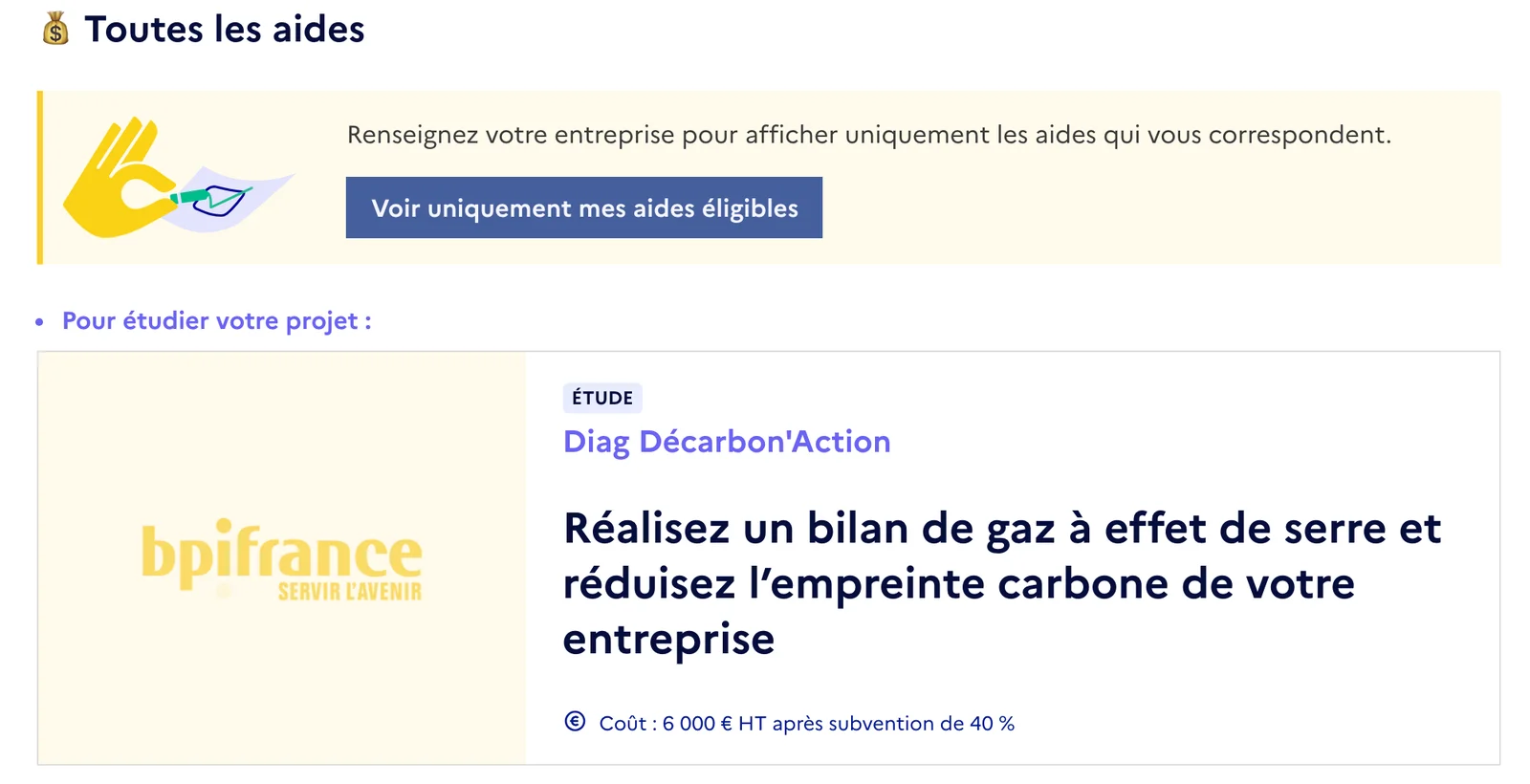
The platform of ADEME and the ministries groups grants by project. On 17 October 2026, the greenhouse gas assessment page listed 11, with the Diag Décarbon'Action first, then free estimates and grants specific to a region. The button at the top filters the list using the company's SIRET number.
Large companies and the research tax credit
Above 500 employees, no national scheme funds the assessment. The Environmental Code in any case requires these companies to produce a statutory assessment (the BEGES, France's mandatory greenhouse gas emissions report) updated every 4 years, at their own cost, as the guide to the mandatory BEGES details.
The research tax credit does not take over. It equals 30% of research expenditure, on the portion of expenditure that does not exceed €100 million, for work that meets the 5 criteria for research and development: novelty, creativity, uncertainty, a systematic approach and reproducible results. The tax guidance does not mention carbon footprint assessments. It does, however, exclude adapting an existing method to a particular case when it raises no new scientific or technical problem (BOFiP, the official tax doctrine, paragraph 350). An assessment that applies an established method, such as Bilan Carbone® (the French carbon accounting method) or the statutory method, therefore does not in principle meet these criteria. Only separate work, carried out alongside, may enter the base of the tax credit if it meets the 5 criteria.
2Which regional grants exist for a carbon footprint assessment?
The regions mainly fund broader support programmes, of which a carbon footprint assessment can be one part. The rate, the cap and the companies targeted change from one region to another, and in most regions no grant names the assessment. The map below lists what the regions and the public platform publish as at 17 October 2026.
Bilan Carbone® grants in the 13 regions
- a grant can pay part of the assessment
- simplified diagnostic, advice or loan
- no regional grant listed
- Booster Transformation Rev350%
of an expert assignment, carbon footprint assessment included, maximum grant of €10,000, for an SME
In 5 of the 13 regions, a grant can pay part of the Bilan Carbone®.
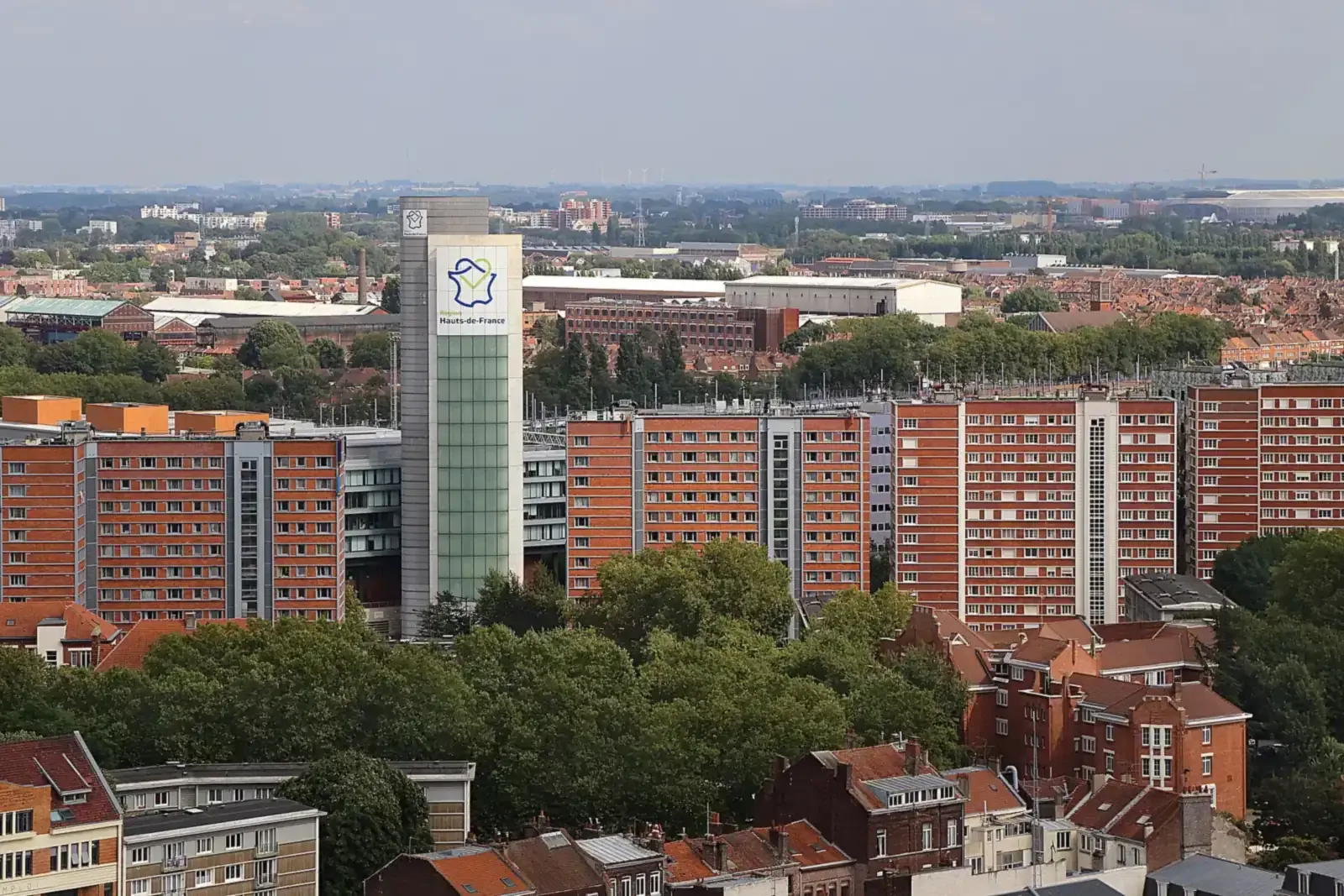
In Hauts-de-France, Booster Transformation Rev3 covers 50% of an expert assignment, with a grant of at most €10,000 per assignment. The carbon footprint assessment is among the themes listed, with energy efficiency and life cycle assessment. The grant targets SMEs in the region, micro-businesses included, for 2 assignments on different themes per calendar year. The expert must be listed by the Region, or get listed before the assignment.
Elsewhere, the grant takes other forms. In Provence-Alpes-Côte d'Azur, CEDRE Premiers pas pays €3,000 on an invoice of at least €3,750 excl. VAT, to companies whose turnover does not exceed €2 million. In Île-de-France, CCI Paris Île-de-France sells a subsidised carbon footprint assessment of 6 days for €3,500 to €3,700 excl. VAT, with support from the European Regional Development Fund (ERDF). Brittany and Centre-Val de Loire fund studies and diagnostics up to 50%.
Can a regional grant be combined with the Diag?
No general rule provides for it: the Diag's fact sheet says nothing about combining aid, and each funder sets its own conditions. Centre-Val de Loire, for example, caps its diagnostic aid at 50% across all funders, without replacing other public funding. Booster Transformation Rev3 and CEDRE Premiers pas fall under the de minimis rule, under which the total of this type of aid that a company receives is capped at €300,000 over 3 years. They mainly serve companies that are not eligible for the Diag, for example because they carried out an assessment less than 5 years ago and want to redo it.
The timing matters too. Booster Transformation Rev3 lets the assignment start only after the award decision. CEDRE Premiers pas, by contrast, requires an invoice already paid less than 6 months ago, hence a service that is completed.
3Which grants fund the transition plan?
Once the assessment is done, the next step is strategy: a reduction pathway and a costed transition plan. 3 national schemes fund it in 2026, depending on the sector and the size of the company:
- ACT Pas-à-Pas, from ADEME (the French Agency for Ecological Transition), supports non-industrial companies for 12 to 18 months. The grant covers up to 80% of the cost, capped at €30,000, if the company has already completed a first assessment.
- PACTE Industrie funds energy mix studies, the ACT method and the investment pathway of industrial companies, up to 80% for a small company, 70% for a medium-sized one and 60% for a large one.
- The Accélérateur décarbonation from Bpifrance and ADEME coaches industrial SMEs and mid-cap companies (ETI in French) of more than 50 employees and €10 million turnover for 18 months, in cohorts of 20 companies. The company pays €30,000 excl. VAT on a programme of €69,000 excl. VAT.
The chart below sets the rates side by side. The share covered doubles between the assessment and the strategy, and a single scheme such as ACT Pas-à-Pas can provide up to €30,000.
Maximum share of the cost covered, by stage
Investments have no published rate: ADEME calculates its aid project by project.
The assessment is funded at 40 or 50%, strategy and studies up to 80%.
A first assessment is enough for ACT Pas-à-Pas, whereas the Accélérateur requires an assessment of the 3 scopes that is less than 2 years old. To aim for the Accélérateur, the strategy is therefore launched within 2 years of the assessment. Going from the assessment to the Science Based Targets initiative (SBTi) pathway of an industrial SME shows what this step produces.
4Which grants fund studies and investments?
The action plan brings projects to light: electrifying a furnace, recovering heat from a compressor, replacing a boiler. Before investing, a feasibility study checks that they stand up, and each of these 2 steps has its own grants.
Feasibility studies
In industry, ADEME funds an energy performance or decarbonisation study up to 80%. A waste heat recovery study is funded up to 70%, with a maximum grant of €100,000 in the 2 cases and applications possible until 31 December 2026. These studies often start from an energy audit, mandatory for some companies.
Investments
For industry, ADEME's Decarb Flash call for projects supports projects with a total cost from €100,000 to €3 million: insulation, process electrification, heat recovery. Applications are filed until 15 February 2027, after a pre-submission meeting with ADEME, for an industrial production site of an SME or large company, outside the European carbon market.
ADEME also supports wood-fired heating plants, heat networks and waste heat recovery, with aid calculated case by case. A wood-fired heating plant must have been the subject of a prior feasibility study. The levers for reducing a company's carbon footprint help prioritise the projects to fund.
Green loans
Loans complement grants. The Prêt Vert (green loan) from Bpifrance runs from €50,000 to €5 million over 2 to 10 years, for independent micro-businesses, SMEs and mid-caps more than 3 years old. It must be paired with another financing of the same amount. Several regions offer their own loan, such as Sud Prêt Climat or the Énergie loan of Auvergne-Rhône-Alpes. Financing carbon credits in order to claim neutrality falls under none of these schemes, as the article on carbon neutrality explains.
Each step has its own grant, from the assessment to the investment, and none funds the whole journey.
5How to combine grants and build the application?
The rules change from one scheme to another, but 4 principles recur in the conditions published by ADEME, Bpifrance and the regions:
- The project must not have started when the application is filed: ADEME's fact sheets exclude any operation for which a contract or an order has been signed or a quote accepted. CEDRE Premiers pas, which pays out on an invoice already paid, is the exception.
- One grant funds one stage: the Diag the assessment, ACT or PACTE Industrie the strategy, ADEME the study and then the investment. They follow one another over time rather than overlapping on the same expense.
- Several regional grants fall under the de minimis rule, under which the total received is capped at €300,000 over 3 years. Each new application therefore counts the aid already obtained.
- Schemes have an end date: the public platform shows ACT Pas-à-Pas, PACTE Industrie and the ADEME studies until 31 December 2026, and Decarb Flash until 15 February 2027.
The public platform filters grants by SIRET number (the establishment registration number) and puts the company in touch with a public adviser. The question of how often to carry out an assessment matters too: the Diag does not fund an assessment if the company has carried out a full one in the last 5 years.
For an ADEME grant, a quote accepted before the application is enough to lose it.
In our view, at Projet Celsius, an eligible SME should start with the Diag Décarbon'Action, then apply for ACT or PACTE Industrie within the year that follows, while its figures still mean something to the teams. A company not entitled to the Diag looks first at its region's grant. The discipline then stays the same: a funded study before each major investment, and each application filed before anything is signed.
6Key takeaways
- The Diag Décarbon'Action leaves €6,000 excl. VAT to pay for a full assessment and an action plan, for companies with fewer than 500 employees and no assessment in the last 5 years.
- The CCIs and the chambers of trades and crafts offer free estimates over 2 to 5 days. These give the main emission sources without replacing an assessment.
- In 5 of France's 13 regions, a regional grant can pay part of the assessment, such as Booster Transformation Rev3 at 50% in Hauts-de-France.
- The research tax credit does not in principle cover a carbon footprint assessment, since it applies an established method. Only separate research work can enter it.
- Strategy and studies are funded up to 80%, and these applications are filed before signing any quote.
To estimate the budget before grants, the Bilan Carbone® price simulator gives an order of magnitude, and the article should your SME carry out a Bilan Carbone® shows the data the assessment requires.
- Bpifrance, Diag Décarbon'Action, offer page, accessed 17 October 2026.
- Bpifrance, Accélérateur décarbonation and Prêt Vert, offer pages, accessed 17 October 2026.
- Transition écologique des entreprises (ADEME and ministries), project "greenhouse gas assessment" and scheme pages for ACT Pas-à-Pas, Évaluation carbone LISE and Decarb Flash 2025-2027, accessed 17 October 2026.
- CMA France, Cap décarbonation, accessed 17 October 2026.
- ADEME, PACTE Industrie, frequently asked questions.
- Hauts-de-France Region, Booster Transformation Rev3; Sud Region, CEDRE Premiers pas; Centre-Val de Loire Region, CAP Transition Écologique; CCI Paris Île-de-France, Subsidised carbon footprint assessment.
- Environmental Code, Article L. 229-25, version in force since 3 May 2025, Légifrance (the Légifrance pages are in French).
- Bulletin officiel des finances publiques (the official tax bulletin), BOI-BIC-RICI-10-10-10-20 (definition of eligible R&D) and BOI-BIC-RICI-10-10-10-25 (related activities), version of 13 August 2025; Service public, research tax credit.
- Commission Regulation (EU) 2023/2831 of 13 December 2023, de minimis aid, Article 3.