

- 1A request for carbon data targets a company assessment, a product or a delivery.
- 2Only the carbon data of a transport service is required by law.
- 3On climate, the Omnibus cap is limited to energy and Scopes 1 and 2.
- 4Send your consumption figures and your allocation key, not a single figure on its own.
A single request for "carbon data" can mean 3 very different things: the company's carbon footprint assessment, the footprint of a product or the emissions of a delivery. The CDP supply chain programme alone approached more than 45,000 suppliers in 2025, and each customer words its question in its own way. The work therefore starts by translating the request into one of these 3 kinds of data.
7 forms of request, 3 sets of data to prepare once
For each request, the data it targets, what to send and the rule that applies.
What to send
The company's assessment and its method, entered in the questionnaire your customer sent you through CDP.
The rule
CDP approached more than 45,000 suppliers in 2025 and assessed nearly 11,000 SMEs on their 2025 data.
A supplier that has prepared these 3 kinds of data once can then answer most questionnaires without starting again, whether the request comes from a manufacturer, a retailer or a public buyer.
1What data does the customer ask for?
Behind the wording used by procurement teams, "your carbon footprint", "your footprint", "your emissions", the data expected almost always falls into one of 3 families. Telling them apart from the outset avoids producing a full assessment when the customer wanted the footprint of a single product reference, or the reverse.
The company's carbon footprint assessment
This is the most frequent request: the company's emissions over a year, Scope 1 for its fuels and vehicles, Scope 2 for purchased electricity, sometimes Scope 3 for its purchases and transport. They are calculated under the Greenhouse Gas (GHG) Protocol or the Bilan Carbone® method (the French carbon accounting method), whose differences our comparison sets out. The voluntary standard published in the Official Journal of the European Union on 21 September 2026 adds energy consumption in megawatt hours (MWh). The customer that receives this assessment must then allocate it to isolate the share that relates to it, and it is often up to the supplier to give it the key.
The footprint of a product
A customer calculating its own Scope 3 prefers the footprint of the product it buys, from cradle to factory gate, because it adds directly to its quantities. It is calculated under ISO 14067 or the PACT methodology, through an approach close to a life cycle assessment (LCA) that the company's own assessment does not replace. For a construction product, this data already exists in the form of a verified FDES, the French format of environmental product declaration for construction products.
The emissions of a service
For a carrier, the data is required by law in France. Article L1431-3 of the French Transport Code requires anyone who organises a transport service to inform its customer of the quantity of greenhouse gases emitted. Since 1 January 2025, failure to do so is punishable by a fine of up to €3,000. The calculation uses default values, company-specific averages or measurements per service, set out in our article on a carrier's carbon footprint assessment.
2Is a supplier required to reply?
Outside transport, no law requires a supplier to give its carbon data to a customer. The constraint is commercial or contractual, and European law now limits what a large customer can demand of a medium-sized supplier.
The contract and the call for tenders
A contract clause or a tender criterion creates the obligation, at least to win the contract, and a customer that assesses its suppliers with EcoVadis often makes it a condition for being listed as a supplier. In public procurement, Article 35 of France's Climate and Resilience Act requires at least one award criterion to address the environmental characteristics of the bid, for procedures launched since 22 August 2026. Our guide to responding to the environmental criterion sets out how to score points.
Outside transport, the use of the data and the size of the supplier decide what it must send
Case shown: a medium-sized supplier approached for a customer's sustainability statement.
A is asking me for carbon data for . My company has .
Worth knowing: Financial years beginning from 1 January 2027; transposition by 19 March 2027 at the latest.
The value chain cap set by the Omnibus Directive
The Omnibus Directive of 24 February 2026 protects companies with no more than 1,000 employees. When a customer subject to the Corporate Sustainability Reporting Directive (CSRD) asks them for information for its sustainability statement, they may refuse anything that goes beyond the voluntary standard, and no contrary clause in a contract is binding on them. The customer must inform them of this, and it may rely on their self-declaration of size.
On climate, this cap is narrow. Annex II of the voluntary standard includes, for a company with more than 10 employees, only energy consumption and gross Scope 1 and 2 emissions, with Scope 2 calculated using the local grid. It includes no climate data for a company with 10 employees or fewer. The cap applies to financial years beginning from 1 January 2027, and the directive must be transposed by 19 March 2027 at the latest.
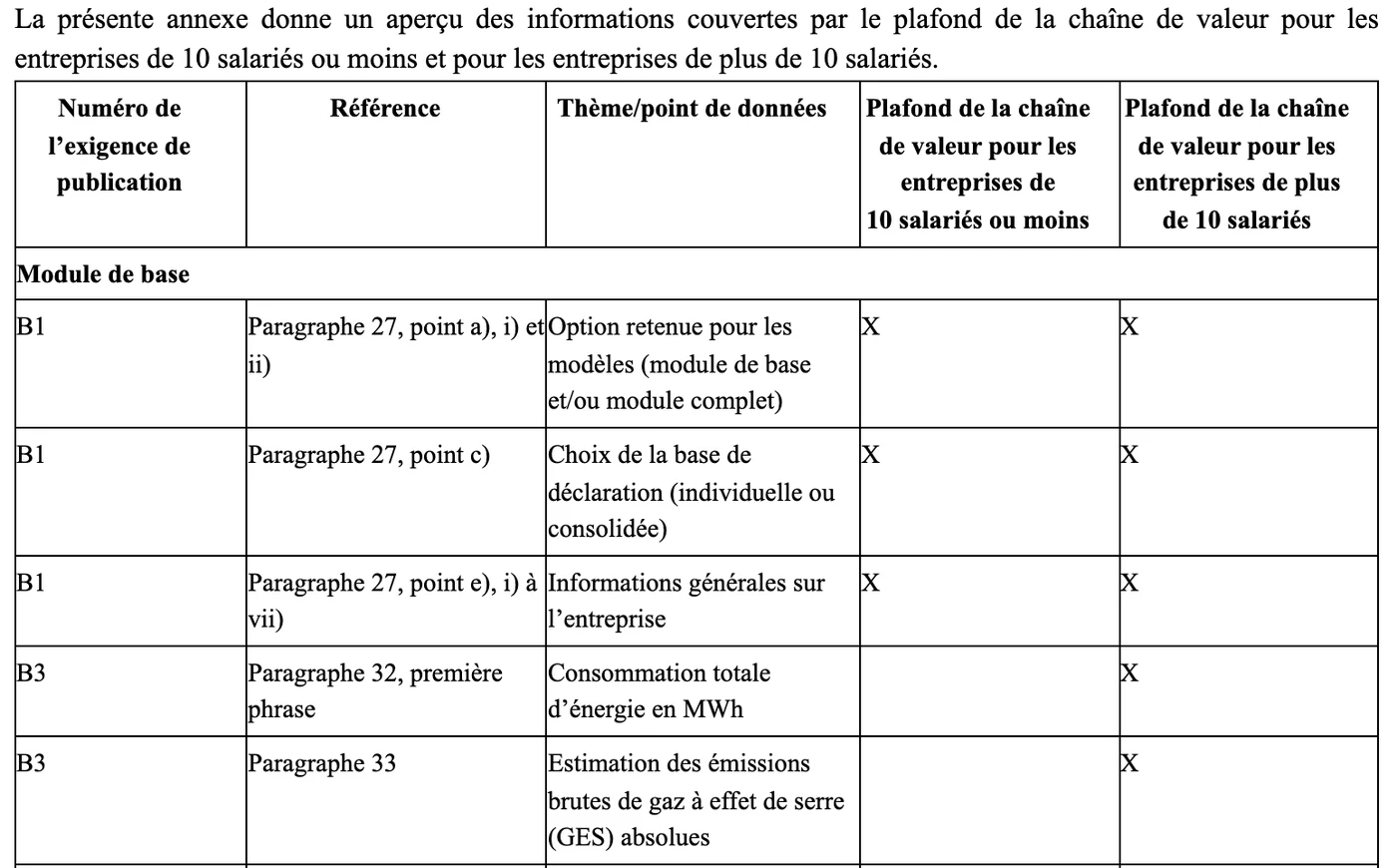
The start of the table in Annex II of the voluntary standard. For climate, only 2 lines of module B3 appear: total energy consumption in MWh and the estimate of gross GHG emissions, Scopes 1 and 2. They are ticked only in the column for companies with more than 10 employees. The text specifies that the cap includes only the data points of this annex, from financial year 2027 onwards.
Scope 3 and the product footprint therefore remain outside the cap, which does not make them enforceable for the sustainability statement. A request made for other reasons, a tender or a procurement strategy, is not covered by this right of refusal, as our article on the revised ESRS points out. Our article on whether Scope 3 is mandatory sets out this rule and its limits.
3Who can prepare the reply?
The reply does not always need a consultancy. What decides is the data expected and the use the customer will make of it, as with the choice between software and a consultancy for a full carbon footprint assessment.
In-house, for Scopes 1 and 2
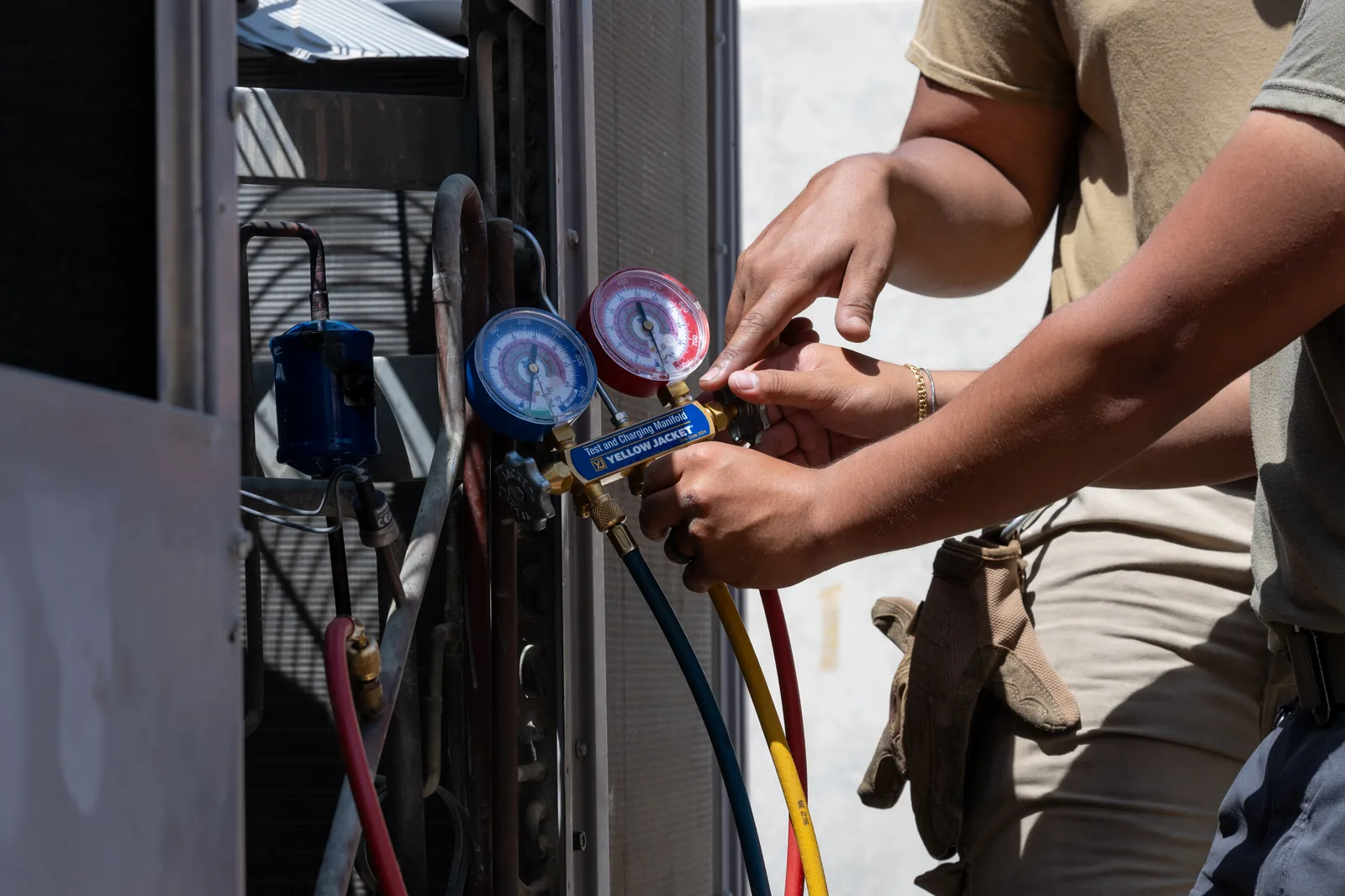
Scopes 1 and 2 are calculated from energy bills, fuel logs and refrigerant top-ups, using public emission factors. A team that keeps these figures can do it itself, within the limits described in our article on doing your own carbon footprint assessment, and say so frankly in its reply. Errors of unit, year or forgotten emission category are frequent, and our list of the pitfalls of a first carbon footprint assessment records others.
With support, for Scope 3 and the product footprint
Scope 3 and the footprint of a product call for methodological choices that an informed customer will review: boundary, allocation rule, sources of the factors. Outside support is justified in 4 situations:
- The customer asks for the footprint of a product, which follows a specific standard and is closer to a first LCA than to a company assessment.
- The customer will use the reply to calculate its own trajectory, and will review it line by line and compare it with those of your competitors.
- The customer requires verification, and the file must then stand up to an independent third party that took no part in the calculation.
- The company has never carried out a full carbon footprint assessment, and the Diag Décarbon'Action (a Bpifrance-subsidised carbon footprint programme for companies established in France) can then fund part of the first calculation.
A third party, when the customer wants verified data
A customer may ask for the data to be verified. For an assessment, this means verification by a third party (in French) (in French), often under ISO 14064-3. For a product footprint exchanged under PACT, the methodology has an independent third party verify the calculation model until 2030, rather than each footprint. EcoVadis for its part ranks third-party-verified data at the top of its 4 levels of reliability, as the scale below shows.
Of EcoVadis's 4 levels, only the top 2 are of use for a customer's Scope 3
Carbon Data Reliability Levels, from the least reliable data to the most reliable.
Insufficient evidence or failed statistical checks.
Corrective action, no reporting.
Best practices partly followed.
Internal monitoring only.
Validated data, aligned with the GHG Protocol.
External reporting and Scope 3.
Verified by an independent auditor.
External reporting and Scope 3.
What the supplier sends
A figure with no method or supporting documents.
An assessment in which only some of the items are documented.
A full assessment, with method and supporting documents attached.
The same assessment, with the opinion of an independent verifier.
Insufficient evidence or failed statistical checks.
Corrective action, no reporting. The supplier sends: a figure with no method or supporting documents.
Best practices partly followed.
Internal monitoring only. The supplier sends: an assessment in which only some of the items are documented.
Validated data, aligned with the GHG Protocol.
External reporting and Scope 3. The supplier sends: a full assessment, with method and supporting documents attached.
Verified by an independent auditor.
External reporting and Scope 3. The supplier sends: the same assessment, with the opinion of an independent verifier.
4How do you prepare a reliable reply?
A reliable reply is one the customer can review and reproduce. It is prepared in 4 steps, from scoping to documentation, and this is what the buyer will check, as our article on verifying supplier data describes.
Have the request clarified
Before calculating, 5 clarifications prevent a reply that misses the point: the year concerned, the boundary (a site, the company, a product), the unit expected, the method required and the use the customer will make of the figure. A customer who wants a footprint per kilogram can do nothing with an annual total in tonnes.
Start from activity data
The GHG Protocol advises buyers to ask preferably for the data the supplier already holds, such as its energy consumption, and to calculate the emissions themselves, which limits errors. The voluntary standard also asks for electricity as shown on the invoices of the energy supplier. Passing on the kilowatt hours and litres, with the factors applied, makes the reply verifiable by the customer.
Allocate between customers
A company's assessment is allocated between customers using an allocation key. The GHG Protocol Scope 3 Standard asks for the key that best reflects how the emissions are produced. The PACT methodology, following ISO 14067, favours a physical key, tonnes, units or volume, and recommends mass in case of doubt. The economic key, based on turnover, attributes more emissions to expensive products, as the calculation below shows, built for this article.
Depending on the key chosen, the share of emissions attributed to a customer can double
Worked example, fictitious values: a supplier whose Scope 1 and 2 emissions are 800 tCO2e a year. Set the customer's share.
Physical key
pro rata to tonnes
Economic key
pro rata to turnover
The emissions allocated to this customer are 2 times smaller with the economic key than with the physical key. The key used is written in the reply, with the share of output bought.
The supplier states the key used and the share of its output bought by the customer. The GHG Protocol also allows it to pass on its total and its share of output, leaving the customer to do the allocation itself.
Document the method
A reply without a methodology note amounts to an estimate. The note states the standard followed, the sources and versions of the emission factors, the exclusions, the year of the data and, for a product footprint, the share of primary data, which PACT always has the supplier pass on. It presents separately what is not deducted from a footprint: offsetting, which ISO 14067 places outside its scope, carbon stored in a product and guarantees of origin. A claimed carbon neutrality has no place in the figure.
A figure the customer can reproduce is worth more than a lower figure it cannot verify.
5What goes into a reusable supplier file?
The same file serves the procurement questionnaire, a first CDP response, EcoVadis, the voluntary standard and the tender. It consists of a few documents, to be updated every year when the accounts are closed:
- The company's assessment for the latest closed year, Scopes 1 and 2 at a minimum, with energy consumption in megawatt hours and the method followed.
- Scope 3 where it has been calculated, category by category, with the excluded categories and the reason for each exclusion.
- The footprint of the best-selling products, from cradle to factory gate, with their declared unit and the share of primary data.
- The allocation key offered to customers, preferably a physical one, and the table of quantities delivered to each of them over the year.
- The methodology note and, if one exists, the verification statement, with the name of the third party and the level of assurance obtained.
Confidentiality is handled through a non-disclosure agreement, or through verification by a third party in place of the detailed activity data, which the GHG Protocol cites as an alternative. The file also serves internally: it prepares the reduction strategy that customers end up asking for.
There is no public price list for this preparation. The cost depends mainly on what already exists, a recent assessment or nothing, on the size of the site and on whether a product footprint is requested, whose cost follows that of an LCA. Our pathway for an SME approached by a customer sets out the steps and the available support. For a full carbon footprint assessment, our article on the cost of a carbon footprint assessment and our simulator give orders of magnitude.
For us, at Projet Celsius, the right reply to a customer is one it can reproduce from the data supplied: consumption figures, dated factors, an explained allocation key. A low, opaque figure costs more the day the buyer checks it. In our carbon footprint assessment engagements, we build this file once, with the supplier's team, so that it can then answer the questionnaires of the following years on its own.
6Key takeaways
- A request for carbon data targets the company's assessment, a product footprint or the emissions of a service: first find out which.
- Only information on the emissions of a transport service is required by law, with a fine of up to €3,000.
- For its sustainability statement, a customer will be able to demand on climate from a supplier with no more than 1,000 employees only its energy and its Scope 1 and 2 emissions.
- A reliable reply starts from consumption data, allocates the assessment with a physical key and documents its method, without deducting offsetting.
- A file prepared once and updated every year answers most questionnaires, from CDP to public tenders.
To see the same data from the buyer's side, read how to verify the carbon data of your suppliers, and for the Scope 3 method, our guide.


