

- 1No French law requires a company to use a consultancy, not even for the regulatory BEGES.
- 2Check the training of the person who will do the work, not only that of the consultancy.
- 3Compare the quantified action plan and the files handed over, not only the price.
- 4Allow €10,000 to €30,000 excl. VAT with a consultancy, or €6,000 excl. VAT with the Diag Décarbon'Action.
A carbon footprint consultancy leads the process with the company: it sets the scope, organises data collection, calculates, checks the results and builds the action plan with management. It is not always the right option. Depending on what the assessment is for and on in-house skills, a simple review or the Diag Décarbon'Action (a carbon footprint programme subsidised by Bpifrance, the French public investment bank, for companies established in France) may be enough, and the tool below shows in 3 answers what is better handed to a consultancy.
Without a trained person in-house, or to build an action plan, the work goes to a consultancy
3 answers show what is best handed to a consultancy, who can carry it out and the price benchmark.
To hand over
A full engagement
Mission Transition Écologique, the French public service that supports companies, puts the full assessment of an SME with a consultancy at around €10,000. To choose a consultancy, you check its training in the method, its references in the sector and what it will hand over at the end. The following sections follow the order of a selection process, from the first screening to the start of the engagement.
1What does a carbon footprint consultancy do?
In its 2025 version, the Bilan Carbone® method (the French carbon accounting method) has 7 steps, described by the Association pour la transition Bas Carbone (ABC), which maintains it. A consultancy carries out 6 of them. The 7th, evaluation, is voluntary: the company does it itself or entrusts it to an independent third party.
A consultancy does not carry out these steps alone. Data collection stays within the company: the invoices, the accounts and the fleet data are there, and it is the company's team that gathers them. The consultant tells you what to look for, checks what comes in, chooses the emission factors and quantifies the levers of the plan.
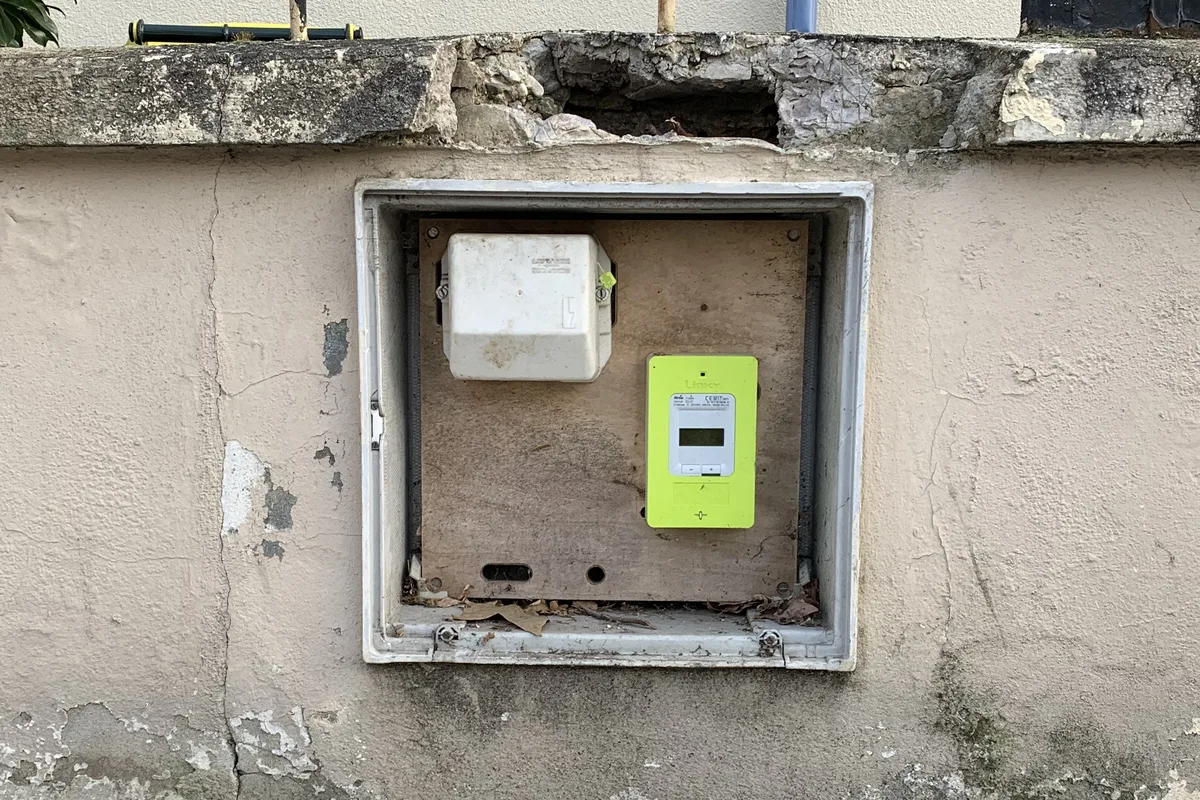
For the calculation, the consultancy relies on software, whose role is set out in the guide to choosing carbon accounting software. This split affects the quote: the more time the in-house team has for data collection, the fewer consultant days the engagement needs.
2Which qualifications should you check in a consultancy?
No legal title is required to carry out a carbon footprint assessment. Article L229-25 of the French Environmental Code requires companies with more than 500 employees to produce a regulatory assessment called the BEGES (bilan d'émissions de gaz à effet de serre), France's mandatory greenhouse gas emissions report, but it does not require them to use a consultancy. Several public benchmarks nevertheless make it possible to check a consultancy before contacting it, provided you know what each one proves.
The ABC directory of providers
The ABC directory listed 355 providers in carbon accounting on 18 October 2026. Across all fields of expertise, 303 providers in the directory say they work in France. It can be filtered by region, type of client, accreditation and sector, the most useful filter for finding references close to the company's activity. The display order is random.
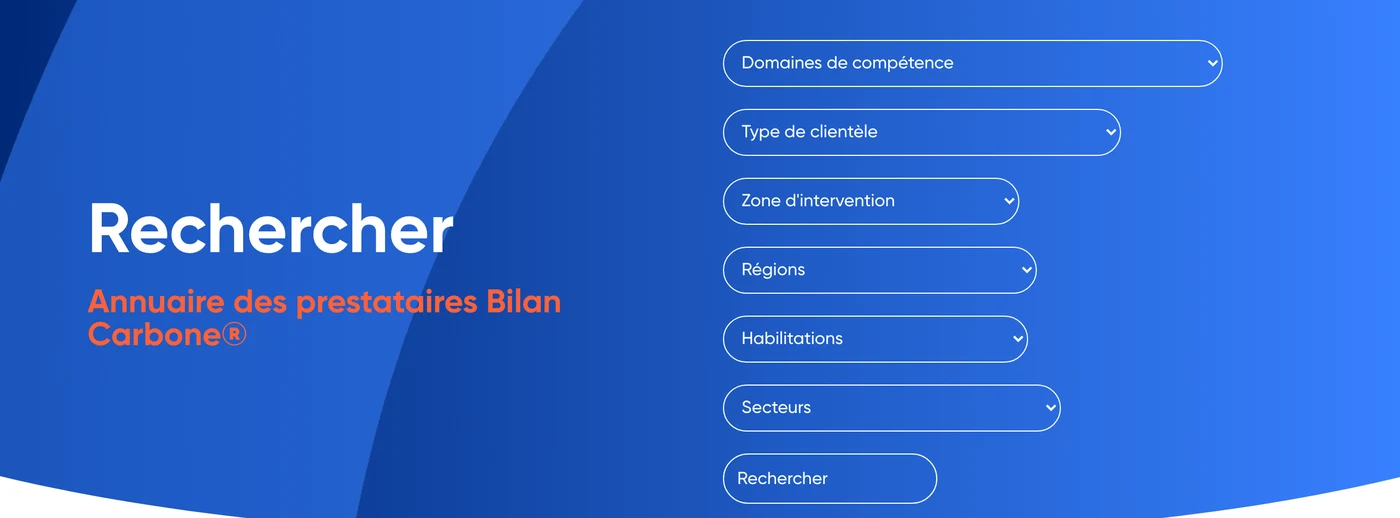
The ABC directory can be filtered on 6 criteria. The "Sectors" filter brings up the providers who say they already work in the company's activity. On 18 October 2026, 355 providers were listed there in carbon accounting, displayed in random order.
Bilan Carbone® training
According to the ABC, which has owned the method since ADEME (the French Agency for Ecological Transition) transferred the rights to it, training is required to apply the Bilan Carbone® method. The course ends with a Professional module, which the ABC makes mandatory for becoming a Bilan Carbone® provider, and only 5 partner bodies are approved to deliver this training. The quote must say who in the team has completed this module, and on which version of the method: the ABC distributes the 2025 version.
Specific accreditations
The directory also lists accreditations, which, on 18 October 2026, applied to only a minority of providers. The OPQIBI 0605 qualification (OPQIBI is a French qualification body for engineering services), which covers carrying out an assessment and drawing up a plan of recommendations for reducing greenhouse gas emissions (OPQIBI classification, in French), applied to 7, and the ACT assessor accreditation, for judging a low-carbon strategy, to 32. The knowledge assessment that the ABC offered was discontinued in 2025. The 9 providers who had passed it are still highlighted at the top of the directory, and the association is preparing a new way of qualifying skills.
For the Diag Décarbon'Action, finally, the experts are certified in Bilan Carbone® or equivalent and approved by ADEME, Bpifrance and the ABC, according to Mission Transition Écologique. Each benchmark proves something different, and none replaces references in the company's sector.
Every Bilan Carbone® provider must be trained, but only 7 to 32 hold an accreditation
3How do you compare 2 carbon footprint consultancies?
At the same price, 2 quotes can hide very different engagements. The questions that tell them apart concern the people, the method and what stays with the company:
- References: how many assessments has the consultancy carried out in the company's sector, and can it describe one, even without naming the client?
- The team: who will do the work, with what training, and how many consultant days are planned on site?
- The method: Bilan Carbone®, the GHG Protocol or the regulatory BEGES format, and for what use of the result?
- The action plan: is it included, with levers quantified in tCO2e (tonnes of CO2 equivalent), a cost and an owner for each?
- The files handed over: will the activity data, the emission factors with their version and the calculations be delivered in a format that can be reused without the consultancy?
- Independence: if a third party must later verify the assessment or the plan, the consultancy that built them cannot play that role.
The choice of method should be discussed before signing, using the comparison of Bilan Carbone® and the GHG Protocol. The price is then read line by line, and the carbon footprint price simulator gives a first order of magnitude. When the result has to leave the company, third-party verification of an assessment (in French) (in French) says in which cases an independent review is needed.
A good quote is judged by what the company will be able to redo on its own the following year.
4How does an engagement run, and what does it deliver?
The Diag Décarbon'Action, offered by Bpifrance to companies with fewer than 500 employees, gives a good idea of the form an engagement takes. Mission Transition Écologique and Bpifrance describe how it runs, from scoping with the study manager to the handover of the deliverables, with a site visit by the expert to collect the data.
The whole programme takes 12 days of expert time spread over 10 months, for €6,000 excl. VAT after a 40% subsidy, and a regional grant tops it up in 5 of 13 regions. Outside the Diag, an engagement follows the same path, at a pace set in the quote. The order of magnitude observed in 2026 then runs from €10,000 to €30,000 excl. VAT, depending on the sites, the data and the depth of Scope 3, with no public price list.
The price of a Bilan Carbone® explains what makes a quote vary. The actual duration depends mostly on the speed of data collection within the company. At the end, the consultancy hands over a report, the assessment by emission category and by Scope, the calculation files and a quantified action plan, in which each lever carries a saving, a cost, an owner and a deadline.
A useful action plan line quantifies the saving, the cost, the owner and the deadline
Example built for this article: a manufacturer shipping 6,000 t per year over 400 km.
A saving calculated with the same factors as the assessment, before and after the lever.
Put end to end with their deadlines, the lines of the plan draw the company's reduction trajectory. An SME that wants to test it against a recognised target can draw on the Science Based Targets initiative (SBTi) trajectory for an industrial SME, which starts from the same assessment.
5What to prepare before contacting a consultancy?
A first conversation moves quickly if the company arrives with 5 items already prepared:
- The use of the assessment and its recipient are known: a customer questionnaire (in French) (in French), a reduction plan, a regulatory BEGES or a sustainability statement.
- The intended scope is set: the legal entities, the sites, the activities and the preferred reference year.
- The list of available data is drawn up: energy invoices, general ledger, fleet log, purchases by supplier and freight, which feed Scope 3.
- An internal contact is appointed, with the time they can devote to data collection throughout the engagement.
- The company's eligibility for the Diag Décarbon'Action is checked with the eligibility test: fewer than 500 employees, at least 1 year of activity and no full assessment in the last 5 years.
If the assessment has to meet an obligation, the BEGES guide says what the law requires. To weigh the in-house option against a consultancy once more, the guide to doing your own assessment compares the 2.
For us, at Projet Celsius, a good consultancy is recognised by what it leaves behind: a team that knows how to repeat the data collection, open files and a plan that management has adopted. We apply these criteria to our own carbon footprint support. Before signing, we advise asking the consultancy for an anonymised example of a calculation file and of an action plan, the document that best separates 2 offers.
6Key takeaways
- A consultancy carries out 6 of the 7 steps of the Bilan Carbone® method, but data collection stays within the company, guided by the consultant.
- Mission Transition Écologique puts the full assessment of an SME with a consultancy at around €10,000, and the order of magnitude observed runs from €10,000 to €30,000 excl. VAT. The Diag Décarbon'Action leaves €6,000 excl. VAT to pay.
- The ABC makes its Professional module mandatory for becoming a Bilan Carbone® provider: the quote must say who in the team has completed it.
- Offers are compared on references in the sector, the quantified action plan and the files handed over, not only on price.
- The consultancy that built the assessment or the plan cannot then verify them as an independent third party.
To compare with an online tool, see the guide to choosing carbon accounting software, and for the budget, the price of a Bilan Carbone®.
- French Environmental Code, Article L229-25, version in force since 3 May 2025, Légifrance, accessed 18 October 2026. The Légifrance pages are in French.
- Association pour la transition Bas Carbone, the Bilan Carbone® method 2025, accessed 18 October 2026.
- Association pour la transition Bas Carbone, training in Bilan Carbone®, accessed 18 October 2026.
- Association pour la transition Bas Carbone, directory of Bilan Carbone® providers, filter counts recorded on 18 October 2026.
- OPQIBI, classification of qualifications, 6 February 2025, qualification 0605.
- Mission Transition Écologique, greenhouse gas assessment and Diag Décarbon'Action, accessed 18 October 2026.
- Bpifrance, Diag Décarbon'Action, diagnostic and support offer.
- ADEME, Base Carbone®, Open Licence, data.ademe.fr, identifiers 43643 (articulated lorry of 34 to 40 t, diesel) and 43734 (freight train, electric traction), accessed 18 October 2026.
- Cover photo: technician in protective equipment at a valve on a French chemical site, November 2016, Butachimie, Wikimedia Commons, CC BY-SA 4.0.
- Photo: Linky electricity meter in its cabinet, rue Professeur-Morat in Lyon, January 2019, Benoît Prieur, Wikimedia Commons, CC0.


