

- 1Only a verifier approved by the programme can sign the verification attestation.
- 2The verifier and their organisation must not have contributed to the declaration.
- 3Book the verifier when the study is launched: the wait can last several months.
- 4No public price list: compare several quotes on the same verification scope.
An FDES (fiche de déclaration environnementale et sanitaire, the French format of environmental product declaration, or EPD, for construction products) states the impact of a construction product over its whole life cycle. A PEP (profil environnemental produit, Product Environmental Profile) does the same for electrical or HVAC (heating, ventilation and air conditioning) equipment. Engineering consultancies use both in the RE2020 calculation (RE2020 is France's environmental regulation for new buildings), drawing on the INIES database, the French national database of environmental declarations, which held 5,660 and 1,888 of them respectively on 16 October 2026.
The product points to the programme, and the programme points to its verifiers
Electrical equipment here also includes HVAC: heating, air conditioning and ventilation.
No declaration enters this database without the attestation of an approved verifier. Choosing that person takes only a few criteria, but it sets the timetable. Attestations published by manufacturers show 5 weeks to 11 months between the file being handed to the verifier and the verification date written on the attestation.
1What is an approved verifier?
An approved verifier is an individual whom a declaration programme has recognised, after assessment, as able to verify the declarations it registers. INIES does this for FDES, and PEP ecopassport, the programme that registers PEPs, does it for PEPs. The 2 programmes are under agreement with the French State, and approval by one is not valid for the other.
How does someone become a verifier?
At INIES, the candidate sits an examination held at least once a year: a prepared case study, then a discussion with a jury. They must have a command of French, have carried out at least 2 FDES for different product families in the last 2 years, and know the NF EN 15804 standard (the French edition of the European standard for construction product EPDs). The programme's steering committee grants the approval.
PEP ecopassport reviews a file, then holds an oral interview in front of a panel of the programme's designated referents. The approval is valid for 3 years and is renewed only with at least 2 verifications carried out over the period and an annual activity report.
What the verifier hands over
Verification produces 2 documents. The attestation, dated and signed, carries the verifier's declaration on honour of independence. The verification report lists the deviations judged not significant and remains confidential: INIES receives it but does not publish it.
What the verifier checks
The ministerial order of 14 December 2021 (an arrêté, in French) sets what the verification covers. The verifier reviews the study behind the declaration, a product LCA, across 5 groups of points:
- The scope of the study, meaning the system boundaries and the cut-off criterion that excludes flows judged negligible.
- Data collection and selection, and their geographical, technological and temporal representativeness for the product sold in France.
- The scenarios used for each stage, from transport to the building site through to end of life, and the allocation rules between co-products.
- The modelling, the calculation of the indicators, then the presentation and interpretation of the results in the declaration itself.
- Additional information, including the health section and comfort information specific to FDES, and the environmental messages of the declaration.
2Is verification mandatory?
Yes, in France. Since 1 July 2017, declarations for construction products, decoration products and building equipment must be verified by an independent third party whenever the manufacturer makes environmental claims about its product. The HQE-GBC Alliance, France's sustainable building association, recalled this in its press release of 3 July 2017.
The text in force
The ministerial order of 14 December 2021, applicable since 1 January 2022, now governs this verification. Its Article 9 repeals the order of 31 August 2015, which contracts and web pages still cite. Since 1 November 2022, a new FDES is calculated under NF EN 15804+A2 and its national complement.
The programme's own checks
The programme then checks the verifiers' work. The order requires it to check each year at least 20% of the declarations verified the previous year, and to entrust at least 5% of them to another third party, which reviews the report and the data. These checks matter all the more because FDES feed the RE2020 carbon indicator, whose thresholds tighten in 2028.
3How do you choose your verifier?
The selection takes 3 steps: independence first, then whether the person is on the programme's list, and finally their answers to the questions that come before the quote.
Independence is not negotiable
The attestation contains a declaration on honour in 3 points, required by the 2021 order. The verifier is not employed by the manufacturer, declares their links of interest with it over the last 3 years, and did not take part in drawing up the declaration. The INIES attestation template goes further: the verifier states there that they have had no link of interest with the manufacturer over that period.
INIES extends this requirement to any third party that contributes to the declaration, engineering consultancy included: the one that carried out the product's first LCA cannot verify it. In its calls for projects, the HQE-GBC Alliance also rules out a declaration being verified by a person from the same organisation. The rules of ECO Platform, the European association of declaration programmes, add that the verifier makes no recommendations.
The public list, and what it tells you
Each programme publishes its list. The INIES list, updated on 17 July 2026, has 58 people, with the end date of their approval. The PEP ecopassport list has 60 as at 10 September 2026, with their working languages.
The number of approved verifiers has more than doubled since 2017
People on each list when it was updated. Hollow markers show figures quoted in another source.
INIES (FDES), 17 July 2026
58 approved verifiers
24 of the 58 approvals run until 30 June 2029. The list gives each verifier's name, email address and approval end date.
INIES approves new verifiers about twice a year, but the pool remains narrow compared with the 5,660 FDES online, which have to be re-verified at each renewal. The programme advises signing a contract at the start of the project, failing which the wait can last several months.
Questions to ask before the quote
5 questions help sort candidates in a first conversation:
- Does your approval cover this programme, and until what date? The public INIES or PEP ecopassport list lets you check before signing.
- Has your organisation contributed to this declaration, to its LCA or to the tool that produced it? A yes rules the candidate out, even if the person did not work on it themselves.
- How many declarations for this product family have you verified in recent years? An insulation material, a joinery product and a heat pump do not raise the same questions.
- When can you start, and how many rounds of exchanges does the quote include? These 2 answers fix the publication date more reliably than the length of the review.
- Will you work from an LCA report in English and from the calculation model? Most INIES verifiers accept English, according to the programme.
3 signals, conversely, should give you pause:
- The candidate offers to correct the calculation themselves or to write part of the declaration, which would take them outside the role of verifier.
- Their name is missing from the programme's list, or their approval ends before the date on which the verification is to be signed.
- The quote guarantees an online publication date, whereas it is the programme that admits the declaration, after its own check.
4How long does a verification take, and how much does it cost?
The lead time is decided before the attestation. Going online and registration cost little and take little time, provided the file is consistent.
How long verification takes
The attestations published by 5 manufacturers or sectors give the date the verifier received the declaration and the verification date. The gap runs from 5 weeks, for the update of a collective FDES for wooden battens, to 11 months for communal letterboxes.
Across 5 published FDES, verification took from 5 weeks to 11 months
Dark bar: from the file received by the verifier to the verification date on the attestation. Light bar: until the declaration goes online on INIES, 1 to 10 weeks later.
Durlumen · Initial FDES
Suspended honeycomb ceilings in anodised aluminium, framework included. Received by the verifier on 3 March 2026, verified on 6 May 2026 (2 months), online on 13 July 2026 (2 months later). The attestation
These gaps combine the verifier's diary, the rounds of exchanges and the manufacturer's time to make corrections. The shortest file was an update, already verified once before.
Going online on INIES
After the attestation, the manufacturer enters its FDES in the database and requests that it go online. Of the 2,633 new FDES published between January 2025 and 16 October 2026, half went online less than 27 days after verification, according to the dates in the INIES database. The median is 21 days before the manufacturer's request, then 5 days for admission by INIES. The admission check rejects an incomplete file, a poorly drafted health summary, a missing indicator or a negative value.
The price
No verification price list is published by INIES, by PEP ecopassport or by the HQE-GBC Alliance: each verifier sets its own quote. The programmes do publish their registration fees, however. At INIES, an FDES costs €220 excl. VAT, or €190 for 20 or more, and an unlimited subscription costs €3,200 excl. VAT per year, under the December 2024 fee schedule, still in force.
PEP ecopassport charges €280 to €865 excl. VAT to register a PEP depending on the manufacturer's membership, under its 2024 fee schedule, still published. The study itself is priced separately: see how much an LCA costs, how to carry out an LCA on a small budget and the funding schemes that help pay for it.
5What should you prepare to avoid back-and-forth?
A study run under a structured eco-design process makes the file simpler to put together, which shortens the verification and prepares the way for going online.
Documents to hand over
The verifier must receive, from the first submission, the documents that carry the calculation:
- The draft FDES or PEP, with its functional unit, the product description, the product references covered and the lifetime used.
- The supporting report or the LCA report, which explains the system boundaries, the cut-off rules, the allocations and the scenarios.
- The production data and its sources, with the year, the site and the version of the database used for each significant flow.
- The supporting evidence for the health and comfort section of an FDES, and the evidence of the product's fitness for use, such as standards or technical assessments.
- The registration number issued by the INIES interface before verification, to be entered on the declaration and on the attestation.
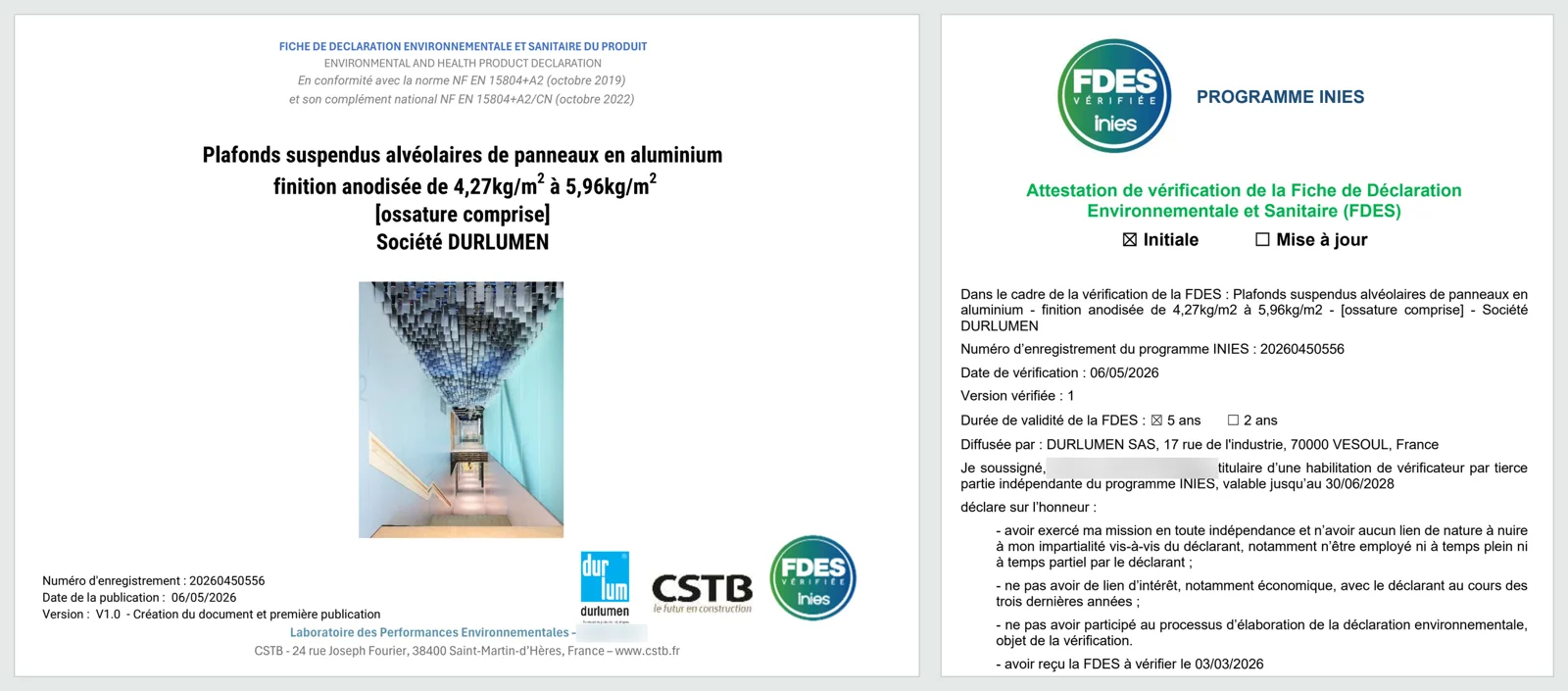
The cover of an FDES for suspended aluminium ceilings, compliant with NF EN 15804+A2, and the attestation signed by the approved verifier. It shows the date the file was received, 3 March 2026, the verification date, 6 May 2026, and the 3 independence commitments required by the 2021 order. The verifier's name is masked here.
A comment and its correction
Because the verification report is not published, the example below is constructed for this article. It concerns stage A4, transport of the product to the building site, and a point that the 2021 order requires to be checked: the geographical representativeness of the data.
As long as a comment remains open, the attestation waits. A written, justified assumption in the first submission most often avoids the question. A team trained in LCA, for example through an LCA training course, anticipates such comments better.
An FDES timeline depends less on the INIES database than on the verifier and the back-and-forth with them.
After going online, complaints
The file is still useful after publication. Anyone may report a suspected anomaly in an FDES, and Annex H of the INIES programme rules (in French) then gives the manufacturer 10 working days to reply if the anomaly is critical or major. It then has 1 month at most to correct a critical anomaly and 3 months for a major one, and its correction goes back through a verifier.
An anomaly is major when correcting it changes one of the indicators by more than 10%, and critical when that change affects the total climate change indicator. An FDES is also used to prove an environmental claim, and an error left in it risks unintentional greenwashing.
6What about a PEP or a foreign declaration?
A PEP
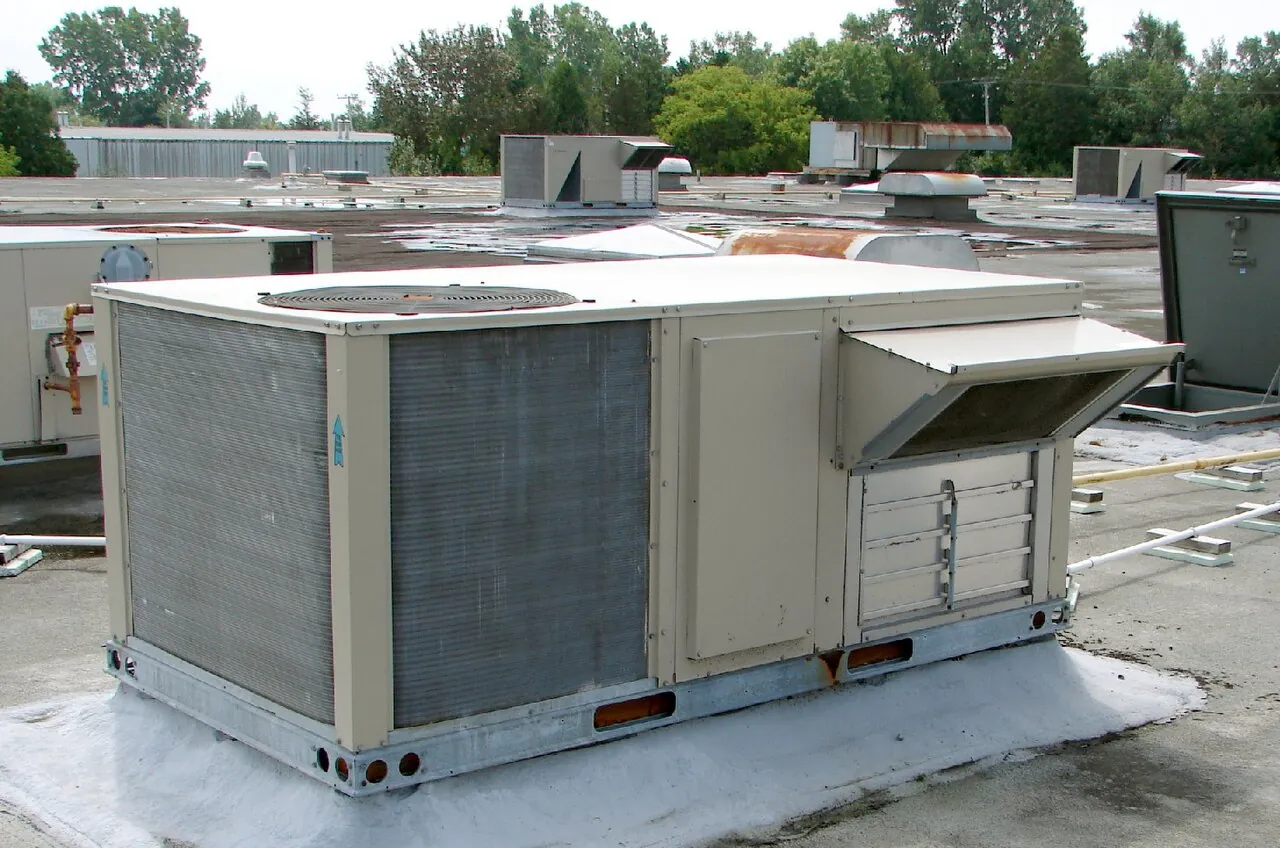
A PEP, such as that of an air-conditioning unit or an electrical switchboard, is verified under PEP ecopassport's AP0002 procedure, which results in a signed declaration of conformity and a verification report. PEPs currently follow the product category rules in edition 4, published in September 2021, which align their indicators with those of FDES.
The PEP ecopassport list distinguishes external verifiers from those who verify in-house, for their employer: 9 of the 60 are in this group. The programme's procedure allows it, but the 2021 order requires, for a declaration used in France, a verifier not employed by the manufacturer. Only 35 of the 60 state that they work in French.
A foreign declaration
A declaration published elsewhere in Europe, called an EPD (environmental product declaration, the international and European equivalent of the FDES), does not replace an FDES. Where it has been verified in a programme that is a member of ECO Platform, with a compliant functional unit, INIES does not re-verify modules A1 to A3. An approved verifier checks the other modules and the health section.
Recognition is not automatic. The German IBU (Institut Bauen und Umwelt, a German EPD programme) states that its recognition with INIES has been suspended since the switch to A2. Each programme also sets its own requirements: the International EPD System approves only verifiers who can show 5 years of LCA practice. Our guide on choosing between FDES, EPD and PEP helps decide upstream, and the one on building eco-design shows what project owners expect. For the opposite case, when a foreign customer asks for an EPD, see which programme and verification to choose for export.
For us at Projet Celsius, the first question to put to a verifier concerns their organisation: has it touched, closely or remotely, the study or the tool that produced the declaration? We prepare LCAs and declarations with manufacturers, and verification then falls to a person from another organisation, whom they choose. Booking that person when the study is launched remains the surest way to hold a publication date. The same independence rule applies to verifying a carbon footprint assessment (in French) (in French) or auditing environmental claims.
7Key takeaways
- An FDES is verified by one of the 58 verifiers approved by INIES, a PEP by one of the 60 approved by PEP ecopassport.
- The verifier is not employed by the manufacturer, has had no link of interest with it in the last 3 years, and their organisation has not contributed to the declaration.
- Verification has been mandatory since 1 July 2017, and the order of 14 December 2021 replaced the 2015 one.
- Across 5 published files, verification took from 5 weeks to 11 months. It is therefore better to book the verifier when the study is launched.
- No verification price list is published, whereas registering an FDES on INIES costs from €190 to €220 excl. VAT.
To understand what an FDES contains before having it verified, see our guide to the acronyms EPD, FDES and PEP.
- INIES, List of verifiers approved by the INIES programme (in French), updated 17 July 2026; earlier lists since July 2023.
- PEP ecopassport, List of approved verifiers, AP0006 ed. 18 (in French), 10 September 2026; editions 7 (2023), 8 (2024), 11 (2025) and 13 (2026).
- Ministerial order of 14 December 2021 on independent third-party verification of environmental declarations, text on AIDA (INERIS) (in French), Articles 2 to 5 and 9.
- Ministerial order of 20 October 2022, NF EN 15804+A2 for declarations (in French).
- INIES, Faire vérifier sa déclaration (Have your declaration verified) and Devenir vérificateur (Become a verifier), in French. Consulted on 16 October 2026.
- INIES, The INIES verification programme and Registering your declaration, in French. Consulted on 16 October 2026.
- INIES, programme rules, in French: Annex A, pricing conditions; Annex H, handling of suspected anomalies, September 2026; Annex L, admission of a declaration, May 2023.
- INIES, Annual day of 28 June 2023, compilation of presentations (in French).
- Alliance HQE-GBC, in French: press release of 3 July 2017 on mandatory verification; call for support no. 4, call for verifiers, May 2025.
- PEP ecopassport, in French: verification procedure AP0002, approval procedure AP0003, registration fees AP0009 and product category rules, edition 4.
- ECO Platform, Verification Guidelines V07, 2023; INIES, Our international action.
- IBU, Mutual recognitions; The International EPD System, Individual verifier application. Consulted on 16 October 2026.
- Durlumen, FDES of anodised honeycomb ceilings and verification attestation, in French, 6 May 2026; attestations published by RENZ, Swisspearl, Uponor and ATIBT; INIES database, verification and publication dates, consulted on 16 October 2026.
- Cover photo: Fons Heijnsbroek, Oosterdokseiland building site in Amsterdam, Wikimedia Commons, CC0.


