
Skip to content
Get in touchFR
Updated in August 2026
Explained

What is the environmental impact of air conditioning?

During a heatwave, the question comes up everywhere: how much does an air conditioner affect the environment? An answer in 5 minutes: a calculator, a multicriteria assessment and measures to take before buying.

Sébastien Pierfederici
By Sébastien Pierfederici, LCA and eco-design specialist at Projet Celsius, PEF expert and IFC trainer. He helps manufacturers assess product environmental footprints.
June 2026
Updated August 2026 · 5 min
The environmental impact of air conditioning goes beyond the CO2 from electricity consumed. In France, the decarbonised mix (around 30 gCO2e/kWh) makes this share 5 to 10 times smaller than elsewhere in Europe, so refrigerant leaks can outweigh consumption. Multicriteria LCA adds the urban heat island, rebound effects and rare metals. This article provides a calculator, a PEF assessment across 12 indicators and 4 low-energy measures to implement beforehand. For low-energy alternatives to conventional air conditioning, see our guide How can you cool without an air conditioner?; for the underlying methodological distinction, our Bilan Carbone versus LCA comparison.
Key takeaways
  • 1In France, the electricity consumed by air conditioning has a small carbon impact. France's very low-carbon electricity mix makes it 5 to 10 times less emissions-intensive than elsewhere in Europe. Attention therefore shifts to refrigerant leaks and impacts that carbon calculations do not show.
  • 2In France, refrigerant leaks outweigh electricity. For an R32 split system losing 5% of its charge each year, they represent around 2 times the emissions from electricity consumed; with the older R410A, whose GWP is 3 times higher, the gap widens further. They do not appear on the bill, and this is what F-Gas regulation seeks to address.
  • 3The solution differs depending on what you examine. Carbon depends on use (electricity and refrigerant leaks), metal resource depletion on manufacturing, and the ozone indicator on refrigerant production.
  • 4The F-Gas timetable tightens from 2027. Refrigerants with a GWP of 150 or more will be prohibited when placing monobloc air conditioners of 12 kW or less on the market from 1 January 2027, then air-to-air split systems of the same capacity from 1 January 2029. R32 and R454B (GWP 466) will then disappear from these small models in favour of refrigerants such as R290 (propane), with a near-zero GWP. Equipment bought today can still be used and maintained after these dates.
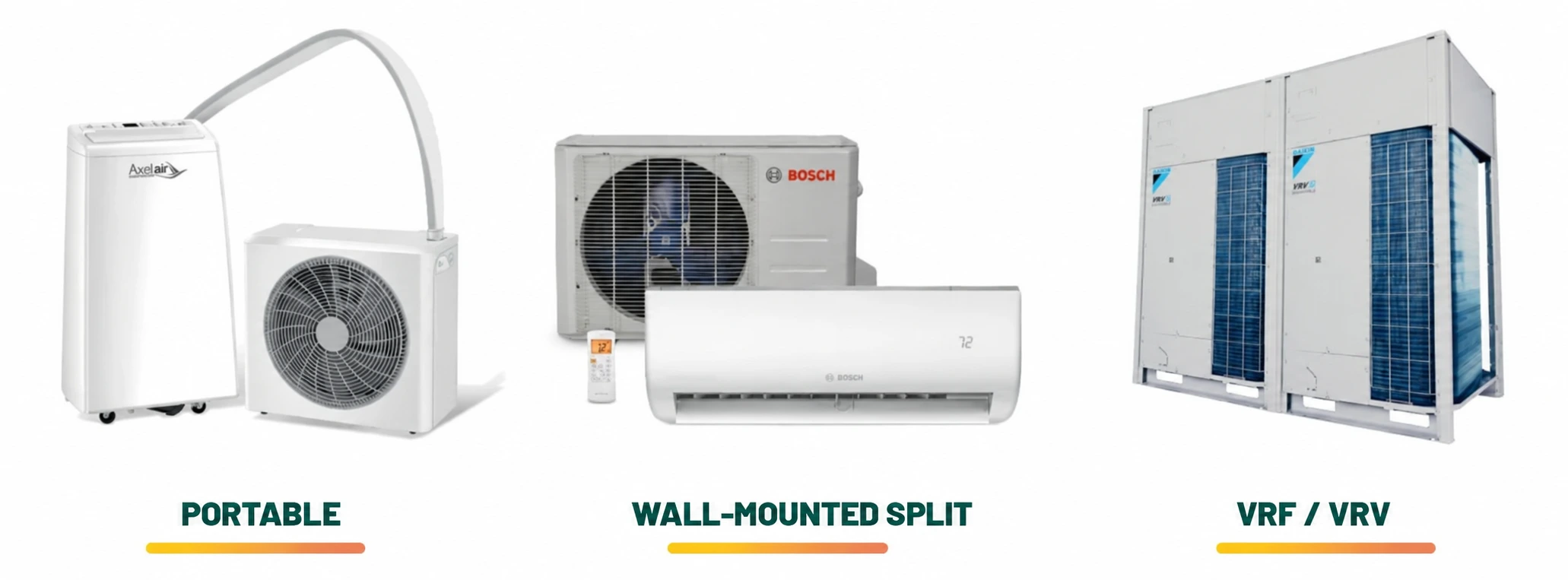
Diagram of the three main air conditioning types: portable monobloc, wall-mounted split, commercial VRF / VRV
Three main families of air conditioning equipment, with very different LCA profiles: portable monobloc (SEER 2.5-3), wall-mounted split (SEER 6-11), commercial VRF / VRV (SEER 6-8.5).

When offices exceed 30 °C during a heatwave afternoon, the question arises in every corridor: install air conditioning, but at what environmental cost? This article first gives a carbon estimate, then explains what that figure does not cover, and finally offers a multicriteria assessment whose verdict changes with the indicator examined. Cooling needs also depend on location: the number of tropical nights by municipality by 2050 ranges from 3 to more than 70 depending on the area.

1How much CO₂ does air conditioning emit in France?

The calculation relies on multiplication: energy consumed × electricity emission factor. We are discussing a product carbon footprint here, rather than an organisation's Bilan Carbone®: the former measures the CO2 emissions from equipment and its use, the latter all emissions from an organisation. In France, this factor is low: around 30 gCO2e/kWh over the life cycle according to RTE 2024, or around 10 times less than in Germany, more than 20 times less than in Poland and around 7 times less than the European average. This still does not allow claims of carbon-neutral air conditioning: an organisation's neutrality remains a legally regulated concept. An air conditioner is technically an air-to-air heat pump: it does not produce cold, but moves heat from inside to outside. This thermodynamic principle is the same for a portable monobloc (2-3 kW cooling capacity, occasional cooling for one room), a wall-mounted split (2-7 kW, living room or small office), a commercial VRF/VRV system (15-150 kW, multi-zone building with energy recovery between simultaneously hot and cold zones), or a reversible air-to-water or ground-source heat pump. Comparing their SEER (Seasonal Energy Efficiency Ratio) alone is therefore insufficient: installed cooling capacity and actual use matter just as much.

Estimate

Estimate your air conditioning's carbon impact

Equipment type

SEER 7, 0.18 kg of refrigerant per kW cooling capacity, volume 250 m³, cooling capacity 7.0 kW

Energy 528 kWh / yearElectricity cost 106 €per year (€0.20/kWh)
Annual emissions by source (kgCO2e/year)
Electricity in useRefrigerant leaks
077153230307

Average mix

58 kgCO2e/year

Electricity 16 kg · Leaks 43 kg

2.9% of the 2 tCO2e/year budget

Grid peak

307 kgCO2e/year

Electricity 264 kg · Leaks 43 kg

15% of the 2 tCO2e/year budget

The integrated calculator lets you simulate a specific case: floor area, ceiling height, equipment type, refrigerant, months of use, European country. Real-time output: consumption, cost, annual emissions and cumulative emissions over 17 years (typical lifespan), comparison of the grid's average and peak mixes. The resulting use-phase footprint is then complemented by the multicriteria assessment.

2Urban heat islands and rebound effects: two mechanisms outside the calculation

This calculator already goes further than a conventional carbon footprint assessment: it separates CO₂ emissions from electricity use and refrigerant leaks, and offers a heatwave "grid peak" view. Yet two mechanisms remain invisible and matter at a collective scale:
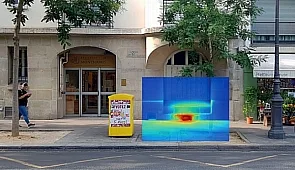
Thermal camera image of a ground-floor air conditioner expelling hot air at 47 °C into public space
Hot air expelled by a ground-floor air conditioner in Paris: up to 47 °C measured with a thermal camera in public space in front of the shopfront. This local impact is completely absent from the individual carbon footprint and matters at a collective scale. Source: Apur, Air conditioning in Paris, April 2025.
  • The urban heat island. An air conditioner does not eliminate heat; it expels it outside. Across a dense neighbourhood, this raises the outdoor temperature by 1 to 2 °C at night (Salamanca et al. 2014, Journal of Geophysical Research: Atmospheres), prompting neighbours to use more air conditioning. Cerema maps this sensitivity free of charge for 12,000 municipalities, and it is one of the measures documented in our guide to adapting a territory. No individual carbon footprint captures this social and environmental cost.
  • The rebound effect (Jevons paradox). Once air conditioning is installed, it is used for longer and at a lower setpoint than planned. Studies of the direct rebound effect (Greening et al. 2000 in Energy Policy; ADEME review) put this additional consumption at 10 to 30% compared with the initial sizing scenarios.

3Multicriteria LCA: an air conditioner's 12 PEF indicators

Climate is only one of sixteen indicators in the European Environmental Footprint (EF 3.0) method. For each environmental dimension, a different LCA phase dominates: electricity use, manufacturing, refrigerant leaks or end of life. The integrated visual, based on the reference scientific report by the Joint Research Centre (the European Commission's scientific body), shows which phase contributes most to each of the 12 main PEF indicators for a residential split air conditioner.

Multicriteria LCA, 12 PEF indicators (EF 3.0)

The dominant phase varies by indicator: estimate based on the literature

Climate change is only one of 16 indicators in the European PEF EF 3.0 method, and the life cycle phase contributing most changes between indicators. With an average European electricity mix, use dominates climate and fine particulate matter; manufacturing dominates mineral and metal depletion and human toxicity; the ozone indicator comes from refrigerant production. These shares are estimates based on the literature, rather than an LCA. Click a bar for details.

Manufacturing (A1-A3)
Refrigerants (B1+B2)
Electricity use (B6)
End of life (C)
Climate change
82%
Ozone layer depletion
80%
Fine particulate matter
25%
65%
Acidification
22%
70%
Ionising radiation
90%
Mineral and metal depletion
70%
25%
Electricity use

Dominant for 8 of 12 indicators with an average European mix. In France, the low-carbon mix substantially reduces this share.

Manufacturing

Metals 70%, human toxicity 50%. Copper, nickel, electronic rare earths. Invisible in use.

Refrigerants

Leading climate source in France, ahead of electricity. Measures: R290 and leak-tightness; F-Gas excludes R32 from new splits of 12 kW or less in 2029.

Of 12 indicators, 8 are dominated by the use phase (climate, particulate matter, acidification, eutrophication, fossil resources, ionising radiation, land, water), where electricity matters and, for climate, refrigerant leaks. This is what the calculator and carbon footprint capture, just as the scope 3 of a Bilan Carbone® isolates an organisation's indirect emissions. Minerals and human toxicity, however, shift towards manufacturing (copper, nickel, electronic rare earths). The ozone indicator mainly comes from the production chain for fluorinated refrigerants: HFCs themselves (R32, R410A) do not deplete the ozone layer.

4Reduce demand before installing equipment: 4 measures

The first question concerns reducing demand before choosing equipment. 4 measures quantified by ADEME reduce cooling demand by 30 to 80%, allowing smaller equipment to be sized afterwards, or none at all.

  • External solar protection (external venetian blinds, solar shading, shutters) cuts up to 80% of solar gains on an exposed façade, or up to 30% lower air conditioning demand (ADEME 2023). This is the most cost-effective measure in an existing office.
  • A ceiling fan consumes 30 to 60 W, compared with 500 to 900 W for a 2.5 to 3.5 kW split at full load, or 10 to 15 times less. Combined with a thermostat set 2 to 3 °C higher, it saves around 30% of air conditioning consumption without loss of perceived comfort.
  • Night-time free cooling cools the building at night with outdoor air through increased mechanical ventilation, with typical savings of 5 to 35 kWh/m²/year in commercial buildings (ADEME 2024).
  • Setting the thermostat to 26 °C rather than 24 °C reduces consumption by around 14% (7% per degree), immediately and at no cost, in line with energy-saving recommendations.
  • If the project allows, a reversible air-to-water or ground-source heat pump beneficially replaces conventional air-to-air conditioning in new buildings or major office renovations. SEER 4-6 for air/water, 5-8+ for ground-source (compared with 3-8 for a high-end split), with much more stable performance during heatwaves (ground temperature at -3 m stays around 12-14 °C). Higher investment (€10-25k for residential ground-source versus €1-4k for a split), but a substantially lower cumulative footprint over 20 years.

None of these measures excludes an air conditioner; they build on one another. This is the logic of an eco-design process applied to thermal comfort: reduce demand first, then optimise equipment. Alternatives to air conditioning (fans, ceiling fans, evaporative cooling, district cooling) are covered separately.

5Key takeaways

  • In France, the electricity consumed by an air conditioner emits 5 to 10 times less CO2 than elsewhere in Europe thanks to a low-carbon electricity mix: refrigerant leaks become the leading source of use-phase emissions.
  • Calculating carbon from electricity is insufficient: refrigerant leaks, the peak mix, urban heat islands and rebound effects must be included. The calculator covers part of this; multicriteria LCA complements the rest.
  • Before buying, measures to reduce demand (solar protection, ceiling fans, free cooling, a 26 °C setpoint) can reduce cooling demand by 30 to 80%. Details are in our article on alternatives to air conditioning.
  • The F-Gas timetable distinguishes equipment: Regulation (EU) 2024/573 prohibits placing self-contained equipment (monobloc, plug-in) of 12 kW or less using a refrigerant with GWP 150 or more on the market from 1 January 2027, and air-to-air split systems of the same capacity from 1 January 2029. The prohibition concerns placing on the market: an R32 unit bought in 2026 can still be used and maintained after that date. Since 1 January 2026, however, refrigerants with a GWP of 2,500 or more have been prohibited for maintenance without any charge threshold, making equipment still charged with R-404A impossible to recharge with virgin refrigerant.

Equipment choices made this year commit the company for 15 to 20 years. To include this source in a formal Bilan Carbone, see how much a Bilan Carbone® costs.


Further resources

Frequently asked questions

A fixed split, without hesitation. Portable air conditioners have a nominal SEER of 2.5 to 3, compared with 6 to 11 for a modern wall-mounted split. For the same floor area, a portable unit consumes 2 to 4 times more electricity. Its structural weakness is sealing. The hot-air exhaust hose passes through a partly open window, creating continuous incoming outdoor (hot) air that divides the effective SEER by ~2 compared with the nominal SEER shown on the product sheet. In actual use, a portable unit therefore operates at a SEER of around 1.3-1.5. It remains a supplementary solution for an occasional room, never a long-term office strategy.
1) External solar protection (external venetian blinds, blinds) on exposed façades. 2) A ceiling fan to gain 2-3 °C of perceived comfort without air conditioning. 3) Night-time free cooling if the building allows. 4) If all this is insufficient, a modern split air conditioner, preferably R290, with a reasonable setpoint (26 °C). This sequence drastically reduces cooling demand before investing in equipment.
3 measures that work together. The first is reducing cooling demand beforehand: external solar protection (external venetian blinds), a ceiling fan, night-time free cooling, a 26 °C setpoint instead of 24 °C. In a standard office, this combination divides demand by 2 to 4. The second is choosing a low-GWP refrigerant, ideally R290 (propane, GWP of 0.02 under the regulation): in France, where leaks contribute around 2 times more than electricity, it removes around 2 thirds of the use-phase footprint compared with R32. The third is maintenance: an annual leak check by a certified refrigeration engineer can divide the leak rate by 2 (from 5% to 2.5% a year) and improves actual SEER by 10 to 15%.
For a typical 30 m² office equipped with a modern split (SEER 8) in France, the calculation has 3 stages. Consumption is around 500 kWh per 4-month season. Electricity emits 500 kWh × 30 gCO2e/kWh (France mix, RTE 2024), or 15 kgCO2e/year. Leaks add more: a split this size contains around 1 kg of R32, and at 5% leakage per year, 0.05 kg × 675 gives 30 to 35 kgCO2e/year. The total is around 45 to 50 kgCO2e/year per unit, with 2 thirds due to leaks. Multiply by 4 to 8 for an office with 25 people. The same installation in Germany (mix of around 380 gCO2e/kWh) would emit 190 kgCO2e/year from electricity alone.
By a large margin. A fan or ceiling fan consumes 30 to 60 W, compared with 500 to 900 W for a 2.5 to 3.5 kW split at full load, or 10 to 15 times less electricity. The key nuance: a fan does not cool the air, but speeds up sweat evaporation and gives a feeling of coolness 2 to 3 °C lower. Above 32-33 °C ambient temperature, it is no longer sufficient. Good practice: use a fan first, with air conditioning as a supplement at a 26 °C setpoint. This combination divides total air conditioning consumption by 2 without loss of perceived comfort.
European F-Gas Regulation (EU) 2024/573 sets a phase-out timetable for high-GWP refrigerants (global warming potential, meaning a refrigerant's greenhouse effect compared with CO2 over 100 years). R410A has a GWP of 2,088, R32 a GWP of 675: a 1 kg leak is equivalent to 675 or 2,088 kg of CO₂. Key dates: monobloc units of 12 kW or less can no longer be placed on the market with a refrigerant of GWP 150 or more from 1 January 2027; for air-to-air splits of 12 kW or less, the R32 prohibition (GWP 675) takes effect on 1 January 2029, followed by all fluorinated gases in 2035. For these small units, the alternative is R290 (propane), with a near-zero GWP; R454B (GWP 466) is only a transitional solution, as it also exceeds the threshold of 150. R32 equipment bought today can still be used and maintained, but this technology will disappear from the small split market in 2029.
Technically, the thermodynamic principle is the same: a refrigerant changes state to transport heat. An air/air split, a reversible air/water heat pump and a ground-source heat pump all work this way; the difference lies in the cold or hot source (air, water, ground) and the refrigerant used. What changes the carbon footprint: equipment SEER, source stability and refrigerant GWP. Ground-source is the most efficient (SEER 5 to 8+, stable ground source at 12-14 °C even during heatwaves, low leak rates in a closed circuit) and the least emissions-intensive over 20 years, but costs €10,000 to €25,000 (including drilling) compared with €1,000 to €4,000 for a split. It suits new buildings, major renovations or long-term commercial use; in an existing home, low-energy measures (solar protection, ceiling fans, free cooling) remain the first measure.
or: [email protected]

More articles to read

View all →
French environmental cost label for clothing: what changed on 1 October 2026
Regulation

French environmental cost label for clothing: what changed on 1 October 2026

6 min read
Which garments can display an environmental cost in France? Timeline and thresholds, 2025-2027
Regulation

Which garments can display an environmental cost in France? Timeline and thresholds, 2025-2027

10 min read
Removable batteries and battery passports: who is affected in 2027?
Regulation

Removable batteries and battery passports: who is affected in 2027?

14 min read

No two situations are exactly alike.

Tell us about yours: your situation, deadline and budget. A senior consultant will reply within 24 working hours with an honest assessment.

Let us discuss it within 24 hours →
Our toolkit

A full range of free assessment tools

Cost estimator, obligation and eligibility checkers, footprint calculator.

Estimate costs and impacts
Ref. 2026·BC·0184REPORT · FINANCIAL YEAR 2026Bilan Carbone®complete 1·2·3Presentation to the Executive Committee · 2027 action planCONTENTS01Executive summaryp. 402Scope and methodologyp. 1203Emissions by scopep. 24042027 action planp. 5605Methodological appendicesp. 78VOLUME84 pages · ConfidentialSTANDARDISO 14064 · GHG ProtocolQUOTATION · BC.2026.0184Issued 05·05·2026 · Valid for 30 daysCelsius consultancy · Paris 3rd arrondissementINDICATIVE COST ESTIMATEYour companyMid-sized company · 180 employees · CSRD 2027SERVICEBilan Carbone®Scope 1·2·3 · 13 weeksBPIFRANCE FUNDING · - 60%INDICATIVE RANGE EXCL. VAT€16,800to €22,400PROJECT DETAILS01 · SCOPING3 weeks~€4,20002 · MODELLING8 weeks~€9,80003 · PRESENTATION2 weeks~€4,800Indicative estimate · Refined after scopingSIRET 891 234 567 00012

Bilan Carbone® cost estimator

Your price range in 1 minute, based on 2026 market rates and public funding.

1 minStart
Estimate costs and impacts
AI FOOTPRINT · MONTHLY USEYOUR TOTAL FOOTPRINT4.2 kgCO₂eq for 1,000 typical prompts · May 2026MODEL COMPARISON · 1,000 TYPICAL PROMPTSGPT-4oOpenAI6.8 kgClaude OpusAnthropic2.1 kgGemini ProGoogle4.5 kgMistral LargeMistral AI · FR1.6 kg

AI carbon footprint calculator

The climate impact of your AI queries, by model and task. Ecologits methodology.

3 minStart
Check an obligation
DIAGDÉCARBON'ACTIONACCELERATE THETRANSFORMATIONOF YOUR COMPANYIN ENERGY ANDTHE ENVIRONMENTOFFICIAL SCHEME · BPIFRANCE × ADEMECHECKER · ELIGIBILITYELIGIBLEYou meet the 3 Diag Décarbon'Action criteria.YOUR FUNDING€10,000 excl. VAT€6,000excl. VATAmount payable by you after the Bpifrance subsidyFUNDING BREAKDOWNBPIFRANCE 40%YOU 60%€4,000€6,000SCHEME SUBSIDISED BY

Diag Décarbon'Action eligibility

Check in 30 seconds whether your business is eligible for Bpifrance funding covering 40% of a Bilan Carbone® assessment.

30 secStart
Check an obligation
FRENCH REPUBLICMinistry for the Ecological TransitionLEGAL REQUIREMENTGreenhouse GasEmissions AssessmentArticle L.229-25 of the French Environmental CodeDecree 2022-982 · published 1 July 2022FREQUENCY · 4 YEARSFILING · ADEMECHECKER · BEGES REQUIREMENTREQUIRED720 employees · BEGES requirementPOTENTIAL PENALTY€50,000maximum fine for failing to complete itart. R.229-50OFFICIAL REFERENCE

BEGES checker

Does the BEGES requirement apply to you? An immediate answer, with the deadline and penalty.

30 secStart
Check an obligation
9:42SCANSCANNING DPP...DPP IDENTIFIEDOrganic cotton T-shirtSKU TX-CB-220 · Batch L-26-04781ESPR COMPLIANT42 DATA POINTS · 5 SECTIONSORIGINIndia · GOTSOrganic cottonFOOTPRINT5.2 kg CO₂eqLCA ISO 14040RECYCLABILITY85%Cotton recycling schemeREPAIRABILITY7.5 / 10Accessible partsEND OF LIFETextile recycling scheme (TLC) · Bordeaux/FRRefashion-approved recovery operatorEU · ESPR 2024/178112.05.2026

DPP checker

Is your product covered by the Digital Product Passport?

1 minStart
Check an obligation
COSTENVIRONMENTAL386POINTS257PER 100 GOfficial methodEcobalyse, v7.0.0CHECKER · ENVIRONMENTAL LABELLINGELIGIBLETextiles · voluntary labellingENVIRONMENTAL COST386 ptsT-shirt 150 g · 257 pts per 100 gExample: Ministry for the Ecological Transition FAQ

Textile environmental labelling 2026

Voluntary labelling, but third parties can publish it from October 2026: where do you stand?

1 minStart