
- 1From 2027, small R32 air-to-water heat pumps leave the market.
- 2Wall-mounted air conditioners have a reprieve until 2029, R32 VRF systems until 2033.
- 3Equipment already installed remains usable, repairable and refillable until end of life.
- 4Inventory your equipment and leaks: 1 kg of R410A accounts for 2.1 tCO2e.
On 1 January 2027, the EU regulation on fluorinated gases, known as F-gas, prohibits placing several families of air conditioners and heat pumps on the market when their refrigerant exceeds a global warming potential (GWP) of 150: self-contained equipment up to 50 kW, including monobloc air-to-water heat pumps, and split air-to-water heat pumps of 12 kW or less. R32, used in many recent heat pumps, has a GWP of 675. Equipment already installed remains usable, repairable and refillable.
Bans on placing equipment on the market, by family, from 2025 to 2035
Each step removes new appliances whose refrigerant exceeds the threshold from sale; installed equipment is not targeted. Click on a family.
Self-contained ≤ 12 kW : Monobloc air-to-water heat pumps, portable or window air conditioners. R32 leaves the market in 2027; in 2032, no fluorinated gas remains, including HFOs. Portable HFC appliances with GWP ≥ 150 have been banned since 2020.
The timetable is often summarised as "R32 banned in 2027", which is inaccurate: an office's wall-mounted air conditioner has a 2-year reprieve, an R32 VRF system can be sold until the end of 2032, whereas R410A chillers leave the market from 2027. This guide follows Annex IV of the Regulation line by line, details what remains permitted after the deadline and quantifies an often underestimated source: refrigerant leaks from existing equipment.
1The F-gas Regulation targets new equipment placed on the market
Regulation (EU) 2024/573, in force since 11 March 2024, replaced the 2014 F-gas Regulation. It organises the phase-out of hydrofluorocarbons (HFCs), the fluorinated gases in air conditioners, heat pumps and refrigeration installations, through 3 levers:
- A decreasing quota: the HFC quantity producers and importers can place on the European market falls in stages, to zero in 2050.
- Bans on placing on the market, listed in Annex IV, removing equipment families from sale according to refrigerant.
- Containment rules for existing equipment: leak checks, refrigerant recovery, technician certification.
GWP, the Regulation's unit of measurement
Global warming potential, written PRP in the French version of the text, measures the greenhouse effect of a kilogram of gas over 100 years relative to that of a kilogram of CO2. The Regulation uses values from the IPCC's fourth report: 675 for R32, 1,430 for R134a, 2,088 for R410A. A kilogram of leaking R410A therefore has the same impact as 2.1 tonnes of CO2. Bans are expressed through thresholds, 150 or 750, or target all fluorinated gases.
Self-contained or split: the distinction determining the date
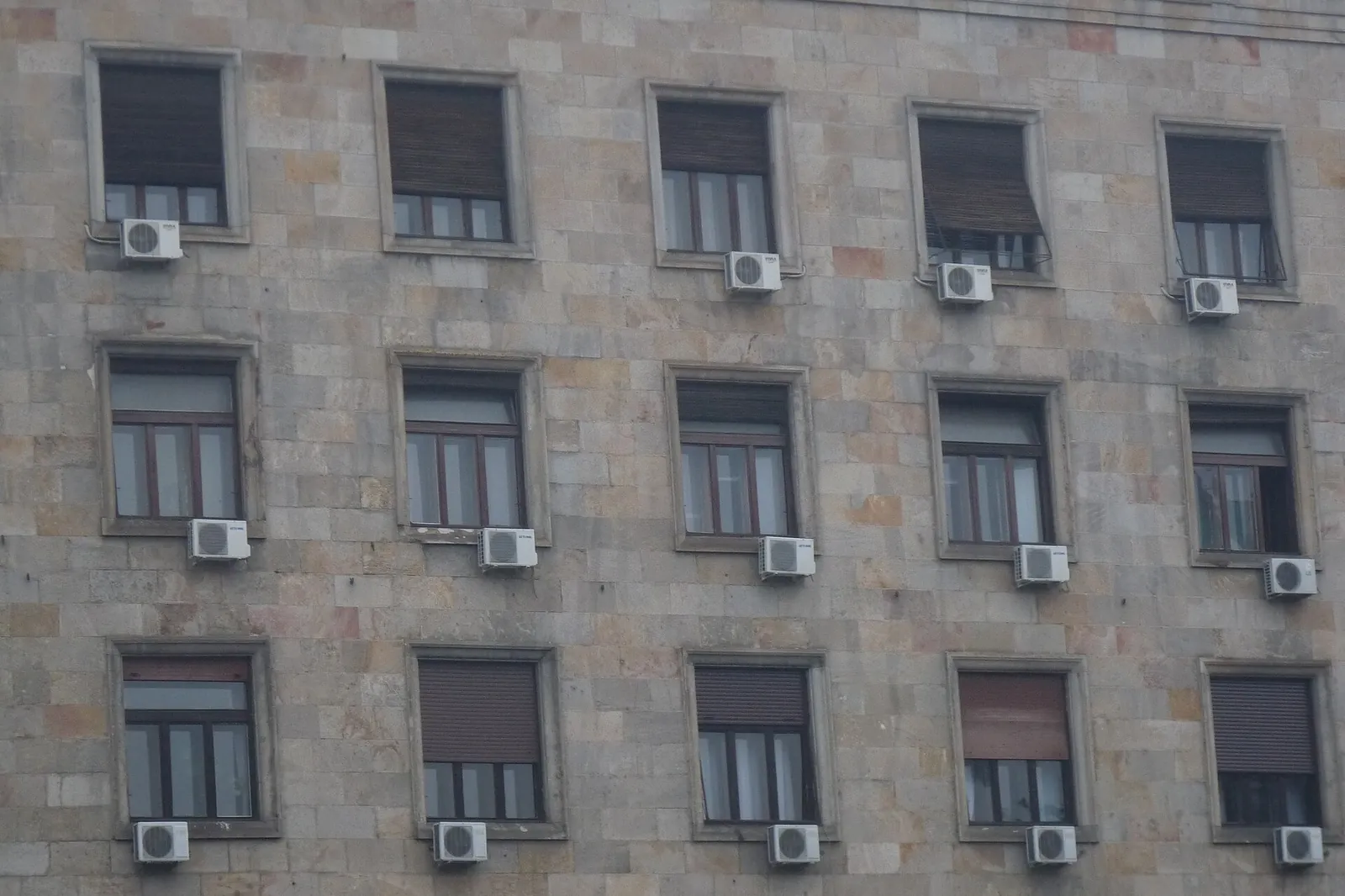
Self-contained equipment is a complete factory-made system with no refrigerant-containing part connected on site: portable air conditioner, monobloc air-to-water heat pump, packaged air-conditioning cabinet, rooftop unit. A split system, or two-unit system, combines an outdoor unit and indoor units connected on site by a refrigeration technician; multi-splits and VRF (variable refrigerant flow systems, or VRV) fall into this category, as does fixed double-duct equipment.
The ban applies to placing on the market, meaning an appliance's first supply within the Union, or its customs clearance on import. An R410A air conditioner installed in 2020 can therefore operate until end of life; our article on air conditioning's environmental impact compares the impacts of its refrigerant and electricity.
2Equipment banned from sale on 1 January 2027
On 1 January 2027, 5 entries in Annex IV apply to air conditioning, heat pumps and chillers. All allow for cases where site safety requirements prevent use of a lower-GWP refrigerant, often flammable: the operator must demonstrate this, and the threshold rises to 750 for self-contained equipment.
Self-contained air conditioners and heat pumps up to 50 kW
Self-contained equipment of 12 kW or less, portable or fixed, and equipment of 12 to 50 kW can no longer be placed on the market with a fluorinated gas whose GWP is 150 or above. The main equipment covered is R32 monobloc air-to-water heat pumps, then packaged air-conditioning cabinets and rooftops below 50 kW. Portable HFC air conditioners at this level have been banned since 2020.
Split air-to-water heat pumps of 12 kW or less
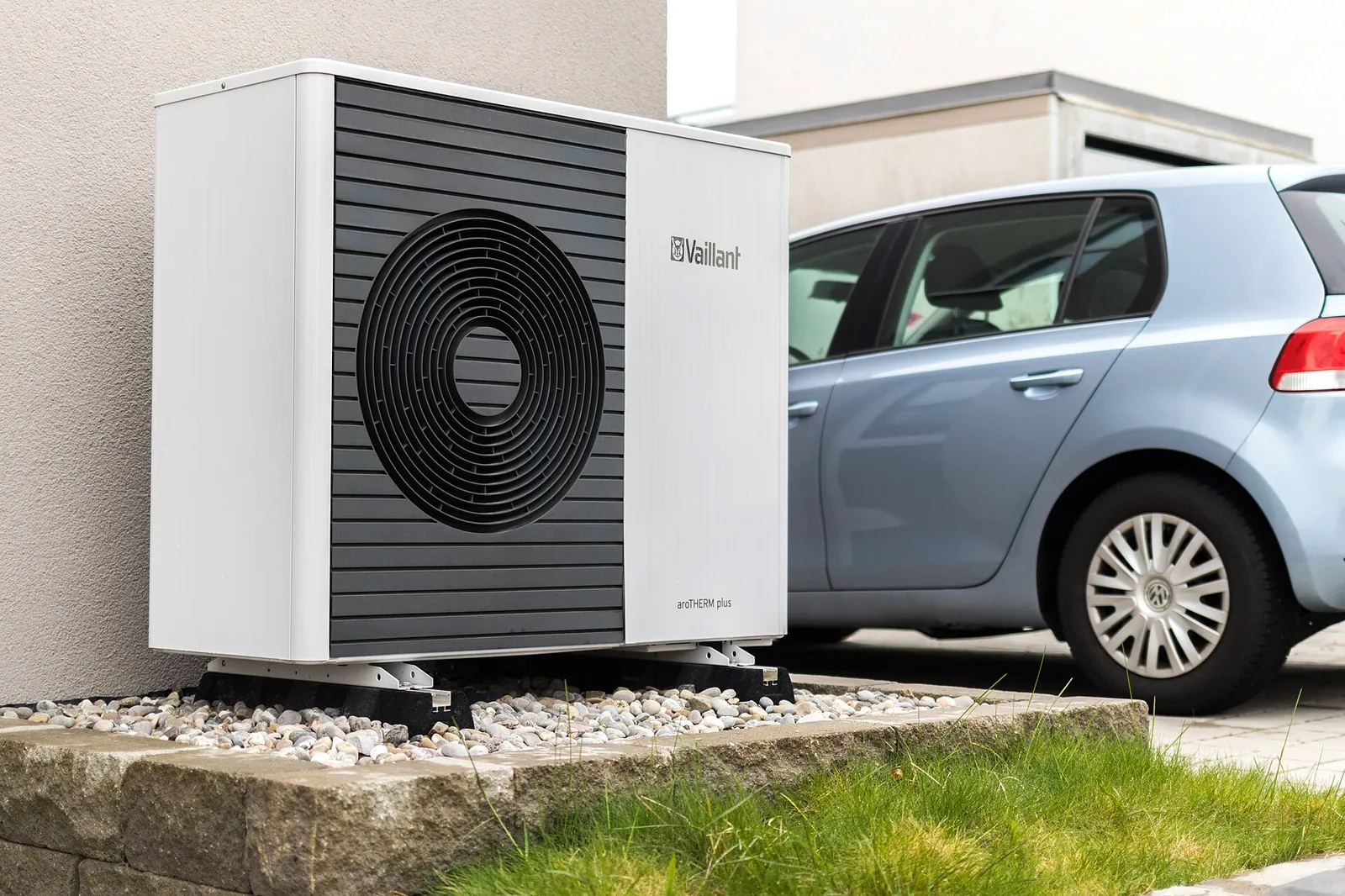
A split air-to-water heat pump connects its outdoor unit to the building's hydraulic module through refrigerant lines. Up to 12 kW, this format can no longer be placed on the market above a GWP of 150, excluding R32 as well as R410A: replacement involves a propane monobloc or a split using a refrigerant below 150 GWP. A split air-to-air air conditioner of the same capacity is affected only on 1 January 2029.
The deadline arrives as ETS2 will increase heating oil and gas prices from 2028 and RE2020 tightens its thresholds in 2028: the heat pump remains the replacement solution, with a different refrigerant.
Chillers
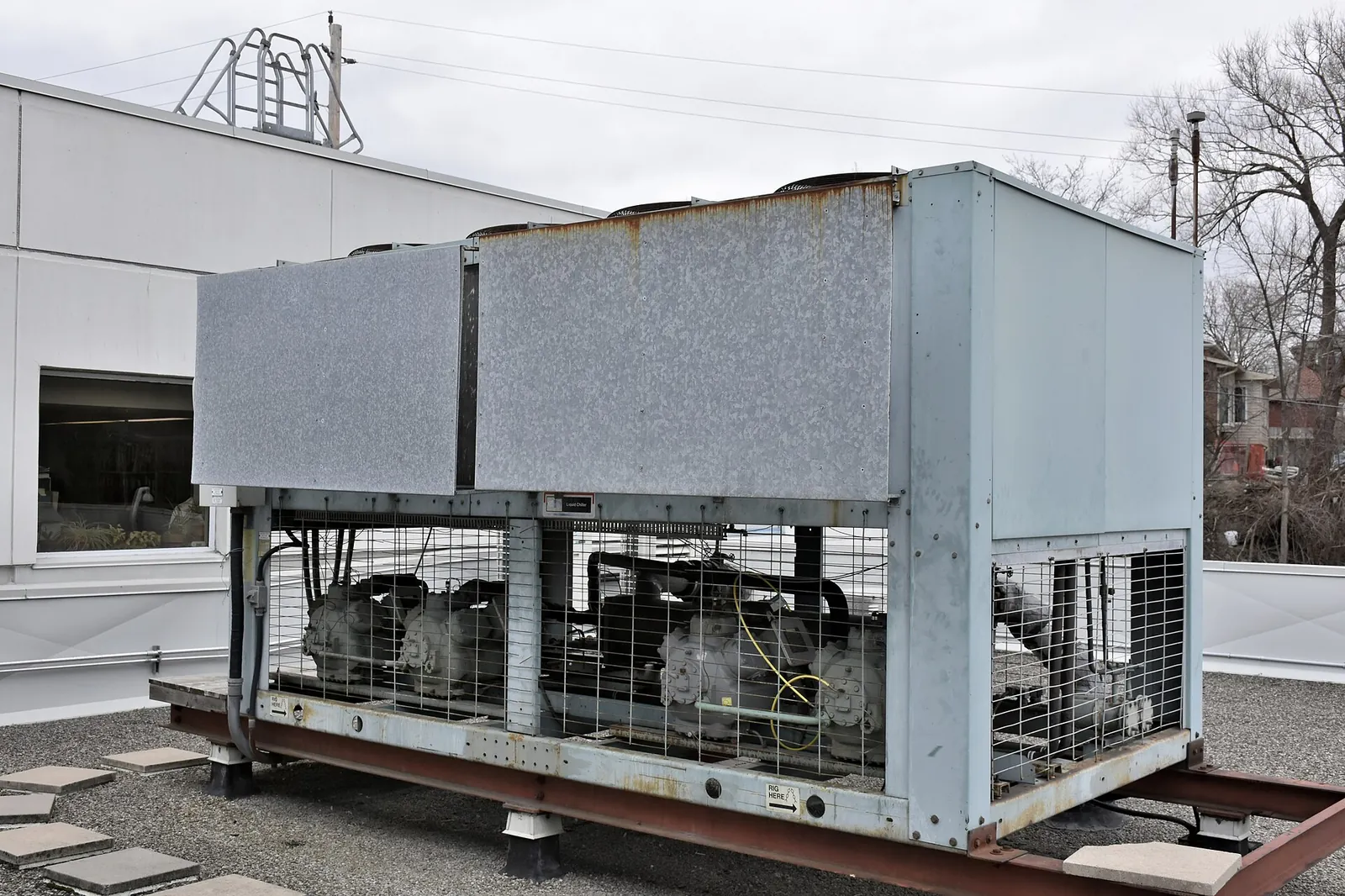
Chillers produce cold water for fan-coil units and air-handling units. Up to 12 kW, the threshold is 150. Above 12 kW, it is 750: R134a (GWP 1,430) and R410A chillers leave the market, while R32, HFOs and propane remain possible. For an office building renewing its cooling production, often under pressure from the tertiary buildings decree, 2027 is the deadline that matters.
3Splits, VRF and large equipment: deadlines from 2029 to 2035
Split air conditioners, multi-splits and VRF systems leave later, in stages. One step has already been reached: since 1 January 2025, a split containing less than 3 kg of refrigerant can no longer be placed on the market above a GWP of 750, removing R410A from small splits, both air conditioners and heat pumps.
- 1 January 2029: split air-to-air equipment of 12 kW or less above a GWP of 150, ending R32 wall-mounted air conditioners; splits above 12 kW above 750, ending R410A VRF systems.
- 1 January 2030: self-contained equipment above 50 kW, such as large rooftops, above a GWP of 150.
- 1 January 2032: self-contained equipment and chillers of 12 kW or less, whatever the fluorinated gas, including HFOs.
- 1 January 2033: splits above 12 kW above a GWP of 150, ending R32 VRF systems.
- 1 January 2035: splits of 12 kW or less, whatever the fluorinated gas.
The complete bans in 2032 and 2035 require so-called natural refrigerants, such as propane or CO2, for small capacities. The Commission must publish by 1 January 2030 at the latest a report on alternatives, expressly mentioning splits, which may be accompanied by a proposed amendment. As at 28 September 2026, no published text reverses these dates, and exemptions granted since 2024 concern neither air conditioning nor heat pumps.
An R410A VRF system can no longer be placed on the market from 1 January 2029; using R32, it remains authorised until 31 December 2032, and the 2 can subsequently be maintained.
Before sizing new equipment, alternatives to air conditioning, solar protection, air circulators or district cooling, reduce the capacity to install, an issue growing with tropical nights expected in 2050.
4Stock, repairs, refilling: what remains authorised after 2027
The deadline does not empty warehouses: the Regulation governs what can still be sold, installed, repaired and refilled.
Selling and installing equipment from stock
Equipment placed on the market before 1 January 2027, meaning imported or manufactured in the Union before that date, can still be sold and installed. The operator commissioning it must be able to demonstrate this date and retain proof for 5 years, such as an invoice or supplier statement. From 1 January 2028, the reseller must also provide this proof (Article 11, corrected in March 2025). Equipment placed on the market after the deadline can be neither used nor resold within the Union.
Repairing with spare parts
Parts for repairing existing equipment remain authorised if the work increases neither capacity, fluorinated gas charge nor refrigerant GWP. Replacing the compressor of an R32 split heat pump therefore remains possible; using the opportunity to install a more powerful outdoor unit no longer does.
An R32 split air-to-water heat pump after 1 January 2027: what remains permitted
Example of an 8 kW model, a category that can no longer be placed on the market from 2027. Only the first stage is ruled out; the others remain possible, sometimes subject to conditions.
Refilling with R32 or R410A
Since 1 January 2026, servicing air conditioners and heat pumps with virgin refrigerant whose GWP is 2,500 or above has been prohibited; reclaimed or recycled refrigerants follow in 2032. R410A and R32 are below this threshold: no maintenance ban targets them. Their availability depends on the quota, and the Ministry for the Ecological Transition warns that HFCs "will therefore become scarcer and more expensive over the years".
5Propane, CO2, R32: which refrigerant for which equipment?
The refrigerant choice for a new appliance is governed by 2 thresholds: 150, closing the door to small equipment, and 750, bounding large splits and chillers. HFOs, a new generation of fluorinated gases, fall below these thresholds but remain fluorinated gases, caught by the complete bans in 2032 and 2035.
Propane (R290)
Propane has a GWP of 0.02 and is not a fluorinated gas: no ban, quota or leak check under the Regulation applies to it. However, it is flammable (class A3), governing the permissible refrigerant quantity and equipment location, and requiring precautions during installation and maintenance.
CO2 (R744)
CO2 has a GWP of 1 and is not flammable. It operates at much higher pressures than HFCs, requiring specific equipment and expertise: the orders of 21 November 2025 created a certification category specifically for handling it.
R32, its blends and HFOs
With a GWP of 675, R32 remains possible in split air-to-air equipment of 12 kW or less until the end of 2028, in splits above 12 kW until the end of 2032 and in chillers above 12 kW with no end date. R32 and HFO blends such as R454B, with a GWP of 470 according to the US Environmental Protection Agency, follow the same thresholds; the Regulation calculates a blend's GWP by weighting that of its components (Annex VI). Pure HFOs, such as R1234ze (GWP 1.37), escape the 150 and 750 thresholds: only complete bans on small capacities target them.
The GWP of common refrigerants against the regulation's thresholds
Logarithmic scale: each tick multiplies GWP by 10. Click on a refrigerant to see until when it can be used in a new appliance.
150 and 750: Annex IV thresholds for new appliances. 2,500: threshold for the ban on servicing with virgin refrigerant.
R32HFC, class A2L
In a new appliance
Existing equipment: Recharging permitted within the HFC quota.
R32 and R454B are classed as mildly flammable (A2L). The summary of authorised uses, drawn up in 2018 and still published by the ministry, places these refrigerants, like propane, among those prohibited by fire safety regulation (Article CH 35) in public-access buildings in categories 1 to 4 and high-rise buildings, noting a revision of the text then underway. This is a typical case where the EU Regulation's safety exception can apply: refrigerant choice is made with the inspection body before ordering.
6Refrigerant leaks, an often underestimated direct emissions source
Refrigerant escaping from a circuit goes directly into the atmosphere. In a Bilan Carbone® as in a statutory BEGES assessment, these leaks are direct emissions, in scope 1: they enter the mandatory BEGES boundary, whereas scope 3 is required only from companies subject to CSRD. They appear on no meter: they must be reconstructed from top-ups noted in service records.
The impact of a kilogram of refrigerant
Under the Regulation, 1 kg of R410A represents 2.09 tCO2e, equivalent to around 8,000 km by car using Base Empreinte's average factor. ADEME's Base Empreinte also publishes GWPs from the IPCC's sixth report: 2,256 for R410A and 771 for R32, or 8% and 14% more. An assessment, Bilan Carbone® or GHG Protocol, states the series used and applies the same to its reference year, otherwise comparison between 2 assessments no longer holds. The Regulation's thresholds are always calculated using its own values.
Base Empreinte's default leakage rates
Without records, Base Empreinte provides default values, established in 2014 with 50% uncertainty:
- Split: 1 kg charge, 5% annual leakage, 85% of the charge lost at end of life.
- VRF: 9 kg charge, 10% a year, 85% at end of life.
- Rooftop: 26 kg charge, 5% a year, 26% at end of life.
- Air-conditioning average: 9 kg, 9% a year, 36% at end of life.
End of life has a substantial impact: using these values, a VRF system loses 8.5 times its annual leakage when dismantled. Recovery by a certified operator is mandatory, and the tracking document created in the public Trackdéchets application records it.
Estimate leaks from an air-conditioning fleet and its mandatory checks
Preset: 4 VRF systems with 9 kg and 20 splits with 1 kg of R410A, using Base Empreinte defaults. Replace these with your equipment and actual leak rates.
Per appliance: 18.8 tCO2e, check every 12 months
Per appliance: 2.1 tCO2e, no periodic check
Estimated leaks per year
9.6tCO2eor 4.6 kg of refrigerant
In an average car37,519 km
In air-conditioning electricity177 MWh
With GWPs from the IPCC's 6th report10.4 tCO2e
Same equipment using R323.1 tCO2e
Total and checks calculated using the regulation's GWPs; a Bilan Carbone® may use those from the 6th report, published by Base Empreinte. Your service records provide the quantities actually topped up.
Example: an office building
Take a building air-conditioned by 4 VRF systems with 9 kg of R410A and 20 splits with 1 kg, using these default values. The VRF systems leak 3.6 kg a year and the splits 1 kg, or 4.6 kg of R410A and 9.6 tCO2e a year, as much as 177 MWh of air-conditioning electricity using Base Empreinte's 2023 factor (54 gCO2e/kWh). In France, where electricity is low-carbon, equipment leaks can have as much impact as its electricity. With R32, the same equipment would emit 3.1 tCO2e a year.
For us at Projet Celsius, this is one of the most poorly estimated sources in service-sector assessments: a default rate is applied instead of rereading service records, which give kilograms actually topped up. Reduction levers start there, in a hotel, a hospital or an industrial site: checks kept up, leak detection, then low-GWP refrigerant on replacement.
7Leak checks, register, certification: the operator's obligations
Existing equipment remains subject to containment obligations borne by the operator: the company exercising actual power over the equipment's technical operation, whether or not it owns it.
Thresholds in tonnes of CO2 equivalent
Equipment containing 5 tCO2e or more of fluorinated gases undergoes a leak check by a certified technician: every 12 months up to 50 tCO2e, every 6 months up to 500 tCO2e, every 3 months above that. A leak detection system doubles these intervals; it becomes mandatory at 500 tCO2e. The 5 tCO2e threshold corresponds to 2.4 kg of R410A and 7.4 kg of R32: changing refrigerant can remove equipment from mandatory checks. Near-zero-GWP HFOs have had their own threshold since 2024: 1 kg of charge. Hermetically sealed, labelled equipment is exempt below 10 tCO2e.
What the operator must retain
In France, every intervention on the circuit produces a service record (Cerfa 15497), signed by the operator carrying out the work and by the equipment operator above 5 tCO2e, and retained for 5 years with check findings, under Articles R. 543-75 onwards of the Environmental Code. Failure to carry out leak checks and absence of measures against a detected leak fall under a class 5 offence: fines up to €1,500 for an individual, €7,500 for a legal entity. The same penalty applies to a distributor placing equipment on the market after its ban date (Article R. 543-123, which still refers to the 2014 Regulation).
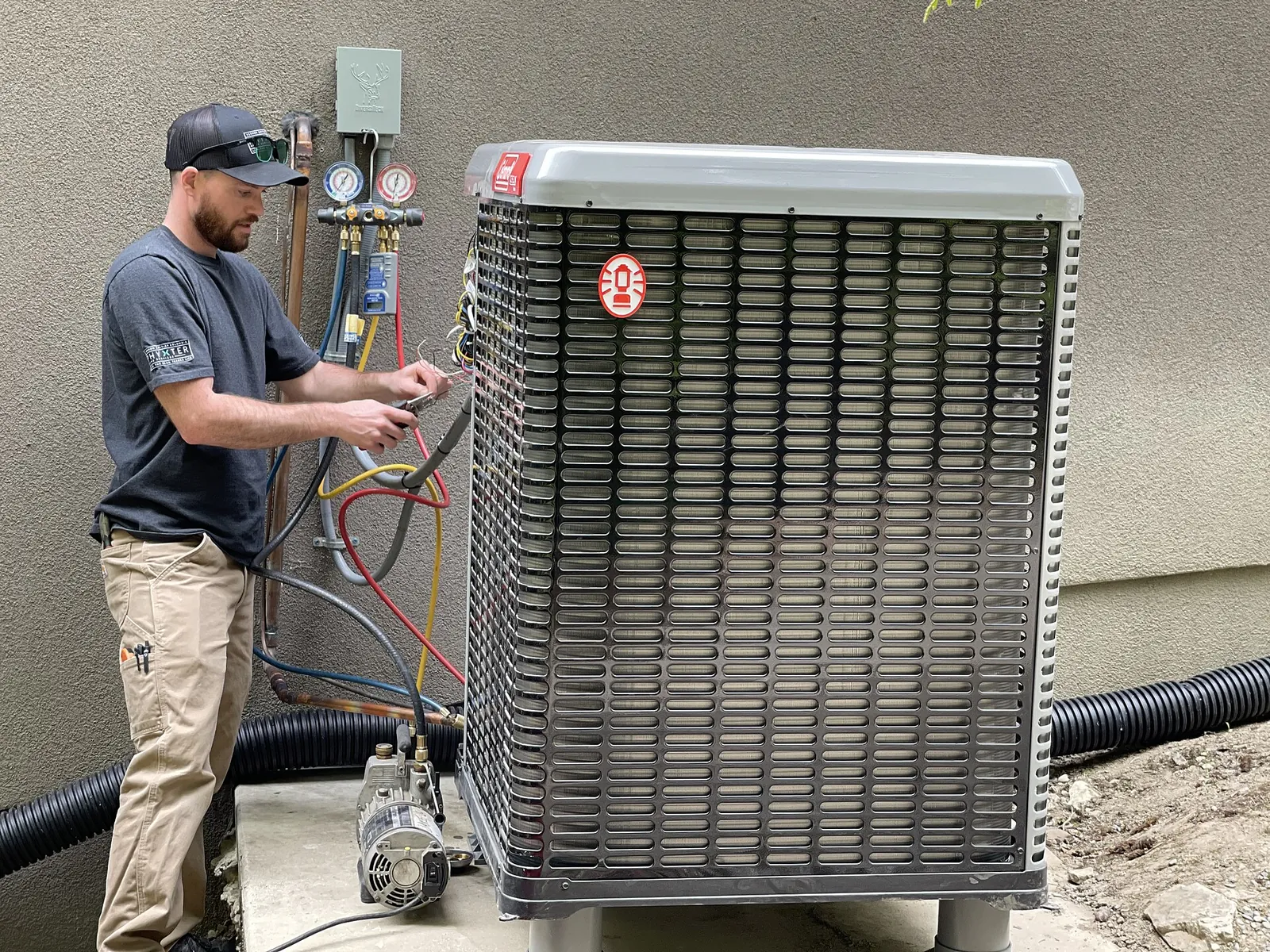
Technicians with broader expertise
All charging, commissioning or work on the circuit is undertaken by a company holding a certificate of capacity, issued for at most 5 years. The orders of 21 November 2025 created categories for hydrocarbons such as propane, CO2 and ammonia; according to the ministry's transition note, companies have until 12 March 2029 to convert their certificates, by which date their technicians must have completed refresher training. For propane or CO2 equipment, this category must be checked in the maintenance contract.
Overall, the equipment list, refrigerants and charges is the first document to prepare: it serves the replacement timetable, leak checks and emissions assessment alike.
8Key takeaways
- On 1 January 2027, self-contained equipment up to 50 kW and split air-to-water heat pumps of 12 kW or less can no longer be placed on the market above a GWP of 150; chillers above 12 kW, above 750.
- Split air-to-air air conditioners follow in 2029, as do R410A VRF systems; R32 VRF systems remain authorised until the end of 2032.
- Installed equipment remains usable, repairable and refillable with R32 or R410A; stock placed on the market before the deadline can be installed, with supporting proof.
- The HFC quota is divided by 2 in 2027: maintaining R410A equipment depends on a refrigerant set to become scarcer.
- Leaks are direct emissions: 1 kg of R410A accounts for 2.1 tCO2e, and leaks from service-sector equipment can have as much impact as its air-conditioning electricity.
To place these leaks among your other emissions, the orders of magnitude of an assessment provide reference points by source and the 10 pitfalls of a first Bilan Carbone® prevent common omissions. Equipment replacement is prepared using energy audit data; it commits the building for the machines' lifetime and belongs in a climate transition plan and, for new buildings, a building eco-design approach. Our Bilan Carbone® support includes inventorying refrigerants and leaks.
- F-gas Regulation: Regulation (EU) 2024/573 of 7 February 2024 on fluorinated greenhouse gases, corrected in French in the OJEU of 19 November 2024 and 24 March 2025 (Article 11, paragraph 1, 5th subparagraph): Articles 3 (definitions), 4 to 8 (containment, leak checks, detection, records, recovery), 10 (certification), 11 and 13 (placing on the market, putting into operation, maintenance), 35 (review); Annexes I and II (GWP), IV (bans), VI (mixtures) and VII (quotas).
- French law: Environmental Code, Articles R. 543-75 to R. 543-123; order of 29 February 2016 and orders of 21 November 2025; Criminal Code, Articles 131-13 and 131-41; Ministry for Ecological Transition page, updated on 28 August 2026; note on the transitional phase, August 2026; summary of permitted uses for alternatives to HFCs.
- Data: ADEME's Base Empreinte: GWPs from the IPCC's 4th, 5th and 6th reports, default air-conditioning charges and leak rates (2014), 2023 factors for "car, average engine type" (0.256 kgCO2e/km) and "electricity, air-conditioning use" (0.0542 kgCO2e/kWh); US EPA SNAP programme (R454B GWP, safety classes of R454B, R32 and R290).