
- 180% of the effort on 3-4 sources accounting for 70 to 80% of an organisation’s footprint.
- 2Purchasing almost always dominates (40 to 70%): this is where the real gains lie.
- 3Energy and mobility quick wins deliver returns, but are insufficient to sustain -30% over 3 years.
- 4Offsetting, green electricity, decorative solar: three misguided ideas to rule out.
A company that has just completed its Bilan Carbone® finds itself with a document of around fifty pages, dozens of emission sources and often the same question: where do we start? The natural temptation is to tackle everything at once, or conversely to focus on the most visible measures (solar panels, waste sorting, electric cars). Both approaches lead to the same result: a plan that runs out of steam after 12 months without significantly affecting emissions.
What can be reduced, and where the opportunities lie
The carbon footprint of a typical company, with a starting baseline of 100.
Todaythe starting footprint
Purchases account for 40 to 70% of the footprint: this is where the main reduction potential lies.
40-70%
After 1 yearquick wins, at no cost
Energy, mobility and remote working.
-12%
After 3 yearscumulative reduction
With a structured plan for purchases and energy.
-30%
Yet in the assignments we support, achievable results are clearly identified. An industrial SME with 180 employees cut 12% of its emissions through three zero-cost actions in less than six months. A research institute with 2,000 people incorporated climate into its governance in four years. A textile brand halved its flagship product’s impact by changing a single dyeing supplier. These successes share neither budget, company size nor even team motivation. They share the order in which they chose their battles. This guide sets that out clearly, starting with the simplest theory and moving through to the subtler pitfalls to avoid.
1Step 1: rank emission sources before starting any workstream
A company Bilan Carbone® contains an average of around thirty emission sources (building energy, employee travel, material purchases, inbound and outbound freight, digital activities, capital goods, etc.). Trying to reduce them all simultaneously is the best way to reduce nothing. The practical rule that works across all assignments we support fits into one sentence: concentrate 80% of the effort on the 3 or 4 sources accounting for 70 to 80% of the total footprint. Other sources can wait their turn, because a company cannot open thirty workstreams in parallel without bringing every one to a standstill, rather than because they are unimportant.
3 categories account for 70 to 80% of the footprint; the other 27 share the rest
3 categories : purchasing, energy, freight27 other categories : waste, water, property, digital...
70 to 80%of the footprint20 to 30%
It issorting the laundry before washing it : start with the sheets, not the socks. Focusing 80 % of the effort on 3-4 categories always beats doing "a little of everything, everywhere".
A useful image is sorting laundry before a wash: start with the large pieces (sheets, towels), rather than the socks. An effective climate plan first answers three simple questions that can be settled in a one-hour meeting:
- Which 3 sources contribute most to my footprint? In nine cases out of ten, these are purchasing (materials, subcontracting, services), energy (heating, electricity) and freight (product transport). If your assessment shows something else, it often indicates poor scoping rather than a genuine sector exception.
- Which measures can I implement for these sources in the next 12 months? In other words, with current resources and without major investment. More demanding measures (building renovation, changing an industrial process) come later, once internal credibility is established.
- Who owns each measure? This question kills more climate plans than any other. CSR cannot do it alone: the procurement manager for purchasing, the technical director for energy, and operations for freight. Without an identified business owner, a measure goes nowhere, regardless of its technical quality.
Once these three questions are settled, your action plan fits on one page. And that page is infinitely better than a 40-page document nobody will ever read. We now detail the four measures that, in the vast majority of cases, account for most reduction volumes. To put your pace in context, SNBC 3 sectoral carbon budgets provide the expected national benchmark by sector.
2Measure No. 1: purchasing, accounting for 40 to 70% of the footprint
This is the largest emission source in almost every assessment we carry out, whether for an SME or a mid-sized company. Purchasing covers everything your company brings through the door: raw materials, components, purchased services, subcontracting and professional services. Technically, this is upstream scope 3: the submerged part of the iceberg, invisible from your office but often representing more than two-thirds of total emissions.
Measure No. 1 - purchasing
What we do not see contributes most
The paradox is that this source combines both the greatest reduction potential and the greatest difficulty in taking action. Why difficult? Because emissions come from your suppliers’ practices, rather than yours. You cannot decide on their behalf to change processes. But you can influence their position by incorporating carbon into your commercial relationship. Two practical measures make this possible, accessible to companies of every size.
Include a carbon criterion in your specifications
Take a practical example. At a metallurgy SME we supported, steel and aluminium purchases accounted for 52% of the total footprint. The team worked on three purchasing measures in parallel: first, rewriting specifications to favour recycled steel over steel from virgin ore (ADEME’s emission factor falls from around 2.2 tCO2e per tonne of virgin steel to less than 1 tCO2e for recycled steel). Next, opening discussions with key suppliers about their own reduction plans: some have already invested in efficient processes and are simply waiting for clients to ask for the information. Finally, identifying the most emission-intensive materials for which a credible technical alternative exists (replacing primary aluminium with secondary aluminium, for example). Results develop over several quarters, rather than a few weeks, but this is the only approach that fundamentally transforms the footprint’s structure.
Ask suppliers for their actual emission data
A simple step, underestimated in most climate plans. Most assessments calculate purchasing emissions using an approximate rule: a given amount of euros spent with a supplier = a given number of kilos of CO₂e, based on average statistical sector ratios. It is quick and accepted by the methodology, but very imprecise, and this imprecision hides the actual room for improvement.
The measure is to ask your ten main suppliers for actual data on what they sell you (carbon footprint per kilo of product, or per functional unit). In 2026, most suppliers do not yet have them, but the request itself prompts action, especially if you represent a significant share of their turnover. Replacing average ratios with actual physical data improves calculation accuracy by 30 to 50%, revealing the real reduction priorities. In practice, this measure costs three well-worded emails and consistently ranks among the most worthwhile for purchasing scope 3!
3Measure No. 2: energy, easy quick wins and illusions to avoid
Energy (heating, air conditioning, lighting, equipment, industrial processes) is the easiest source to tackle: technical solutions are known, data are readily available (your bills) and returns on investment can be calculated to the nearest euro. Four familiar actions dominate energy quick wins: switching lighting to LED (payback in one to two years), optimising thermal controls (lowering the heating setpoint by one degree reduces the bill by 7%), insulating weak points in the building (roof, windows and doors), and replacing fossil-fuel boilers with heat pumps where the site allows. Together, these actions produce a 15 to 30% reduction in energy emissions over two to five years, often with nothing left to pay thanks to grants.
Note: for several years, the Tertiary Decree has required buildings above 1,000 m² to reduce consumption by 40% by 2030 (against a reference year chosen between 2010 and 2019). For affected companies, inaction carries regulatory risk as well as a carbon cost, with penalties for failure to report on the OPERAT platform.
Watch the pitfall: energy is a quick win, rather than the entire strategy
Here is something most companies discover afterwards. In France, electricity supplied by the grid is already very low-carbon thanks to the nuclear and hydro mix (around 50 to 60 gCO₂ per kWh according to ADEME’s Base Empreinte, compared with 300 to 500 g in most European countries). Consequently, in a French assessment, electricity is often a small source, typically 3 to 8% of the total. If a company concentrates its efforts and budget here while purchasing accounts for 60%, it is looking at the wrong end of the telescope.
We have seen companies spend €200,000 on solar panels to reduce their footprint by 2%, while three phone calls to steel suppliers would have had ten times more impact at almost no cost. The lesson: energy actions are excellent quick wins that unite teams. They build internal credibility, mobilise technical teams and rapidly demonstrate quantified results, but they are never enough on their own to deliver a serious reduction pathway.
4Measure No. 3: mobility, a significant source in service companies
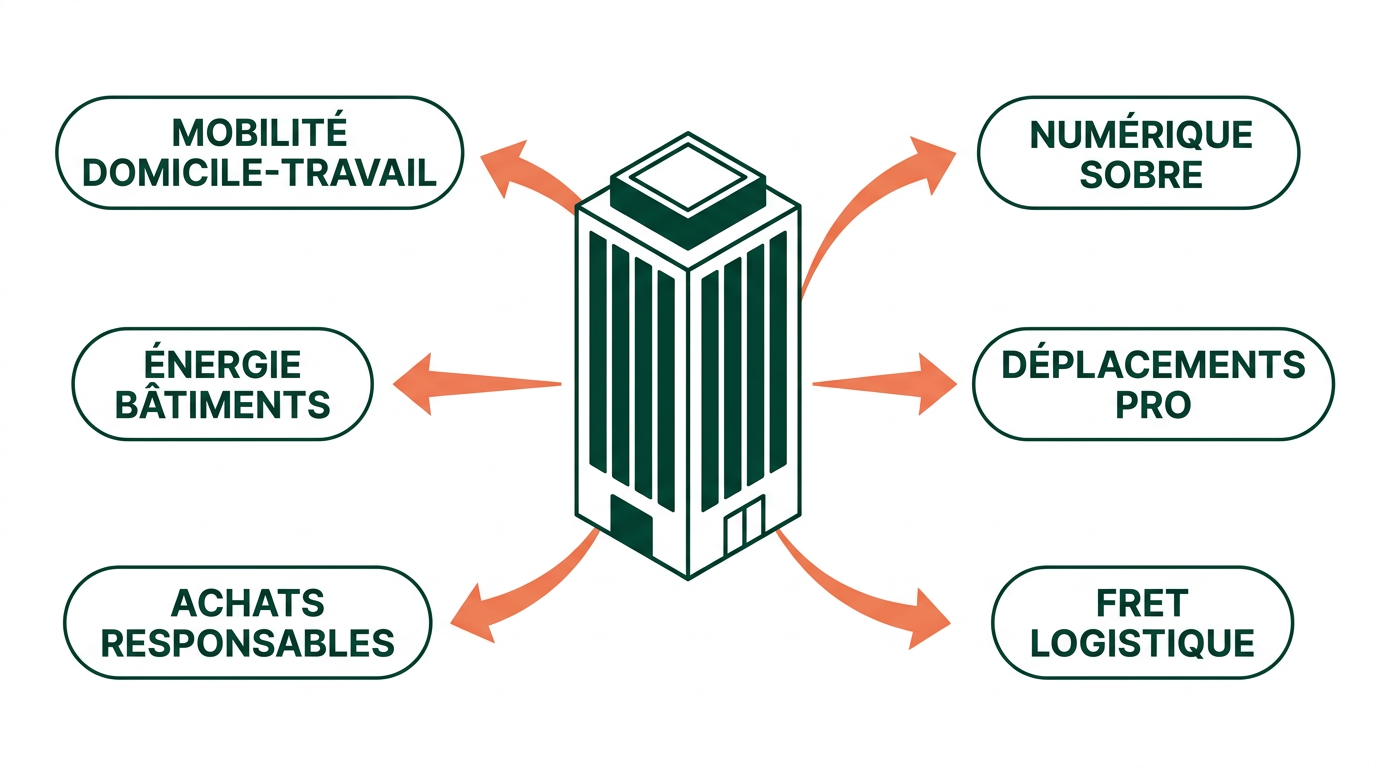
Travel (business and commuting) typically accounts for 15 to 30% of a service company’s footprint, depending on sector and location. The measures are known and accessible, and results appear quickly. Four actions form most of the mobility action plan on the majority of assignments:
- The 4-hour rule: trains mandatory when a journey takes less than four hours by train. Over these distances, a flight emits around 50 times more CO₂ than a TGV per kilometre. This rule can be set out in an internal memo and apply the next day.
- The sustainable mobility allowance: a tax scheme allowing employers to reimburse up to €800 a year for commuting by bike, carpooling or public transport. A strong signal, marginal cost and exempt from social contributions.
- Fleet greening: replace combustion vehicles with hybrids or electric vehicles as they are renewed. No accelerated replacement plan is needed: incorporating the criterion into every new leasing contract is enough to decarbonise the fleet in 3 to 5 years.
- Working from home: one day a week reduces commuting emissions by 20%. In areas where urban infrastructure makes a private car necessary, this is by far the most powerful measure, and the most popular internally.
Top management setting an example matters as much as rules
Something we consistently observe in the field: successful mobility plans are those where management starts by applying the rules to itself. When the executive committee gives up two flights per quarter in favour of videoconferences, the impact in tonnes of CO₂ is modest (a few dozen at most), but the effect on internal credibility is considerable. Conversely, it is difficult to ask employees to cycle or take the train when executives continue to fly from Paris to Lyon. This is why a climate plan without a clear behavioural signal from top management consistently becomes a plan for show, regardless of the technical quality of everything else.
The companies progressing fastest distribute ownership throughout the organisation, rather than concentrating it in one person. Having the best plan is not what distinguishes them.
5Measure No. 4: supplier engagement, the structural measure for the long term
You cannot reduce purchasing by 30% without changing suppliers or products: that is obvious. But you can engage strategic suppliers in a reduction process, and this measure transforms scope 3 over time. The approach generally develops through three practical moves: including a carbon criterion in tenders (differentiating rather than disqualifying, typically 10 to 15% of the technical score); asking key suppliers to measure their own emissions and share reduction plans; and jointly developing action plans for the most emission-intensive sources in what they sell you. Large companies subject to the CSRD now do this consistently within their non-financial reporting.
Mental map - where to start
Which measure to prioritise: expected impact vs required effort
priority
The cascading effect: how one client moves an entire sector
This is the most powerful and least-known mechanism for decarbonising industrial sectors. Once carbon criteria enter a large group’s purchasing processes, they apply to every new tender and contract renewal. Suppliers unable to respond are progressively excluded. Those remaining start examining their own supply chains and pass the request on to their subcontractors. In a few years, a requirement set by one influential client spreads across three or four levels of the chain.
If you are an SME supplying a large group now subject to the CSRD, expect this type of request within the next 12 to 24 months. Practical advice: it is better to have your Bilan Carbone® ready and a credible action plan to present than to produce them urgently to retain a strategic contract.
6Misguided ideas that undermine most plans
Three measures recur in corporate climate plans, and none of them reduces physical emissions. Worse, they consume time, budget and credibility that will then be unavailable for effective measures. Setting them out in black and white saves months.
Promise vs reality
Three measures that seem obvious, and reduce almost nothing
Why carbon offsetting never replaces reduction
Buying carbon credits to "offset" emissions means funding a project (tree planting, renewable energy elsewhere) supposed to absorb or avoid as much CO₂ as you emit. On paper, it looks clever. In practice, it is not a reduction strategy: your physical emissions have not changed by a gram. Offsetting remains possible, but only after reducing everything that can be reduced, and only for unavoidable residual emissions.
The legal risk is now real. The 2021 Climate and Resilience Act strictly regulates carbon neutrality claims: penalties up to €100,000 and a requirement to publish a correction if you cannot substantiate your reduction pathway. European Directive (EU) 2024/825, known as EmpCo, which was due to apply throughout the Union from 27 September 2026, goes further: it prohibits claims to consumers that a product has a neutral, reduced or positive climate impact based on offsetting, and its transposition into French law is still awaited. Using carbon credits as a "quick" measure without starting reduction means buying legal risk at a high price.
Why green electricity reduces almost nothing in France
This is the most common pitfall in climate plans. A "green" electricity contract is signed and a -15% result proudly displayed in the assessment. Yet physical emissions have not changed: the electricity mix reaching your meter is exactly the same, whether under a conventional contract or one with guarantees of origin. It is the pooled national grid, already very low-carbon thanks to nuclear power (50-60 gCO₂/kWh).
What changes is accounting, rather than reality. International standards (GHG Protocol) recognise two calculation methods: one (market-based) considers your commercial contract, the other (location-based) considers what is fed into the grid. A serious assessment publishes both, precisely to avoid accounting sleight of hand. Only physical reductions count in a Bilan Carbone® that holds up over time.
Why rooftop solar is not the measure you think it is
Installing photovoltaic panels on a commercial site in France costs between €100,000 and €500,000, depending on area. For a service company where electricity represents 5% of the total footprint, the maximum reduction through self-consumption is capped at 1 or 2% of the overall footprint. In other words: considerable investment, very little avoided carbon.
This is a communication measure rather than a climate measure, and even then only if the panels are visible. The budget trade-off is almost always unfavourable compared with equivalent investment in purchasing or freight. Solar remains relevant for industrial sites with high consumption and buildings where self-consumption exceeds 30% of needs. Elsewhere, it is for show.
7The typical action plan: three waves over three years to reach -30%
Now that we have ruled out what does not work, let us look at what does. In our assignments with SMEs and mid-sized companies, one pathway appears almost consistently when the plan is structured and ownership distributed throughout the organisation. It has three overlapping waves, each with its timeframe, measures and realistic orders of magnitude. The idea is to sequence waves to build lasting momentum, rather than launching everything simultaneously.
Action plan - 3 years, 3 waves
Prepare the next wave while implementing the current one
The waves overlap. This is a ramp-up, rather than a sequential timeline.
- Relamping LED
- Thermal controls
- 4h rule
- Working from home
- Carbon criteria in tenders
- Supplier data
- Energy audit
- 1st EPC
- Material substitution
- Fleet electrification
- Low-carbon CAPEX
- SBTi pathway
- Months 0-6: the quick wins wave (target -12%). Tertiary Decree implementation started, LED relamping, revised thermal controls, the 4-hour travel rule, at least one day working from home. No significant CAPEX, visible gains in 3-6 months, internal credibility established
- Months 6-18: the suppliers wave (target -20 to -25%). Carbon criteria included in the first 10 tenders, emission factors requested from main suppliers, an in-depth energy audit, a first EPC (energy performance contract) started if the property portfolio allows
- Months 18-36: the structural wave (cumulative target -30%). Material substitution for the 2-3 most emission-intensive product references, electrification of vehicles reaching the end of their life, a low-carbon investment plan included in the multi-year budget, an SBTi pathway submitted if the company is subject to the CSRD
Three benchmarks to remember: a company that has never acted often achieves its first gains at almost no cost in the first year, in a proportion depending on the share of energy and travel in its footprint. A cumulative -30% over 3 years is achievable for an SME that properly structures its plan. Beyond that, CAPEX, R&D and often a change of business model are needed. That is where strategic work begins, beyond the annual action plan.
The number one condition for success: distribute responsibility for the plan
The number one reason corporate climate plans fail is neither technical nor budgetary. It is that one person owns the subject, often in CSR or QSE, without a dedicated operational budget or authority over business departments. When that person changes role or leaves, the plan stops abruptly. This explains why so many climate initiatives stall after 18 months.
Companies that reduce emissions bring the CFO, procurement and operations to the table, alongside CSR. In practice, this means three things: carbon indicators in management dashboards alongside financial indicators, a named contact in every business department (procurement, production, sales, HR), and regular executive committee discussions. Climate becomes a cross-cutting issue, rather than a box to tick. This is basic management applied to carbon, nothing exotic, but it distinguishes a plan that survives from one that dies.
8Key takeaways
A Bilan Carbone® is a starting point, rather than an end in itself. A successful action plan is one the organisation sustains at 70% implementation over time, rather than the most ambitious on paper. The difference between companies that reduce emissions and the others lies in ranking measures and distributing responsibility throughout the organisation, rather than technology or budget. Here are five benchmarks to remember before starting the first workstream.
Key takeaways
Five benchmarks for choosing the right battle
- 80% of the effort on 3-4 sources accounting for 70 to 80% of the footprint. Opening 40 workstreams in parallel is the best way to reduce nothing. Concentrating effort is rule No. 1
- Purchasing almost always dominates (40 to 70% of the footprint). The real gains come from there, rather than solar panels or relamping, although these remain part of the plan as quick wins
- Energy and mobility quick wins unite teams and deliver returns, but are never enough to sustain a -30% pathway over 3 years. They build the internal credibility needed to change purchasing
- Offsetting, green electricity, decorative solar: three misguided ideas consuming time and budget for 1-2% actual reduction. Exclude them from the main plan; retain them as marginal options if the context justifies it
- Operational ownership is everything. CFO + procurement + operations + CSR at the table. A plan owned by one person will not survive their departure. A distributed plan survives every departure
Bilan Carbone® is the diagnosis. The action plan is the treatment. Until both are on the CFO’s desk at the same time, only half the work is done, and it is the less useful half. So if you have an assessment but no plan, now is the time to start!