
- 1SNBC 3 was adopted by Decree No 2026-636 of 16 July 2026.
- 2The ceilings fall from 342 Mt CO2e per year over 2024-2028 to 262, then 194.
- 3No direct obligation arises for businesses: SNBC targets the State.
- 4The knock-on effects have dates: greener public procurement on 22 August 2026, followed by the carbon market.
The third National Low-Carbon Strategy was adopted by Decree No 2026-636 of 16 July 2026, published in the Official Journal on 18 July. It had been expected since 2023 and had seen as many postponements as revisions. Its publication produced the usual press headline, "France targets -50% emissions in 2030", and the question business leaders ask when they see it: does this require me to do anything?
France's carbon budgets, met and still to meet
France missed its first carbon budget and met the second. The July 2026 decree sets what follows. The 3 views below show the pathway to follow, what the current pace would produce, and what actually happened in previous periods. In Mt CO2e per year, excluding carbon sinks.
The decree aligned its first 2 years with emissions already measured: 367 Mt in 2024 and 359 Mt in 2025 are observations, rather than targets. The actual effort begins in 2026, and from 2027 requires a reduction almost 3 times faster than in 2025.
The decree itself answers this question in its explanatory notice, and the answer is no: it creates no obligation for businesses. What it offers a business leader is of a different kind, and probably more useful than an additional obligation: their sector's quantified pathway over fifteen years, and the map of the regulatory regime their site falls under.
1What the decree of 16 July 2026 sets
The National Low-Carbon Strategy has been France's climate roadmap since 2015. It is revised every 5 years and sets carbon budgets, meaning emission ceilings that must not be exceeded over a given period, together with public policy directions for each sector.
Three carbon budgets until 2038
Article 2 of the decree revises the two existing budgets and creates a third. The ceilings are set at 342 Mt CO2e per year for 2024-2028, 262 Mt for 2029-2033 and 194 Mt for 2034-2038. These are annual averages over the period, rather than cumulative ceilings. To put the scale in perspective, France emitted 367 Mt CO2e in 2024 and 359 Mt in 2025, according to Citepa's inventory.
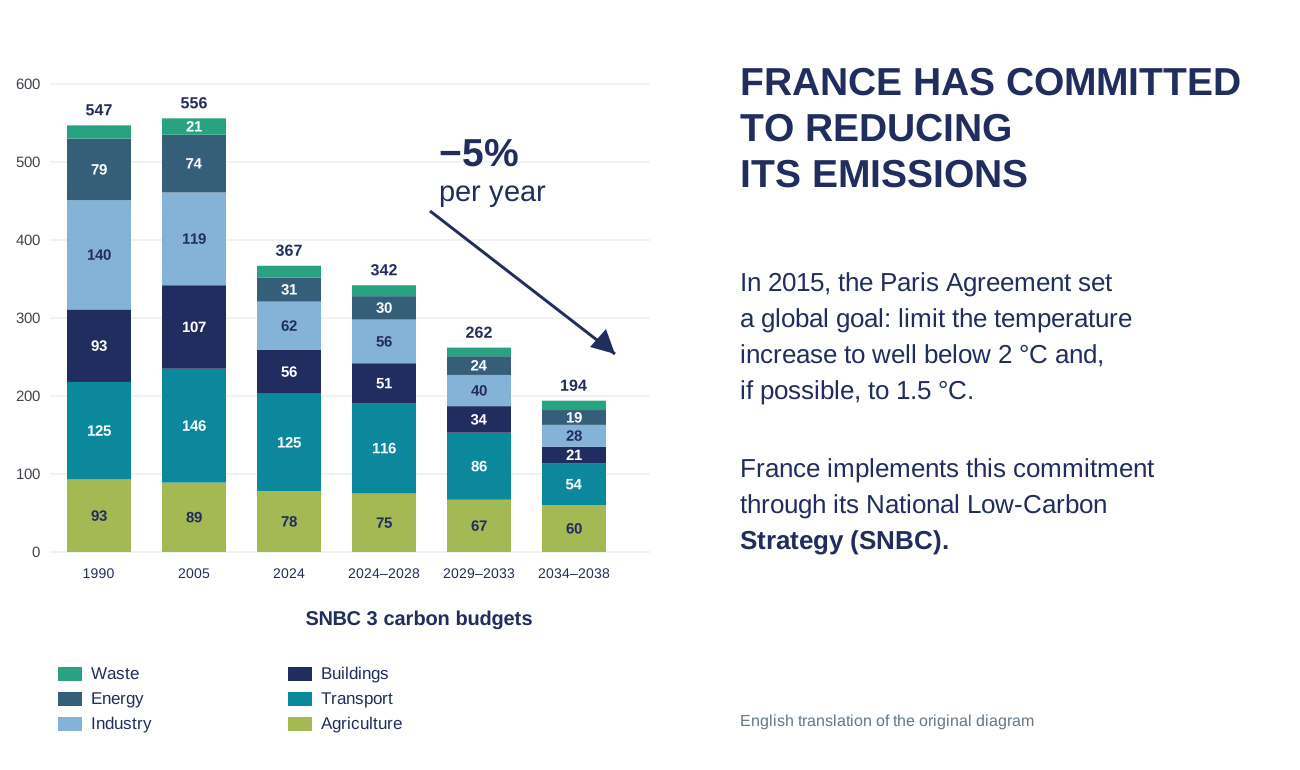
The decree then breaks these budgets down by area of activity. Transport falls from 125 Mt in 2024 to 116, 86, then 54 Mt. Buildings fall from 56 to 51, 34, then 21. Industry falls from 62 to 56, 40, then 28 Mt, a 55% reduction over about ten years. Agriculture, by contrast, falls only from 78 to 60 Mt over the same period: the effort is very unevenly distributed, and this is strategic information for anyone wanting to anticipate where the next regulations will land.
What "excluding carbon sinks" means
All these figures carry the same qualification: they are set excluding carbon sinks, meaning without counting absorption by forests and soils (the LULUCF sector) or technological capture. The decree assigns these a separate ceiling in Article 10, and this ceiling plans for deterioration: from -52 Mt CO2e absorbed in 2024, France's natural sink is expected to reach -33 Mt on average over 2029-2033. The decree incorporates forest dieback into planning.
A word about the figure everyone remembers: the decree never says "-50%". It sets an annual pathway passing through 276 Mt in 2030, against a 1990 reference of 547 Mt given in the same text. That makes -49.5%. The difference is small, and no one will criticise a ministry for rounding. But in a report or presentation to the executive committee, the figure in the text is preferable to the one in the press release.
2SNBC is binding on the State, rather than businesses
Most press coverage skipped this point, although it appears in the decree's explanatory notice, even before its first article. The notice identifies those concerned:
Parties concerned: State; local authorities and their groupings; public-law legal entities; economic sectors.
Businesses are not listed, except through the collective, non-binding wording "economic sectors". The legal mechanism is consistent with this list. Article L. 222-1 B of the Environmental Code requires the State, local authorities and their public establishments to take the strategy into account in their planning documents: urban planning documents, regional plans, territorial climate plans.
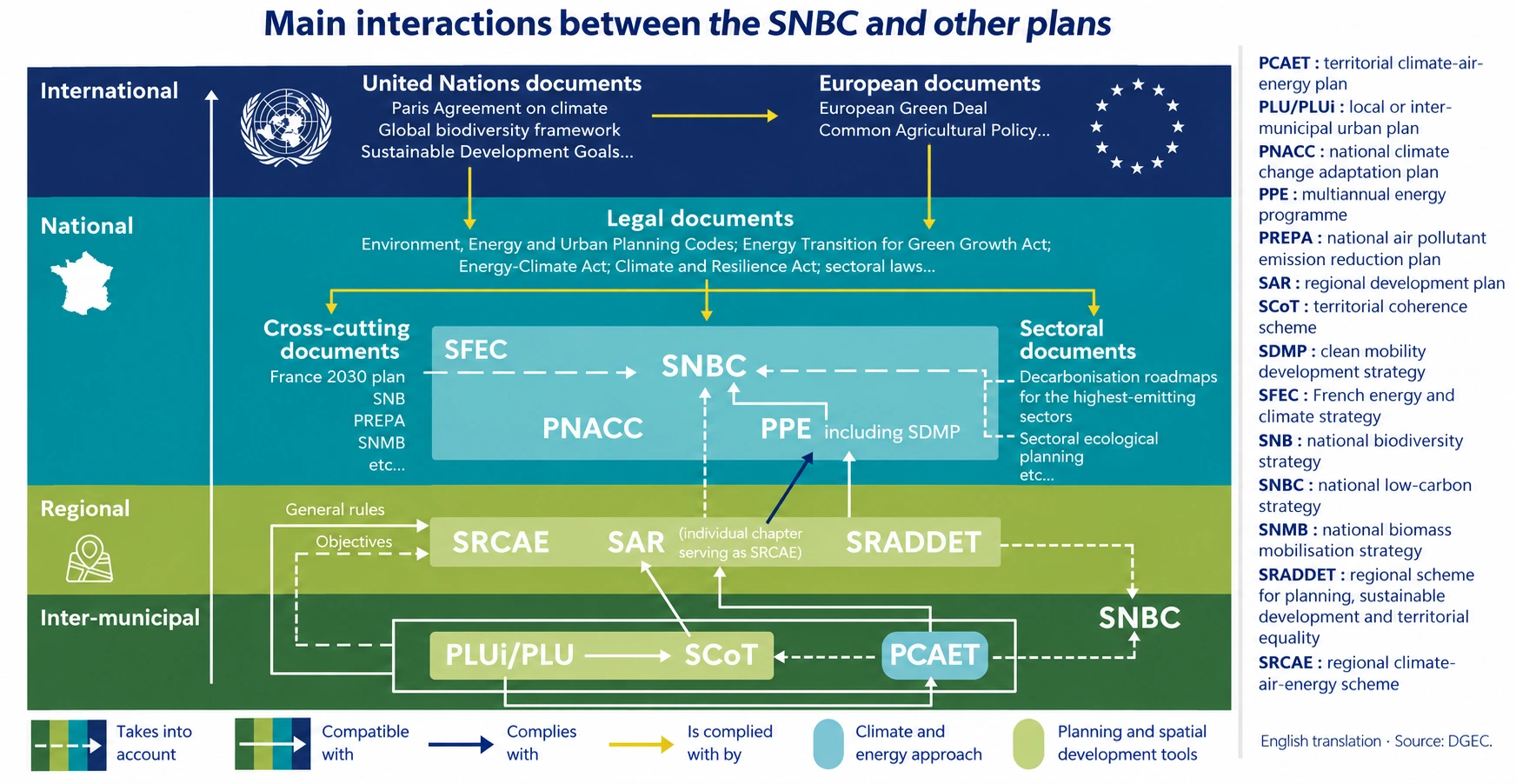
This requirement has force, but it targets the State. In the Commune de Grande-Synthe case, the Conseil d'État ruled in 2020 and then 2021 that reduction targets bind the State to results, and ordered it to take additional measures to meet its pathway. SNBC is therefore an instrument that can be invoked in law, and it operates against public authorities, rather than private parties.
The exact position at the publication date of this article: no text requires a French business to adopt a pathway compatible with SNBC. Other existing requirements, such as mandatory BEGES reporting for businesses with more than 500 employees, arise from other provisions and did not change on 16 July.
3The 4 channels through which it nevertheless reaches businesses
A strategy with no effect on economic operators would be of little interest. The effects exist; they simply pass through texts that do impose obligations. Three of these channels have a firm date.
Public procurement, since 22 August 2026
Under Article 35 of the Climate and Resilience Act of 22 August 2021, every procurement procedure launched since 22 August 2026 must include an award criterion incorporating the environmental characteristics of the tender, together with an environmental clause in the contract's performance conditions. The practical factsheet from Bercy's Legal Affairs Directorate explains that price as the sole criterion consequently becomes prohibited, unless an overall cost incorporating the environment is used. This is the most tangible channel for a business.
For an SME bidding for public contracts, particularly those undertaking a decarbonisation assessment, this changes the nature of the competition: the carbon footprint becomes a component of the score. What earns points and what the DAJ excludes are covered in our guide to the environmental criterion in public procurement. It is also the fastest channel.
The 4 channels through which SNBC reaches a business
The strategy is binding only on public authorities. It affects private parties through 4 routes, 3 of which have a firm date. Select a channel.
Award criterion incorporating the tender's environmental characteristics and environmental performance clauses, mandatory for every procurement procedure launched from this date. Article 35 of the Climate and Resilience Act, Decree No 2022-767.
European regimes translating the pathway into a price
The European carbon market sets a declining, payable ceiling for the installations it covers. The carbon border adjustment mechanism entered its definitive regime on 1 January 2026, with the first certificate surrender on 30 September 2027 and certificate sales starting only on 1 February 2027: the actual CBAM timetable for manufacturers is later than many remember. RE2020 and the carbon footprint of new buildings follow the same logic of sectoral translation. The second carbon market, covering buildings and road transport, has been postponed to 2028.
Finance and purchasing organisations
SNBC 3 quantifies the additional investment needed at around 80 billion euros per year by 2030 compared with 2024, across all participants, and announces consideration of stronger environmental conditions on funding. These environmental conditions are not yet a rule. In practice, schemes already financing decarbonisation require a methodological counterpart: Diag Décarbon'Action requires a complete assessment, and transition funding almost always relies on a quantified action plan.
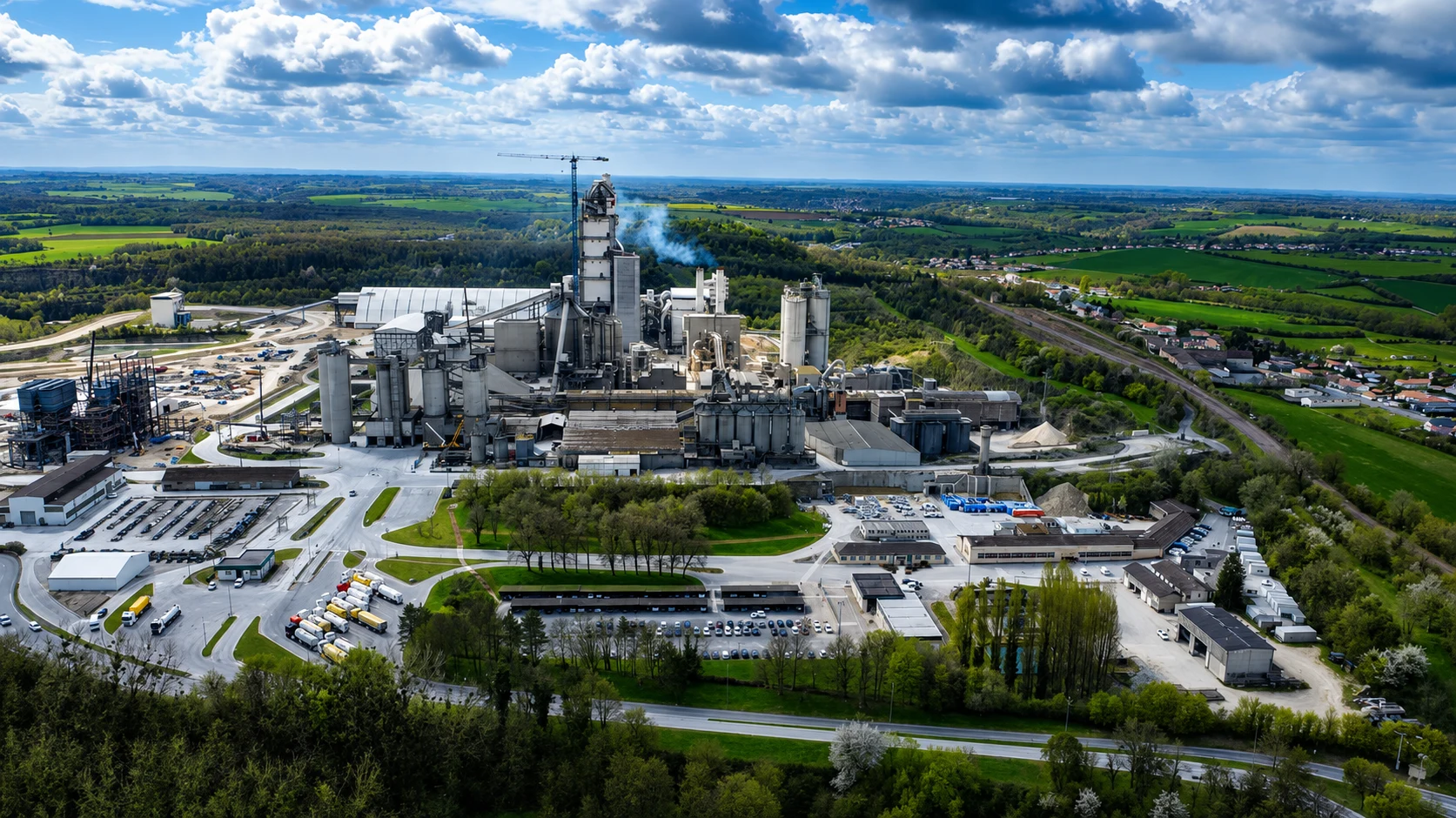
The scale of this support can be seen in major projects. The Airvault cement works in Deux-Sèvres commissioned a new kiln line in May 2026 representing 285 million euros, with support from France Relance and the Nouvelle-Aquitaine Region, for a carbon footprint reduced by 27% per tonne of cement. Few SMEs operate at this scale.
The fourth channel remains: the value chain. Companies subject to the CSRD publish their indirect emissions, and therefore question their suppliers. Following the Omnibus revision, the directive's scope is narrowed to companies with more than 1,000 employees and 450 million euros in turnover, taking most SMEs out of reporting scope without taking them out of customer questionnaires. From this perspective, the link between Bilan Carbone® and the CSRD remains the most frequent issue among clients.
4Paying for carbon or awaiting regulation: the 2 regimes
Article 4 is the decree's most concrete contribution for a business, and the least discussed. Previous SNBC versions divided carbon budgets by economic sector. This one adds a second breakdown, by European regulatory regime, in three lines sufficient to locate any industrial site.
The 2 carbon regimes, and what they change in practice
The decree divides carbon budgets according to the European regime each installation falls under. This line, rather than the business sector, determines whether a company pays for its carbon today or anticipates it for tomorrow.
Cement works, steelworks, glassworks, refineries, paper mills, large boiler plants. Around 1,200 sites in France.
You pay for each tonne emitted at the market price. The European ceiling falls every year, whatever France decides. The pathway appears directly in the profit and loss account.
Industrial SMEs, food, transport, buildings, agriculture, waste. The vast majority of businesses.
You pay nothing for carbon today. The State bears the target and passes it on through sectoral regulations, energy taxation and product standards.
Domestic civil aviation has a third line, at 4 Mt CO2e per year until 2033, then 3 Mt. A single group can fall under the 2 regimes: a cement works under allowances and its lorry fleet outside the system.
Fixed installations covered by the European emissions trading system (the ETS, around 1,200 sites in France) have 60 Mt CO2e per year over 2024-2028, then 45, then 33. Everything else, transport, buildings, agriculture, waste and industry outside the system, falls under the European Effort Sharing Regulation (ESR): 278 Mt per year, then 214, then 158. Domestic civil aviation completes the picture with 4 Mt.
Under the ETS, the constraint is quantitative, European and payable: an allowance, a price, a bill. Under the ESR, the constraint falls on the French State, which must achieve -47.5% in 2030 compared with 2005, and reaches businesses through sectoral regulations, energy taxation or product standards. In the first case, the business has a bill and a meter. In the second, it has deadlines arriving through regulation, often with two or three years' notice. Knowing what a Bilan Carbone® measures remains the prerequisite in both cases.
The decree also provides a yardstick manufacturers were missing. Industry must fall from 62 Mt in 2024 to 56 Mt over 2024-2028, then 40 Mt over 2029-2033, or around -4.5% per year by 2030. A company reducing emissions by 2% per year is behind its own sector, and can now check this against a source published in the Official Journal rather than a consultancy's benchmark. This is a figure to know before building a reduction pathway and commissioning the Bilan Carbone® of a production site.
The scale deserves comparison with the most widespread private standard. An SBTi pathway aligned with 1.5 °C, using an absolute approach, requires -4.2% per year on scopes 1 and 2. The two rates converge, which is reassuring, but their scopes differ: SBTi reasons by company and incorporates the value chain; SNBC reasons by territory and sector. An SBTi-aligned company is not automatically "SNBC-aligned", and the reverse is equally false.
5A carbon budget for imports: a world first
The decree's other innovation is a legal object that existed nowhere. Article 8 sets carbon budgets in terms of the consumption footprint, meaning it counts emissions generated abroad to produce what France imports. France is the first country to include such a target in a regulatory text.
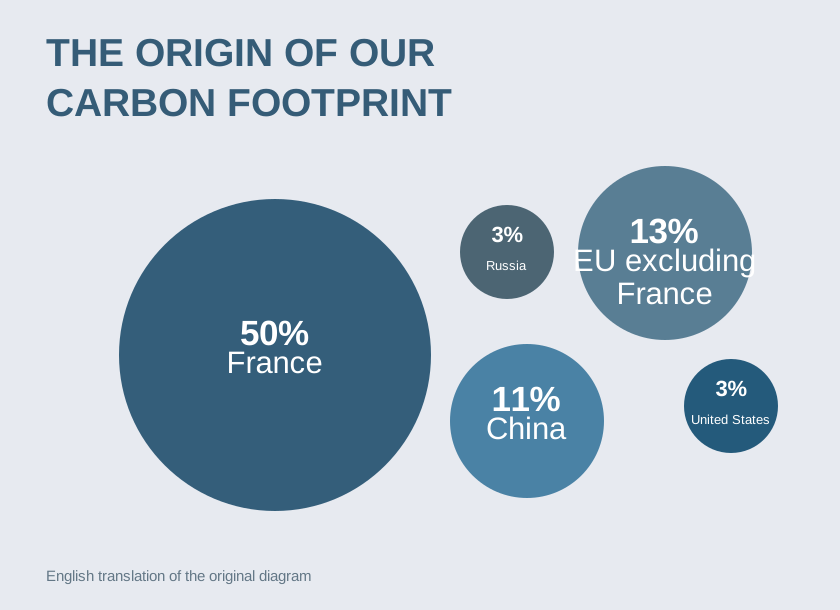
The values are expressed as ranges, which is itself a useful acknowledgement: 516 to 531 Mt CO2e per year over 2024-2028, 408 to 446 over 2029-2033, 312 to 358 over 2034-2038. The decree justifies this imprecision through "sensitivity to the international context", meaning that part of the target depends on foreign suppliers' decarbonisation rather than France's domestic policy.
The accompanying table contains the figure every purchasing manager should find relevant: imported emissions represent 284 Mt CO2e in 2024, or 50.4% of France's carbon footprint of 563 Mt. The decree assigns them a target of 148 to 194 Mt over 2034-2038. It also corrects a reference point still widely circulated: France's footprint is 1.53 times its territorial emissions, rather than 2 times. The ratio of 2 belonged to a methodology that has since been revised.
For a business, this is the first public signal about what carbon accounting calls scope 3. The State puts into a decree that half the national impact occurs beyond its borders, and the accompanying directions are explicit about the means envisaged: strengthening the border adjustment mechanism, eco-design, reindustrialisation. The question of whether scope 3 is mandatory will not remain in this form for long.
6Key takeaways
- Decree No 2026-636 of 16 July 2026 sets 3 carbon budgets: 342, 262, then 194 Mt CO2e per year until 2038, excluding carbon sinks.
- No new obligation falls on businesses. The decree's explanatory notice identifies the State, local authorities, public-law legal entities and economic sectors.
- The knock-on effects have dates: mandatory environmental criterion in public procurement on 22 August 2026, CBAM surrender on 30 September 2027, second carbon market in 2028.
- Article 4 maps the regimes: 60 Mt per year under the European carbon market, 278 Mt under effort sharing. This line determines the nature of your constraint.
- Industry must maintain around -4.5% per year by 2030, a rate close to the -4.2% of a 1.5 °C SBTi pathway, but over a different scope.
Its adaptation counterpart is the 3rd National Adaptation Plan, for which we have identified what actually obliges a business: one sets the pace of emission reductions, the other organises preparation for effects already under way.
SNBC 3 is not another regulation to comply with. It is the framework within which the next ten years' sectoral regulations will be written, and the first public document giving the expected pace sector by sector and year by year. A business can locate its own reduction pathway within it before committing investment. If carbon neutrality comes up in internal discussions, carbon orders of magnitude are a better starting point than national targets.
- Légifrance, Official Journal No 0166 of 18 July 2026 · Decree No 2026-636 of 16 July 2026 on national carbon budgets and the National Low-Carbon Strategy ↗
- Ministry of Ecological Transition · National Low-Carbon Strategy: France's climate roadmap ↗
- High Council on Climate, 12 March 2026 · Opinion on the draft third National Low-Carbon Strategy ↗
- Citepa, June 2026 · Secten Report, 2026 edition: greenhouse gas emissions inventory ↗
- EUR-Lex · Regulation (EU) 2021/1119 establishing the framework for achieving climate neutrality ↗