

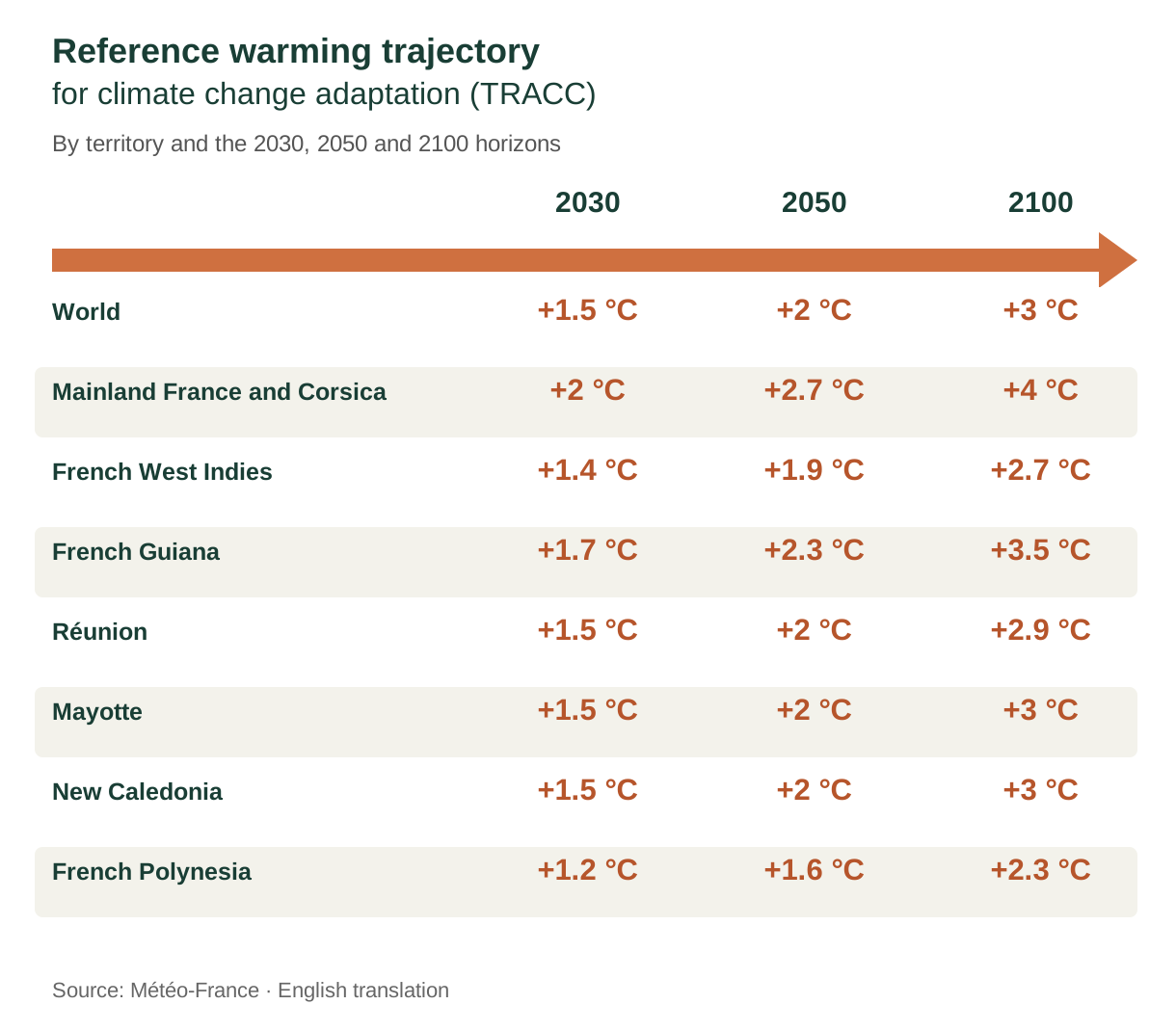
- 1France bases its adaptation on a quantified trajectory reaching +4 °C in 2100.
- 2The only obligation in force for an SME is the heat decree of 27 May 2025.
- 3The plan intends to make adaptation a condition for access to public funding and short-time working, with no implementing legislation to date.
- 4A business's starting point: a physical exposure assessment, site by site.
Adaptation to climate change has long taken second place to mitigation and its emission reduction targets set by the national low-carbon strategy. The 3rd National Climate Change Adaptation Plan, published on 10 March 2025, is an attempt to close this gap. It organises the country's preparation for warming of +4 °C in 2100 in metropolitan France.
Ten months between the plan and the decree underpinning it
The third national adaptation plan was published in March 2025. The reference warming trajectory underpinning it only became enforceable in January 2026.
For an SME director or QSE manager, three categories matter: what is mandatory, what makes funding conditional and what remains an incentive. Across PNACC 3's 52 measures, these categories do not overlap, and the most binding of the three does not feature in the plan.
The plan's structure and the climate trajectory underpinning it come first.
15 areas and 52 measures: what PNACC 3 contains
France is on its third adaptation plan, following those of 2011 and 2018-2022. The third changes scale: for the first time it is based on a quantified warming trajectory, the TRACC, preparing mainland France for +2 °C in 2030, +2.7 °C in 2050 and +4 °C in 2100 compared with the pre-industrial period, above the global average because continents warm faster than the ocean. Since Decree No 2026-23 of 23 January 2026, this trajectory has been written into the Environmental Code and is gradually becoming binding on impact assessments, natural risk prevention policies and infrastructure standards. We used it to calculate the exposure of France's 35,191 municipalities by 2050.
What each area covers
- Area 1, protecting the population. Weather alerts, crisis management, health, housing. Flagship measure: strengthening the Barnier Fund for natural risk prevention.
- Area 2, resilience of territories, infrastructure and essential services. Incorporating the official trajectory into planning documents, networks and service continuity.
- Area 3, adapting human activities. The area concerning businesses, agriculture, tourism and the timber sector.
- Area 4, protecting natural and cultural heritage. Forests, water, biodiversity, heritage sites.
- Area 5, mobilising the nation's active forces. Training, research, finance, cooperation.
The action count varies across official documents, from "more than 200" in March 2025 to 341 sub-actions in the June 2026 review. The number of measures, however, does not change: 52.
2The area 3 measures aimed at businesses
Area 3 of the plan brings together measures 33 to 41. Three concern non-agricultural businesses, three others agricultural and forestry sectors, the final two tools and data, and only one creates an obligation, restricted to a narrow scope. Measures 34 and 35, discussed below, use financial incentives.
Three regimes depending on size and sector
The plan does not treat every business the same way. Three regimes coexist, from direct obligations to voluntary support.
What is mandatory
Large energy and transport groups, operators of vital importance
- Vulnerability study, deadline end of 2024
- Adaptation plan, 2025
What makes funding conditional
Any business applying for public funding
- Review of ADEME, France 2030 and Bpifrance schemes, 2026
- Short-time working conditional on an adaptation commitment
- Tourism investments aligned with mountain range plans, 2027
What encourages
SMEs and microbusinesses
- ADEME and Bpifrance support
- Business ecological transition platform
- Amounts "to be defined from 2027"
The plan currently imposes no direct obligation on SMEs. The actual constraint is financial before it is regulatory.
Measure 33: vulnerability study and adaptation plan
The plan distinguishes three groups. Large energy and transport groups were to complete a vulnerability study by the end of 2024, a deadline already passed when the plan was published, then an adaptation plan in 2025. Operators of vital importance fall under European Directive 2022/2557 on the resilience of critical entities. All other businesses are encouraged to adopt a plan, with ADEME and Bpifrance support.
The planned monitoring indicator is the share of target businesses with a study and a plan. These 2024 and 2025 milestones are behind us, and none of the official publications consulted gives this rate. As for the measure's resources, the factsheet lists amounts "to be defined from 2027".
Measures 36 to 38: agriculture, agri-food and forestry
Agricultural and agri-food sectors are preparing adaptation roadmaps with a mandatory water component. Since 2023, crop insurance has been based on a three-tier scheme, and animal transport is subject to mandatory restrictions during heatwaves. The timber sector works over a longer horizon, through to 2100, because of forestry cycles.
Measure 41: making climate data available
This measure, led by the Directorate General of the Treasury, Banque de France and DGEC, plans to provide businesses with the climate tools and data needed for their risk analyses. It is the logical counterpart to reporting obligations: documenting physical risk by site requires usable projections at a finer scale than the region.
3The obligation already applying is the heat decree
For an industrial SME, a hospital or a construction business, the most tangible regulatory constraint in 2026 is outside the adaptation plan. It is in the Labour Code.
What the employer must do, by alert level
Obligations accumulate: each step adds to the previous ones, up to suspension of work.
Permanent baseline
Heat risk assessment indoors and outdoors. Cool drinking water near workstations, at least 3 litres per day per worker on construction sites. Employee training.
Yellow and orange alerts
Suitable prevention measures: changes to processes, moving workstations to cooler areas, adjusting working hours, shading and insulation, protective equipment.
Red alert
Daily risk reassessment. Mandatory suspension of work if measures are insufficient, for physical work at high temperatures.
The heat decree of 27 May 2025
Decree No 2025-482 of 27 May 2025, which entered into force on 1 July 2025, creates Articles R. 4463-1 to R. 4463-8 of the Labour Code. It requires a heat risk assessment, indoors and outdoors, linked to Météo-France's alert thresholds. When the response involves cooling equipment, the regulatory timetable for refrigerants constrains the choice of equipment.

- Prevention measures to implement: changes to processes, moving workstations to cooler areas, adjusting working hours, shading and insulation, suitable protective equipment, employee training.
- Cool drinking water near workstations, with a minimum of 3 litres per day per worker on construction sites.
- Under a red alert: daily risk reassessment and mandatory suspension of work if measures taken are insufficient to protect employees carrying out physical work at high temperatures.
- Prohibition on exposing under-18s to extreme temperatures.
This legislation is enforced by the labour inspectorate, whereas measure 33 merely encourages SMEs to adopt an adaptation plan.
Any site whose activity involves physical work or poorly insulated premises falls within the decree's scope. Future heat exposure becomes a compliance parameter, and using air conditioning is not the only response: passive and low-energy cooling solutions fall among the measures listed in the decree, which mentions shading, insulation and moving workstations.
The heat decree is enforced by the labour inspectorate, while the plan merely encourages SMEs to adopt an adaptation plan.
4The plan seeks to make public money conditional on adaptation

Measure 34: reviewing funding schemes
This measure does not take the form of an obligation. Measure 34 plans a review of ADEME, France 2030 and Bpifrance schemes to incorporate adaptation, with an assessment expected by the end of 2025 and changes from 2026. Regions are invited to do the same for their own funding.
Above all, the same measure plans to make short-time working conditional on a business commitment to adaptation, with a deadline in the second quarter of 2025. Access to an employment support scheme would therefore depend on documented adaptation work. That deadline has passed and no implementing legislation has been published to date, which also applies to the assessment of funding schemes expected by the end of 2025.
This approach directly concerns businesses already using public funding for the transition, whether Diag Décarbon'Action or regional schemes. An application documenting a complete climate trajectory, mitigation and adaptation, starts with an advantage over one addressing emissions alone. Public funding to watch: budgets for the two main adaptation funds, the Green Fund and Barnier Fund, fall in the 2026 budget, increasing competition between applications and making the initial assessment all the more decisive.
The plan intends to make tourism investments conditional in 2027
Measure 35 goes further for one sector. Mountain range authorities are drawing up strategic adaptation plans under the 2021 Climate Act, and the plan intends to make tourism investments conditional on alignment with these plans in 2027. The associated vulnerability observatory has €300,000 over 3 years.
5Where a physical exposure assessment starts

Public data are enough for the first pass
An initial exposure assessment requires no proprietary data. Localised climate projections are public on the DRIAS portals; impacts on water resources are available through the Explore2 project, completed in 2024, which projects summer flows falling by around 30% by the end of the century and the proportion of dry watercourses rising from 15% to 25%. Risk zoning is available on Géorisques.
Météo-France provides ClimaDiag Commune, a free service producing a summary of around ten pages per municipality across the three TRACC horizons, covering climate, natural risks, health, agriculture and tourism. It is the least costly starting point for a given site, and our municipality exposure map helps locate it among metropolitan France's 35,191 municipalities.
A physical exposure assessment is scoped like a carbon assessment for an industrial SME, with costs comparable in scale to those of a Bilan Carbone®. Public funding can still be combined, and measure 34 of the plan points towards better funding for this type of work. For a healthcare establishment, the approach connects with a hospital climate strategy, where continuity of care during heatwaves is already an operational issue.
Exposure is assessed at the address
Heat and cooling capacity, water stress for processes, flood exposure for stocks and insurability: these parameters vary between municipalities and sometimes between neighbourhoods. This is the same level of detail as a Bilan Carbone® for an industrial site, with the same data collection challenges.
The reasoning extends along the value chain. A sole supplier based in a municipality highly exposed to fires or low river flows affects business continuity, and this exposure can be mapped like scope 3 emissions.
The connection to CSRD and Bilan Carbone®
Businesses still subject to CSRD after Omnibus must document their physical risks by site and time horizon. TRACC becomes the common reference for these analyses in France, and how this connects to Bilan Carbone® is teams' first question. The two exercises measure different things: one concerns what the business emits, the other what it experiences.
6Key takeaways
- PNACC 3 has 52 measures in 5 areas, published on 10 March 2025, with 18 ministries involved. The number of actions varies across documents; the number of measures does not.
- The trajectory underpinning it has been in the Environmental Code since 23 January 2026, without being automatically enforceable. It becomes binding as planning documents, impact assessments and sector standards are revised.
- The plan imposes no direct obligation on SMEs. The binding obligation targets large energy and transport groups and operators of vital importance.
- The legislation actually constraining an SME is the heat decree of 27 May 2025, applying since 1 July 2025, with 4,500 inspections in the first year.
- The main measure is financial. The plan intends to make public funding, short-time working and, for mountain tourism, public investment support from 2027 conditional on adaptation, with no implementing legislation to date.
- Resources do not match the announcements. Green Fund from 2.5 billion in 2024 to 650 million in commitments in 2026, Barnier Fund from 300 to 287.4 million.
A business wanting to address the issue in the right order starts with its physical exposure, site by site, using publicly available free data. It then identifies the consequences for asset sizing, supply chain continuity and reporting obligations. To understand how a territory undertakes the same work at its own scale, we have described the method and available tools.
- Ministry for the Ecological Transition · 3rd National Climate Change Adaptation Plan ↗
- Ministry for the Ecological Transition · Warming trajectory written into the Environmental Code, Decree No 2026-23 of 23 January 2026 ↗
- Ministry for the Ecological Transition · PNACC 3 area 3 factsheets, measures 33 to 41 ↗
- INRS · Applicable regulations for heat at work, Decree No 2025-482 of 27 May 2025 ↗
- High Council on Climate · Opinion on the 3rd National Adaptation Plan, March 2025 ↗
- High Council on Climate · 2026 annual report, Climate dangers: France facing its responsibilities ↗
- Senate · Report on the 2026 Finance Bill, Ecology mission ↗
- Ministry for the Ecological Transition · PNACC 3 review one year on, press kit of 17 June 2026 ↗
- CESE · Anticipating and preventing climate change risks, opinion of 13 January 2026 ↗
- Ministry for the Ecological Transition · Regulatory adaptation framework, PCAET and planning documents ↗