
- 1Three routes break through the €15,000 to €20,000 barrier: Diag, simplified study, in-house training.
- 2Bpifrance Diag: €5,400 to €7,200 payable under a regulated public fixed fee.
- 3In-house training becomes worthwhile as soon as several LCAs are planned for a stable range.
- 4Ask for the quote's person-day breakdown before signing: this is the opportunity.
Before looking at the routes individually, you need to see the balance. On one side, the market price of a consultancy LCA; on the other, what you can aim for through funding, simplification or bringing it in-house. The gap is far greater than most business leaders imagine.
Which route to choose to get started with LCA?
Click a route to compare price, ideal use, strength and limitation.
Diag Éco-conception
Three routes, three distinct economic principles - and three use cases that do not quite overlap. The rest of the guide details each; this overview provides a map to identify which you naturally lean towards.
1What really determines the price of an LCA
A consultancy charging for an LCA is not selling software. It is selling expert time. The billing basis is the person-day: between €600 and €1,200 excl. VAT for a senior consultant, between €1,200 and €2,400 excl. VAT for a scarce expert. A complete LCA takes 10 to 40 days over 2 to 6 months. Everything else follows from this.
In an LCA at €20,000, who gets what
Five categories, very unequal shares. Software is never the issue.
- Data collection€12,000~ 18 days
- Modelling and calculations€3,000~ 4 days
- Initial scoping€2,000~ 3 days
- Analysis and writing€2,000~ 3 days
- Critical review*€1,000~ 2 days
Five factors change the number of days, and therefore the final bill:
- Product boundaries. An electronic product with 150 components is not a tube of mayonnaise. The more materials, processes and life cycle stages to model, the longer the mapping takes. This is the parameter that sets the initial order of magnitude
- Supplier data availability. This is the category that makes budgets balloon. Collecting primary data (energy consumption, formulation recipes, building FDES) accounts for 60 to 80% of engagement time. A supplier who does not reply means a day reconstructing data using sector averages - and a loss of precision to accept
- The number of indicators. A single-criterion carbon footprint (one indicator, greenhouse gases) is completed much faster than a PEF LCA covering the 16 European indicators. A single criterion is enough to decide on a material choice. Multiple criteria become unavoidable when seeking environmental labelling, calculated using Ecobalyse
- The methodological framework. A generic ISO 14040 LCA leaves substantial latitude. An LCA compliant with a sector PEFCR (cosmetics, textiles, food) imposes a detailed framework that reduces downstream collection but requires more upstream discipline. Slightly more expensive at first, it saves time afterwards
- The labelling objective. An internal diagnostic to manage ecodesign does not require a critical review. Public communication or a tender with environmental criteria requires one (ISO 14071): 2 to 5 days from an independent external expert, at a minimum of €1,200 excl. VAT per day. This factor alone can add €5,000 excl. VAT to a quote
Before signing anything, keep this framework in mind. An LCA at €25,000 excl. VAT typically breaks down into 4-6 days of scoping, 15-20 days of collection and modelling, 3-5 days of analysis and writing, and 2-5 days of review. Each column offers room for negotiation - and this is precisely what opens up the following three low-budget routes.
2The three ways to reduce the budget
Once you understand what determines the price, three routes emerge to lower it. Each acts on a different column of the bill, and each has its appropriate use case.
- Co-fund the study with a public grant - the headline price remains high, but the amount payable becomes accessible
- Deliberately simplify the study - fewer indicators, tight boundaries, explicitly accepted secondary data
- Bring the expertise in-house by training someone in your organisation - external costs disappear after the first study, and LCA principles enter everyday product work
These three routes do not compete. The most effective companies combine two over 12 to 24 months: typically an initial study through the Bpifrance Diag to define the method, then in-house training to carry out subsequent studies without making the budget balloon again. We look at each in detail. The LCA training co-delivered by Celsius at IFC.D notably lets you practise OpenLCA on guided cases before applying the method to your projects.
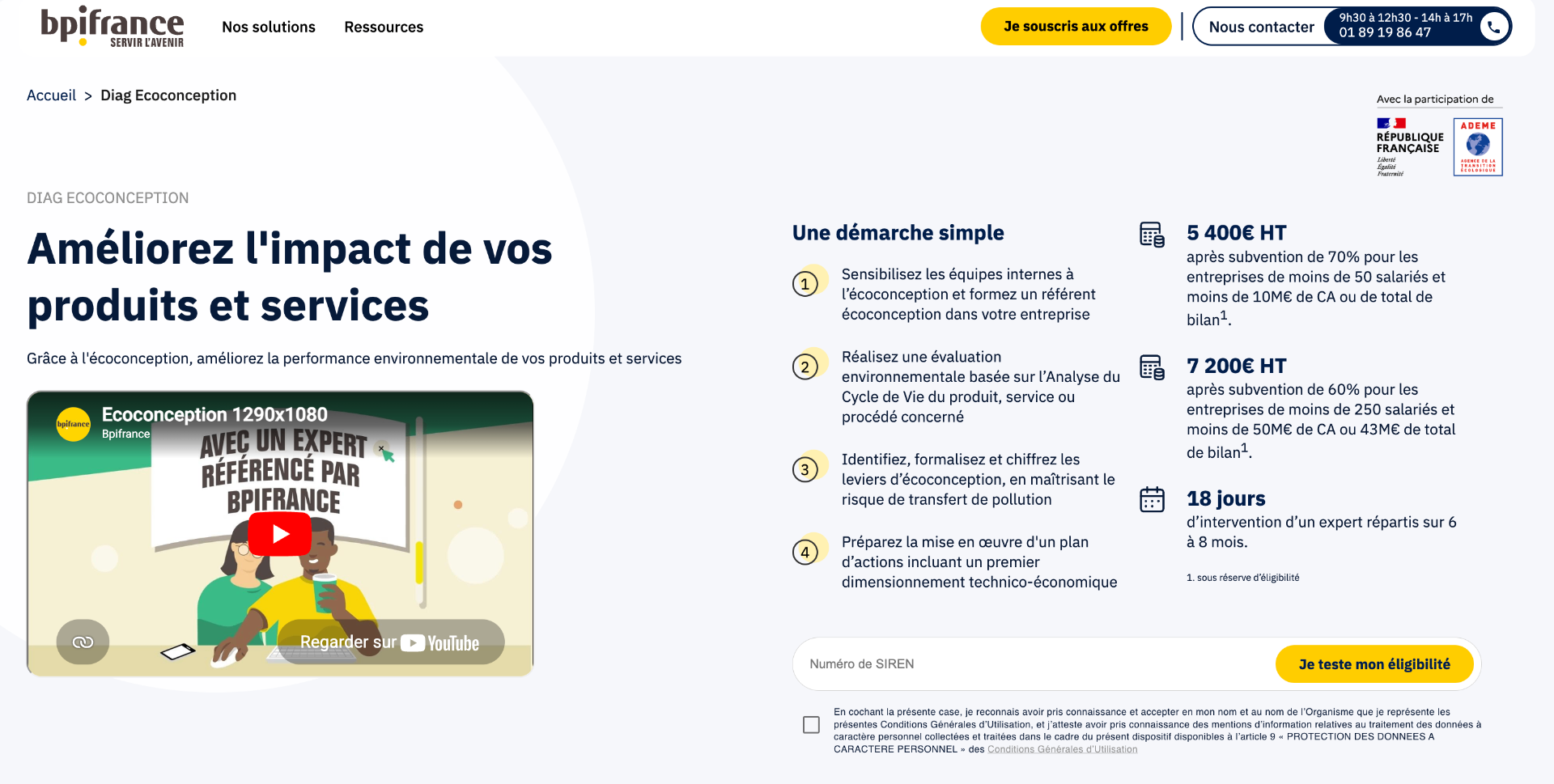
The programme's official Bpifrance page. Total cost €18,000 excl. VAT, subsidised at 70% for companies with fewer than 50 employees (€5,400 excl. VAT payable) and at 60% for 50 to 249 employees (€7,200 excl. VAT). 18 days of work by a listed expert, spread over 10 months. This is the most structured route for an initial product LCA.
3Option 1 - Bpifrance Diag Éco-conception
This is the best-known and most structured option for a French industrial SME in 2026. Diag Éco-conception is co-funded by ADEME and Bpifrance, delivered by experts listed by Pôle Éco-conception.
The total service cost is fixed at €18,000 excl. VAT, subsidised at 60-70% depending on company size:
- Micro-businesses and small companies (fewer than 50 employees, turnover below €10 million): €5,400 excl. VAT payable (70% grant)
- SMEs (50 to 249 employees, turnover below €50 million): €7,200 excl. VAT payable (60% grant)
What the Diag includes: LCA screening of a product (or limited range), an ecodesign workshop to identify improvement opportunities, and a prioritised action plan. The planned duration is 10 months (18 service days), with a deliverable usable internally to guide product decisions. For a structured first step, this is exactly what is needed - no more, no less.
What it does not cover: a complete ISO 14040/14044 LCA, public or regulatory communication (no critical review), and product-to-product comparison for labelling. It is an entry route, not an environmental labelling deliverable.
Check eligibility beforehand: a company with fewer than 250 employees, including micro-enterprises, in any sector, with at least 1 year of activity and less than €50 million in turnover or €43 million on the balance sheet. The Diag can be combined with Diag Décarbon'Action for the Bilan Carbone® component.
When to choose it: first LCA, no internal expertise available yet, a need for a structured framework and a deliverable that stands up before the executive committee.
4Option 2 - Simplify the study: one criterion, tight boundaries, online tools
When you are not eligible for the Diag, or only want initial quick mapping, you can act on two variables simultaneously: reduce the number of indicators and tighten the boundaries.
A single-criterion carbon LCA of one product, with one use scenario and secondary data (Ecoinvent databases, ADEME Base Empreinte), comes to between €3,000 and €8,000 excl. VAT through a consultancy. It is more than sufficient to identify a product's largest categories ("where is the carbon footprint concentrated?"), decide on a material choice or inform an internal commercial argument. It is insufficient for public communication, regulatory labelling or a tender with multi-criteria environmental requirements.
In addition, several online tools are available to support this simplified work - without replacing methodological expertise when the study must stand up before a third party:
- Ecobalyse: public tool developed by the State and ADEME, open-source, based on the 16 PEF categories with its own weighting and additions. Free. Current coverage: textiles (voluntary labelling, publishable without the brand's agreement since 1 October 2026), food (voluntary method stabilised in May 2026), furniture undergoing trials. Useful for a covered sector, not extendable at the company's discretion
- ADEME Bilan Produit®: free online tool backed by Base Empreinte. Enables a simplified multi-criteria LCA for an initial estimate. Widely used in teaching and training. Not for a critical review or external publication, but excellent for an initial overview
- OpenLCA: open-source software (GreenDelta), free, compatible with Ecoinvent and Base Empreinte databases. Maximum flexibility. Requires sound in-house expertise, which brings us to the third option
- Simplified SaaS (Carbo Produit and equivalents): paid solutions starting at €150-€300 per month, simplified interfaces, quick initial results. Useful for getting to grips with the process. Accepted methodological limitations: not for a critical review
Remember: these tools are not an independent route. They support the "simplification" option. They become more powerful when used by someone trained in the method - precisely the purpose of the next option.
5Option 3 - Train an engineer in-house to become independent
This option is the least visible initially, and by far the most worthwhile over the medium term. It rests on a simple observation: an LCA is two distinct things put together. A method, and product data.
For the price of one outsourced LCA, you carry out four in-house
With training, break-even comes with the second LCA. Beyond that, each marginal study costs two times less.
The method can be learnt. LCA is governed by ISO 14040 and 14044, establishes a functional unit approach, and requires mastery of database interpretation (Ecoinvent, Base Empreinte) and a tool (Bilan Produit, OpenLCA or SimaPro at professional level). Two days of qualifying training are enough to cover that column, provided the trainee has structured reasoning - typically a product engineer, R&D manager or quality project manager.
The product data are already in your organisation. The engineer managing your development knows the formulation recipes, sourced components, manufacturing processes, critical suppliers and actual use scenarios. However expert an external consultant is in LCA, they spend several days reconstructing this map through calls, emails and technical data sheets. Your engineer has had it in mind for three years.
Training someone who already has the data in the method costs less than paying an expert to acquire data you already have. The principle is simple; the figures confirm it.
Qualifying LCA training costs between €1,450 and €1,800 excl. VAT per person (2-day format, in person or remotely, with support from a senior practitioner). Compared with €15,000-€20,000 excl. VAT per outsourced LCA, the cost of this route mainly lies in the trained engineer's time, and the investment pays off as soon as several studies are planned. For a range of 5 to 10 products to map during the year, the company gains lasting expertise, rather than a report ageing on a shelf.
The other benefit is less quantifiable but probably more important in the long term: LCA principles enter everyday product work. The trained engineer does more than churn out LCAs. They decide on a material choice while the design is taking shape, rather than six months later in an end-of-project report. Ecodesign becomes a design habit, rather than a compliance deliverable.
This route does not suit every profile. A company without a dedicated product engineer (a business leader alone, mainly commercial teams) lacks the foundation to make training worthwhile. A rapidly changing range (fast collections, short-lived products) recoups the expertise less effectively than a stable range. And for cases requiring an ISO 14071 critical review - a published comparative claim, a public tender with multi-criteria requirements - occasional outsourcing remains recommended. Only for these specific cases, rather than as a default habit.
6What does not replace an LCA: automatic scoring
A necessary clarification before concluding. Several commercial tools offer a "free LCA" or one "automated in 3 clicks from the product name". It is not an LCA.
These tools provide environmental scoring built on proprietary databases, often opaque about their assumptions. They do not comply with ISO 14040/14044, do not clearly distinguish primary from secondary data, and will withstand neither a technical auditor, a demanding industrial client nor regulatory environmental labelling. Scoring can be useful to raise awareness within a team or provide an order of magnitude - it does not serve as an LCA when communication or compliance is at stake.
If it is free and instant, it is not an LCA; it is scoring. Both have their place; they do not fulfil the same function.
7Which route for your case
To choose, ask one question: how many LCAs will you carry out?
Which LCA route for your case?
Three quick questions to identify the route matching your situation: outsource through the Diag, carry out a simplified study or train in-house.
Just one, occasionally. The Bpifrance Diag if you have never carried out an LCA (€5,400 to €7,200 excl. VAT), a simplified study if you only need to decide on a specific trade-off (€3,000 to €8,000 excl. VAT). In-house training is not worthwhile for a one-off.
Several over the next 24 months. In-house training becomes the most effective route, provided you have a product engineer to hold the expertise. For a stable range of 5 to 10 products, each in-house study replaces an external service costing €15,000 to €20,000 excl. VAT.
A complete ISO LCA for labelling or a public tender. This is no longer a low-budget route: accept a cost of €12,000 to €25,000 excl. VAT. The three options apply upstream (tight scoping, well-prepared data) to stay at the low end, rather than fall below it.
In every case, before accepting a quote: ask for the person-day breakdown by phase (scoping, collection, modelling, writing, review). A competent consultancy provides it readily, and this is exactly where your room for negotiation lies.
8Key takeaways
A low-budget LCA is not a downgraded LCA. It is an LCA tailored to the right question. The question asked before accepting the quote, rather than discovered on receiving the report.
- Three routes break through the €15,000 to €20,000 barrier. Bpifrance Diag (€5,400 to €7,200), a simplified study (€3,000 to €8,000) or in-house training (€1,450 to €1,800 per person). Each has its appropriate use case; none is absolutely better.
- In-house training wins as soon as several LCAs are planned. With a stable range and a product engineer, each in-house study replaces a service costing €15,000 to €20,000 excl. VAT - and the expertise stays with you.
- Before signing, ask for the quote's person-day breakdown. This is where the opportunities lie. And beware of "free LCA in 3 clicks" scoring: it raises awareness, but does not stand up before an auditor or client.
Sources: Bpifrance Diag Éco-conception fee schedule (2026 update), ISO 14040/14044 and ISO 14071, ADEME Base Empreinte, Pôle Éco-conception, Celsius engagement experience 2024-2026.