
- 1What the LCA will be used for sets the study level, and therefore the expert and the price.
- 2A public declaration or comparison requires an expert, followed by a check by a third party.
- 3A full LCA costs €10,000 to €25,000 excl. VAT in 2026, with no public fee schedule.
- 4For an SME, the French Diag Éco-conception leaves €5,400 or €7,200 excl. VAT to pay.
A product LCA costs from a few thousand euros to more than €25,000 excl. VAT in 2026, depending on what it is used for. A life cycle assessment (LCA) measures a product's impacts from the extraction of raw materials to end of life, but quotes use the term for very different studies, from a screening to an FDES (the French format of environmental product declaration for construction products) verified by a third party.
Who can help with your product LCA?
Choose a study level: who does it for you, and at what price level.
Only the product's climate impact is calculated, under ISO 14067. It is often what an industrial customer asks for in its procurement questionnaire.
The page of the French state start-up Ecobalyse, written at its launch in 2021, already put this calculation at between a few thousand and several tens of thousands of euros, depending on the complexity of the product and on data collection. What the study will be used for sets its level, and therefore the provider.
1Which level of product LCA should you commission?
An LCA follows a product over its whole life cycle: materials, manufacturing, transport, use and end of life. It calculates several impacts at once, climate, water, resources or toxicity, whereas a Bilan Carbone® (the French carbon accounting method) counts the greenhouse gases of an entire organisation. The 4 phases of ISO 14040 stay the same at every level; what changes is the depth of the data and the external check.
The 6 levels of a product LCA, with their standard and their check
The result stays with you or your customer
The result is made public
An external check becomes mandatory as soon as the result compares or declares in public. Below that, a review remains a choice.
Sources: ISO 14040, 14044 and 14067; INIES and PEP ecopassport programmes; ISO 14025 for EPDs; Ecobalyse, French Ministry for Ecology and ADEME.
Studies that stay within the company
The first 3 levels stay within the company or with its customer. A screening, or simplified LCA, models the product with generic data to find the stages that weigh most; no standard defines it, and what it covers depends on the quote. A product carbon footprint follows ISO 14067 and calculates only the climate impact: it is often what an industrial customer asks for in its procurement questionnaire. A full LCA, compliant with ISO 14040 and 14044, collects data specific to the product and provides the basis for an eco-design process.
When a third party must check the study
As soon as the result leaves the company to compare or to declare, an external check is added. ISO 14044 requires a critical review by a panel of at least 3 experts in one case only: a comparison between products intended for the public, as explained in choosing an expert for the critical review.
The French construction sector has its own declarations: the FDES (fiche de déclaration environnementale et sanitaire) for a construction product, and the Product Environmental Profile (PEP) for electrical equipment. Neither enters INIES, the French public database of these declarations, without the certificate of a verifier authorised by its programme. Outside French construction or for export, the environmental product declaration (EPD), in the international format of ISO 14025, also goes through independent verification. The choice between FDES, PEP and EPD is made before you ask for a quote.
Environmental labelling
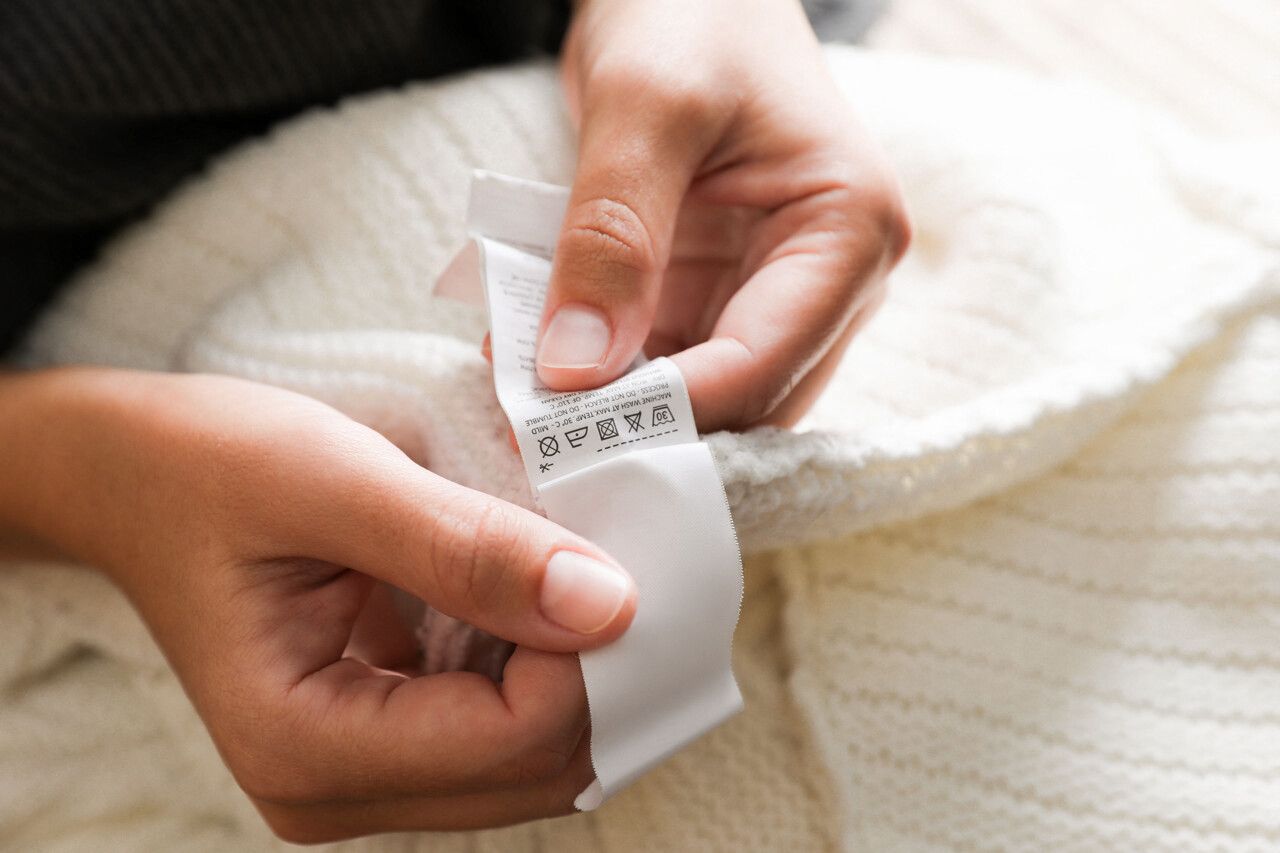
Textiles have their own public method. Since 1 October 2025, a brand in France may display the environmental cost (coût environnemental) of a garment, calculated with the official Ecobalyse tool, which is free and online. At European level, the Product Environmental Footprint method, known as PEF, sets calculation rules by product category.
2How much of an LCA can be done in-house?
An SME can carry out an initial screening on its own, provided that one person spends a few days on it and can read a model. 3 families of tools exist:
- Free public tools: Ecobalyse, run by ADEME (the French Agency for Ecological Transition) and the French ministry for ecology, calculates the impacts of clothing, food and certain objects, Agribalyse provides those of agricultural and food products, and ADEME's Bilan Produit carries out a simplified LCA of a product from a free account.
- The open-source software openLCA, published by GreenDelta, is free, but the inventory databases that have to be loaded into it, such as ecoinvent, are sold separately.
- Licensed software is sold on quotation: SimaPro, One Click LCA or Sphera's LCA for Experts, the name GaBi has carried since 2023.
The data, on the other hand, sits within the company: the bill of materials, material masses, the workshop's energy consumption, offcuts, packaging and transport. Collecting it often takes most of the time in a first LCA, as shown in the guide to LCA on a small budget, and the team that knows the production line does it fastest.
Scoping, data and review
4 tasks become harder without LCA experience:
- Scoping fixes the result before any calculation: the functional unit, the system boundaries and the allocation rules between co-products can no longer be corrected once the study has started.
- Choosing data takes practice: the same process exists in several versions in the databases, and a difference between software tools can change the conclusions of a study, as shown in verifying an LCA run on software.
- A critical review and a verification require a complete report, documented assumptions and a sensitivity analysis, which the reviewer goes through point by point.
- An FDES or a PEP also follows the calculation rules of its programme and its product category, which only a practitioner of that programme knows well.
Training an in-house lead remains useful in every case: that person steers the study, keeps the model and reuses it for the next products. LCA training courses range from free online courses to multi-day programmes on software.
3What are the risks of a poorly scoped LCA?
No law requires an SME to carry out an LCA of its product as such. The risk comes from a figure passed on or published without a sound basis, and it takes 3 forms.
A claim you cannot prove
Writing "30% less impact" on a product sheet without a verified comparison exposes you to a charge of misleading commercial practice, which the French Consumer Code already penalises. The European directive against greenwashing, known as EmpCo, has tightened these rules since 27 September 2026 in the countries that have transposed it; France is still waiting for its law. The list of banned claims shows what no longer passes.
A rejected declaration or a review that stalls
A study that has not followed the programme's rules goes back for correction, and the timetable slips. Certificates published by manufacturers show from 5 weeks to 11 months between submission of the file to the verifier and the verification date, according to the guide to choosing an FDES verifier. Without an FDES, the engineering consultancy that calculates a building uses a default value, as explained in reading FDES in the RE2020 calculation, RE2020 being France's environmental regulation for new buildings.
A decision taken on a wrong figure
The most costly risk is less visible: changing a material, a supplier or a packaging on the strength of a poorly scoped model. A study that calculates only climate impact can hide burden shifting, towards water or resources, which a full LCA would have revealed.
The scope of an LCA, its functional unit and boundaries, can no longer be corrected once the study has started.
4Which LCA consultants carry out product LCAs?
Providers fall into groups by company size, from the large group to the SME taking its first steps. The criteria for comparing quotes apply to all of them.
For a large group: the large consultancies
Quantis, a consultancy specialising in LCA, was acquired by Boston Consulting Group (BCG) in 2022. At the time it had 270 experts, with offices in France, the United States, Switzerland, Germany and Italy, according to BCG's announcement. It carries out LCAs "at product and portfolio level" and sets up reusable data systems, according to its services page. The international group Anthesis offers ISO-compliant LCAs, environmental declarations and the organisation of an external critical review, according to its LCA page.
These consultancies serve first and foremost a group that wants a common method across dozens of product ranges and several countries. Neither publishes prices: everything is on quotation. For an SME, these offers designed for product portfolios give few benchmarks against which to judge a quote.
For an industry: the technical centres
A French technical centre knows the processes of its industry. The Pôle Éco-conception, the "national eco-design centre", carries out LCAs and critical reviews, and acts as an independent third party. Cetim, for mechanical engineering, offers simplified or standardised LCAs and declarations. IPC, for plastics processing, describes itself as "referenced as an eco-design expert by Bpifrance" (the French public investment bank), without mentioning full LCAs on its LCA page. FCBA, for wood and furniture, has one verifier authorised by INIES.
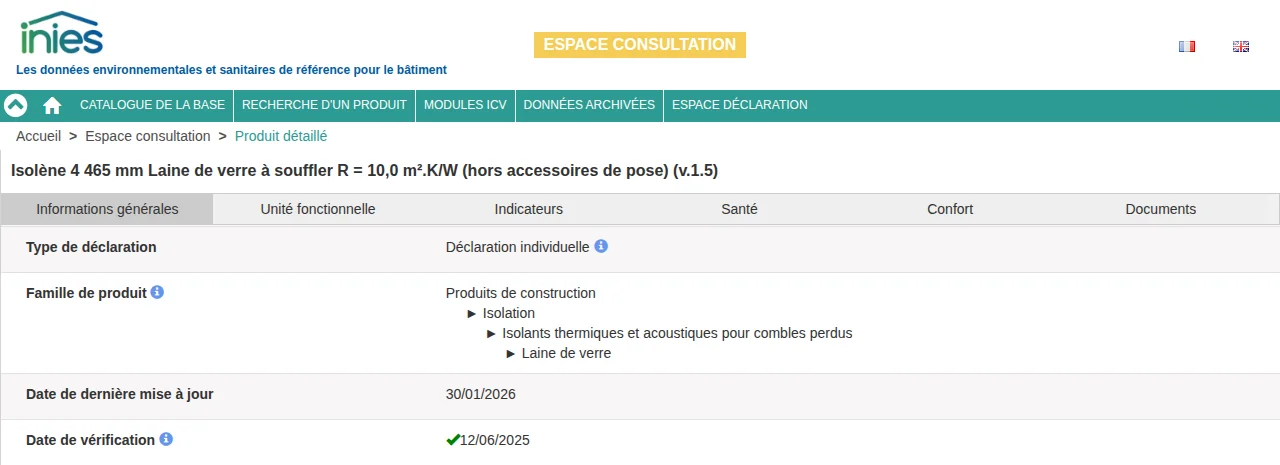
Each FDES in the French public database shows its declaring organisation, its product family and its verification date, here 12 June 2025 for a blown glass wool. It is this verification by an authorised third party that engineering consultancies prepare and that verifiers carry out, some of whom work in technical centres.
They serve first and foremost the companies in their industry: their prices are set on quotation, and their expertise covers their own sector.
For an industrial SME or mid-cap: the engineering consultancies
Projet Celsius carries out full LCAs under ISO 14040 and 14044 and product carbon footprints under ISO 14067, for industrial SMEs and mid-cap companies (ETI in French). Our service page states 3 to 6 months for a full LCA, including data collection from suppliers, and 4 to 8 weeks for a screening. For an FDES, we carry out the study from factory data, write the project report and prepare the verification, which an authorised verifier invoices separately. The study runs from scoping to interpretation, and ends with costed eco-design levers, with a documented report and model that can withstand a critical review.
Projet Celsius is referenced as an expert for the Diag Éco-conception (Bpifrance's eco-design diagnostic). Bpifrance does not publish its list of experts. Sébastien Pierfederici, who wrote this article, leads the LCA training course of the Institut de formation carbone, designed by Projet Celsius. We do not verify FDES or PEP, a role reserved for an authorised verifier independent of the study, and we do not deploy LCA software within a large group.
Other specialist engineering consultancies work for this profile, all on quotation:
- EVEA, founded in 2005 in Nantes and a cooperative since 2017, carries out LCAs, critical reviews and declarations; its history mentions 1 PEP verifier and 2 FDES verifiers.
- Cycleco, based in the Ain département, has taken part in developing the European Product Environmental Footprint method since 2013.
- RDC Environment, based in Brussels with an office in Rouen, writes ISO-compliant LCAs and carries out critical reviews, "whether you are an SME or a large multinational".
None of the 3 publishes prices, so comparison has to go through quotes.
For a first step, public tools, openLCA and a short training course remain the lightest form of support: a trained in-house lead then steers the study, even when it is entrusted to an expert. A tool calculates. It does not scope the study or have it checked.
5How much does a product LCA with a consultant cost?
No public fee schedule sets the price of an LCA: each provider prices expert days. The typical ranges observed in 2026, which vary between providers, are set out in the cost of a product LCA. At Projet Celsius, quotes are in the order of €15,000 to €25,000 excl. VAT for a full LCA and €5,000 to €9,000 excl. VAT for a product carbon footprint, 2026 ranges refined case by case.
Product LCA prices by study level, in euros excl. VAT
Typical ranges observed in France in 2026, except the Diag Éco-conception, whose price is public.
Screeningvery simplified LCAfrom €3,000
Simplified LCAgeneric data€5,000 to €10,000
Full LCAISO 14040 and 14044€10,000 to €25,000
Review by an experton top of the study€3,000 to €5,000
Diag Éco-conceptionSMEs, LCA and action plan€5,400 or €7,200 to pay, €18,000 before the grant
For an eligible SME, the Diag costs as much as a simplified LCA, action plan included.
Sources: typical ranges observed in 2026, varying between providers; Bpifrance, Diag Écoconception page, consulted on 6 November 2026.
An FDES or a PEP rests on a full LCA carried out under the programme's rules, to which verification, with no public price, and registration are added, as explained in choosing an FDES verifier. Before an individual FDES, the trade association's collective FDES or a configurator recognised for RE2020 is sometimes enough, for much less. A published comparison requires an LCA of each product and a review panel. In 2020, ADEME paid €13,350 excl. VAT for the critical review alone of its comparative LCA of bulk and pre-packaged sales, according to the cost of a critical review.
The Diag Éco-conception, for an SME
For an SME, the only price set by a public scheme is that of the Diag Éco-conception, funded by ADEME and operated by Bpifrance. It comprises 18 days of support spread over 10 months, including the product LCA and the action plan. The grant leaves €5,400 excl. VAT to pay for companies with fewer than 50 employees and under €10 million in turnover or balance sheet total. It leaves €7,200 excl. VAT for companies with fewer than 250 employees and under €50 million in turnover or €43 million in balance sheet total. The price before the grant is €18,000 excl. VAT, subsidised at 70% or 60% by ADEME.
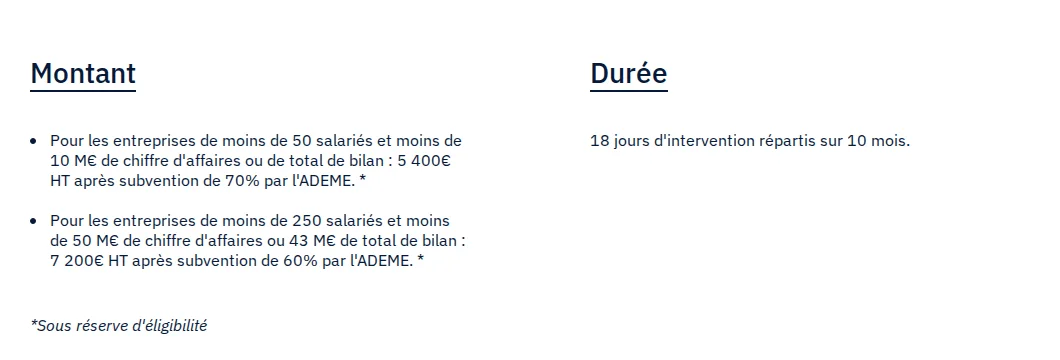
The official page fixes the programme: 18 days of support spread over 10 months, with an analysis of the context, training of an in-house lead, an LCA-based assessment and the action plan. It gives the amount left to pay after the ADEME grant: €5,400 excl. VAT below 50 employees and €10 million, €7,200 excl. VAT below 250 employees. It does not publish the list of experts.
The Diag has 2 limits worth knowing. The expert is selected by Bpifrance from the engineering consultancies it has referenced, and both the critical review and the verification of a declaration remain outside the programme. The eligibility conditions and the funding that can be combined are covered separately.
6Key takeaways
- What the study will be used for decides the LCA level: an internal screening, a carbon footprint for a customer, a full study, a declaration or a public comparison.
- An SME can carry out an initial screening on its own, with Ecobalyse, ADEME's Bilan Produit or openLCA.
- Large consultancies, specialist engineering consultancies, technical centres and software serve different company sizes and uses.
- A full LCA costs in the order of €10,000 to €25,000 excl. VAT in 2026, with no public fee schedule.
- The Diag Éco-conception leaves an SME €5,400 or €7,200 excl. VAT to pay, for 18 days spread over 10 months.
The price breakdown, item by item, is in our article on the cost of a product LCA.
- Bpifrance, "Diag Écoconception" page in the offer catalogue (profile, terms, amount, duration), consulted on 6 November 2026
- beta.gouv.fr, page of the state start-up Ecobalyse, "Problem" section, consulted on 6 November 2026
- ISO 14044:2006, Environmental management, life cycle assessment, requirements and guidelines
- ISO 14067:2018, Greenhouse gases, carbon footprint of products
- BCG, "BCG announces the acquisition of the consultancy Quantis", press release of 15 September 2022, consulted on 6 November 2026
- Quantis, "Environmental impact assessment" page, consulted on 6 November 2026
- Anthesis, "Life cycle assessments (LCA)" page, consulted on 6 November 2026
- EVEA, home page, consulted on 6 November 2026; Cycleco; RDC Environment, "Life cycle assessment", consulted on 6 November 2026
- Pôle Éco-conception, home page and "Supporting you"; Cetim, "Reducing the environmental footprint"; IPC, "Life cycle assessment" and "Eco-design"; FCBA, "Environmental performance", consulted on 6 November 2026
- openLCA, FAQ; SimaPro, commercial plans; One Click LCA, pricing; Ecobalyse; Sphera, 2023.1 update of the LCA databases, consulted on 6 November 2026
- INIES database, "Isolène 4 465 mm" record, Saint-Gobain Isover, verified on 12 June 2025, consulted on 6 November 2026