
- 1No certification of a carbon footprint assessment exists: it is reviewed, evaluated or verified instead.
- 2CDP, SBTi and B Lab recognise ISO 14064-3 verification by an accredited third party.
- 3The verifier cannot have helped to build the carbon footprint assessment it verifies.
- 4Prepare an evidence file: calculation file, supporting documents and versioned emission factors.
A client, a funder or CDP asking for a "verified" Bilan Carbone® (the French carbon accounting method) does not always mean the same thing. The word covers 4 approaches, from an internal check to the opinion of an accredited body, and the right one depends on who the company has to prove its figures to.
Which approach for verifying a Bilan Carbone®?
Choose an approach: who carries it out, what it delivers and who recognises it.
They differ in who carries them out, what they deliver and who recognises them. The sections below compare them, then cover the choice of verifier and the file to prepare.
1Can a carbon footprint assessment be certified?
No. The Association pour la transition Bas Carbone (ABC), France's low-carbon transition association, which owns the Bilan Carbone® trademark, states that the label "certified Bilan Carbone®" corresponds to no certification process. The association certifies 2 other things: people, through a certificate of training in the method, and software, through a recognition of compliance for calculation tools valid for 3 years. Neither validates an assessment: recognised software produces a wrong assessment if the data entered are wrong, including for an assessment you carry out yourself.
Internal check and expert review
The GHG Protocol, the international reference for carbon accounting, sets no rules on how a verification is conducted, as our comparison Bilan Carbone® or GHG Protocol points out. It notes that external verification increases the credibility of the inventory and allows for internal verification by staff independent of the calculation. Such an internal check makes a decision more reliable, but CDP does not accept it as verification.
An expert review goes further: an external specialist reads the calculation file, the emission factors and the justifications, then delivers a report of comments. No standard governs it, so its value rests on the independence and competence of whoever carries it out.
The ABC evaluation
Since the 2025 update of the method, the ABC has offered a voluntary evaluation of assessments against a common framework, for Bilan Carbone® assessments and for regulatory BEGES reports alike (the BEGES, bilan d'émissions de gaz à effet de serre, is France's mandatory greenhouse gas emissions report). It takes 2 forms: a guided online self-assessment or an evaluation by an expert certified by AFNOR Certification, which may lead to an attestation. The ABC itself places it alongside standards-based verification, critical review and regulatory inspection: before ordering it, you should ask the recipient of the assessment whether they recognise it.
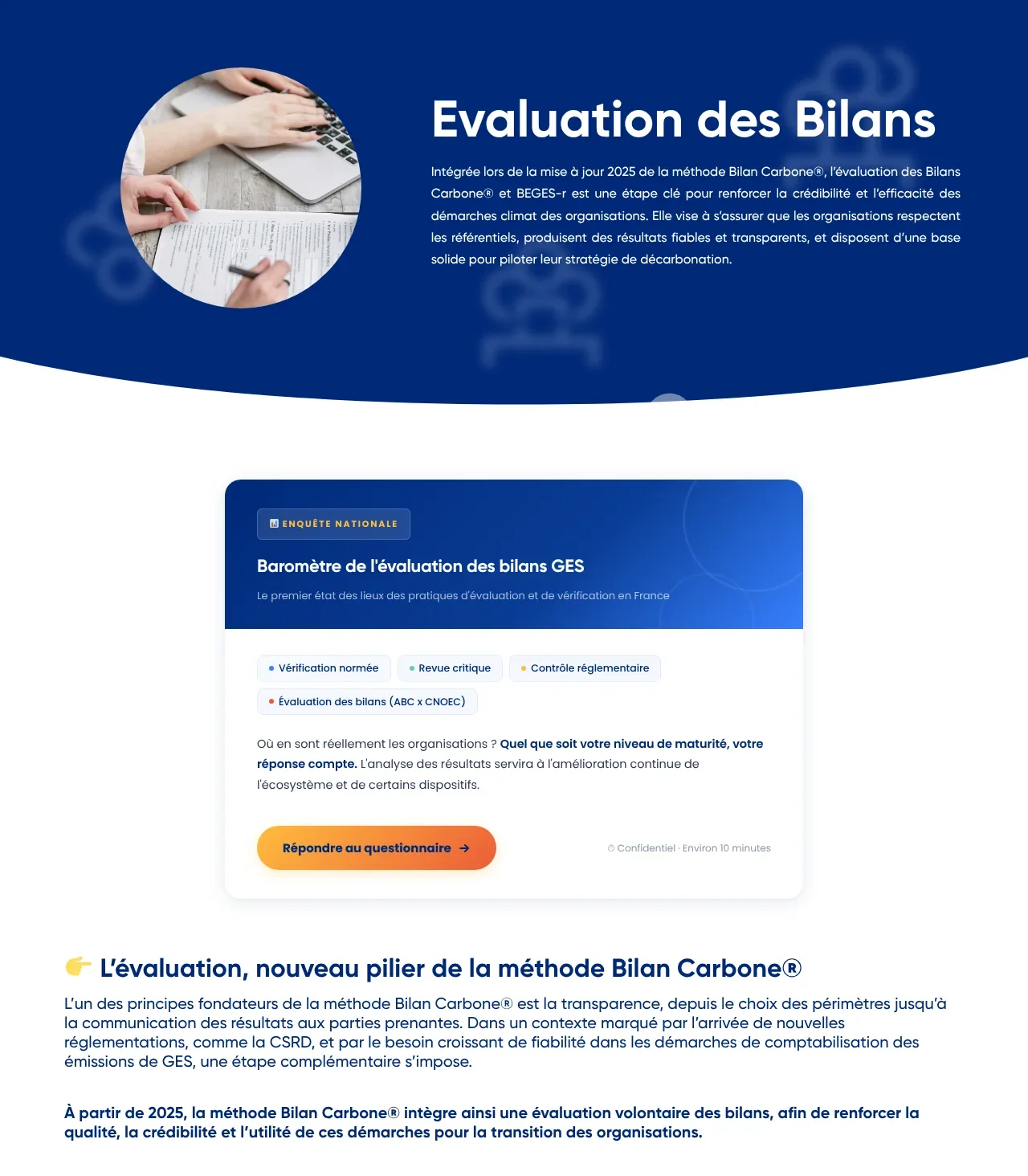
The association's page presents evaluation as a voluntary step, built into the Bilan Carbone® method at its 2025 update, for Bilan Carbone® assessments and regulatory BEGES reports alike. Only experts trained and certified by AFNOR Certification may conduct it. The ABC places it alongside 3 other mechanisms, standards-based verification, critical review and regulatory inspection: it is not an ISO 14064-3 verification.
Verification under ISO 14064-3
ISO 14064-3:2019 is the standard for verifying greenhouse gas statements, whether they concern an organisation, a project or the carbon footprint of a product. The verifier issues an opinion, with limited or reasonable assurance: the latter requires more evidence, and therefore more time and budget. This is the approach that CDP, the Science Based Targets initiative (SBTi) and B Lab recognise as third-party verification.
2Who requires carbon footprint verification?
Few frameworks impose it, and a client or a funder asks for it more often than the law does. The ranking below sorts 6 common frameworks by level of requirement, from the most demanding to the most flexible.
CDP, SBTi, B Lab and EcoVadis
4 frameworks come up in clients' requests. CDP rewards a verification opinion under a standard it accepts, including ISO 14064-3, and does not count internal verification. In V2 of its standard, applicable from 1 February 2027, SBTi requires at least limited assurance of the base-year inventory for its category A, which in France includes companies with 250 or more employees and €50 million in turnover (2 of 3 criteria, group figures). B Lab requires verification every year from large companies, and EcoVadis requires none but places it at the top of its 4 reliability levels. The details are in our articles on B Corp, EcoVadis and the SBTi pathway for an industrial SME.
Where external verification stands in 6 common frameworks
For each framework, what it asks for and from when.
The CSRD, for the largest companies
The Omnibus Directive of 24 February 2026 restricts the CSRD (Corporate Sustainability Reporting Directive) to companies with more than 1,000 employees and more than €450 million in turnover, with transposition due by 19 March 2027 at the latest. Their sustainability statement, emissions included, must receive limited assurance from a statutory auditor or an independent third-party body. An SME below these thresholds only receives requests from its clients, within the limits set out in the revised ESRS and the CSRD for SMEs.
The regulatory BEGES
The BEGES provides for no third-party verification: oversight is administrative, and the fine for failing to publish can reach €50,000. Voluntary verification remains worthwhile when the same calculation also feeds a CDP or SBTi submission, and our BEGES eligibility test tells you in 2 minutes whether the company is covered.
A client asks for a "verified" assessment
The word covers all 4 approaches, and buyers rarely use it precisely. Before choosing, 3 questions put to the client settle the matter:
- Under which standard? If the client cites ISO 14064-3 or a CDP requirement, you need a verification body; if it cites nothing, an expert review with a written report often meets the request.
- With what level of assurance? Reasonable assurance requires considerably more evidence than limited assurance, and the verifier's quote changes accordingly.
- By what kind of third party? An accredited body, an expert whose profile the buyer accepts, or an evaluator certified by the ABC: the answer sets the list of possible providers.
It is better to ask these questions before launching a review, so as not to pay for 2 checks of the same file.
3How do you choose the verifier?
2 criteria are non-negotiable: independence and recognised competence in the target standard. The rest is compared on quotes, as for an EmpCo green claims audit or a life cycle assessment (LCA) review.
The 2 routes for verifying a Bilan Carbone®
Follow a route: from the body that recognises the third party to those that accept its deliverable.
An expert review falls within neither route. No body recognises it: its value rests on the expert's independence and on what the recipient accepts.
Independence
The third party that verifies an assessment cannot have helped to build it. The ISO/IEC 17029 standard, which verification bodies follow, prohibits verifying a statement on which the body has provided consultancy. ISO 14065 also excludes from verification, for at least 2 years, staff who advised the client on that statement.
The consultancy that helped to build a carbon footprint assessment cannot then verify it.
Accreditation and its scope
A body that verifies under ISO 14064-3 must itself comply with ISO 14065:2020. In France, Cofrac, the French accreditation committee, accredits validation and verification bodies, including those that verify greenhouse gas emission statements. The scope of an accreditation is shown on its accreditation certificate, public in the Cofrac directory. It states which fields and which standards the body may verify, and it is the scope you need to compare with the client's request.
Questions to ask before signing
A verification quote is compared on 5 points, written into the offer:
- The standard and level of assurance chosen, with the materiality threshold that will be used to judge discrepancies, set at the start of the engagement.
- The boundary covered (Scopes, Scope 3 categories, sites and year), so that the opinion covers what the recipient expects.
- The accreditation certificate and its scope or, for an expert review, the expert's references on assessments comparable to yours.
- The engagement plan: document review, interviews, any site visit and the planned rounds of exchanges on discrepancies.
- The deliverable, a signed opinion, a discrepancy report or both, and the right to pass it on to the client, the funder or CDP.
Warning signs
4 warning signs should lead you to reject a verification offer:
- The provider offers to "certify" the assessment, a process the ABC says does not exist, or presents an evaluation as an ISO 14064-3 verification.
- The offer cites neither the standard, nor the level of assurance, nor the materiality threshold: the opinion cannot then be submitted to CDP or SBTi.
- The verifier offers to correct the file itself, or has already advised the company on this assessment, which ISO/IEC 17029 prohibits.
- The accreditation certificate is missing, or its scope does not cover greenhouse gas statements.
4How does a verification work?
The third party does not redo the assessment. According to the GHG Protocol, verification is an objective assessment of the accuracy and completeness of the reported information. The verifier tests whether the data, the emission factors, the boundary and the exclusions are justified, then judges whether what remains wrong weighs enough to distort how the assessment is read.
What the third party checks
From one body to another, the engagement follows a similar outline:
- The verifier agrees the boundary, the level of assurance and the materiality threshold with the company, then writes its verification plan.
- It identifies the emission categories where an error would weigh most, generally the dominant categories and those that rely on estimates.
- It traces a sample of lines back to their evidence and reruns part of the calculations with the factors cited, in the database version stated.
- It delivers the list of discrepancies, lets the company correct them, then issues its opinion on the corrected statement.
The verifier checks whether an error, alone or added to the others, exceeds the threshold set at the start of the engagement, often 5% of the total.
The 5% threshold and recurring discrepancies
The GHG Protocol cites as a rule of thumb that an error becomes material above 5% of the total inventory. ISO 14064-3 judges materiality on errors taken individually or in aggregate: several small discrepancies in the same direction can cross the threshold together, as in the constructed example below. This is also why the third party looks first at the dominant categories, where a small relative error weighs heavily.
Discrepancies found in an assessment, against the 5% threshold
Constructed example: choose one of the 4 discrepancies found in an industrial SME's assessment.
From one file to the next, the discrepancies found are concentrated in 4 areas described by the carbon accounting standards:
- Transcription and unit errors, which the GHG Protocol asks you to track down before any calculation by checking conversion factors and unit labelling.
- Double counting between categories: Scopes 1, 2 and 3 are mutually exclusive for the reporting company, so transport included in a purchase price is not counted in 2 categories.
- Estimated data that are not flagged, whereas the Scope 3 Standard recommends the data most representative in terms of technology, time period and geography.
- Undocumented exclusions, which the 2022 BEGES method prohibits when they are partial and requires to be justified one by one.
What drives the price
No public price list exists for an ISO 14064-3 verification or for an ABC evaluation. The price depends on the boundary (Scopes, sites, Scope 3 categories), the level of assurance, the quality of the file and the number of rounds of exchanges on discrepancies. A complete file shortens the engagement more than any other factor. The cost of the assessment itself is estimated separately, with what a carbon footprint assessment costs in France, our price simulator and the funding available to pay for it.
5What should you prepare before having your assessment verified?
A verifier works on evidence. An in-house assessment should therefore be prepared like a case file, and most delays come from a missing document rather than from a calculation error.
The 6 documents in the file
A file that goes through without back-and-forth brings together 6 documents, to be gathered before the first meeting:
- The calculation report: organisational and operational boundaries, base year, emission categories included and each excluded category with its justification.
- The complete calculation file, formulas included, so that the verifier can rerun the calculations line by line.
- The activity data and their dated supporting documents: energy invoices, meter readings, accounting extracts of purchases, transport data.
- The emission factors, with the database used, such as the Base Empreinte, the public emission factor database of ADEME (the French Agency for Ecological Transition), its version and the justification for each factor taken from outside that database.
- The register of assumptions and estimates, with their origin and an order of magnitude of the uncertainty where it weighs on the total.
- The names of the people who carried out and reviewed the assessment, so that the third party can establish its independence before accepting the engagement.

An assessment carried out with software or by a consultancy is prepared in the same way and, since it is repeated regularly, this file is updated at each reporting cycle.
Review before you verify
Verification files almost always stall on the same points, those listed in our pitfalls of a first carbon footprint assessment: a factor whose source can no longer be traced, an estimate whose origin nobody knows, a category excluded without written justification. A review before verification spots them while they are still cheap to correct. It can come from a colleague who did not do the calculation or from an external expert, provided that person does not then act as the verifier. The same reasoning applies to reviewing an LCA or having an FDES verified (the FDES is the French format of environmental product declaration for construction products), and, on the purchasing side, to verifying your suppliers' carbon data.
For us at Projet Celsius, the useful order is to review first, then verify. An expert review spots poorly justified categories before a verifier finds them, and the verification then covers a clean file. In our carbon footprint engagements, we review assessments carried out by an in-house team, another consultancy or an online tool, never an assessment we have built ourselves. When the framework requires ISO 14064-3 verification by an accredited body, we say so from the first conversation.
6Key takeaways
- No certification of a carbon footprint assessment exists: it is reviewed, evaluated by the ABC or verified under ISO 14064-3, depending on its use and its recipient.
- ISO 14064-3 verification by an accredited third party is the one that CDP, SBTi and B Lab recognise, with limited or reasonable assurance.
- SBTi requires it for targets validated under V2 of its standard, applicable from 1 February 2027, in category A, which includes companies with 250 or more employees and €50 million in turnover.
- The regulatory BEGES imposes no verification, and the CSRD now only covers companies with more than 1,000 employees and €450 million in turnover.
- The verifier must be independent of the calculation and judges discrepancies individually or in aggregate against a threshold, often 5% of the total.
To gauge the budget for the assessment before having it verified, see what a carbon footprint assessment costs in France, and to revisit the method itself, what the Bilan Carbone® measures.