
- 1A QR code, an online record: composition, repair and end of life together.
- 2No single date: each product family receives its own timetable, legal text by legal text.
- 3Batteries first, on 18 February 2027; no other ESPR product before 2028.
- 4The main task is data: suppliers, composition, footprint, well before choosing the tool.
Since 20 July 2026, the European Commission has maintained a digital product passport registry. Still almost empty, within a few years it will list identifiers for millions of products sold in the European Union: batteries, clothing, furniture, tyres, toys or detergents, each linked to its own online record.
For a manufacturer, importer or distributor of physical products, the date when the passport becomes mandatory and its contents depend primarily on the product family.
1What is a digital product passport?
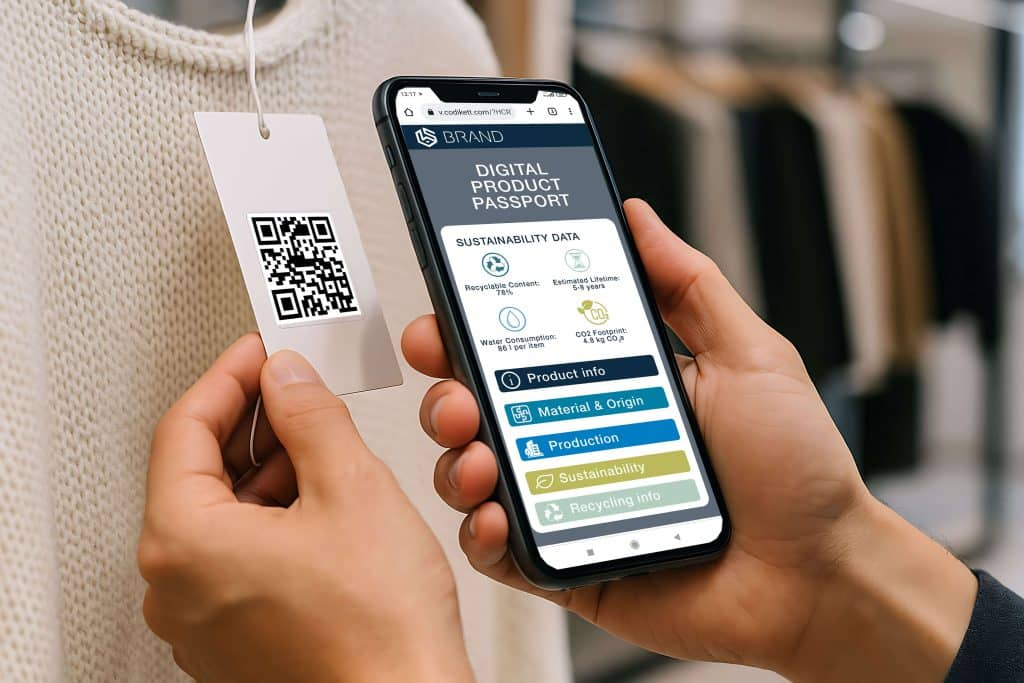
A digital product passport is a product's identity record, accessible online through a carrier placed on the product, its packaging or its documentation. This carrier is usually a QR code, but the regulation leaves the door open to a barcode or a chip. A scan opens a page describing the product: its materials, origin, environmental performance and how to repair and recycle it.
The passport works like a car's service record: a document following the product throughout its life, including when ownership changes, which everyone consults according to their needs, except that it is digital, standardised across Europe and mandatory.
From product to screen: how a digital passport circulates
The passport is stored neither in the product nor in a single European database: the carrier points to data maintained by the company.
It carries a data carrier: usually a QR code, a barcode or a chip.
Specific to the model, batch or item, according to the family's legal text.
Hosted by the company or a provider, with a mandatory backup copy.
The Commission keeps only identifiers there. Online since 20 July 2026.
What each reader sees in the passport
Access rights are set product by product by each delegated act. Illustration of typical profiles.
The data remain with the company
There is no large European database containing all the records: information is hosted by the company itself or a specialist provider, with a mandatory backup copy. The Commission maintains only an identifier registry, allowing customs and authorities to verify that an imported product has its passport.
Everyone sees what concerns them
Access rights are set product by product: consumers see composition, durability and repair advice; repairers access spare parts and disassembly; recyclers access materials and substances; authorities access compliance documentation.
2Why Europe requires it
The passport originated in the European Ecodesign for Sustainable Products Regulation, known as the ESPR, which entered into force on 18 July 2024. This text extends to almost all physical goods an approach previously covering only energy-consuming appliances: setting durability, repairability, recycled content or environmental footprint requirements. Only a few sectors are excluded, such as food, medicines or vehicles.
For these requirements to serve a purpose, information must circulate along the chain. Today, a sorting centre does not know which foams an end-of-life sofa contains, a repairer searches in vain for a part reference and a customs officer cannot check within a few seconds whether an imported product meets the rules. The passport is designed to address these 3 situations with a single tool.
A passport tool takes a few weeks to deploy; gathering reliable data from tier 2 or 3 suppliers often takes more than a year.
It also serves fair competition, since an imported product must present the same passport as a product manufactured in Europe, and customs can check its registration. For a full presentation of the regulation, our ESPR guide details its other provisions, including the ban on destroying unsold clothing and footwear, in force since July 2026 for large companies.
3When does it become mandatory, and for which products?
The passport becomes mandatory family by family through implementing texts called delegated acts: each sets the exact passport content for a product category and can only apply at least 18 months after adoption.
When the passport becomes mandatory, family by family
Solid dates are set by a legal text. Dotted dates are our estimate: announced delegated act adoption plus the minimum 18-month interval.
Scroll the timeline to the right
Batteries lead the way in February 2027
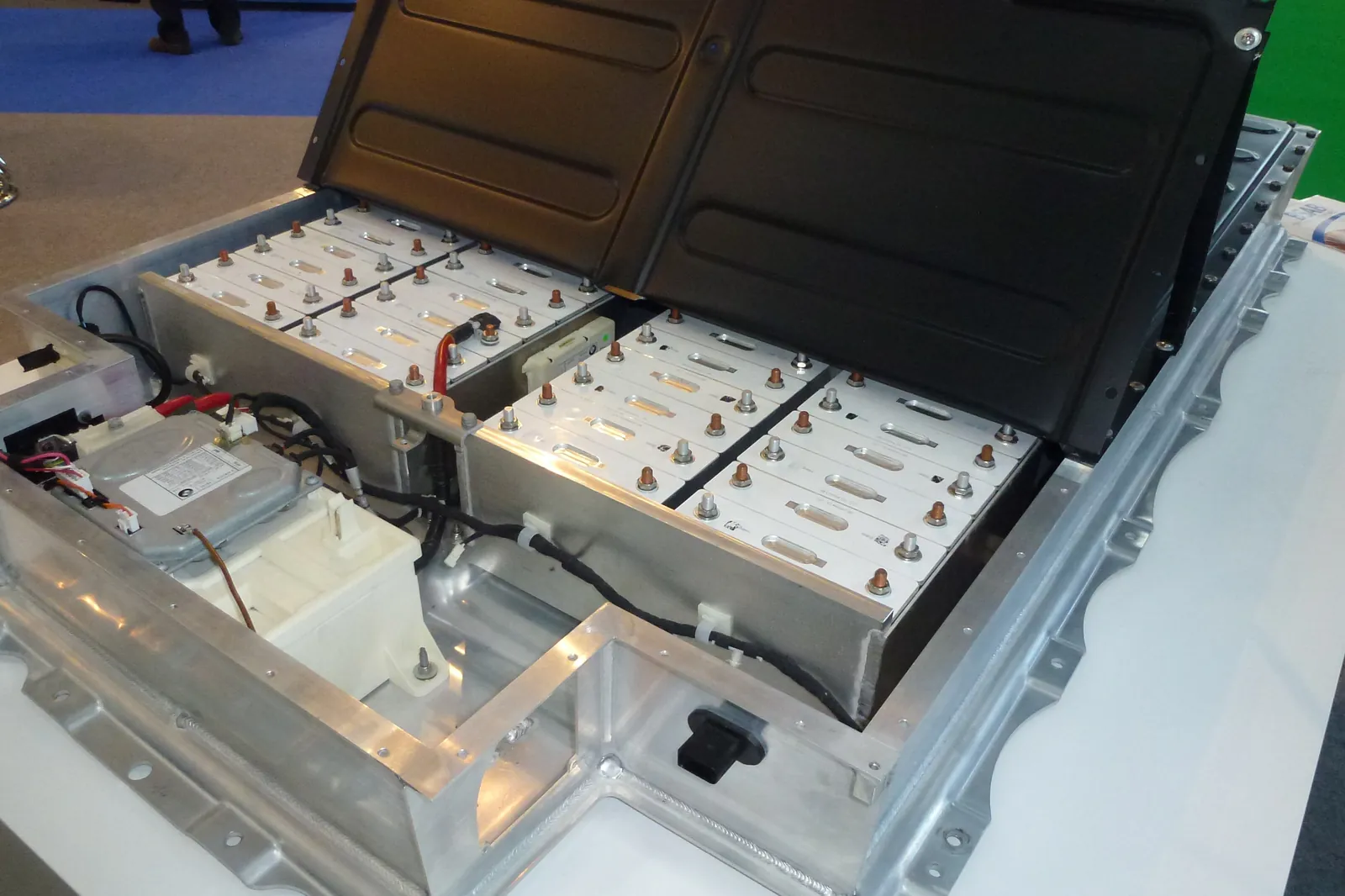
Batteries have their own regulation, adopted in 2023. The passport becomes mandatory on 18 February 2027 for electric vehicle batteries, light means of transport batteries (electric bicycles and scooters) and industrial batteries exceeding 2 kWh. It will provide access, in particular, to their carbon footprint, recycled material share and state of health. Our Batteries Regulation guide details these requirements, and our article on a battery's carbon footprint shows where it occurs.
Steel, textiles, tyres, furniture: no earlier than 2028
The first ESPR work plan, published in April 2025, sets the sequence: iron and steel first, then textiles and clothing, tyres and aluminium, furniture and finally mattresses, with the steel act expected in late 2026. Given the minimum 18-month interval, no ESPR passport should be required before 2028, and most consumer products will arrive between 2029 and the early 2030s.
Textiles are the case our clients follow most closely: the delegated act is planned for 2027, placing the requirement around 2029. Our guidance on textile eco-design helps with preparation. French brands already have a foretaste through clothing environmental cost labelling, launched in October 2025. For furniture, our article on what the ESPR brings to furniture details the sector timetable, while our mattress LCA article anticipates the plan's final family.
Toys, detergents, buildings: sector-specific regulations
The passport extends beyond the ESPR: the new Toys Regulation requires it from 1 August 2030, and the revised Detergents Regulation from 23 September 2029. For construction products, an act is expected in 2027, followed by the same 18-month interval. All use the same principle of identifiers, carriers and differentiated access, adapted sector by sector. Our ESPR, DPP and labelling overview connects these texts.
4Who must provide it?
The passport is the responsibility of whoever places the product on the European market: the manufacturer, or the importer when the manufacturer is established outside the Union. Distributors and online marketplaces must ensure the passport remains accessible at the time of sale. There is no general SME exemption: the regulation instead provides for tools, guides and support desks in each Member State.
For families still without a legal text, the dates we give are estimates drawn from the Commission's work plan, which may slip if adoption of delegated acts is delayed.
Deadline and first action, family by family
Choose a product family to see the deadline, legal text, responsible operator and first action.
Mandatory passport
18 February 2027
Regulation (EU) 2023/1542 on batteries
In practice, the question extends beyond the operator placing the product on the market: to complete a passport, a furniture brand needs data from its foam supplier, a clothing brand from its spinning mills and dyers, a bicycle manufacturer from its battery assembler. Even if your product is not yet scheduled, your clients will soon ask for information about what you sell them.
5What will it contain?
The exact content is set by each family's delegated act, but the regulation outlines the menu. In principle, it will contain product identity (unique identifier, manufacturer, importer, compliance documents, instructions and safety information) and the presence of substances of concern. Depending on the product, performance information is added: durability, repairability index, recycled content, carbon or environmental footprint.
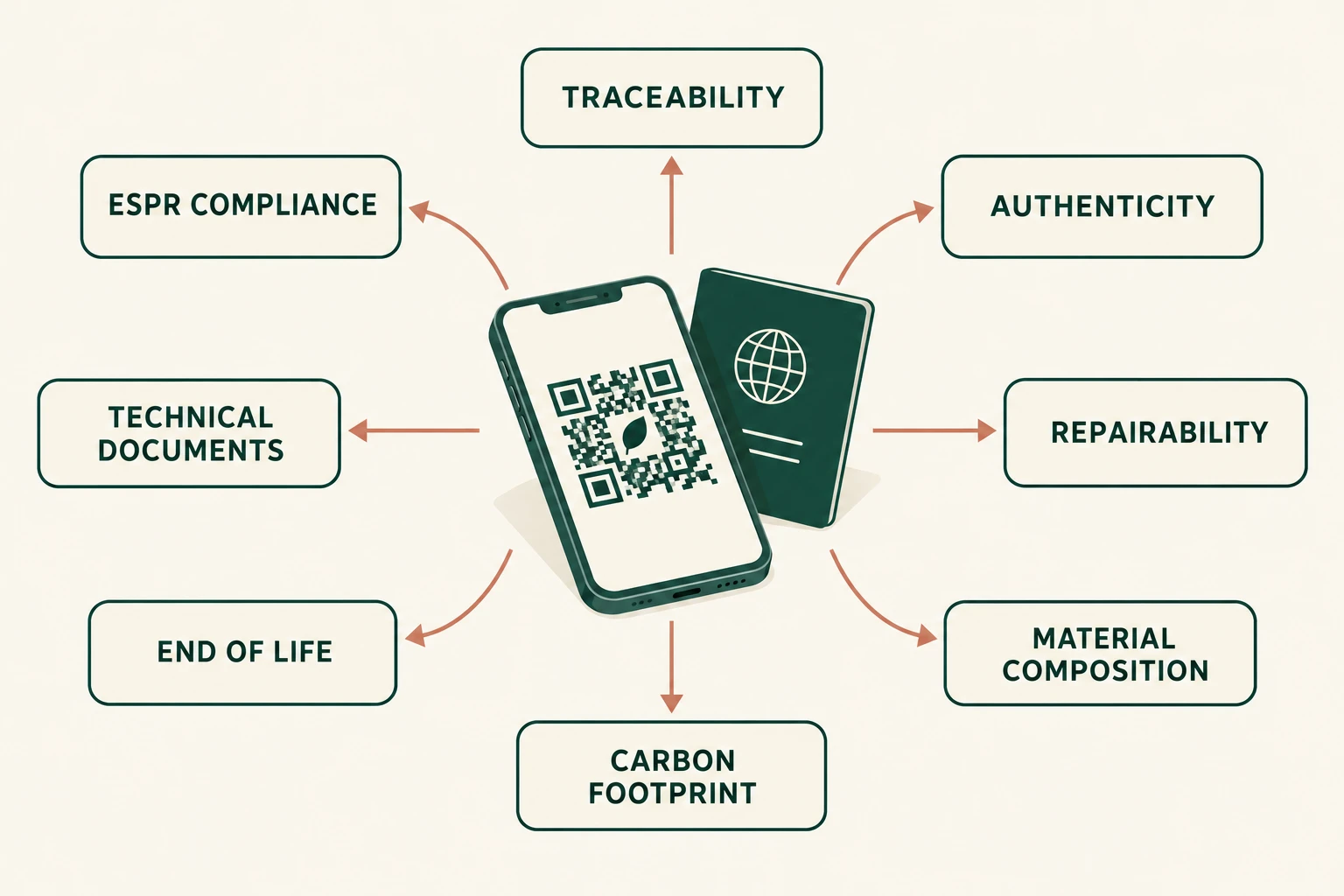
Behind a scan, 8 possible information families: each delegated act will select from this menu those that matter for its product category.
One final information family serves end of life: disassembly instructions, materials to separate, recycling streams. It mainly interests repairers and recyclers, and is often the hardest to document for products assembled from many components.
Example: an electric bicycle battery passport
The Batteries Regulation provides the most concrete example, since its content is already set. An electric bicycle battery passport will include in particular:
- Its identity: manufacturer, place and date of manufacture, chemistry, weight and capacity.
- Its carbon footprint and its share of recycled cobalt, lithium, nickel and lead.
- Its performance and durability: nominal capacity, expected lifespan, then its state of health as it is used.
- Disassembly and safety information useful to repairers, refurbishers and recyclers.
If you already publish the "environmental qualities and characteristics" product sheet required in France by the AGEC law, some data overlap: recycled content, presence of hazardous substances, recyclability. The passport goes further, in a standardised, machine-readable format shared across Europe. Footprint calculation follows specific rules, which we detail in our article on DPP calculation methods.
6Where to start?
Except for batteries, no passport needs to be built today. Yet the work to start is lengthy, because data sit with your suppliers, in technical sheets and in footprint calculations taking months. Companies approaching it most calmly follow an order close to a conventional eco-design process.

- Locate your products in the timetable, family by family, to know what is urgent and what can wait.
- Inventory the data you already have: technical sheets, AGEC product sheets, declarations of conformity, product codes.
- Start working with suppliers: composition, material origins, substances, using simple questionnaires repeated each year.
- Measure your flagship products' environmental footprint through a life cycle assessment, which will also serve your communications and tenders.
- Choose the tool last, once your sector's delegated act is published. European technical passport standards were published in July 2026; providers will align with them.
For us at Projet Celsius, the costliest mistake is starting with the platform: a passport tool takes a few weeks to deploy, whereas gathering reliable data from tier 2 or 3 suppliers often takes more than a year. Companies that have already conducted a first product LCA have a head start, and those that have never done one can begin with a controlled budget: LCA cost depends mainly on the number of products and the quality of available data.
7Key takeaways
- The digital product passport is an online identity record, opened through a QR code or another carrier, following the product throughout its life.
- The data remain with the company; the Commission maintains only an identifier registry, online since 20 July 2026.
- Batteries are the first affected, on 18 February 2027. Other families follow at the pace of delegated acts, no earlier than 2028.
- The operator placing the product on the market provides the passport, but the whole supplier chain contributes.
- The priority task is data: suppliers, composition, footprint, before choosing the tool.
To place the passport within the wider set of product obligations, our ESPR, DPP and labelling overview connects the legal texts, and our digital passport service describes how we support data collection and footprint calculation.
- ESPR Regulation: Regulation (EU) 2024/1781 of 13 June 2024 establishing a framework for setting ecodesign requirements for sustainable products, Chapter III (Articles 9 to 15) and Annex III; Article 4 (minimum 18-month interval); Article 22 (SME support); Article 25 (unsold goods).
- Registry and standards: Implementing Regulation (EU) 2026/1778 on the registry; registry launch announcement, 20 July 2026; Implementing Decision (EU) 2026/1736 (standards EN 18216 and EN 18219 to 18223).
- Timetable: ESPR work plan 2025-2030, COM(2025) 187; Commission page on iron and steel.
- Other regulations providing for a passport: Regulation (EU) 2023/1542 on batteries, Article 77; Regulation (EU) 2025/2509 on toy safety, Article 19; Regulation (EU) 2026/405 on detergents, Article 21; Regulation (EU) 2024/3110 on construction products.
- France: Environmental Code, Article L. 541-9-1 and Decree No 2022-748 of 29 April 2022 ("environmental qualities and characteristics" product sheet).