
- 1A mattress LCA measures 16 indicators, not just carbon: water, eutrophication, ecotoxicity.
- 2444 kg of CO₂e per bed, with 68% from raw materials, rather than the factory.
- 3Furniture environmental labelling is being prepared, with a score calculated through product LCA.
- 4Bpifrance’s Diag Éco-conception funds 60 to 70% of an LCA costing €10-18k excl. VAT.
A mattress X-ray
444 kg CO₂e per mattress, over its lifespan - equivalent to 2,200 km by car
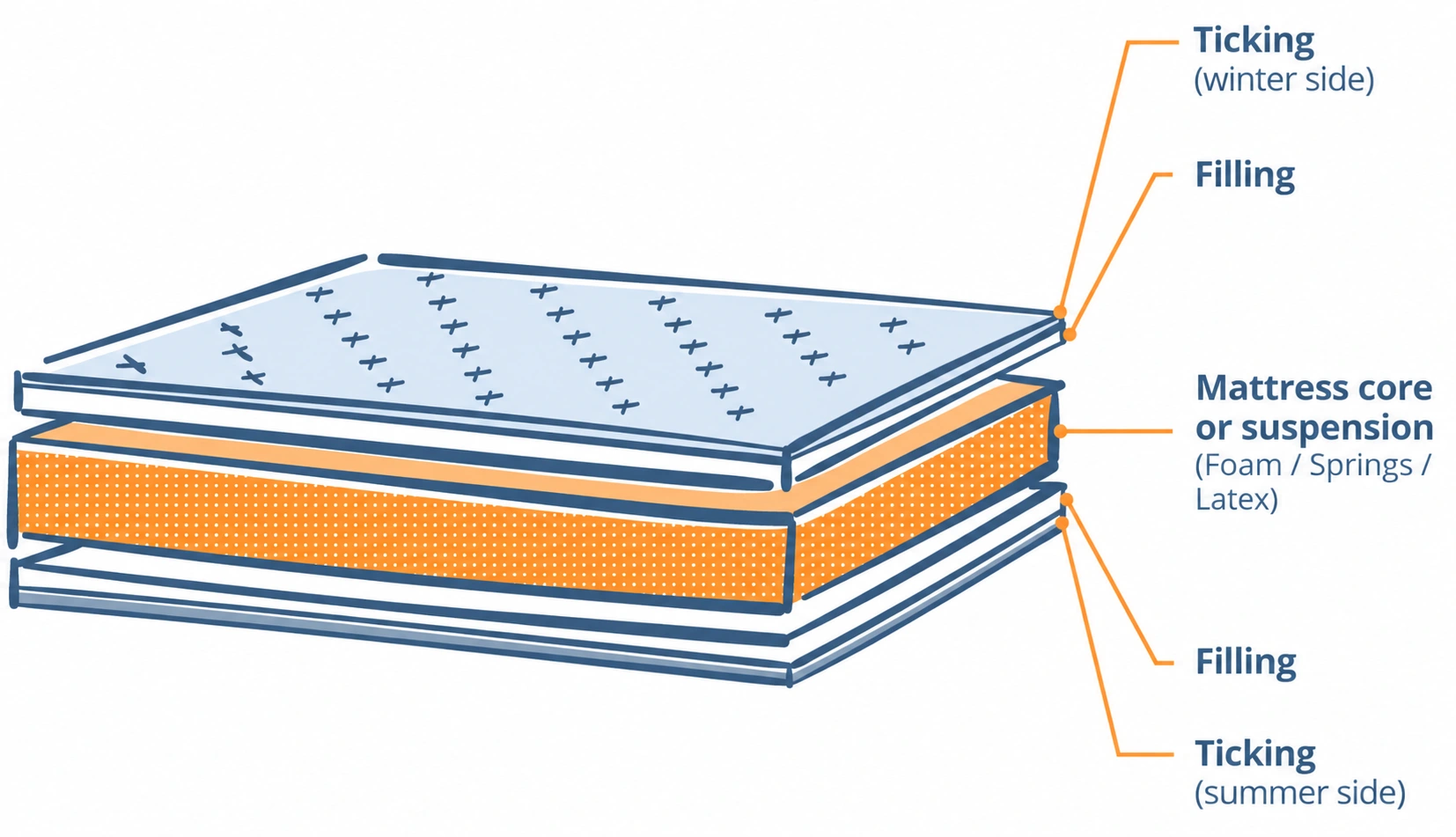
Source: ADEME Impact CO₂, indicative hybrid mattress data. LCA is not limited to carbon.
Life cycle assessment (LCA) remains little known in the bedding sector - but will become essential. The State’s work on furniture environmental labelling is preparing an environmental score calculated through LCA, which will be able to appear on every mattress in shops and online, with no date or obligation set to date. This guide explains in practical terms what LCA measures for a mattress, how much it costs and how to proceed. For the sector’s underlying trend, see also fast bedding and mattresses becoming disposable.
Whether you are a business leader, quality manager or CSR manager in bedding, you do not need environmental expertise to follow: we start from scratch and build up gradually.
1What is an LCA, and why is bedding concerned?
Life cycle assessment is a scientific method measuring a product’s environmental footprint from birth to death: from raw material extraction (oil for foam, steel for springs, rubber trees for latex) to end of life (recycling, incineration, landfill), through manufacture, transport and use. LCA’s distinctive feature is that it considers more than carbon. It measures 16 indicators: climate change, water consumption, acidification, human toxicity, land use, resource depletion... This complete view makes it such a revealing - and sometimes uncomfortable - tool.
The 16 PEF indicators explained
The 3 indicators that most distinguish bedding products
Source: ADEME Impact CO₂, Kipli 2023 carbon footprint assessment. Mattress LCA is not only about carbon.
Why does this concern bedding manufacturers now? Three reasons converge. First, furniture environmental labelling is being prepared: mattresses sold in France will be able to display an environmental score calculated through LCA, using a method still under development which will probably, as for textiles, draw on PEF (Product Environmental Footprint). Next, the European Digital Product Passport (DPP), whose mattress delegated act is expected in 2029, will require the same data in digital form. Finally, environmental data are increasingly requested by professional buyers (hotels, local authorities, public procurement) in their tenders.
In other words: manufacturers who have already completed their LCA will have a score to show when labelling arrives. Others will have to do it urgently, with providers at capacity and longer lead times. It is the same dynamic as in textiles, where brands that anticipated environmental labelling start one to two years ahead.
Product LCA and Bilan Carbone®: two different tools
This is the most frequent confusion among manufacturers starting out, and it can easily cost 6 months of project time. Bilan Carbone® measures an organisation’s greenhouse gas emissions (your factory, offices, travel). LCA measures a product’s impact over its entire life cycle, across 12 to 16 indicators. Environmental labelling requires a product LCA, rather than a corporate Bilan Carbone®. The two are complementary and the data overlap, but they are distinct exercises with different results.
2444 kg of CO₂ per bed: ADEME’s figures explained
The reference figure comes from ADEME’s Empreinte database and the Impact CO₂ tool: a complete bed (frame + base + mattress) emits 444 kg of CO₂ equivalent over its life cycle. This is equivalent to 2,200 km in a combustion-engine car, or a return flight from Paris to Marseille. And this is only the climate change indicator - just one of the 16 indicators making up the future environmental score.
Springs vs foam vs latex
Multi-criteria comparison - 140×190 cm mattress
Pocket springs win in multi-criteria LCA. Latex wins on carbon alone but loses on water and land.
Source: UFC-Que Choisir, ADEME Impact CO₂, Kipli 2023.
What stands out when breaking down this figure is the distribution. ADEME gives it clearly: 68% of the impact comes from raw materials (303 kg CO₂e), 14% from assembly and distribution, 9% from upstream transport and 9% from factory manufacture. In other words, material choices determine two-thirds of your footprint. Manufacture, which many business leaders imagine as the main source, accounts for only 9%. This is the classic product LCA pattern: the impact lies in the material, rather than the process.
- Raw materials: 68% - oil extraction (PU foam), steel production (springs), rubber-tree cultivation (latex), wool carding, cotton spinning
- Assembly and distribution: 14% - shaping layers, cover, packaging, delivery to point of sale
- Upstream transport: 9% - transporting materials from suppliers, highly variable depending on geographical sourcing
- Factory manufacture: 9% - processing energy, gluing, sewing, quality control
What this means in practice for a manufacturer: if you want to reduce your environmental score significantly, the priority is not optimising your production line. It is rethinking your materials. This is counter-intuitive for a manufacturer, but LCA consistently demonstrates it.
3Springs, foam, latex: LCA results by technology
This is one of the most counter-intuitive results of LCA applied to bedding: in a multi-criteria assessment, pocket-sprung mattresses generally have the best environmental profile. UFC-Que Choisir’s investigation summarised it in a direct phrase: "natural gives way to springs". Here is what the figures show for each technology.
Impact hotspots: where the kg CO₂e hide
Breakdown by life-cycle phase - complete bed 444 kg CO₂e
PU foam = oil, latex = water + land, steel = energy
Gluing, cutting, ticking manufacture
Latex from South-East Asia, foams from Eastern Europe
Cover washing, deformation
Incineration 85%, RENUVA recycling 15%
Source: ADEME Impact CO₂ - complete bed = 444 kg CO₂e. Indicative breakdown, hybrid spring/foam mattress.
Springs: recyclable steel makes the difference
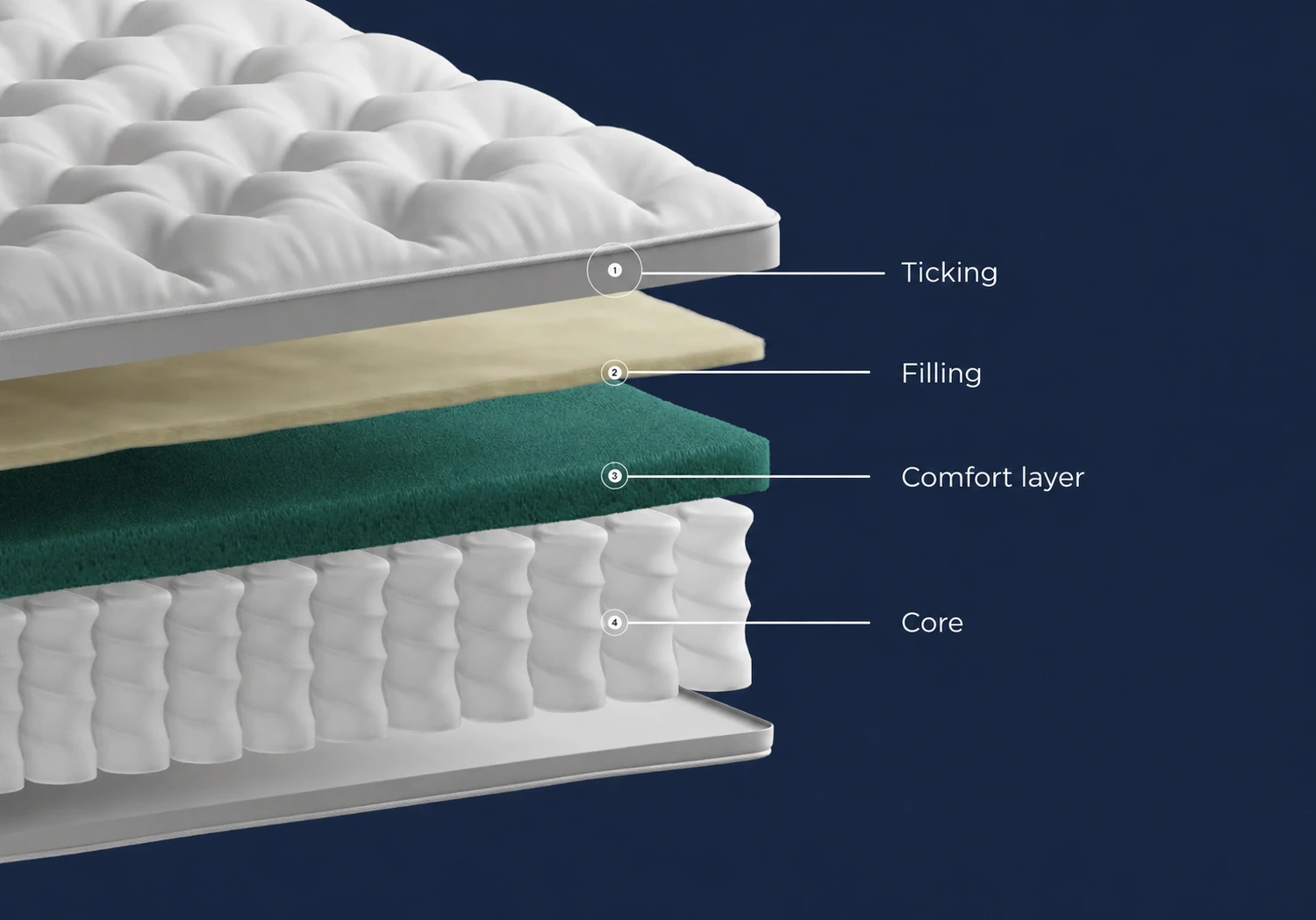
Springs are made of steel, a material produced predominantly in Europe and 100% recyclable at end of life. The recycling sector is mature: springs are extracted magnetically in Ecomaison centres, which process 4 million mattresses each year in France, with a 97% recovery rate. Transport distances are short (European value chain), and product lifespan is long. This combination - local, recyclable, durable material - gives sprung mattresses a structural advantage. Order of magnitude: around 240 kg CO₂e for a 140x190 mattress.
Natural latex: when "natural" does not mean "environmentally friendly"
Rubber-tree latex is extracted in South-East Asia (Thailand, Malaysia, Indonesia). Sea transport contributes, but is not the main source of impact. What really increases the footprint is a combination of factors: rubber-tree cultivation requires considerable agricultural land (the LCA "land use" indicator), latex is often combined with wool or cotton layers requiring intensive washing, and the finished mattress is considerably heavier than a sprung mattress.
The data published by Kipli in its 2024 carbon footprint assessment are revealing: 230 kg CO₂e for its 140x190 mattress. This is a very good result for a latex mattress, but Kipli is an optimised case (certified latex, manufacture in Italy, traced supply chain). For a generic latex mattress imported from Asia, the gap widens considerably in favour of springs. This is exactly the kind of nuance LCA can quantify for each product reference.
PU foam: the oil scenario
Polyurethane foam starts with a structural disadvantage: raw material derived from oil, energy-intensive extraction and processing, historically limited recycling. A standard foam mattress emits around 290-300 kg CO₂e in 140x190, or 25 to 30% more than a sprung mattress. But the good news is that this is the technology where eco-design is progressing fastest. Tediber reports a sixfold reduction in the carbon footprint of its Pelote mattress through recycled foams and manufacture in France (Haute-Loire). Camif reports -39% for its mattress with recycled foams. And RENUVA™ technology (chemical recycling of PU foam into new polyols) is gradually closing the material loop.
Natural gives way to springs. This is the most counter-intuitive result of mattress LCA - and what the future environmental score will make visible on shop shelves.
4End of life: a variable source of impact affecting the score
End of life accounts for 2 to 10% of a mattress’s total impact depending on its design - a substantial difference determined by choices made far upstream. A sprung mattress whose steel is extracted magnetically benefits from an end-of-life credit in LCA: recycling generates an environmental benefit credited against the overall score. By contrast, a glued multilayer foam mattress is almost impossible to dismantle: no material recycling, only energy recovery.
The 5 stages of a mattress LCA
From brief to legally binding report - 10 to 19 weeks
Functional unit, scope, lifespan
BOM, masses, origins, processes, transport
⚠️ 50-60% of the timeEco-meuble or SimaPro, ecoinvent data
Hotspots, sensitivity, material comparison
Independent verifier (mandatory for labelling)
✓ Legally binding LCAInventory (stage 2) is the bottleneck. Suppliers who do not respond slow everything down.
Ecomaison, the producer responsibility organisation managing France’s furniture sector, processes 4 million mattresses per year. The overall recovery rate is 97%, but material recycling alone accounts for only 55%. The target is to exceed 70% by 2027. The new RetourMat plant at La Cavalerie (Aveyron), opened with IKEA and Ecomaison, will process 750,000 mattresses per year and is raising the sector’s performance.
What this means for a manufacturer: a mattress designed with zipped or interlocking layers (rather than glued ones) allows dismantling at end of life and automatically improves the LCA score. This is a design choice made upstream, rather than an adjustment that can be made afterwards. Manufacturers incorporating disassembly into their new models gain a structural advantage in their environmental score.
5How a mattress LCA works in practice
A mattress LCA takes place in five stages over 3 to 6 months. Half this time is spent collecting supplier data - the normal project bottleneck.
Mistakes that cost 6 months
5 practical traps and how to correct them
Each mistake adds 2 to 6 months. Combined: a 6-month project → 18 months.
Stage 1 - Scoping: choosing the right product
We always start with the bestseller. Not the premium product, the innovation being launched or the one marketing wants to promote. The best-selling product, because it contributes most to your overall footprint and its score will receive the most scrutiny. A typical functional unit is: "provide a 140x190 cm sleeping surface for 10 years of normal use". This wording defines the comparison scope and incorporates product lifespan. System boundaries: cradle to grave, in accordance with the BP X30-323-10 standard.
Stage 2 - Mapping every component
For a typical hybrid mattress (springs + foam + textile), the bill of materials may contain 15 to 25 components: pocket-spring unit, HR foam sheet, memory foam, felt, polyester filling fibre, stretch ticking, sewing thread, glue, plastic packaging film... The classic mistake is forgetting secondary materials. The glue bonding the layers is often a VOC and toxicity hotspot, packaging film contributes more than expected, and the delivery wooden pallet falls within the scope. In LCA, these "small" sources sometimes create the surprises.
Stage 3 - Collecting supplier data (the bottleneck)
This is the heart of the project, and where lead times are determined. For each component, you need: the exact mass (rather than the catalogue estimate), geographical origin, manufacturing process, the supplier’s energy consumption and the production scrap rate. In practice, the manufacturer controls its internal data but depends on suppliers for everything upstream. The French spring supplier responds in 48 hours. The Turkish foam supplier takes three weeks. The Thai latex producer does not respond at all.
The standard solution: use generic data (Empreinte® or ecoinvent databases) for materials without supplier responses, and specific data where available. Generic data are averages: every actual piece of data obtained from a supplier makes your score representative, better or worse, and avoids the official method’s unfavourable default values. This is a powerful argument for motivating internal data collection. Allow 2 to 3 months for this stage, with systematic follow-ups.
Stages 4 and 5 - Modelling and action plan
Modelling uses specialist tools: Eco-meuble (developed by FCBA, aligned with furniture sector standards), SimaPro or openLCA (general-purpose LCA software). Calculation generates results for the 16 PEF indicators and reveals your product’s hotspots. A good LCA deliverable does not produce an 80-page report nobody reads. It produces a prioritised action plan: the 3 to 5 practical levers that reduce your score. If PU foam accounts for 45% of the carbon impact, the first lever is substituting recycled foam. If latex transport is the issue, the lever is regional sourcing. LCA turns intuition into a quantified decision.
6Common mistakes to avoid when starting
Several mistakes recur among manufacturers launching their first LCA. They are easy to avoid when you know about them beforehand.
Mattress LCA budget: costs and funding
Diag Éco-conception funds 60 to 70% of the first LCA
Diag Éco-conception can be combined with certain regional grants. Check with your CCI.
- Confusing product LCA with corporate Bilan Carbone®. One measures a product across 16 indicators, the other an organisation’s GHG. Labelling requires product LCA. This confusion costs 6 months of project time - the number 1 mistake
- Underestimating supplier data collection. It accounts for 50 to 60% of total project time. Allow 2 to 3 months for this stage alone, with a generic-data backup plan for suppliers who do not respond
- Neglecting end of life in design. A glued mattress = no material recycling = poor score. A mattress with zipped layers = dismantlable = improved score. This choice is made during design, rather than retrospectively
- Forgetting glue and packaging. "Small" sources that create toxicity and VOC hotspots. Always include them in the scope - forgetting them exposes you to unpleasant surprises when the score is published
- Waiting for perfect data. An LCA with 60% specific data is infinitely more useful than no LCA at all. Iteration will follow. The trap is postponing indefinitely because "the data are not good enough"
An LCA with 60% specific data is infinitely more useful than no LCA. The classic trap is postponing the project indefinitely because the data are not good enough.
7How much it costs and how to fund your LCA
The budget for a complete mattress LCA is between €10,000 and €18,000 excl. VAT, depending on the number of products and depth of analysis. A substantial share can be funded through public support.
- Simplified LCA (1 product, predominantly generic data, initial hotspots): €5,000 to €8,000 excl. VAT - useful for initial internal screening, insufficient for labelling
- Complete LCA (1-3 products, specific data, eco-design plan): €10,000 to €18,000 excl. VAT - the format preparing for environmental labelling
- LCA + ISO 14044 critical review (published comparison): add €3,000 to €5,000 excl. VAT
Bpifrance’s Diag Éco-conception is the main funding lever. This scheme, co-funded by ADEME, covers 60 to 70% of a first eco-design programme including LCA. Amount payable by a bedding SME: €5,400 to €7,200 excl. VAT depending on size. Conditions: be an SME with fewer than 250 employees, not have previously benefited from the scheme, select a listed provider. It can be combined over 12-18 months with Diag Décarbon'Action (corporate Bilan Carbone®) and ACT Pas à Pas (climate strategy), for a total of €15k to €25k in public support covering product LCA, the corporate footprint assessment and the roadmap.
8Key takeaways
Mattress LCA produces three things: a precise measure of each product’s footprint, the hotspots to address through eco-design and the data needed for future environmental labelling and the DPP, whose mattress delegated act is expected in 2029. Here are the key points to remember.
- 68% of the impact lies in raw materials, rather than the factory. This is the defining result of any mattress LCA: material choices determine two-thirds of the score.
- Results by technology challenge intuition: in multi-criteria LCA, springs (recyclable steel, European supply chain) often have a better profile than natural latex (transport from Asia, land use).
- Supplier data collection accounts for 50 to 60% of project time - the normal bottleneck. Allow 2 to 3 months for this stage alone.
- Bpifrance’s Diag Éco-conception funds 60 to 70% of a first LCA’s cost. Amount payable: €5,400 to €7,200 excl. VAT depending on company size.
- End of life is a design lever: a mattress with zipped layers (rather than glued ones) automatically improves the score through the recycling credit.
Manufacturers launching their LCA in 2026 will have time to iterate on eco-design before the score becomes public. Those waiting for labelling to become widespread will have a score - but not necessarily the best one!
Sources: ADEME Impact CO₂ (Empreinte database), UFC-Que Choisir (bedding LCA investigation), Kipli 2024 carbon footprint assessment, Ecomaison 2024 annual report, FCBA Eco-meuble, Tediber (Pelote manufacturing data).