
- 1CFB rather than complete LCA: €25k to €50k and 6 months, rather than €40k to €80k and 8 to 12 months.
- 2You are the declarant if you assemble in Europe: your cell supplier has no obligation.
- 3Supplier collection = critical path: 8 to 12 weeks for a usable dataset from an Asian manufacturer.
- 4Deadline during 2028 at the earliest for industrial batteries above 2 kWh: start the project in the second half of 2026.
Once the requirement applies, during 2028 at the earliest, no industrial battery above 2 kWh will be able to enter the European market without a carbon footprint declaration verified by a third-party body. Regulation EU 2023/1542 made this a condition of CE marking, alongside safety tests. No declaration, no market.
This guide sets out the basics and gets into practice: exactly what the Regulation requires, which method to apply, which data to collect and from whom, how long it takes, and the pitfalls that cost those starting without support 3 to 6 months of delays.
1What Regulation 2023/1542 requires
Most manufacturers we support discover this requirement during a sales meeting: a client asks for the carbon declaration, the compliance manager looks into it and finds a Regulation with 117 articles and delegated acts arriving progressively. Let us start with the most useful information: what is required, from whom and in what form.
CFB or LCA: what the law requires, what goes further
The European Regulation requires a carbon declaration (CFB). A complete LCA is not mandatory but informs product trade-offs. These are two levels, rather than two alternatives.
Standardised carbon declaration, required to place a battery on the European market.
- IndicatorkgCO₂e/kWh (just 1)
- Budget€25k - €50k
- Duration≈ 6 months
- VerificationThird-party mandatory
360° assessment (water, resources, toxicity…) to manage eco-design beyond carbon.
- Indicators16 impact categories
- Budget€40k - €80k
- Duration8 - 12 months
- VerificationRecommended
In practice, start with the CFB to stay on the market, then extend to a complete LCA when seeking to differentiate the product or prepare for environmental labelling.
The Regulation requires manufacturers and importers of industrial batteries above 2 kWh to produce a carbon footprint declaration (Carbon Footprint of Batteries, or CFB). This quantified document states: over its entire life cycle, this battery emits X kilograms of CO₂ equivalent per kilowatt-hour delivered. It is neither an audit nor a voluntary label: it is a regulatory requirement. Without this verified declaration, there is no CE marking and no placing on the European market.
The declaration follows a precise methodology developed by the JRC (the European Commission’s research centre), based on the PEF (Product Environmental Footprint) method. It must be verified by a notified third-party body.
CFB vs complete LCA: what is the difference?
This is the most frequent and costly misunderstanding. The carbon footprint declaration is not a complete LCA. The data to collect are largely the same, but the deliverable, budget and timetable differ considerably.
- CFB (what the Regulation requires): just 1 indicator (kgCO₂e/kWh), a budget of €12,000 to €25,000 excl. VAT excluding verification, a 6-month timeframe and a deliverable focused on regulatory compliance
- Complete multi-indicator LCA: 16 impact categories (warming, acidification, eutrophication, toxicity, etc.), a budget of €40,000 to €80,000, an 8 to 12 month timeframe and a broader deliverable that the Regulation does not require
- The pitfall: a manufacturer commissioning a complete LCA when it needs a CFB risks doubling its budget for a deliverable that goes beyond what the Regulation requires
Who must produce the declaration?
It is the economic operator placing the battery on the European market. If you assemble battery packs from cells purchased from a Chinese or Korean manufacturer (CATL, EVE Energy, BYD), you are the declarant. Your cell supplier is not. You must obtain its data, incorporate them into your calculation and produce the declaration. Many European assemblers have yet to grasp this, and discover along the way that their cell supplier has no obligation to make their lives easier.
If you assemble batteries from purchased cells, you are the declarant. Your supplier is not. And it has no obligation to make your life easier.
2Understanding the methodology
The Regulation leaves no choice of method: the declaration must follow a precise framework set by the JRC, derived from PEF (Product Environmental Footprint). In practice, this framework imposes three things: a standardised calculation scope (cradle-to-gate + end-of-life module), a result unit (kgCO₂e per kWh delivered over the lifetime) and a hierarchy of data sources (primary first, secondary only as a justified fallback). We will explain these three constraints in plain language, because the official documentation does not.
A battery’s carbon impact is determined at the factory, rather than by its formula
For an exactly identical cell, the footprint varies by a factor of 5.7 depending on the manufacturing country. The factory’s electricity mix determines it, rather than the chemistry.
Cradle-to-gate scope + module D
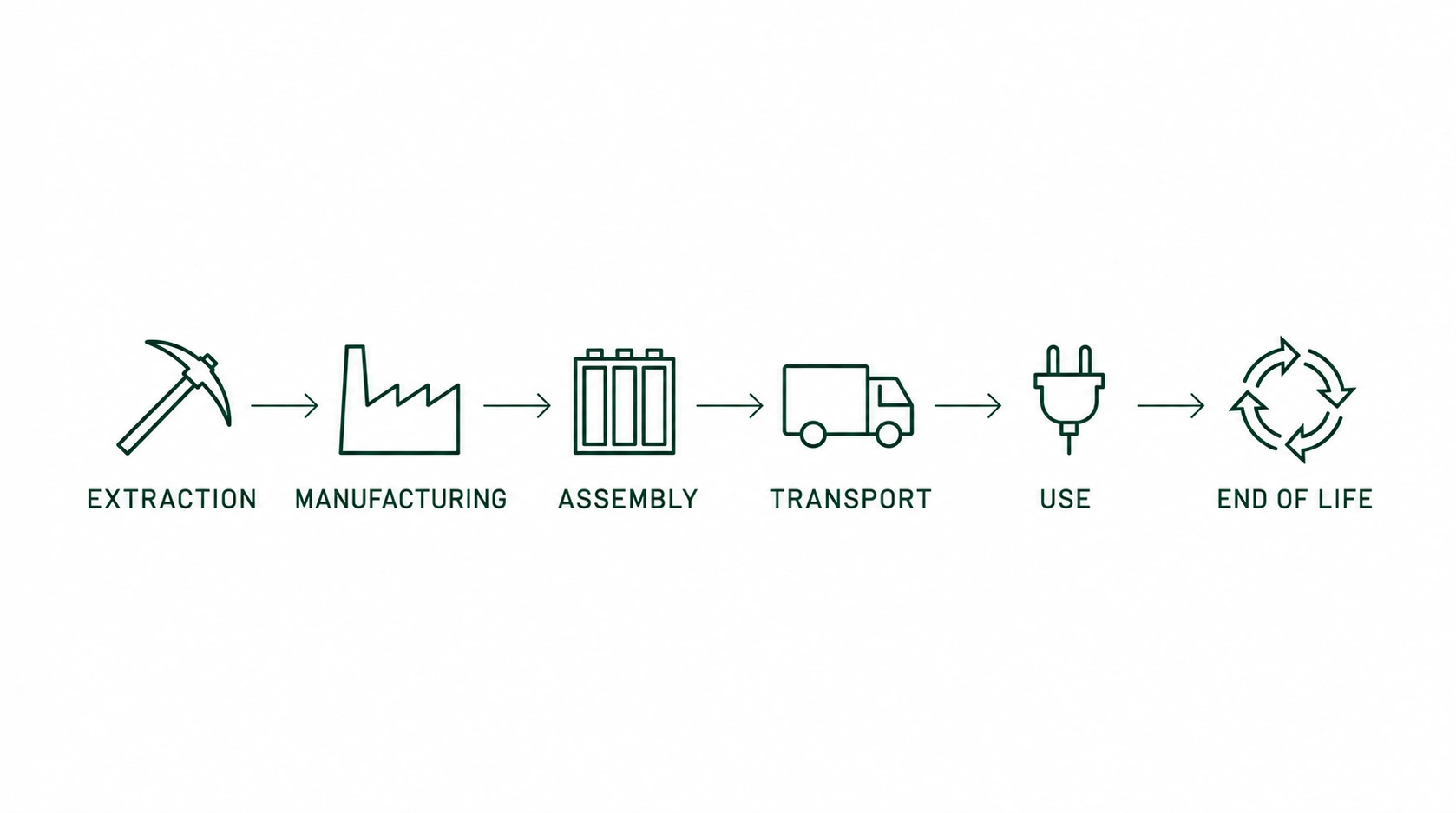
The calculation covers the entire chain, from raw material extraction (lithium, cobalt, nickel, graphite) to the exit from your factory. A "module D" is added to estimate end-of-life benefits: when materials are recycled and avoid the production of virgin materials, the footprint falls. The Regulation sets progressive recovery targets:
- Lithium: 50% by the end of 2027, 80% by the end of 2031
- Cobalt, copper, nickel: 90% from the end of 2027
- Module D: recovered materials reduce the final footprint by 5 to 15%, depending on recycling scenarios
Functional unit: the kWh delivered
The result is expressed as kgCO₂e per kWh of total energy delivered over the lifetime, rather than "kg of CO₂ per battery". The distinction matters: cycle life appears in the denominator. A battery lasting 6,000 cycles has half the footprint per kWh delivered of an identical battery lasting only 3,000, even if their manufacture had exactly the same carbon cost. This is a structural advantage for batteries designed to last, and a measurable argument for thermal management systems (immersion cooling, optimised BMS) that extend lifetime.
Primary vs secondary data
The Regulation distinguishes between primary data (your own measurements and those of your suppliers) and secondary data (generic databases such as ecoinvent or EF 3.1). The rule is simple: everything under your direct control must be covered by primary data. For upstream processes, supplier data are the target. Generic databases are accepted only as a last resort, and every use must be justified in the declaration.
The electricity mix in the country where cells are manufactured matters more than everything else. An NMC battery manufactured in Norway can outperform an LFP battery manufactured in China.

3Four workstreams, one priority: data
Once the methodological framework is set, everything moves to a single question: obtaining the data. This is where the project begins, and where delays arise. Because of collection, rather than modelling (relatively standard once the data are available). Here are the four workstreams in order of criticality.
4 workstreams, one accounting for 60% of the effort
Click a phase to see what to collect. Each segment’s width is proportional to its share of total collection time.
BOM, chemistry, supplier electricity mix, geographical origin. The workstream that determines everything.
- Detailed BOM by component (cathode, anode, electrolyte, separator)
- Exact cell chemistry: NMC, LFP, NCA
- Geographical origin → electricity mix in the manufacturing country
- Supply cycle: 8 to 12 weeks for an Asian supplier
Raw materials and geographical origin
This is the most demanding and consequential workstream. For every battery component, you need the precise chemical composition and geographical origin. The electricity mix in the cell manufacturing country is the leading impact factor, and the differences are considerable: an NMC811 cell ranges from 27 kgCO₂e/kWh in Norway to 155 in China (source: ScienceDirect, 2024). Median footprints are around 62 kgCO₂e/kWh for LFP compared with 74 for NMC811, around 16% lower (source: Nature Communications, 2024). But an NMC battery manufactured in Scandinavia can have a lower footprint than an LFP produced in a coal-powered Chinese province.
- Cell chemistry: NMC, LFP or NCA, with the composition of active materials (cathode, anode, electrolyte, separator)
- Current collectors, casing, BMS: materials and geographical origin
- Cooling system: liquid, air, immersion (affects manufacturing energy)
- Geographical origin of every component: this determines the electricity mix, and therefore the impact
The problem is obtaining these data. We were supporting a French assembler of stationary storage batteries, with LFP cells purchased from two Chinese suppliers. The first responded in 9 weeks with an Excel file in Mandarin, without the geographical origin of the lithium. The second responded in 10 days with a complete file, but the scopes did not match between the two. Standardising the data took another three weeks. The lesson: allow 8 to 12 weeks to obtain a usable dataset from an Asian supplier, and send the questionnaire with explicit instructions on the expected units and formats.
Manufacturing data (factory)
- Energy consumption in kWh per battery produced (distinguishing dry room, formation/ageing and assembly)
- Production yield: every defective cell has consumed energy for nothing
- Manufacturing waste: quantities and treatment routes
- Your site’s electricity mix: PPA purchasing contract, national grid, renewable share
These are mandatory primary data: sector averages cannot suffice for your own processes. The good news is that these data are under your control and rarely difficult to obtain if your meters are in place.
Transport and logistics
Distances and modes of transport between every link: from extraction to the cell manufacturer, from the manufacturer to your factory, and from your factory to the client. This is rarely the dominant source (sea transport of a finished battery contributes far less than the electricity mix in the manufacturing country), but the Regulation requires specific data and the verification body will check them.
End of life and recycling
Two main recycling routes, two very different profiles:
- Hydrometallurgy: better material recovery (including lithium), more expensive, sector still scaling up
- Pyrometallurgy: more mature industrially, but loses lithium in the slag
- High uncertainty: the European sector is young and actual large-scale data are scarce; this is the part of the calculation where assumptions most influence the final result
4What is the regulatory timetable?
Now that we know which data to collect and how long it takes, one question remains: by when? The timetable under Regulation 2023/1542 has already changed. In July 2025, the Council postponed the due diligence deadline from August 2025 to August 2027 (Regulation 2025/1561), mainly to give notified bodies time to become established. For rechargeable industrial batteries above 2 kWh, here are the key dates:
Timetable for industrial batteries >2 kWh
Four deadlines shaping the next 5 years. Click a milestone to see what to prepare in practice.
A prerequisite for placing on the EU market. A third-party-verified study, using the Commission’s harmonised method. Start collection 12 months before the deadline to manage supplier cycles.
- February 2027: digital product passport (DPP) required
- February 2028: mandatory carbon footprint declaration, verified by a third-party body
- Then: carbon performance classes (A, B, C) to compare batteries
- February 2030: maximum carbon footprint threshold; batteries exceeding it are banned from the market
Six months for a first declaration, 4 to 8 weeks for third-party verification, and reasonable preparation time: a manufacturer wanting to be ready without rushing should start its project in the second half of 2026 at the latest.
Typical timetable for a CFB project
- Month 1: scoping and sending supplier questionnaires (do not wait until everything is scoped: supplier collection is the critical path)
- Months 2 to 4: collecting supplier data, follow-ups at D+15 and D+30, identifying a technical contact at each supplier (rather than the salesperson) and preparing substitution scenarios using secondary data
- Month 5: modelling and sensitivity analyses on critical parameters (electricity mix, cathode chemistry, end of life)
- Month 6: verification by a notified third-party body
- For a 2nd product with the same value chain: divide by two; the model and contacts are already in place
5Mistakes that cost 6 months
We see these three mistakes recur consistently among manufacturers starting without support. Each can cost 3 to 6 months of delays or tens of thousands of euros.
- Underestimating supplier collection: this is about the quality of data received as well as response times. Formats are not standardised, geographical traceability concepts are not always understood in the same way, and the right contact (the factory’s technical manager, rather than the salesperson) is not always identified. Send your questionnaires from month 1, be explicit about expected units and allow 8 to 12 weeks
- Commissioning a complete LCA instead of a CFB: the Regulation requires the latter, rather than the former. Confusion can double the budget (from €30k to €60k+) and timetable (from 6 to 12 months). Check what your provider is proposing
- Failing to plan third-party verification: the process takes 4 to 8 weeks, and there are still few notified bodies for batteries in Europe in 2026. A verification slot should be booked 2 to 3 months ahead, rather than when the model is finished
6Passing third-party verification
Verification is not a formality. The notified third-party body checks methodological compliance, primary data traceability, consistency of assumptions and justification of secondary data. The carbon footprint declaration forms part of the CE compliance file, alongside safety certifications.
Five documents to prepare during the study, rather than afterwards
Each document has its window in the study cycle. Retrospective documentation costs 3 times more than documenting as you go.
Complete model, documented assumptions, frozen version.
Completed, dated, signed by an identified manager.
Certificates, invoices, customs declarations.
Scope choices, justification of secondary data.
Result variation under critical assumptions.
In practice, here is what the body will request:
- Modelling files: the complete model with all assumptions
- Completed and dated supplier questionnaires
- Evidence of geographical origin of raw materials (certificates, invoices, supplier declarations)
- Documentation of methodological choices: why this scope, why this secondary datum rather than a primary one
- Sensitivity analyses: how the result varies when critical assumptions change
If your supplier data are incomplete or poorly documented, this is where things get stuck. Booking a slot 2 to 3 months before your preferred date is prudent: notified bodies competent in industrial batteries are still becoming established in 2026.
7Where to start
If you are reading this article, you are probably in one of two situations: you have not started yet and are looking for a starting point, or you have started and wonder whether you are on the right track. In both cases, here is the practical sequence.
The 4 steps to get started, and the one step that derails projects
A typical industrial battery LCA follows 4 steps over 6 months. But one alone carries 70 to 80% of the risk of going off track: supplier collection. Click each step for the expert insight and practical actions.
What can be done in-house: collecting factory data (consumption, yield, your site’s electricity mix), regulatory scoping, identifying technical contacts at your suppliers and following up questionnaires. These workstreams are under your direct control and require no specialist PEF expertise. What requires external support: modelling itself (command of the PEF framework, scope selection, qualification of secondary data, sensitivity analyses), technical discussions with the notified body and critical review of responses from Asian suppliers. For a CSR team that has never carried out an LCA, learning the PEF method requires 2 to 3 weeks full-time before producing the first line of the model. This is the most frequent blind spot when deciding to bring the work in-house without measuring the investment.
Step 1 - Clarify the need: CFB or complete LCA
Carbon footprint declaration (CFB) or complete LCA? If the only objective is compliance with Regulation 2023/1542, it is a CFB. If you also aim for product eco-design or multicriteria marketing communication, a complete LCA can be justified, but the budget and timetable double.
Step 2 - Send supplier questionnaires
This is the critical path. Exact cathode chemistry, factory electricity mix and geographical origin of active materials. Be explicit about the expected units (kWh/battery, kgCO₂e/kWh of cell, percentage) and response format. Do not wait until every methodological detail is scoped before sending the first questionnaires.
Step 3 - Gather factory data
Energy consumption by source, production yield and site electricity mix. These are data you already have (or should have). If your meters are not in place, now is the time.
Step 4 - Book third-party verification
As soon as the project starts, identify a notified body and book a slot 2 to 3 months before your target date. Slots are scarce in 2026, and will be scarcer still in 2027 when everyone wakes up at the same time.
8Key takeaways
The battery carbon footprint declaration is a market requirement, rather than a voluntary label: without it, no CE marking and no placing on the European market. The deadline for industrial batteries above 2 kWh will fall 18 months after the methodological delegated act, which is still awaited: during 2028 at the earliest. A complete project takes six months, plus 4 to 8 weeks of third-party verification.
The right method to request from your provider is a CFB (€25k to €50k, 6 months), rather than a complete multi-indicator LCA (€40k to €80k, 8 to 12 months) that the Regulation does not require. The critical path is always collecting supplier data, rather than modelling: allow 8 to 12 weeks to obtain a usable dataset from an Asian cell manufacturer, and speak to the factory’s technical manager, rather than the salesperson.
Finally, the electricity mix in the cell manufacturing country matters more than everything else: it is the variable that allows a Norwegian NMC to outperform a Chinese LFP. A manufacturer wanting to be ready without rushing must start its project in the second half of 2026 at the latest, without waiting for publication of the delegated act. If you are still wondering whether you are affected, you probably already are.