
- 1France's per-garment penalty has applied since 1 September 2026; advertising and influencer promotion will be banned from 1 January 2027.
- 2A very wide product range combined with repair costs that are high relative to the price triggers France's fast fashion penalty.
- 3A brand sold mainly through a platform is automatically treated as having 100,000 product references.
- 4Check your range, prices and main sales channel, then display manufacturing locations.
Since 1 September 2026, under France's extended producer responsibility (EPR) rules, a T-shirt sold for €8 by a brand that offers more than 10,000 product references per customer segment and has no repair service carries a €2 penalty as part of its EPR fee (éco-contribution), at least 50 times the standard amount in the fee schedule. This is the first step of Law No. 2026-602 of 8 July 2026 aimed at reducing the environmental impact of the textile industry, known as the anti-fast-fashion law. The second step takes effect on 1 January 2027: a ban on advertising and on influencer promotion for ultra-fast fashion (mode ultra-express in the French text of the law).
Application timeline of the law's measures
Law of 8 July 2026 and ministerial order of 24 August 2026, position as at 28 September 2026.
Between these 2 dates, many textile companies are asking whether the law applies to them, and the answer depends on the measure. The penalty is based on a coefficient that any brand can calculate today, including French retail chains. The rules on advertising, influencers and awareness messages depend on a definition of ultra-fast fashion whose thresholds await a Conseil d'État decree (a decree adopted after review by France's highest administrative court), not published as of 28 September 2026.
1What the law of 8 July 2026 sets out: a definition, then staggered measures
The law's 12 articles mainly amend the French Environmental Code, but also the Consumer Code, the General Tax Code, the 2023 law on commercial influence and the Education Code, where the law adds awareness of sustainable clothing consumption to the environmental education taught in schools.
A bill that took 2 and a half years to pass
Introduced in the National Assembly in January 2024, with Anne-Cécile Violland MP as rapporteur, the bill was adopted there on 14 March 2024 and by the Senate on 10 June 2025. A joint committee (commission mixte paritaire) agreed the text on 17 June 2026, and the 2 chambers passed it on 24 and 29 June 2026. The law was promulgated on 8 July and published in the Journal officiel (the French official gazette) the next day. Although public debate closely associates it with Shein, the law names no company: its measures apply according to criteria.
Ultra-fast fashion, defined by 2 cumulative criteria
The new Article L. 541-9-1-1 of the Environmental Code defines ultra-fast fashion as practices that shorten the period of use or the lifespan of products by placing a high number of new product references on the market, combined with weak incentives to repair them. The 2 criteria are cumulative and apply to new clothing, footwear and household linen, that is, the products covered by the textile EPR scheme.
The text excludes clearance sellers, which resell other producers' unsold stock, and does not cover second-hand sales. For an online marketplace, the practice is assessed across all the product references it offers, except those of brands that sell mainly through another channel. The numerical thresholds, by brand and by sales channel, must be set by a Conseil d'État decree.
The law's other measures
Alongside this definition, the law introduces 6 measures, which enter into force on different dates:
- A penalty per garment as part of the EPR fee, since 1 September 2026, for all producers.
- An authorised representative established in France for any foreign company subject to EPR, since 10 July 2026.
- Manufacturing locations shown next to the price for any garment sold online.
- Awareness messages on ultra-fast fashion platforms, whose content awaits a decree.
- A ban on advertising, on the word "free" and on influencer promotion from 1 January 2027.
- The end of the tax reduction for corporate philanthropy (mécénat) on donations by these producers, and 2 reports to Parliament: one on extending the carbon border adjustment mechanism (CBAM) to textiles, the other on mirror measures on imports.
2The penalty per garment has applied since 1 September 2026
The penalty takes the form of a modulation of the EPR fee that every producer placing clothing on the market already pays to Refashion, the approved producer responsibility organisation (PRO, éco-organisme in French) for textiles, household linen and footwear. In 2025, this fee amounted to €162.7 million for 3.6 billion items, an average of 4.5 euro cents per item.
Amounts by type of garment, from 2026 to 2030
The law sets a range for the amount per item: €0.25 to €12 in 2026, with a floor and a ceiling that rise each year until they reach €2 to €20 from 2030. The ministerial order of 24 August 2026, published on 28 August, sets the amounts for 12 types of garment within that range. The amounts are identical in 2026 and 2027, from €0.50 for boxer shorts or a pair of socks to €12 for a coat, with €2 for a T-shirt and €9 for jeans; from 2030 they range from €2 to €19.50.
Household linen and footwear remain outside this schedule of amounts. A penalised product loses access to Refashion's eco-design bonuses, and a share of the fees must now fund collection, sorting and recycling infrastructure in France.
A durability threshold set at 0.8
The penalty applies to any product whose durability coefficient D is less than or equal to 0.8. This coefficient, which ranges from 0.67 to 1.45, is the one used in the environmental labelling scheme for clothing, and the order provides that a calculation made under the labelling method is valid for the penalty. It combines 2 indices in equal parts, each scored from 0 to 1:
- Range width (G): the maximum number of product references the brand offers on any one day, per segment (women, men, children, babies, underwear). G is 1 below 1,000 references, 0.5 at 7,000 and 0 above 16,000. A brand sold mainly through a platform is treated as having 100,000 product references.
- Repair incentive (R): the average repair cost (€10 for a T-shirt, €14 for trousers, €31 for a jacket) relative to the price incl. VAT, excluding sale prices, and, for companies that are not small or medium-sized enterprises (SMEs), the existence of a repair service labelled by Refashion, which counts for a third.
In the formula, the 0.8 threshold amounts to G + R not exceeding 1/3. A brand that stays below 10,000 product references per segment is therefore never exposed to it, whatever its price; above that level, everything depends on the selling price relative to the cost of repairing the item.
Calculate the penalty for a garment
Describe the garment and your situation: the calculation applies the formula in the ministerial order of 24 August 2026 and the ministry's methodology note.
2.00€
Penalty scale: €2.00. The cap of 50% of the price excl. VAT (€3.33) does not come into play.
Refashion has yet to set out the details
As of 28 September 2026, Refashion has not published its operating procedure: on 15 September, ADEME (the French Agency for Ecological Transition) said that the PRO would adjust its fee schedule and determine how to identify the companies affected. The law authorises it to collect data from platforms automatically, despite their terms of use, on terms to be set by decree. On its usual timetable, a year's volumes are declared at the start of the following year, so items sold since September would be invoiced in 2027.

3What the penalty costs on an €8 T-shirt
The €8 T-shirt is far from an extreme case: according to Refashion's annual barometer, the average price of an entry-level item sold in France was €8.30 in 2025, and 7 in 10 purchases fall in this segment, excluding second-hand.
The calculation for a T-shirt sold on a platform
Consider a T-shirt sold for €8 incl. VAT by a large brand whose main sales channel is a platform, with no labelled repair service. Its range width is automatically set at 100,000 product references, so G = 0, and repairing it costs €10, more than its price, so R = 0. Its coefficient therefore falls to the minimum, D = 0.67, and the penalty applies in full: €2 per item in 2026 and 2027.
Relative to the price of €6.67 excl. VAT, these €2 represent 30% of the price. They are also 50 times the standard EPR fee for a men's T-shirt in the 2026 Refashion fee schedule, which is €0.0396. For 100,000 items a year, the bill rises from around €4,000 to more than €200,000.
The price below which a garment is penalised
For a brand treated as having 100,000 product references, price is all that matters. For a company that is not an SME and has no labelled repair service, our calculations put the threshold at €15.11 incl. VAT for a T-shirt or a shirt, €21.16 for jeans and €46.85 for a coat. For an SME, the T-shirt threshold falls to €12.88. A labelled repair service takes a large brand almost entirely out of the penalty zone: its T-shirt remains in it only below about €10.
Where the penalty starts, by product range size and price
Zone where the durability coefficient does not exceed 0.8, for a large company with no labelled repair service. Above 16,000 product references per segment, only the price matters.
The cap at 50% of the price excluding VAT
At the producer's reasoned request, Refashion must limit the penalty to half of the selling price excluding VAT. The law does not specify which price is the reference: we use the price paid by the consumer net of 20% VAT, which is the price in a direct sale. For the €8 T-shirt, this cap is €3.33 and only comes into play in 2030, when the fee schedule reaches €3.50. For a €5 T-shirt, the cap falls to €2.08, and the penalty stays frozen at around €2 from 2026 to 2030.
The effect is clearer on jeans sold for €15 incl. VAT, whose penalty is cut from €9 to €6.25 from 2026. The cheaper the item, the lower the cap: the increase scheduled up to 2030 affects only garments whose price excluding VAT is more than twice the penalty.
Capped at 50% of the price excluding VAT, the penalty on jeans sold for €15 stays at €6.25 from 2026 to 2030, while the fee schedule rises from €9 to €17.25.
The limits of the penalty
At Projet Celsius, we consider that the penalty weighs heavily on low-priced items from 2026, at 30% of the price excluding VAT for an €8 T-shirt, but that its scheduled increase up to 2030 runs into the cap for those same items, where ultra-fast fashion concentrates its sales. The coefficient does not measure volumes either: a brand that sells millions of units of a narrow range escapes it, a limitation we already noted in our guide to the textile labelling coefficient. Finally, nothing prevents a producer from passing the penalty on in its prices, and the penalty's effectiveness will depend on Refashion's ability to identify brands and their actual volumes.
4Advertising and influencers: what will be banned from 1 January 2027
The second step of the law targets demand. From 1 January 2027, 2 bans apply to ultra-fast fashion products and to the brands that rely on it.
All advertising, direct or indirect
The new Article L. 229-61-1 of the Environmental Code prohibits advertising relating to these products and advertising that directly or indirectly promotes the brands. According to the government's guidance page, this covers in particular event sponsorship, product placement in films or series and favourable media reviews. The word "free", often applied to delivery, may no longer be used as a selling point for these products.

The sanction mirrors the one for fossil fuel advertising: a fine of up to €100,000 for a legal entity and €20,000 for an individual. These amounts may be raised to the entire amount spent on the operation and doubled for a repeat offence.
Influencers: a fine of up to €100,000
The 2023 law on commercial influence now prohibits influencers from any promotion of these products and brands, paid or unpaid, whatever the compensation. Breaches are subject to an administrative fine of up to €100,000, imposed by the DGCCRF (the French consumer protection authority). Agencies and brands that work with content creators should review contracts that run beyond 31 December 2026.
A ban that depends on a decree
These 2 bans rely on the definition of ultra-fast fashion, whose thresholds for product references and repair criteria must be set by a Conseil d'État decree. This decree had not been published as of 28 September 2026, nor had the decree setting out the implementing rules for the advertising ban. Without it, it is impossible to know which brands fall within scope, which would make the ban hard to enforce on 1 January 2027.
5Shein and Temu: what the law can require of them
The French ministry presents the penalty as aimed in particular at the best-known non-European platforms. In 2025, Shein had already accepted a fine of €40 million for misleading commercial practices, including unsubstantiated environmental claims, a subject we cover in our article on carbon neutrality (in French).
The penalty and the authorised representative apply to all sellers
Textile EPR applies to anyone placing clothing on the French market, wherever it is established. Since 10 July 2026, a foreign company subject to EPR must also appoint an authorised representative established in France to answer for its obligations (the rule is set out in our article on the EPR authorised representative) and register under a unique identifier (identifiant unique, or IDU, also known as unique identification number, UIN), the EPR registration number issued by ADEME. The penalty is therefore the measure most directly enforceable against large online sellers.
An exception for operators established in the European Union
The article that defines ultra-fast fashion and imposes the awareness messages does not apply to persons established in another country of the European Union or the European Economic Area, and the advertising ban excludes online services provided from another Member State. This is the country-of-origin principle of the e-Commerce Directive: France can enforce these rules against them only through a case-by-case derogation procedure, notified to the Commission and to the State of establishment.
Which measure applies to whom
The rule that applies to each type of player, measure by measure, as it stands on 28 September 2026, before the implementing decrees.
Conditional or upcoming. The ban does not cover online services provided from another EU Member State, except through a derogation procedure. For media falling under French jurisdiction, it refers to a definition that excludes these operators: its scope remains to be clarified.
Shein sells in Europe through a subsidiary established in Ireland, as the CNIL, the French data protection authority, pointed out when it sanctioned the company in September 2025. According to the European Commission, Temu sells through a subsidiary based in Dublin. In our reading, without a derogation procedure, the messages and the online advertising ban do not reach them directly, whereas the penalty, which does not depend on this definition, remains fully enforceable. The ban on influencers makes no exception of this kind, but it refers to the same definition: its scope for these brands has yet to be clarified.
A text examined by Brussels
France notified the bill to the Commission on 27 June 2025 (notification 2025/0336/FR). The Commission and Sweden issued detailed opinions, which put its adoption on hold until 30 December 2025. The penalty mechanism, on the other hand, is consistent with EU law: Directive (EU) 2025/1892 allows Member States to modulate contributions according to ephemeral and ultra-ephemeral fashion practices.
6What French brands must check
A French brand with a narrow range is not caught by the definition of ultra-fast fashion, but 2 provisions of the law apply to it directly, and the first depends on its main sales channel.
Calculate your durability coefficient
A brand that has already calculated the environmental cost (coût environnemental, also known as the French eco-score) of its garments with the Ecobalyse calculator knows its coefficient, since the order recognises that method. Other brands do not need a life cycle assessment (in French) to find it: it is calculated from the maximum number of product references sold on a single day per segment on the main channel, the price incl. VAT, excluding sale prices, of each type of garment, and whether the brand runs its own repair service, labelled by Refashion under the repair bonus (in French). This coefficient is part of the environmental cost used by the textile score calculation tools (in French).
The main pitfall is for brands that sell mainly through online marketplaces: if the platform is their main channel, or if they have no unique identifier in their own name on a multi-brand site, they are treated as having 100,000 product references. An SME that sells T-shirts at €10 on a marketplace then crosses the threshold with only a few hundred styles.
Display manufacturing locations next to the price
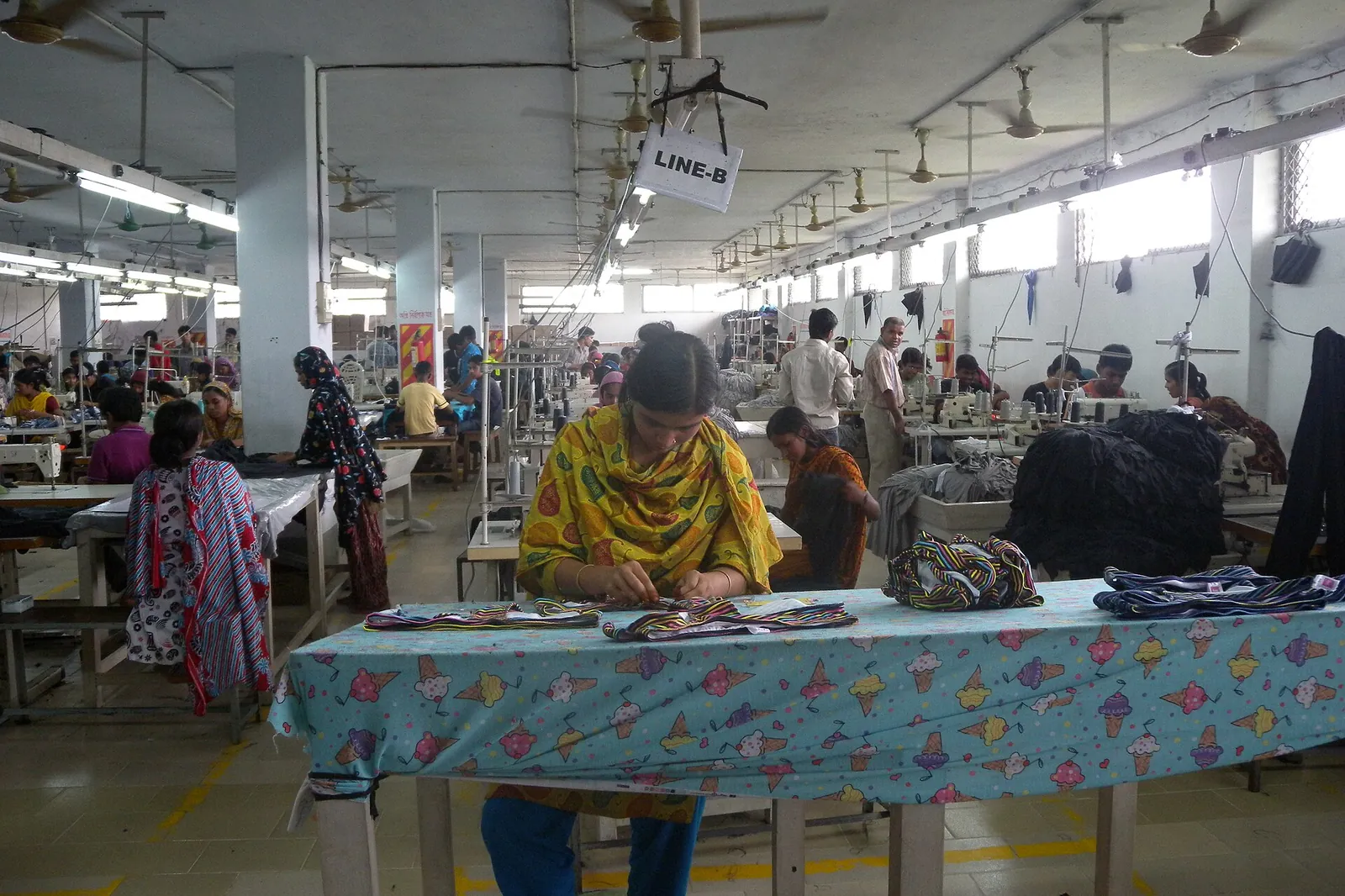
Article L. 541-9-1-2 applies to any garment, pair of shoes or household linen item sold online, with no condition as to size or commercial practice: manufacturing locations must appear near the price, in characters of the same size. The text does not refer to a decree and does not define what is meant by manufacturing locations.
Brands above €10 million in turnover and 10,000 units placed on the market must already state, under the AGEC law (France's Anti-Waste and Circular Economy Act), the countries of weaving, dyeing or printing, and garment making, according to the ministry's FAQ. For them, what is new is where the information appears; for smaller brands, the obligation is entirely new.
Prepare for the series of deadlines ahead
The penalty comes on top of a busy timetable. From 1 October 2026, a third party will be able to publish the environmental cost of a garment without the brand's agreement, which will increase the risk of publishing nothing (in French). The EU ban on destroying unsold goods, provided for by the Ecodesign for Sustainable Products Regulation (ESPR) (in French), has applied to large companies since July 2026, and the textile Digital Product Passport (DPP) (in French) is expected around 2029.
Finally, any communication about the sustainability of a collection must be substantiated, under the rules on environmental claims (in French), which the Empowering Consumers (EmpCo) Directive tightens further. Our overview of ESPR, DPP and environmental labelling (in French) sets them in context.
7Key takeaways
- Law No. 2026-602 of 8 July 2026 targets ultra-fast fashion, defined by a high number of new product references and weak incentives to repair.
- Since 1 September 2026, any garment whose durability coefficient does not exceed 0.8 carries a penalty of €0.50 to €12 per item, and up to €19.50 in 2030.
- The cap at 50% of the price excluding VAT, which applies at the producer's request, freezes the penalty on the cheapest items: from 2026 for jeans at €15 and from 2028 for a T-shirt at €5.
- From 1 January 2027, advertising and influencer promotion will be banned, but the decree setting the thresholds of the definition has not yet been published.
- French brands must check their coefficient and main sales channel, and display manufacturing locations next to the price online.
For the penalty in the wider context of EPR schemes, our guide to EPR schemes explains how the EPR fee is calculated, and our article on textile eco-design (in French) sets out the levers that improve both the environmental cost and the durability coefficient.
- Law: Law No. 2026-602 of 8 July 2026 aimed at reducing the environmental impact of the textile industry, Journal officiel of 9 July 2026, Articles 1 and 2 (Environmental Code, Articles L. 541-9-1-1 and L. 541-9-1-2), 3 (General Tax Code, Article 238 bis), 5 (Articles L. 541-10-9-1 and L. 541-10-27), 6 (Article L. 229-61-1) and 7 (Law No. 2023-451, Article 4 IV bis); full text on AIDA.
- Penalty: Ministerial order of 24 August 2026 amending the specifications of the textiles, household linen and footwear (TLC in French) scheme, Journal officiel of 28 August 2026, paragraph 2.2.3.1 (text on AIDA); ministry methodology note of 28 August 2026; ADEME, 15 September 2026.
- Durability coefficient: Ministerial order of 6 September 2025 on the methodology for calculating the environmental cost of textile clothing products, Article 6.
- Sanctions: Environmental Code, Articles L. 229-63 (advertising) and L. 541-9-5 (EPR); Law No. 2023-451 of 9 June 2023, Article 4 IV bis (influencers).
- Sector data: Refashion: 2026 fee schedule, 2025 indicators, 2025 consumption barometer, published on 17 June 2026.
- European law: Technical Regulation Information System (TRIS) notification 2025/0336/FR of 27 June 2025; Directive (EU) 2025/1892 of 10 September 2025, Article 22a, paragraph 14 (textile EPR by 17 April 2028 at the latest), and Article 22c, paragraph 6 (modulation according to ephemeral and ultra-ephemeral fashion practices); Directive 2000/31/EC on electronic commerce, Article 3.
- Official presentations: Ministry of Ecological Transition and Entreprendre Service Public, 20 July 2026; the ministry's AGEC FAQ, November 2025.
- Operators cited: CNIL, sanction of 1 September 2025 (Infinite Styles Services Co. Limited, Irish subsidiary of Shein); European Commission, press release IP/26/1707 of 31 July 2026 (WhaleCo Technology Limited, Temu). The Légifrance pages are in French, as are the other French official and industry sources linked above.