
Skip to content
Get in touchFR
Updated in June 2026
Explained

ChatGPT carbon footprint: what a query costs and how much AI weighs in a company's footprint

A ChatGPT query uses about 0.3 Wh, the same order of magnitude as a Google search: the earlier estimate of 2-3 Wh has been cut by a factor of 10. For a service-sector SME, AI accounts for less than 1% of the carbon footprint.

Guillaume Pakula
By Guillaume Pakula, co-founder of Celsius. Since 2019, he has helped 80+ organisations with their Bilan Carbone® and climate strategy.
February 2026
Updated June 2026 · 6 min
A ChatGPT query uses about 0.3 Wh, the same order of magnitude as a Google search: the widely repeated "10 times more" rested on an outdated figure that recent measurements have divided by 10. For an SME with 200 employees, AI accounts for less than 1% of its Bilan Carbone® (the French carbon accounting method). Within digital, what matters is the manufacturing of equipment: extending the lifespan of a PC fleet from 4 to 6 years cuts the annualised manufacturing footprint by about 33%.
Key takeaways
  • 1A ChatGPT query uses about 0.3 Wh, the same order of magnitude as a Google search.
  • 2AI weighs less than 1% of the carbon footprint of an SME, even with intensive use.
  • 3The real digital lever is making equipment last, which cuts the annualised manufacturing footprint by about 33%.
  • 4Hosting in France or Scandinavia cuts emissions by a factor of 5 to 10.
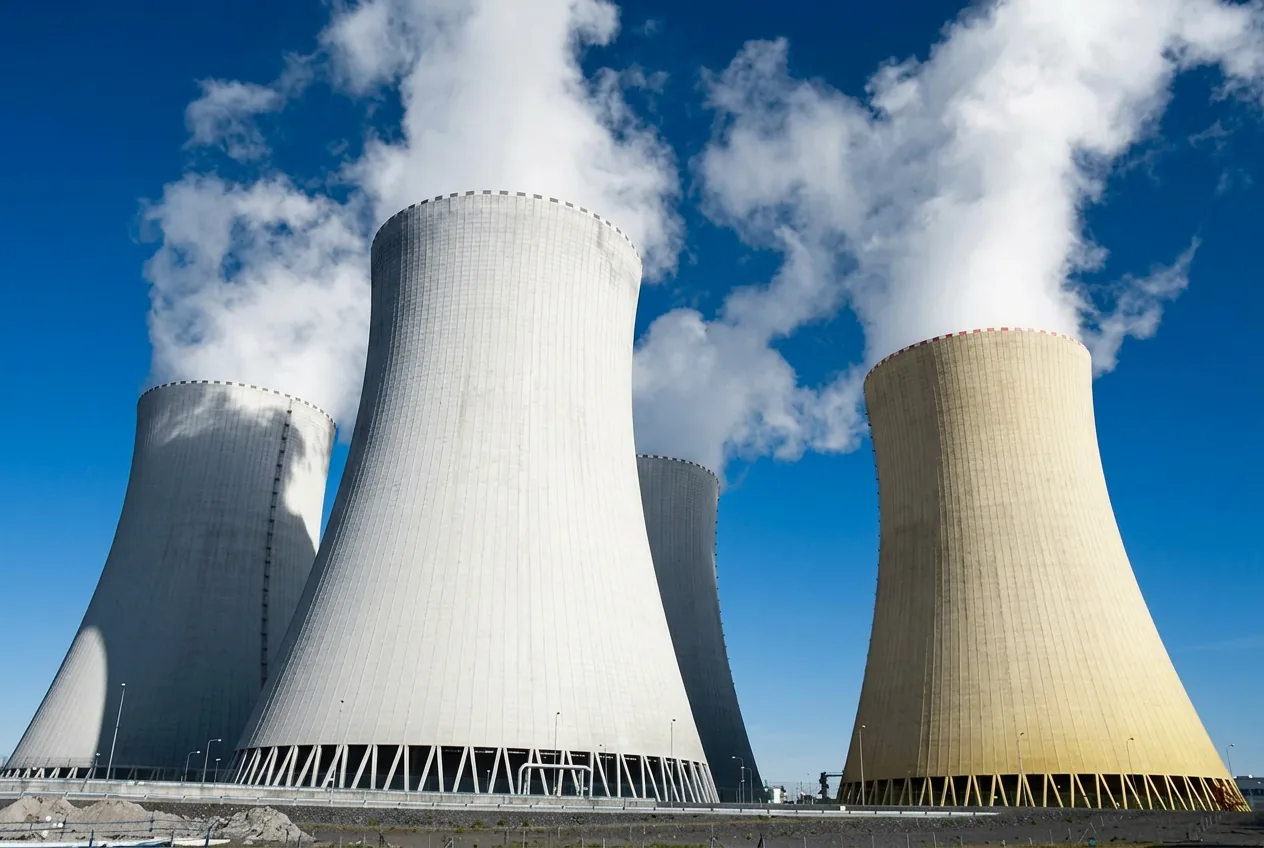
Cooling towers of a nuclear power station releasing plumes of water vapour into the sky
What comes out of the cooling towers is water vapour, not CO2: a data centre's carbon footprint is determined further upstream, by the electricity mix that powers its servers.

Google's 2026 environmental report shows emissions 81% higher than in 2019, including an 18% rise in 2025 alone, driven by the construction of data centres for AI. This is the most visible effect of AI on the climate, along with the water AI consumes to cool these facilities. The question is what this means for a company that uses these tools.

In most cases, it matters far less than the headlines suggest, as long as you think in orders of magnitude (in French) and compare AI with the other emission sources in the footprint.

For a long time, a query to an AI model was said to use 2 to 3 Wh, or 10 to 15 times as much as a Google search. That figure is now out of date: recent analyses have divided it by about 10, and according to Epoch AI the old estimate was about 10 times too high. For a model-by-model breakdown, the ChatGPT, Claude and Gemini comparison ranks the published figures.

Orders of magnitude

ChatGPT query and Google search: the same category

The estimate that made AI seem energy-intensive (2-3 Wh per query) has been divided by 10.

÷10compared with the original estimate: the gap with Google has narrowed sharply

A typical AI query and a Google search both use a few tenths of a Wh.

Epoch AI; Google (2009, the only official figure for search); arXiv 2508.15734. Per query: a fraction of a gram of CO2e, depending on the hosting country.

A short text query to ChatGPT, Gemini or Claude uses about 0.3 Wh: Google measured a median Gemini query at ~0.24 Wh (arXiv study 2508.15734), Sam Altman puts ChatGPT at ~0.34 Wh, and a benchmark of GPT-4o, a model withdrawn from ChatGPT in February 2026, gives ~0.43 Wh. An AI query and a Google search are therefore of the same order of magnitude, nowhere near a factor of 10. For more on this comparison, see ChatGPT query vs Google search.

  • AI query (generative AI, short text): ~0.3 Wh, not the 2-3 Wh that used to be quoted
  • Standard Google search: same order of magnitude, ~0.3 Wh
  • Life cycle of a large model: 20,400 tCO2e for Mistral Large 2, from training to January 2025, including 18 months of use, according to the life cycle assessment (LCA) that Mistral published with Carbone 4 and ADEME (the French Agency for Ecological Transition)
  • Data centres worldwide: ~1.5% of global electricity consumption in 2024, projected to reach ~3% in 2030 (base case of the IEA, the International Energy Agency)

2AI makes up a small share of an SME's carbon footprint

For an SME with 200 employees that uses AI tools intensively (100 queries per employee per day, which is already a lot), the annual footprint of that use stays below 1 tonne of CO2, very little next to the main emission sources:

Perspective

AI and cloud account for less than 1% of an SME carbon footprint

Typical emissions breakdown for an SME with 200 employees

Within digital emissions, equipment manufacturing accounts for far more than AI use. 100 queries per day per employee, 200 employees: less than 1 tonne of CO2 per year.
ADEME, Celsius estimates
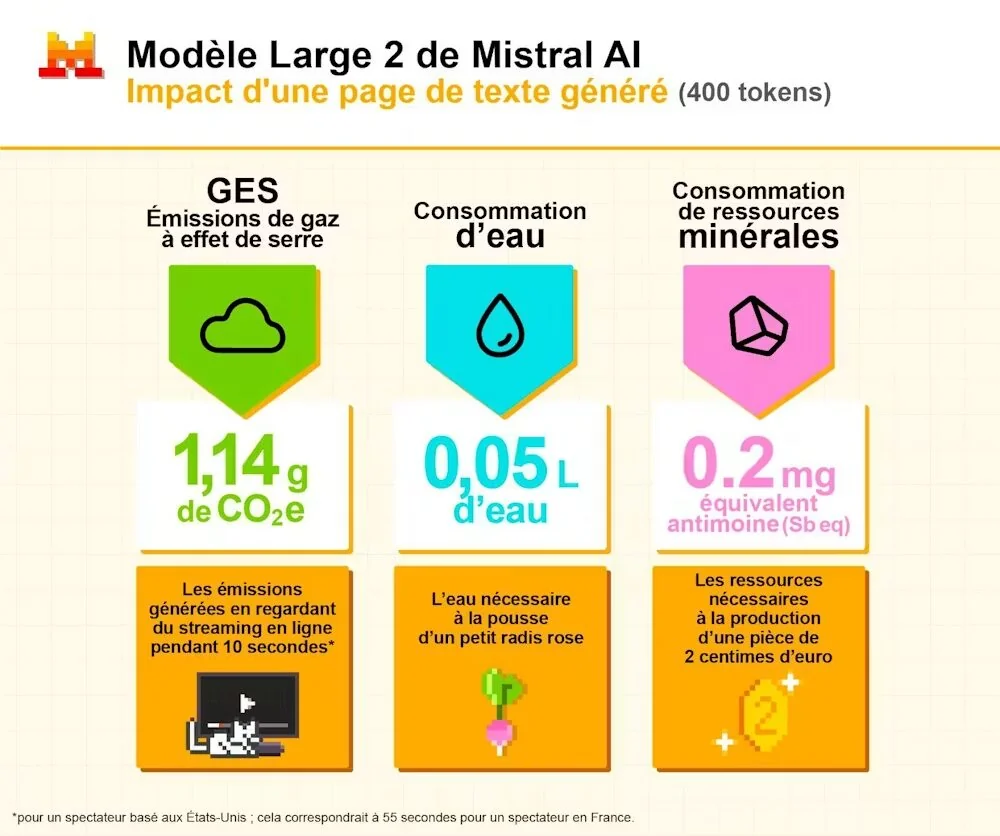
Mistral AI infographic: impact of a page of text generated by Mistral Large 2 - 1.14 gCO2e, 0.05 L of water, 0.2 mg of antimony equivalent
Provider LCA - Mistral × Carbone 4 × ADEME
1.14 gCO2e for 400 tokens: a figure to read within its boundary
See the Mistral Large 2 LCA

Mistral has published the first complete life cycle assessment of a large model, covering production, training, inference (meaning use of the model to answer queries) and the end of life of the servers. The figure is useful but cannot be compared point by point with Google's per-query measurement (~0.24 Wh), which covers only the data centre's electricity. A broad boundary on one side, a production indicator on the other.

3AI use is growing fast, and its trajectory is worth monitoring

If AI use doubles every year (as it does in many companies) and efficiency gains in models do not offset that growth, digital could become a significant emission source within 5 to 10 years. For now, they do not: the gains are absorbed by the increasing size of models.

Google emissions

Google: emissions up 48% in 5 years

Annual emissions in MtCO2e, driven by AI data centres.

+48%compared with 2019

051015growth of generative AI10.2201910.5202010.8202111.5202213.0202314.92024

IEA projection: data centres = approximately 3% of global electricity in 2030.
Google Environmental Report, IEA 2024
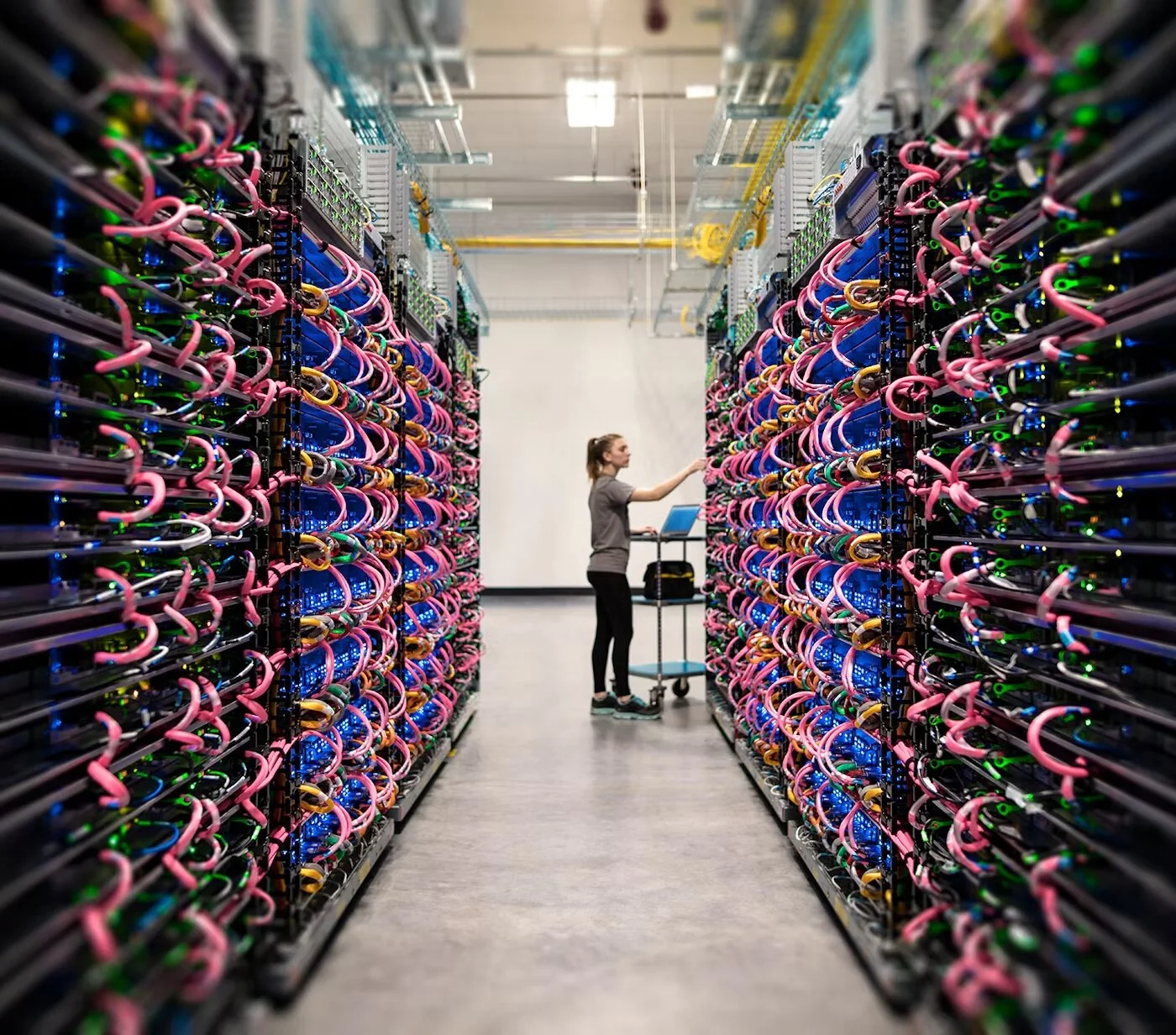
Aisle of a Google data centre with a technician working between racks of cabled servers
Behind every query there are physical racks, cables and the people who work on them: Google's emissions trajectory climbs as these rooms multiply.

Including AI in your Bilan Carbone® (the French carbon accounting method) now gives you a baseline against which to measure this change. Methodologies exist, although they are still young: the ADEME digital reference framework and the database of the French organisation Boavizta.

45 levers to reduce your company's digital carbon footprint

In descending order of impact:
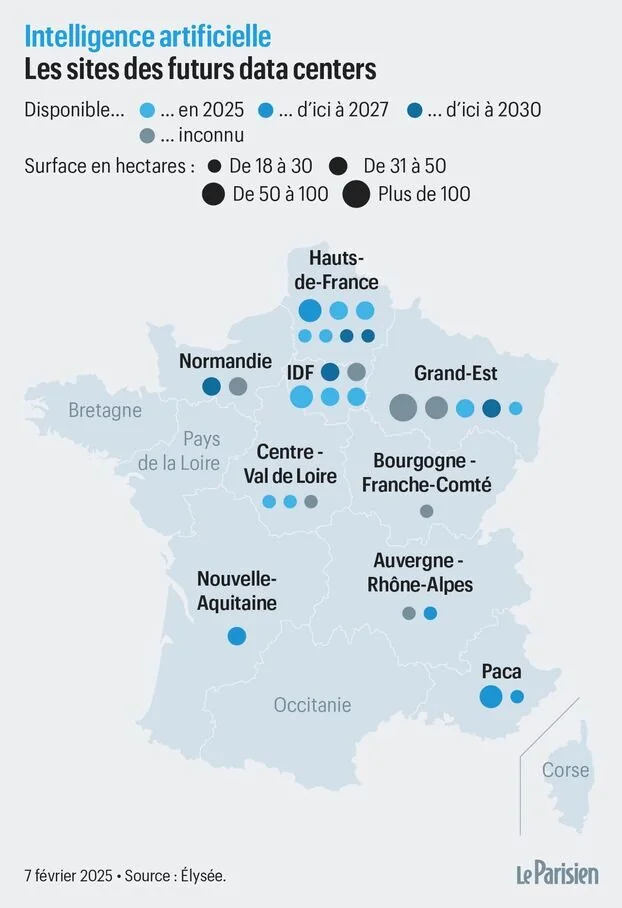
Le Parisien map of future data centre sites in France: Hauts-de-France, Île-de-France, Grand Est, Normandy, Centre-Val de Loire, Burgundy-Franche-Comté, Nouvelle-Aquitaine, Provence-Alpes-Côte d'Azur
The cloud's physical footprint - French presidency (Élysée), February 2025
Where the "cloud" lands in France
Read the Le Parisien report (in French)

About thirty sites announced by 2030, concentrated in Hauts-de-France, Île-de-France and Grand Est. Behind the word "cloud" lie hectares of land, a grid connection and a local electricity mix, which together decide the real footprint. The issue has moved beyond energy and become one of land-use planning.

  • Extend the lifespan of equipment from 4 to 6 years: the annualised manufacturing footprint falls by about 33%. This is the number 1 lever, and it saves money.
  • Include refurbished equipment in the IT purchasing policy: a refurbished PC has a footprint ~70% lower than a new one
  • Choose a cloud hosting provider in France or Scandinavia: emissions are 5 to 10 times lower than with a US data centre powered by natural gas
  • Use AI selectively: a chatbot that answers questions the FAQ already covers wastes energy. Reserve AI for high-value tasks
  • Choose smaller models when the task allows it: a small model uses 5 to 10 times less energy than a frontier model on simple tasks

5Key takeaways

For most organisations, AI has a real but still marginal carbon cost. Within digital, manufacturing equipment weighs far more than the use of cloud services; what needs watching in the coming years is how AI use develops.

  • An AI query uses about as much energy as a Google search (~0.3 Wh each): the old factor of 10 has not survived recent measurements, and usage remains marginal at the scale of a company's carbon footprint.
  • AI accounts for less than 1% of the total footprint of most SMEs, even when it is used intensively
  • The most effective digital lever is extending the lifespan of equipment: going from 4 to 6 years cuts the annualised manufacturing footprint by about 33%.
  • The choice of data centre matters: hosting in France or Scandinavia emits 5 to 10 times less than hosting in the United States, on a life cycle assessment basis.
  • Google's emissions have risen by 81% since 2019: the issue is real at the macro level, but it is not (yet) a priority for an SME.

Further resources

Frequently asked questions

About 0.3 Wh for a short text query. The long-standing estimate of 2-3 Wh (10 times a Google search) has been divided by about 10 by recent analyses: Google measured a median Gemini query at ~0.24 Wh, and Sam Altman puts ChatGPT at ~0.34 Wh. An AI query and a Google search are now of the same order of magnitude.
For most companies, AI is not a priority emission source: it accounts for less than 1% of the footprint in most cases. The priorities remain purchases (Scope 3 (in French)), energy and travel. AI is something to include and monitor, not an emergency.
ADEME's digital reference framework and the Boavizta database provide emission factors for each type of cloud service. In practice, your cloud provider (AWS, Azure, GCP) also publishes emissions data by service. These figures go into your Bilan Carbone® under digital services in Scope 3.
No. The aim is to use AI selectively rather than systematically, and to choose hosting providers with a low-carbon electricity mix. Giving up AI to save 1 tonne when the executive committee's travel (in French) emits 24 would be a poor trade-off.
Yes, 5 to 10 times lower on a life cycle assessment basis, thanks to the French electricity mix (90% low-carbon, mainly nuclear). It is a simple but rarely used lever: choose a hosting provider with data centres in France or Scandinavia.
Yes, if it is used well: it can optimise logistics, analyse consumption data and model reduction scenarios. Its net effect depends on what it saves compared with what it consumes.
The footprint arises in 2 phases: training, which happens once, and use (inference, meaning running a trained model to answer a query), which recurs with every query. The LCA published by Mistral puts Mistral Large 2 at 20,400 tCO2e, including training and the first 18 months of use. A short text query uses about 0.3 Wh, the same order of magnitude as a Google search: Google measured 0.24 Wh for a median Gemini query. Worldwide, data centres accounted for about 1.5% of electricity consumption in 2024, and the IEA projects a share of around 3% in 2030.
The first lever is targeted use: reserving AI for high-value tasks rather than using it by default (for example, to answer questions that an FAQ already covers). Next come smaller models, where the task allows it (5 to 10 times less energy than a frontier model on simple tasks), and hosting in France or Scandinavia, which can cut emissions by up to a factor of 5 to 10 compared with a US data centre powered by gas. Within a company's digital carbon footprint, extending the lifespan of equipment from 4 to 6 years matters more: the annualised manufacturing footprint falls by about 33%.
or: [email protected]

More articles to read

View all →
French environmental cost label for clothing: what changed on 1 October 2026
Regulation

French environmental cost label for clothing: what changed on 1 October 2026

6 min read
Which garments can display an environmental cost in France? Timeline and thresholds, 2025-2027
Regulation

Which garments can display an environmental cost in France? Timeline and thresholds, 2025-2027

10 min read
Removable batteries and battery passports: who is affected in 2027?
Regulation

Removable batteries and battery passports: who is affected in 2027?

14 min read

No two situations are exactly alike.

Tell us about yours: your situation, deadline and budget. A senior consultant will reply within 24 working hours with an honest assessment.

Let us discuss it within 24 hours →
Our toolkit

A full range of free assessment tools

Cost estimator, obligation and eligibility checkers, footprint calculator.

Estimate costs and impacts
Réf. 2026·BC·0184RAPPORT · EXERCICE 2026Bilan Carbone®complet 1·2·3Restitution Comex · Plan d'action 2027SOMMAIRE01Synthèse exécutivep. 402Périmètre et méthodologiep. 1203Émissions par scopep. 2404Plan d'action 2027p. 5605Annexes méthodologiquesp. 78VOLUME84 pages · ConfidentielRÉFÉRENTIELISO 14064 · GHG ProtocolDEVIS · BC.2026.0184Émis 05·05·2026 · Validité 30 jCabinet Celsius · Paris 3eCHIFFRAGE INDICATIFVotre entrepriseETI · 180 collaborateurs · CSRD 2027PRESTATIONBilan Carbone®Périmètre 1·2·3 · 13 semainesAIDE BPIFRANCE · - 60 %FOURCHETTE INDICATIVE HT16 800à 22 400 €DÉTAIL DE LA MISSION01 · CADRAGE3 sem.~ 4 200 €02 · MODÉLISATION8 sem.~ 9 800 €03 · RESTITUTION2 sem.~ 4 800 €Estimation indicative · Affinée après cadrageSIRET 891 234 567 00012

Bilan Carbone® cost estimator

Your price range in 1 minute, based on 2026 market rates and public funding.

1 minStart
Estimate costs and impacts
EMPREINTE IA · USAGE MENSUELVOTRE EMPREINTE TOTALE4,2 kgCO₂eq sur 1 000 prompts type · Mai 2026COMPARAISON DES MODÈLES · 1 000 PROMPTS TYPEGPT-4oOpenAI6,8 kgClaude OpusAnthropic2,1 kgGemini ProGoogle4,5 kgMistral LargeMistral AI · FR1,6 kg

AI carbon footprint calculator

The climate impact of your AI queries, by model and task. Ecologits methodology.

3 minStart
Check an obligation
DIAGDÉCARBON'ACTIONACCÉLÉREZ LATRANSFORMATIONÉNERGÉTIQUE ETÉCOLOGIQUE DEVOTRE ENTREPRISEDISPOSITIF OFFICIEL · BPIFRANCE × ADEMESIMULATEUR · ÉLIGIBILITÉÉLIGIBLEVous remplissez les 3 critères du Diag Décarbon'Action.VOTRE FINANCEMENT10 000 € HT6 000 €HTReste à charge après subvention BpifranceRÉPARTITION DU FINANCEMENTBPIFRANCE 40%VOUS 60%4 000 €6 000 €DISPOSITIF SUBVENTIONNÉ PAR

Diag Décarbon'Action eligibility

Check in 30 seconds whether your business is eligible for Bpifrance funding covering 40% of a Bilan Carbone® assessment.

30 secStart
Check an obligation
RÉPUBLIQUE FRANÇAISEMinistère de la Transition ÉcologiqueOBLIGATION LÉGALEBilan d'Émissions deGaz à Effet de SerreArticle L.229-25 du Code de l'environnementDécret 2022-982 · publié 1er juillet 2022PÉRIODICITÉ · 4 ANSDÉPÔT · ADEMESIMULATEUR · OBLIGATION BEGESASSUJETTI720 salariés · obligation BEGESSANCTION ENCOURUE50 000 €amende max si non-réalisationart. R.229-50RÉFÉRENCE OFFICIELLE

BEGES checker

Does the BEGES requirement apply to you? An immediate answer, with the deadline and penalty.

30 secStart
Check an obligation
9:42SCANSCANNING DPP...DPP IDENTIFIÉT-shirt coton bioSKU TX-CB-220 · Lot L-26-04781CONFORME ESPR42 DATA POINTS · 5 SECTIONSORIGINEInde · GOTSCoton bioEMPREINTE5,2 kg CO₂eqACV ISO 14040RECYCLABILITÉ85%Filière cotonRÉPARABILITÉ7,5 / 10Pièces accessiblesFIN DE VIEFilière TLC · Bordeaux/FRRécupérateur agréé RefashionUE · ESPR 2024/178112.05.2026

DPP checker

Is your product covered by the Digital Product Passport?

1 minStart
Check an obligation
COÛTENVIRONNEMENTAL386POINTS257POUR 100 GMéthode officielleEcobalyse, v7.0.0SIMULATEUR · AFFICHAGE ENVIRONNEMENTALÉLIGIBLETextile · affichage volontaireCOÛT ENVIRONNEMENTAL386 ptst-shirt 150 g · 257 pts pour 100 gExemple : FAQ du ministère de la Transition écologique

Textile environmental labelling 2026

Voluntary labelling, but third parties can publish it from October 2026: where do you stand?

1 minStart