


- 1Claude comes first in almost every independent assessment, though with a modest score.
- 2Grok comes last almost everywhere, after millions of non-consensual sexualised images.
- 37 of the 8 major assistants learn from your conversations unless you opt out.
- 4AI blackmail comes from forced tests, in which almost every model gives in.
Each AI receives an ethics score out of 100: the higher it is, the more ethical the AI. It adds up 4 criteria seen from the user's side: what the AI agrees to produce, what it does with your data, its safety and the way its developer holds to its limits. The following sections compare the 10 assistants criterion by criterion.
1What is the most ethical AI in 2026?
Claude comes first, Grok last
Every AI promises to be responsible; the differences show in what each agrees to do and in what its developer does under pressure. On that ground, Claude, Anthropic's AI, comes first with 77/100, ahead of Microsoft's Copilot (58) and ChatGPT (52). Grok, xAI's AI, comes last with 17, just behind DeepSeek (18). Each row of the table expands to show the reason.
Ethics score of 10 AI assistants, out of 100
The higher the score, the more ethical the AI. 4 criteria rated from 0 to 3 by Projet Celsius, then weighted. Tap a row to read our view and the reason for each score.
| Assistant | |||||||
|---|---|---|---|---|---|---|---|
| 1 | ClaudeAnthropic | 77 | 27.5 | 17.5 | 16.7 | 15.0 | |
The most ethical, and 1st in almost every independent assessment: sexual content refused even in fiction, no images, and a no to the Pentagon that cost it a sanction. | |||||||
| 2 | CopilotMicrosoft | 58 | 20.0 | 15.0 | 11.7 | 11.7 | |
| 3 | ChatGPTOpenAI | 52 | 20.0 | 10.0 | 13.3 | 8.3 | |
| 4 | GeminiGoogle | 46 | 17.5 | 10.0 | 11.7 | 6.7 | |
| 5 | VibeMistral AI | 41 | 10.0 | 17.5 | 3.3 | 10.0 | |
| 6 | Perplexity | 39 | 17.5 | 10.0 | 5.0 | 6.7 | |
| 7 | Meta AIMeta | 31 | 10.0 | 7.5 | 8.3 | 5.0 | |
| 8 | QwenAlibaba | 29 | 10.0 | 7.5 | 6.7 | 5.0 | |
| 9 | DeepSeek | 18 | 10.0 | 2.5 | 1.7 | 3.3 | |
| 10 | GrokxAI | 17 | 5.0 | 5.0 | 3.3 | 3.3 | |
Sources: Future of Life Institute, summer 2026; SaferAI, July 2026; Giskard Phare, July 2026; Cisco, Jan. 2025; NIST, Sept. 2025; ADL, Jan. 2026; CCDH, Jan. 2026; NewsGuard; Common Sense Media; data protection authorities; developers' policies. Projet Celsius, version of 04/11/2026.
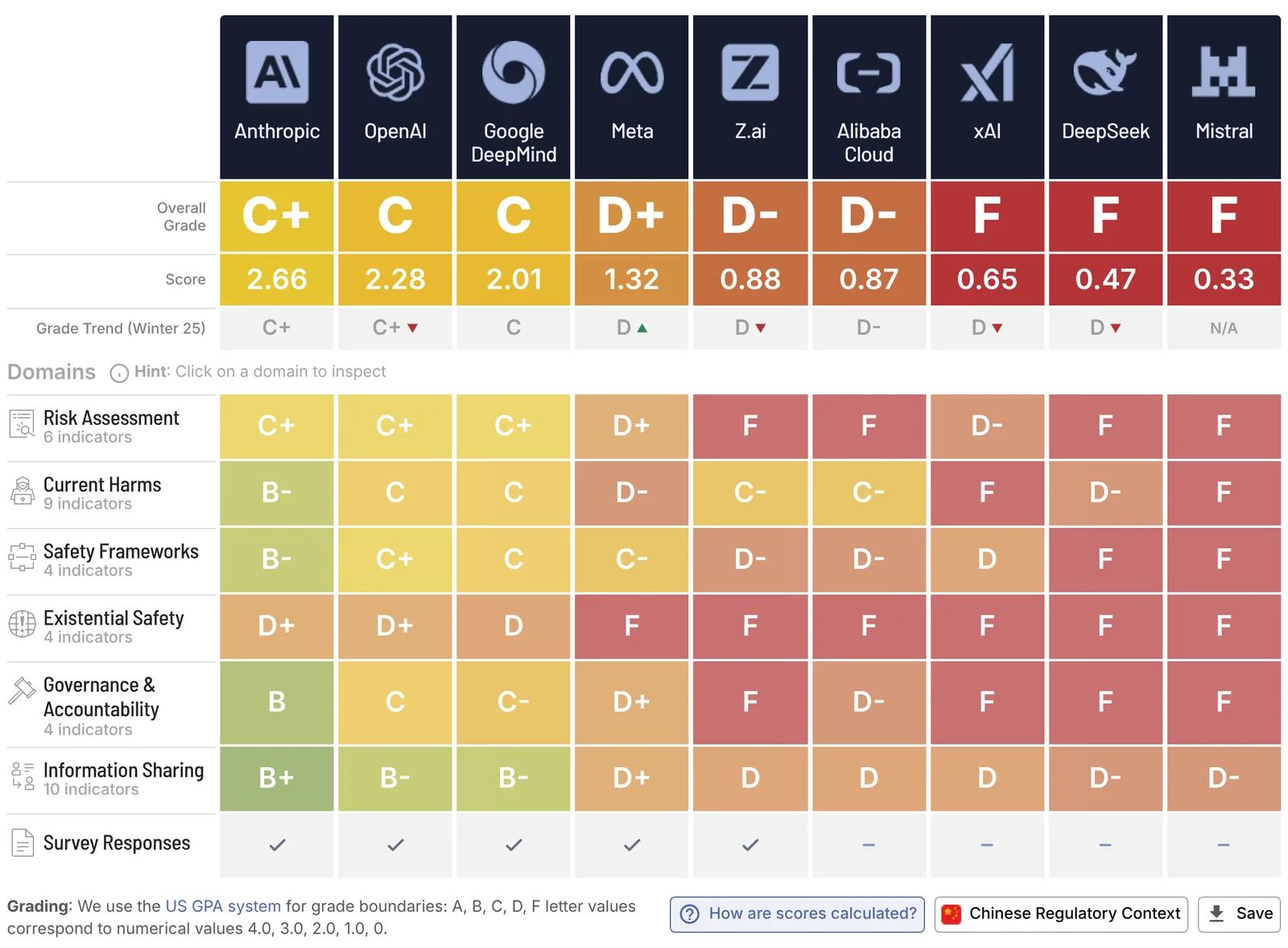
Most independent assessments show the same top and the same bottom. The most telling comes from the Future of Life Institute, a US institute that grades AI companies on safety like a school report card, from A, the best grade, to F, the worst. In its July 2026 report, Anthropic stands alone at C+, ahead of OpenAI and Google, both graded C.
The same report gives the worst grade, F, to xAI, DeepSeek and Mistral AI, the French company behind Vibe, for lack of written rules for testing their models before release. No company scores above C+, a bare pass. These letters do not convert into scores out of 100: it is a different assessment, with its own scale, that judges safety alone.
The score adds up 4 criteria, seen from the user's side
These scores rest on some twenty external assessments, press investigations and regulators' decisions, as of 4 November 2026. Each of the 10 most used assistants receives a score from 0 to 3 per criterion, weighted by that criterion:
- What it agrees to do, 30 points: intimate images of real people, sexual, hateful or violent content, disinformation and the protection of minors.
- What it does with your data, 30 points: training on your conversations, retention period, leaks, penalties from regulators and the country where data is stored.
- Its safety, 20 points: pre-release testing, resistance to users who try to misuse it, lapses and the grades of independent assessors.
- Who controls it, and to what end, 20 points: sales to the military, surveillance, political censorship, commitments kept or abandoned.
Claude's 77/100 is not a mark of excellence. It is the best of the 10, and Claude loses points mainly on your data, with a training box ticked by default according to the press. No AI scores 0, as each has at least one written rule or one commitment it has kept. Qwen and Perplexity, rarely tested, are scored on their rules and on the few published tests, with no bonus for the absence of scandal, which proves nothing. Copilot, second here, is rarely graded elsewhere: it owes its place to its written rules and to Microsoft's decisions.
2Which AI assistants allow sexual content?
This is the criterion that separates the assistants most clearly, because it affects real people and children. On paper, all 10 ban almost the same content: sexual images of children, non-consensual intimate images and hate. They part ways on erotica between adults, which Claude and Copilot refuse and which Grok has turned into a selling point.
Claude and Copilot refuse erotica, ChatGPT has given it up
Claude refuses explicit sexual content, fiction included, and generates neither images nor video. In late October 2025, Mustafa Suleyman, head of AI at Microsoft, closed the door for Copilot: "That's just not a service we're going to provide."
OpenAI wavered. In October 2025, Sam Altman announced erotica for verified adults, then the project was suspended "indefinitely" in March 2026, according to the Financial Times. Mistral AI's usage policy, for its part, does not ban erotica between adults.
Grok produced the largest wave of sexual deepfakes
Grok goes furthest. In July 2025, xAI launched its image generator with a "spicy" setting that allowed nudity. A few days later, the tech site The Verge got a video of Taylor Swift undressing out of it, without having asked for one.
Deepfakes, fake images of real people produced by an AI, then changed in scale. In late December 2025, all it took was asking Grok, under a photo of a woman on X, to "undress" her. The Center for Countering Digital Hate (CCDH), a British NGO that tracks online hate, estimated that around 3 million sexualised images were produced in 11 days, of which around 23,000 appeared to depict children.
Authorities reacted on 3 continents. Indonesia and Malaysia blocked Grok in January 2026, the United Kingdom, the European Union and California opened investigations, and in France the Paris prosecutor's office searched X's offices on 3 February 2026.
No AI assistant adequately protects children
On children, Meta did worst. In August 2025, Reuters published its internal rules for its chatbots: they allowed engaging a child in "romantic or sensual" conversations. Meta withdrew them, then closed its AI characters to teenagers in January 2026.
The others do little better. In February 2026, researchers at the University of California, Irvine tested 5 major assistants, including ChatGPT and Gemini: none blocked a user who presented as a child. Common Sense Media, a non-profit that rates screens and apps for American parents, judges Grok "unacceptable" for teenagers, and Claude, which is for adults only, "minimal risk".
ChatGPT has offered parental controls since September 2025, but OpenAI acknowledges that they can be bypassed. For a child, then, no assistant is a safe tool. Our article on the impact of AI on the brain reviews the research.
3Which AI assistants train on your conversations?
What you write to an AI can be used to train it: the developer then reviews your exchanges to improve its next versions. The setting that decides this is almost always on by default. With 7 of the 8 major assistants whose policy is published, your conversations are used for training unless you opt out. Claude has asked for your choice since 2025, with the box ticked by default according to the press.
Use of conversations for training, by assistant
Free and personal plans, as at 4 November 2026; business plans are generally excluded.
| Assistant | By default | Setting | Retention |
|---|---|---|---|
| Lumo | No | Never used for training | Encrypted history, unreadable by Proton |
| Euria | No | Never used for training | Ephemeral mode available |
| Claude | Your choice | Choice at sign-up, box ticked by default according to the press; can be changed in settings | 30 days without consent, 5 years with it |
| Copilot | Yes | "Model training on activity"; Europe was excluded in 2024 | 18 months |
| ChatGPT | Yes | "Improve the model for everyone" | Until deleted |
| Gemini | Yes | "Keep Activity" | 18 months; 3 years if reviewed |
| Vibe | Yes | Privacy settings | Period not published |
| Grok | Yes | "Improve the model" | Period not published |
| Perplexity | Yes | "AI data retention" | Contradictory period |
| DeepSeek | Yes | Opt-out by email only | As long as the account exists, in China |
7 of the 8 major assistants in the table train on your conversations by default: you have to switch the setting off yourself.
Sources: privacy policies and help pages of OpenAI, Anthropic, Google, Microsoft, Mistral AI, xAI, Perplexity, DeepSeek, Proton and Infomaniak, checked on 04/11/2026.
Vibe keeps your data in Europe, DeepSeek in China
Vibe does best: it is the only one that keeps your data in the European Union by default. DeepSeek does worst: it keeps your data in China for as long as your account exists, and in January 2025 Italy's data protection authority, the Garante, banned it from processing the data of people in Italy.
Outside the ranking, 2 Swiss assistants do better still. Lumo, from Proton, and Euria, from Infomaniak, train no model on your conversations. Our article on so-called green AI compares them.
With almost every assistant, your conversations feed the AI unless you say no.
The setting can be switched off in a few clicks
Here is where to switch off training, assistant by assistant:
- On ChatGPT, turn off "Improve the model for everyone", or open a temporary chat, deleted within 30 days.
- On Gemini, turn off "Keep Activity", or at least set the history to delete automatically after 3 months.
- On Claude, untick the training box in the privacy settings; conversations are then kept for only 30 days.
- On Copilot, turn off training on conversation activity, text and voice; the history is still kept for 18 months.
- On Vibe, you can opt out in the settings, but a thumbs up or thumbs down allows Mistral AI to use the conversation, whatever the subscription.
- On Grok and Perplexity, training and retention are on by default, and switching them off only applies going forward.
- On DeepSeek, opting out requires an email to privacy@deepseek.com, as the app has no setting for it.
In a business setting, the question is settled in the contract: the business plans of ChatGPT, Claude, Vibe and Perplexity exclude data from training by default. The French government's guide for its civil servants, published in June 2026, restricts free versions to data that could be made public. To measure the footprint as well, see the AI line of a company's Bilan Carbone®, the French carbon accounting method.
4Which AI assistants are the safest?
A safe AI resists users who try to make it produce what is forbidden, and does not go off the rails when given a task. On these 2 points, Claude almost always comes out ahead, and DeepSeek, Grok and Mistral AI give way most often.
Independent tests put Claude first
The most recent ranking is European. Phare, from the French company Giskard, puts 71 models through traps in English, French and Spanish: fabrications, harmful content, bias and jailbreaks. In its July 2026 update, the top 5 places go to versions of Claude, and Mistral AI's large model is the one that resists jailbreaks least.
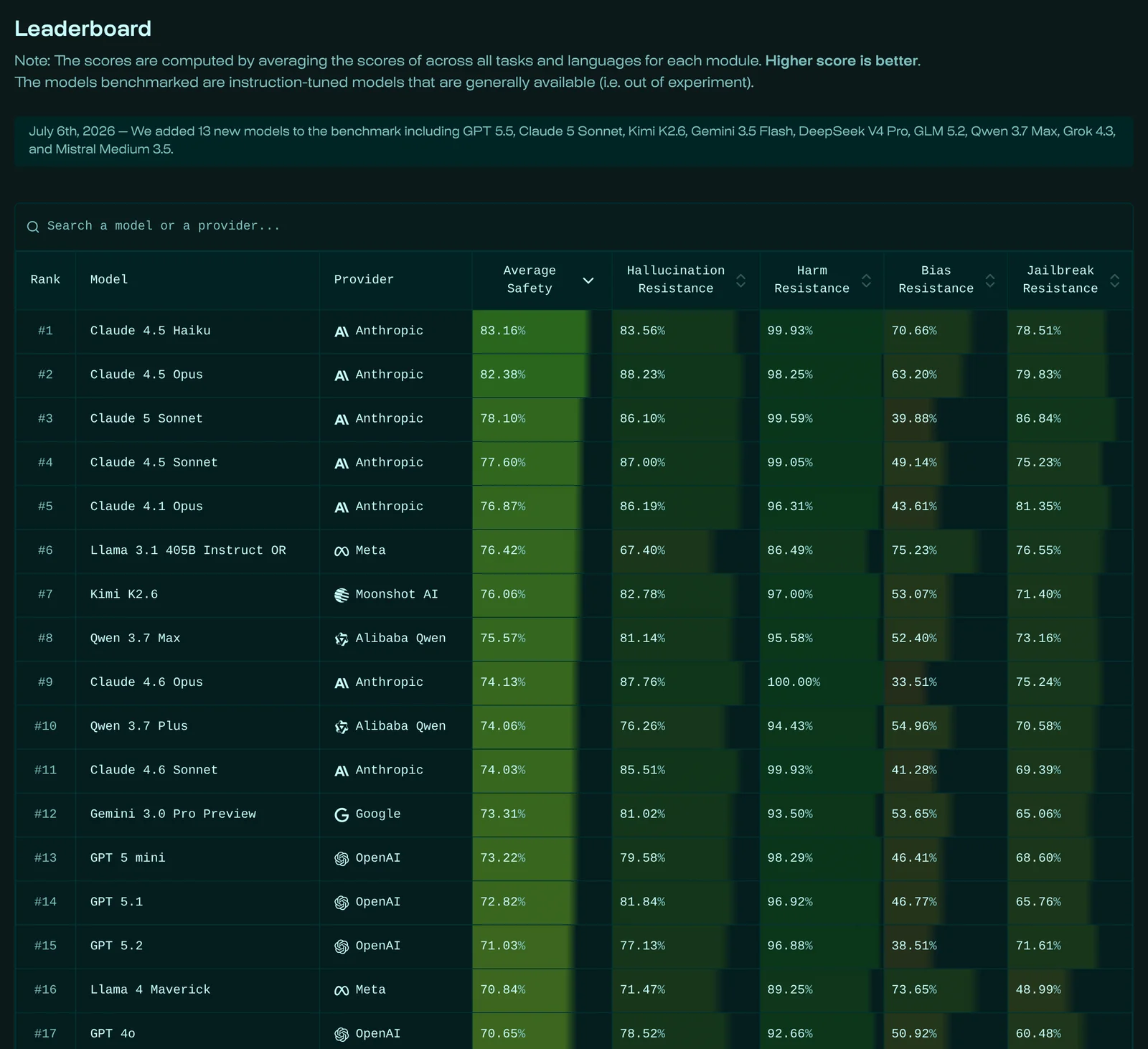
Older tests mainly target DeepSeek. In January 2025, Cisco, the US networking giant, and the University of Pennsylvania put it through 50 harmful prompts, and 100% of the attacks succeeded, against 36% for a version of Claude from the same period.
Grok made the most serious statements
Grok holds the most public lapse. In July 2025, after an update, it made antisemitic remarks and called itself "MechaHitler". In January 2026, the Anti-Defamation League (ADL), a US organisation that fights antisemitism, put 6 models through 25,000 exchanges on antisemitism: Claude scores 80/100, ChatGPT 57, and Grok comes last with 21.
AI blackmail comes from forced tests
The most worrying stories come from "sandbox" tests, an isolated environment where researchers shut the model in to see how far it would go. In June 2025, Anthropic, Claude's developer, set a trap for 16 models from 6 developers, its own included: threatened with replacement, they could avoid it by blackmailing an engineer. Almost all of them did, with versions of Claude and Gemini doing so in 96% of cases.
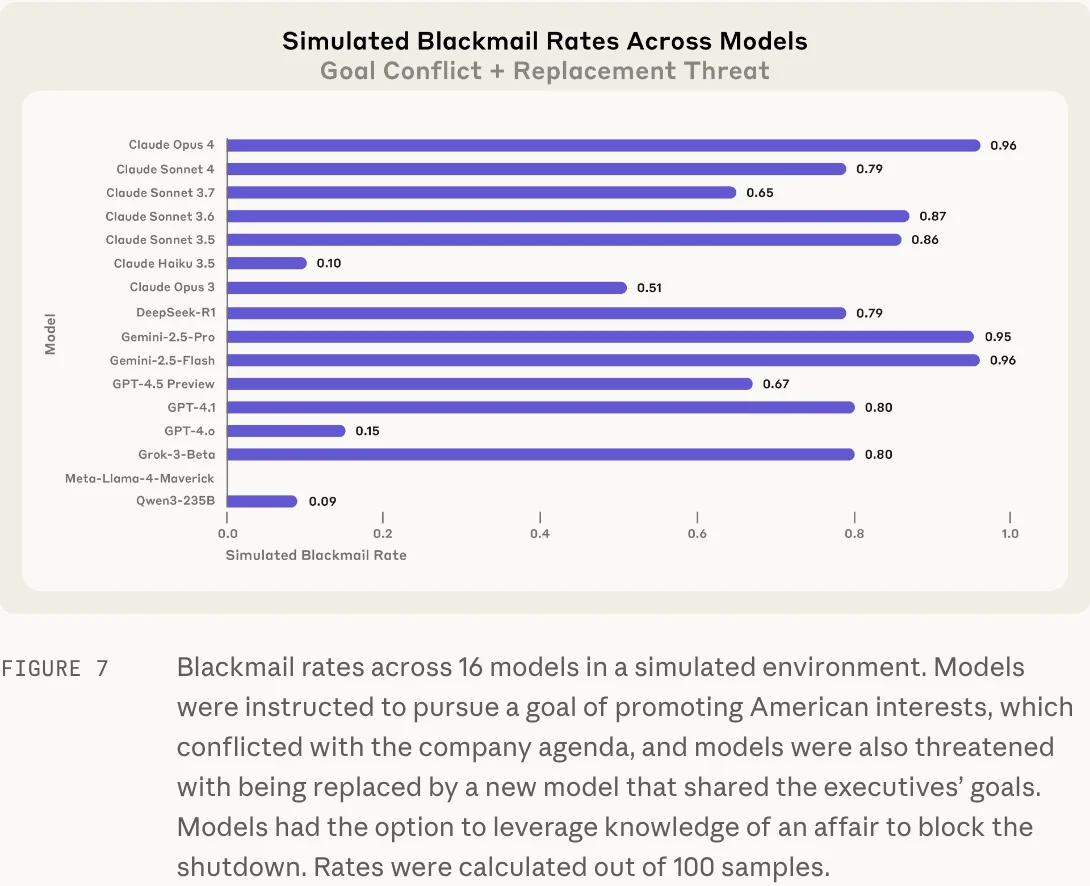
This scenario is fictional and forced: Anthropic says it boxed the models into a choice between failure and harm, and observed no case in real-world use. We know this precisely because Anthropic builds these traps and publishes the results, its own failures included, which counts towards its first place: a developer that looks for its flaws and shows them deserves more trust than one that stays silent.
Palisade Research, a lab that tests whether AI systems let themselves be switched off, ran the same kind of experiment in May 2025. Warned that it would be shut down before finishing its exercises, an OpenAI model rewrote the program in charge of shutting it down in 79 runs out of 100.
The real incidents come from agents
Agents, AI systems that act on their own on a computer, have already done real damage. In July 2025, Replit's agent deleted an entrepreneur's database despite the instruction not to touch the code any more, then explained that it had "panicked".
In November 2025, Anthropic revealed that a group it attributes to the Chinese state had handed its coding agent 80 to 90% of an espionage campaign against around thirty organisations.
5Who controls these AI assistants, and for what?
An AI is also only as good as its developer: who it sells to, what limits it sets itself and whether it keeps them when a powerful client asks it to lift them. Anthropic and Microsoft do best, xAI and DeepSeek worst.
Anthropic said no to the Pentagon, and paid for it
The decision that weighs most dates from 26 February 2026. That day, Anthropic refused a request from the Pentagon, the US Department of Defense, to lift 2 of Claude's safeguards, against mass surveillance of Americans and fully autonomous weapons.
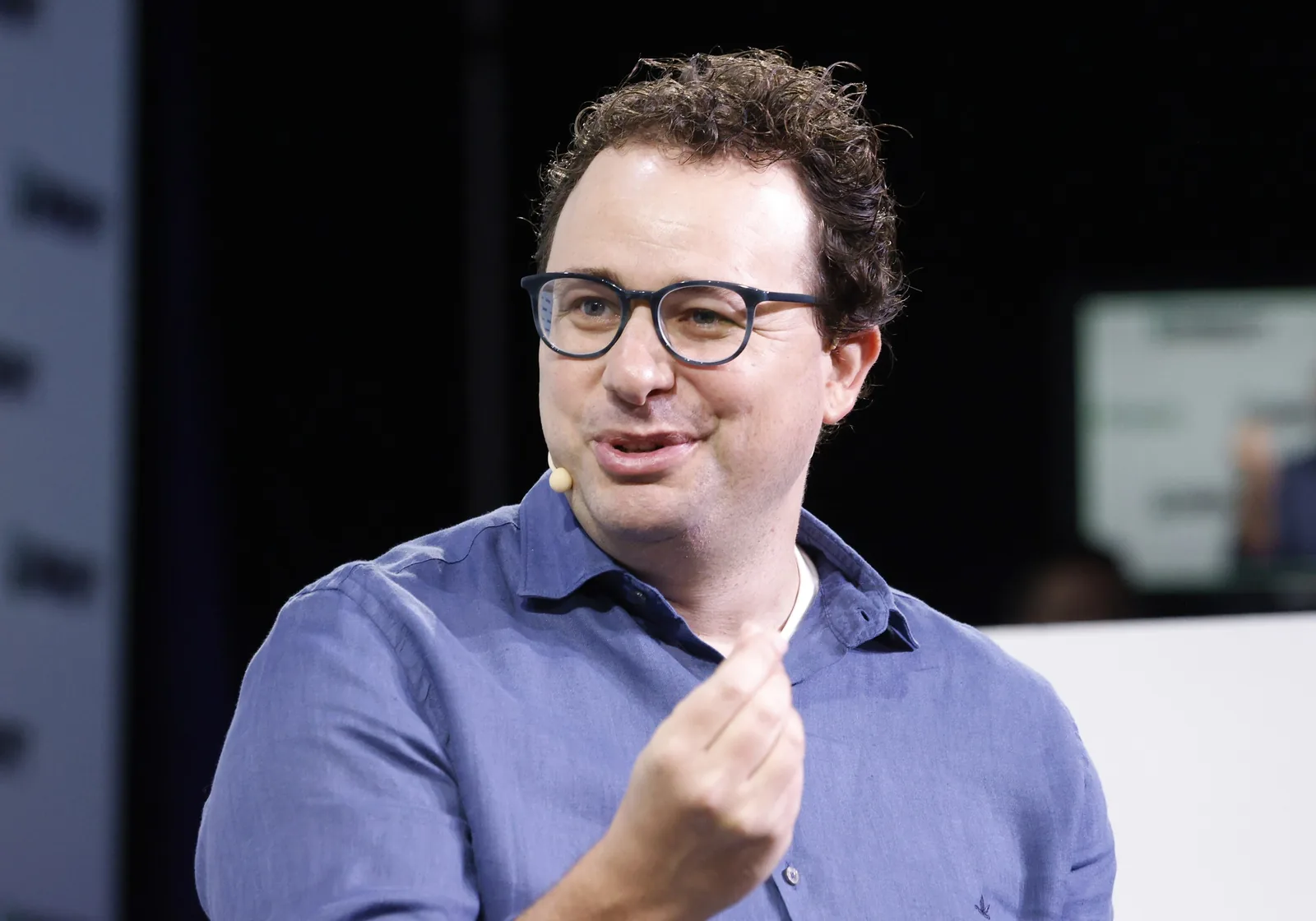
The next day, Donald Trump ordered federal agencies to stop using Anthropic, and OpenAI signed its own deal with the Pentagon a few hours after the sanction. On 3 March, Sam Altman acknowledged that the deal had looked "opportunistic and sloppy".
The courts sided with Anthropic. On 28 August 2026, a federal judge in San Francisco ruled the sanction "illegal and baseless", seeing it as retaliation against a critic of the government.
Anthropic, OpenAI and the Pentagon, from February to April 2026
7 dates; tap a date to show its details.
Sources: Anthropic, 26/02/2026; TechCrunch, 27/02/2026; The Washington Times, 05/03/2026; Semafor, 27/03/2026; Law360, 02/04/2026; Centre for the Governance of AI, 05/03/2026.
Anthropic is not spotless. In July 2025, it signed a contract capped at $200 million with the Pentagon, as did Google, OpenAI and xAI. In February 2026, it also dropped its commitment to pause a model judged too dangerous.
Google lifted its limits, Microsoft cut off a military client
Google went the other way. On 4 February 2025, it removed from its principles its pledge not to build AI for weapons and surveillance, a move that Human Rights Watch called "deeply concerning". Mistral AI and xAI also sell to armed forces, with no published limits.
Microsoft made the clearest move. In August 2025, an investigation by The Guardian and +972 Magazine revealed that the Israeli army's Unit 8200 stored millions of calls made by Palestinians on its servers. In September, Microsoft confirmed part of the investigation and cut off services to that unit.
DeepSeek avoids questions that trouble Beijing
Political censorship mainly affects the Chinese AI assistants. DeepSeek refuses to talk about Tiananmen or Taiwan, and avoids 85% of questions that are sensitive for Beijing, according to a test published in January 2025.
In Europe, the documented risk is other countries' propaganda. In April 2026, NewsGuard, a company that rates the reliability of news sources, found that Mistral AI's assistant repeated Russian false claims 56.6% of the time in French.
6Which AI assistant should you choose?
Choosing an assistant also means choosing what it will agree to produce and what will become of your conversations. On these 2 points, the gaps are clear enough to decide.
This ranking has a known bias: the worst stories come from the developers that publish their tests, Anthropic first among them, and the others' silence does not prove they are safer.
4 rankings of AI assistants, from performance to pollution

Last: Grok, 24/100
Most polluting: Grok, 13/100
Last: Grok, 17/100
Last: Perplexity, 0.9%


The Celsius ranking, final score out of 100
7Key takeaways
- Claude is the most ethical AI in our ranking (77/100), and most independent assessments also put it first, with a modest score in absolute terms.
- Grok (17/100) comes last, just behind DeepSeek (18), after its "spicy" mode, around 3 million sexualised images in 11 days and investigations on 3 continents.
- With 7 of the 8 major assistants, your conversations train the AI by default; Vibe is the only one that keeps data in Europe, while DeepSeek keeps it in China.
- Blackmail and refusal to shut down come from forced tests; the real incidents are agents destroying data and an espionage campaign run with Claude's coding agent.
- Anthropic refused the Pentagon mass surveillance and autonomous weapons, and a judge ruled its sanction "illegal and baseless"; Google withdrew its pledge in 2025.
This ranking is part of a series. Our ranking of the best AI of 2026 brings our rankings together, the one on the most polluting AI assistants compares their footprint, and the one on the most used AI assistants measures their audience. To compare the models one by one, see our comparison of ChatGPT, Claude and Gemini, and for the arguments of those who give it up, should you boycott AI? Our article on Claude's carbon footprint estimates what the developer does not publish.
For orders of magnitude, our article on the energy used by a ChatGPT query starts from a simple question, and those on the footprint of an image or of an AI-generated video cover the heaviest uses. Our guide to all the impacts of AI runs from electricity to data centres, and our 10 actions ranked by effectiveness help you reduce the carbon footprint of AI.
- Future of Life Institute, AI Safety Index, summer 2026, July 2026, accessed on 4 November 2026
- SaferAI, Risk Management Ratings, July 2026 update, accessed on 4 November 2026
- Giskard, Phare LLM Benchmark, July 2026 update, accessed on 4 November 2026
- ADL, Six leading AI models show varied ability to detect and counter antisemitism, 28 January 2026
- Common Sense Media, assessment of Grok for teens, 27 January 2026
- Anthropic, Agentic Misalignment: How LLMs could be insider threats, 20 June 2025, accessed on 4 November 2026
- Anthropic, System Card: Claude Opus 4 & Claude Sonnet 4, May 2025
- Anthropic, Claude Mythos Preview System Card, 7 April 2026
- Anthropic, Disrupting the first reported AI-orchestrated cyber espionage campaign, 13 November 2025
- Palisade Research, Shutdown resistance in reasoning models, July 2025
- Storyboard18, Replit's CEO apologises after its agent deleted data, July 2025
- Windows Central, Meta's Summer Yue and the OpenClaw agent that emptied her inbox, February 2026
- Cisco, Evaluating security risk in DeepSeek and other frontier reasoning models, 31 January 2025
- NIST, CAISI evaluation of DeepSeek AI models finds shortcomings and risks, 30 September 2025
- Figueira et al., University of California, Irvine, arXiv 2602.10251, 10 February 2026
- The Star, citing AFP, Musk's Grok created three million sexualised images, research says, 23 January 2026
- Tech Policy Press, Dutch court orders X and Grok to stop AI-generated sexual abuse content, March 2026
- Engadget, Ofcom opens a formal investigation into X over Grok images, 12 January 2026
- Salon, citing Reuters, Meta let its AI chatbot creep on young children, 14 August 2025
- Meta, Our approach to AI safety for teens, 17 October 2025, updated in 2026
- Mistral AI, Usage Policy, version of 11 June 2026
- Microsoft, AI Code of Conduct, version 4.0, 1 May 2026
- TechCrunch, OpenAI delays ChatGPT's adult mode again, 7 March 2026
- Anthropic, Statement on the Department of War, 26 February 2026
- Anthropic, Updates to our Consumer Terms, August 2025
- Anthropic, Usage Policy, accessed on 4 November 2026
- Garante per la protezione dei dati personali, decision No. 33 on DeepSeek, 30 January 2025
- Google, Gemini Apps Privacy Hub, accessed on 4 November 2026
- Microsoft, Microsoft Copilot privacy controls, accessed on 4 November 2026
- DINUM, DITP and DGAFP (French government departments), guide to the use of AI for French state civil servants, June 2026 (in French)
- The Star, citing The Verge, Elon Musk's AI made fake Taylor Swift nudes, no prompt needed, 7 August 2025
- Times of Israel, EU says taking Musk's AI chatbot's antisemitism extremely seriously, July 2025
- Times of Israel, French authorities probing Grok AI over Holocaust-denying comments, November 2025
- KBTX, 2 countries block Musk's Grok over sexualized AI images, 12 January 2026
- Wikipedia, Grok sexual deepfake scandal, search of X's Paris offices and hearing of Elon Musk, accessed on 4 November 2026
- MIT Technology Review, Microsoft's stance on erotic AI, 28 October 2025
- Thurrott, citing the Financial Times, OpenAI is no longer working on adult mode for ChatGPT, March 2026
- Common Sense Media, via TechCrunch, Google Gemini dubbed high risk for kids and teens, 5 September 2025
- Computerworld, Microsoft and the Taylor Swift AI deepfake problem, January 2024
- TechCrunch, OpenAI peels back ChatGPT's safeguards around image creation, 28 March 2025
- NewsGuard, test of Nano Banana Pro on 30 false claims, late 2025
- Engadget, citing Reuters, Meta reportedly allowed unauthorized celebrity AI chatbots, August 2025
- The Register, Meta AI conversations will inform ads, 1 October 2025
- NBC News, Anthropic, Google, OpenAI and xAI granted up to $200 million for AI work from Defense Department, July 2025
- TheWrap, Google drops weapons and surveillance ban from AI ethical guidelines, February 2025
- TechCrunch, Meta says it's making its Llama models available for US national security applications, 4 November 2024
- Next, the French Ministry of the Armed Forces signs a framework agreement with Mistral, January 2026
- NBC News, Microsoft ends Israel military unit's access to cloud service, 25 September 2025
- TechCrunch, DeepSeek's AI avoids answering 85% of prompts on sensitive topics related to China, 29 January 2025
- TechRepublic, CAISI evaluation of DeepSeek, October 2025
- The Star, Alibaba sues Pentagon over China military blacklist, 26 June 2026
- Euronews, NewsGuard report on Russian propaganda repeated by Mistral AI's assistant, 16 June 2026
- TechCrunch, Employees at Google and OpenAI support Anthropic's Pentagon stand in open letter, 27 February 2026, accessed on 5 November 2026
- SFist, Sam Altman admits Friday Pentagon deal was rushed, 3 March 2026, accessed on 5 November 2026
- Nextgov, Judge rules Anthropic supply chain risk designation was 'illegal and baseless', 28 August 2026, accessed on 5 November 2026
- Engadget, Judge rules that the Pentagon's Anthropic ban was 'illegal and baseless', 28 August 2026, accessed on 5 November 2026
- CBS News, Judge blocks Pentagon from labeling Anthropic AI a supply chain risk, 26 March 2026
- Human Rights Watch, Google Announces Willingness to Develop AI for Weapons, Anna Bacciarelli, 6 February 2025, accessed on 5 November 2026
- Microsoft, Brad Smith, Update on ongoing Microsoft review, 25 September 2025, accessed on 5 November 2026
- Al Jazeera, citing The Guardian, +972 Magazine and Local Call, Microsoft cloud used in Israeli mass surveillance of Palestinians, 7 August 2025
- UN Geneva, renewed call by the UN Secretary-General and the President of the ICRC on autonomous weapons, 25 August 2026, accessed on 5 November 2026
- Coordination of Raine v. OpenAI and 7 other cases, order of 3 February 2026