


- 1Video is the heaviest use, as Google itself acknowledges on its help page.
- 2The default model decides most of it: at OpenAI, the large model would use 8 times as much as the small one.
- 3Where the servers run matters: the same query emits about half as much carbon in Europe.
- 4The 2 most frugal serve a light model by default and have published a measurement of their impact.
An AI assistant pollutes first through the choices its developer makes on your behalf: the model that answers, the uses the app promotes, the electricity powering its servers and what it does to reduce its footprint. This ranking scores those 4 choices for 10 consumer assistants, and each section takes one criterion to say which AI does best and which does worst.
1Which AI is the most polluting in 2026?
Grok pollutes the most, Gemini the least
To find out which AI pollutes the most, you have to look at what each developer decides for its users, not only at what a single query consumes. On that basis, Grok, xAI's assistant, is the most polluting, with an environmental score of 13/100. Gemini, from Google, is the most frugal, at 73/100, just ahead of Vibe, from the French company Mistral AI, at 72.
Environmental score of 10 AI assistants, out of 100
From the most frugal to the most polluting. 4 criteria scored from 0 to 3 by Projet Celsius, then weighted. Tap a row to read our view and the reason for each score.
| Assistant | |||||||
|---|---|---|---|---|---|---|---|
| 1 | GeminiGoogle | 73 | 33.3 | 10.0 | 13.3 | 16.7 | |
| 2 | VibeMistral AI | 72 | 26.7 | 15.0 | 15.0 | 15.0 | |
| 3 | CopilotMicrosoft | 53 | 23.3 | 6.7 | 10.0 | 13.3 | |
| 4 | ClaudeAnthropic | 47 | 20.0 | 13.3 | 6.7 | 6.7 | |
| 5 | DeepSeek | 45 | 23.3 | 11.7 | 3.3 | 6.7 | |
| 6 | Perplexity | 42 | 20.0 | 11.7 | 6.7 | 3.3 | |
| 7 | ChatGPTOpenAI | 40 | 20.0 | 6.7 | 6.7 | 6.7 | |
| 8 | Meta AIMeta | 37 | 20.0 | 3.3 | 3.3 | 10.0 | |
| 9 | QwenAlibaba | 33 | 13.3 | 3.3 | 6.7 | 10.0 | |
| 10 | GrokxAI | 13 | 13.3 | 0.0 | 0.0 | 0.0 | |
The most polluting: giant models, 1.2 billion videos in one month in early 2026 and gas turbines, without a single published figure. | |||||||
Sources: Google, August 2025; Mistral AI, July 2025; CLEER, Sept. 2026; compar:IA; developer reports and announcements; Stanford FMTI, Dec. 2025; Ember. Projet Celsius, version of 04/11/2026.
Behind Gemini and Vibe, Copilot, at 53, comes close to the 2 most frugal without joining them. Claude, DeepSeek and Perplexity sit between 47 and 42, then ChatGPT, Meta AI and Alibaba's Qwen fall from 40 to 33, just above Grok. Each row of the table expands to show the reason for its score.
The score adds up 4 criteria, and the query weighs the most
On each criterion, an assistant earns 0 to 3 points, based on public documents dated before 4 November 2026, and those points are then scaled to the weight of the criterion. As in our other rankings, the higher the score, the better, and a faultless AI would score 100:
- A query, 40 points: the energy, water and carbon of a query sent to the model the app serves by default. A light, measured model earns the most.
- Images, video and agents, 20 points: the less the app pushes these heavy uses, including agents, AI systems that chain tasks on their own, the more it earns.
- Electricity, 20 points: servers in a country with low-carbon electricity, with no gas burned on site to power them, earn the most.
- Developer efforts, 20 points: more economical models, figures published with their method and a verified climate target.
The 4 criteria of our environmental score and their weight
On each criterion, an assistant receives 0 to 3, then weighted. The more frugal it is, the more points it earns: a faultless AI would score 100.
A query, 40 points. The energy, water and carbon of a query sent to the default model, measured by the developer or estimated by researchers. This criterion weighs the most, because it recurs with every use.
Does best GeminiDoes worst QwenGrok
Scores from 0 to 3 set by Projet Celsius from public documents dated before 4/11/2026.
On the energy of a query, a developer that publishes nothing receives an average score, adjusted for the size of its models: without a measurement, we can neither praise it nor condemn it. Its silence does, however, cost it the points of the last criterion, which rewards published figures. These scores remain an expert judgement, updated when a developer publishes new figures.
2How much energy does a single query use?
A query to an AI uses little energy, but it is repeated billions of times a day: that is why this criterion counts for 40 points out of 100. A quick query uses about 0.3 Wh (watt-hour), as much as an LED bulb left on for 2 minutes, according to the Base IA, Projet Celsius's database of AI impact figures. That is the scale of this whole section: one query. Our article on what a query consumes details this calculation.
Gemini and Vibe answer with a light model by default
Gemini does best on this criterion. It answers with its small model by default, and Google measured the typical query under real conditions: 0.24 Wh, an LED bulb left on for a minute and a half, and 0.26 mL of water, barely 5 drops. Its August 2025 study remains the only real-world measurement published by a developer: Google recorded what its servers consume for the queries users sent to Gemini, instead of estimating it.
Vibe comes just behind: it answers in fast mode by default, and reasoning has to be switched on by hand. In July 2025, Mistral AI published with ADEME, the French Agency for Ecological Transition, the only full assessment by an AI developer, a life cycle assessment that also counts the manufacture of the servers. It puts one response at 1.14 g of CO2e, as much as driving a car for 8 metres. CO2e, or CO2 equivalent, adds up all greenhouse gases in a single unit.
For water, published figures range from 1 to more than 170, because developers do not count the same water. Google counts only the water its data centres evaporate to cool the servers. Mistral AI adds the water used by the power plants that generate the electricity and in manufacturing the servers, and arrives at 45 mL per response, 3 tablespoons. OpenAI gives a figure close to Google's, without saying what it counts.
Water per query according to the developer that publishes it, in mL
The only 3 figures published by an AI developer, each with its own scope.
A gap of 1 to more than 170, mostly down to scope. Mistral AI counts the water needed to generate the electricity and manufacture the servers; Google counts only the water used to cool its data centres.
Sources: Google, arXiv 2508.15734, August 2025; Sam Altman, June 2025; Mistral AI, life cycle assessment of Mistral Large 2, July 2025, 400-token response.
ChatGPT sits in the middle: free accounts get the small model, subscribers a much more energy-hungry one. OpenAI publishes only one figure, 0.34 Wh per query, close to the typical query, given by its chief executive in June 2025 without a method. Our article on the energy used by a ChatGPT query redoes the calculation.
Grok and Qwen serve their largest models, even for simple queries
Grok and Qwen do worst. Alibaba promotes giant models, and Grok serves its most powerful model even for simple queries, through an Auto mode that does not say which model it picks. Nobody has measured what they consume. Without a measurement, their score starts from the midpoint, then drops because their models are large. Perplexity and Copilot, which do not say which model answers either, are scored the same way.
Within the same AI, the small model uses 8 to 20 times less energy
The choice of model matters more than the choice of assistant. The CLEER database, published in September 2026 by the Sustainable AI Group, researchers with no ties to the developers, estimates the electricity used by 51 models, including those whose developer says nothing. According to it, Claude's large model uses about 20 times as much as the small one for the same conversation, and OpenAI's 8 times as much.
Energy per conversation by model, in Wh
Independent estimates for a typical conversation; the line marks 0.3 Wh, the quick query in the Base IA.
At Anthropic, Opus uses 20 times as much as Haiku; at OpenAI, Sol uses 8 times as much as Luna.
Sources: Sustainable AI Group, CLEER, data of 29/09/2026 (estimates, low confidence for some models); Projet Celsius's Base IA.
These are estimates, with low confidence for several models. The same AI also uses up to 4 times as much depending on the servers that run it. Our comparison of ChatGPT, Claude and Gemini compares the models one by one.
3Why do images and video weigh so much?
An AI does more than answer questions: it draws and it films, and these uses take far more computation. In 2024, researchers from Hugging Face, the main platform for sharing open-access models, and Carnegie Mellon University measured the electricity used by 88 of these models: generating an image uses about 60 times the energy of a text. A video strings together dozens of images per second, and no developer publishes what it consumes.
Energy for 1,000 queries by task, in Wh
Average of 88 open models measured on the same servers, published in 2024.
Generating an image takes about 60 times the energy of generating a text. 1,000 images use as much as 130 phone charges.
Source: Luccioni, Jernite and Strubell, "Power Hungry Processing", ACM FAccT 2024 (arXiv 2311.16863), Table 2; 2023 models, Nvidia A100 cards. Projet Celsius chart based on the published figures.
Grok pushes video further than any other assistant. In early February 2026, xAI announced 1.245 billion videos generated with Grok Imagine in 30 days, and the tool is one click away in the X feed. Our article on the impact of an AI-generated video gives the orders of magnitude.

Meta AI follows closely. It appears in WhatsApp, Instagram and Messenger without being sought out, and since September 2025 the app has offered Vibes, an endless feed of short videos entirely generated by AI.
ChatGPT pushes images. In March 2025, the wave of Studio Ghibli-style images produced 700 million images in one week, to the point that Sam Altman wrote that OpenAI's graphics processors (GPUs) were "melting". Our article on the footprint of an AI-generated image puts a figure on it.

Gemini also generates images in bulk, but Google is the only developer to say what costs the most: its help page rates video and Deep Research as "high" cost, and a simple query as "very low".
Relative cost of each Gemini use, according to Google
Google itself ranks its uses, from least to most costly. A relative cost, not an energy measurement.
Video and Deep Research are the 2 most costly uses. Google also advises starting a new chat when you change topic.
Source: Google, Gemini Apps limits and upgrades, Relative usage cost table, accessed 04/11/2026; wording condensed by Projet Celsius.
Claude and Vibe do best. Claude generates neither images nor video, and Vibe does not make video. Their weak point lies elsewhere, in agents, AI systems that chain tasks on their own for hours: in August 2025, Anthropic had to limit subscribers who ran its coding agent day and night. For users, video remains the first use to keep for real needs.
4Where do the servers run?
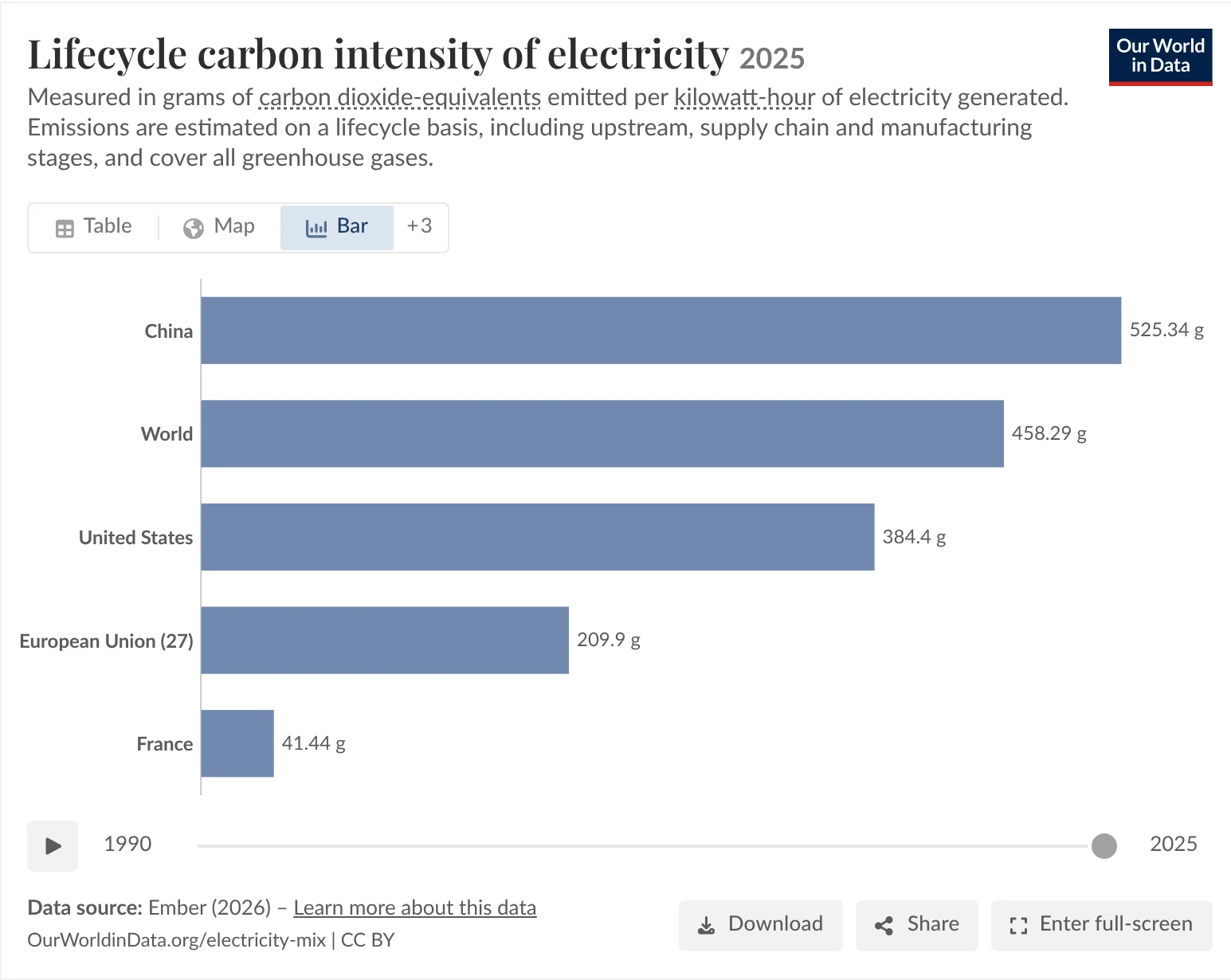
The same query emits more or less carbon depending on the electricity of the country where the server runs. With average global electricity, a quick query emits about 0.14 g of CO2e, as much as driving a car for 1 metre. That is little for one query, but it is repeated billions of times a day. On a European server, it emits nearly half as much as in the United States, and in France, whose electricity is mostly nuclear and therefore low-carbon, 11 times less than the global average.
Grok and Meta AI burn gas next to their servers
Grok does worst on this criterion. To power Colossus, its supercomputer in Memphis, xAI installed gas turbines on site. The NAACP, a major American civil rights organisation, accuses it of running 27 of them without a permit at the end of 2025 on a neighbouring site, and a federal judge refused at the end of October 2026 to dismiss the complaint.
Meta follows, with 10 gas-fired power plants ordered in March 2026 for Hyperion, its Louisiana campus. ChatGPT and Claude, which run mainly in the United States, are going the same way: OpenAI has obtained gas turbines for its Texas site, and Anthropic announces sites powered by gas on site.
DeepSeek and Qwen run mainly in China, where electricity emits slightly more than the global average. Alibaba reports 73.6% "clean" electricity without saying how it counts it, and DeepSeek says nothing about its own.
For the same query, gas burned on site emits about 15 times as much as the French grid. The chart below counts 1,000 queries, so that the gaps can be read.
CO2e of 1,000 queries by the electricity powering the servers, in g
The same query, at 0.3 Wh: only the electricity powering the server changes.
With gas burned on site, the same query emits about 15 times more than in France. Gemini and Copilot are not shown: Google and Microsoft do not say in which countries their queries are processed.
Sources: Ember via Our World in Data, electricity generated in 2025; CLEER, on-site gas scenario, Sept. 2026; Projet Celsius's Base IA. Projet Celsius calculation, order of magnitude.
Vibe, Gemini and Copilot bet on low-carbon electricity
Vibe does best on this criterion. Its data stays in the European Union by default, and in March 2026 Mistral AI financed a computing centre in Essonne, south of Paris, on the French grid, whose opening is not yet confirmed.
Gemini follows. Google is the only one to count hour by hour: 65% of the electricity used by its data centres was carbon-free in 2025, a more honest figure than the "100% renewable" claims calculated over the year.
Copilot comes next. In September 2024, Microsoft signed a 20-year contract to restart a reactor at Three Mile Island, the plant of the 1979 accident. For an organisation, the country where the servers run is a question to put to its provider before signing.
5Which AI developers are making an effort?
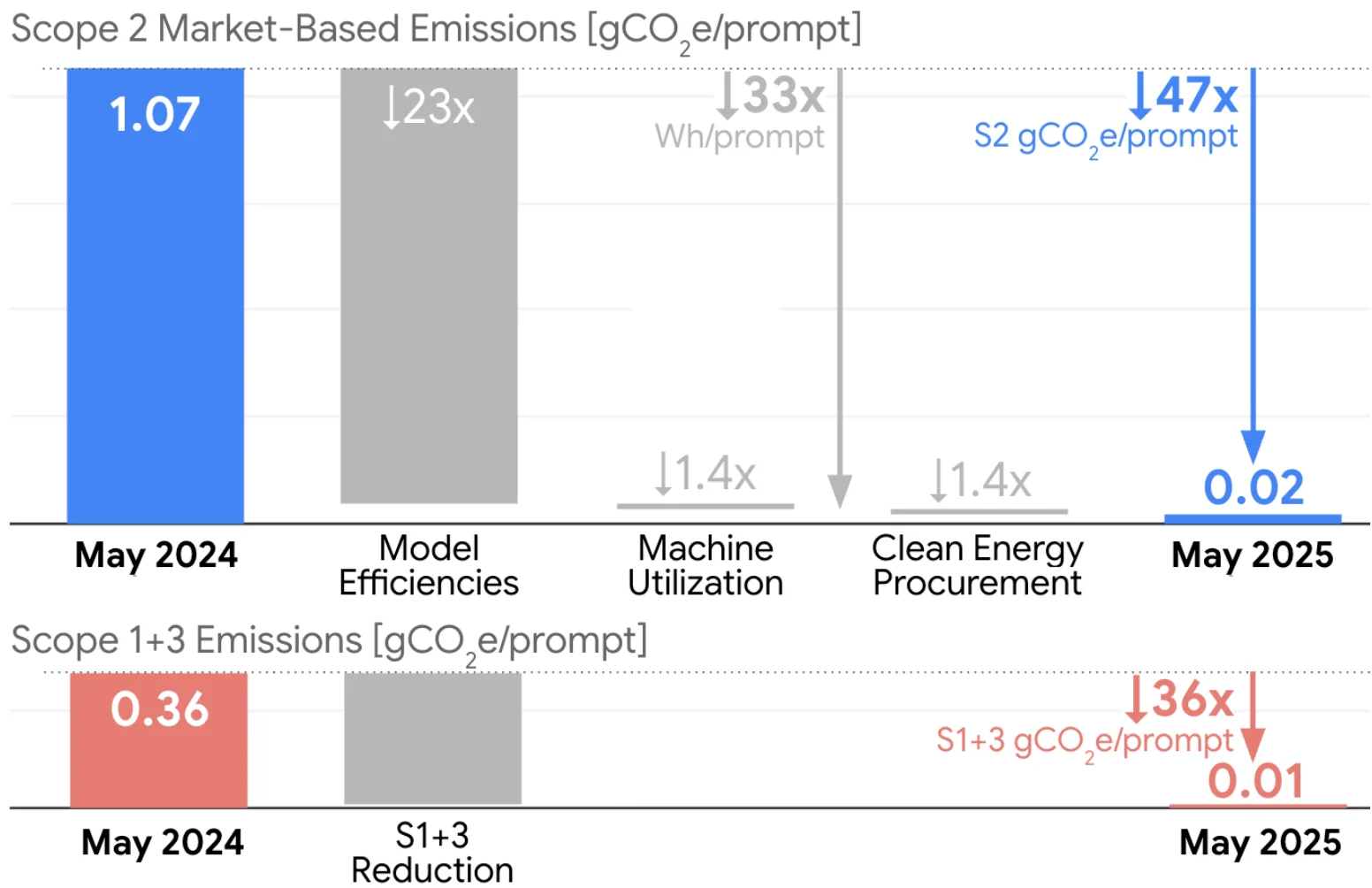
Google makes the clearest and best-measured effort, which puts Gemini at the top of this criterion. The others announce efficiency gains without figures: according to Stanford University's transparency index, 10 developers out of 13 publish nothing on the energy or carbon of their flagship model.
Google cut the energy of a query by a factor of 33 between May 2024 and May 2025, mainly thanks to more efficient models. Yet its total emissions have risen by 81% since 2019, and its measurement has not been verified by any third party.
Grok does worst: xAI publishes no energy, water or emissions figures. Microsoft and Meta sit in between, with full reports and a climate target validated by the SBTi (Science Based Targets initiative), which checks that such targets are in line with the Paris Agreement, but nothing per query. For a buyer, a figure published with its method is worth more than a promise, and our article on the stages at which AI pollutes says what should be measured.
6What do other assessments say?
Public assessments confirm our 2 extremes, and we stand by our scores where they differ. xAI, the developer of Grok, comes joint last in the Stanford transparency index, and Google remains the only developer to have measured a query under real conditions.
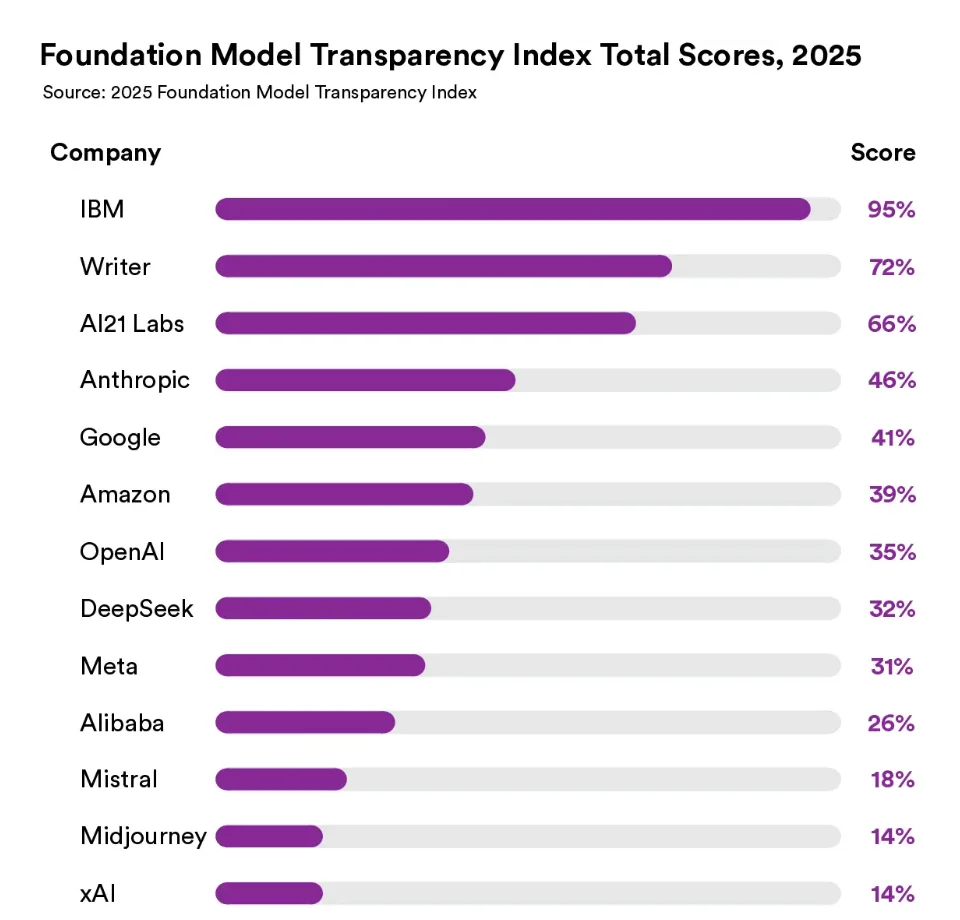
Vibe is the most disputed score. Stanford gives Mistral AI 0 on environment, but it only assesses training, whereas Vibe answers with its small model by default.
Claude, by contrast, fares better elsewhere: independent estimates place its small model among the most economical of all. Its score of 47/100 is mainly due to the silence of Anthropic, which publishes no figures: without a measurement, its query is scored at the midpoint, and it loses the points reserved for developers that publish.
Our own experience of use adds a caveat to this score, without being able to quantify it: to reach a given result, Claude goes so directly to the point that it needs fewer back-and-forths, and therefore less computation. Used for real work, it is very efficient. Anthropic points the same way for its latest large model, Opus 5.5, which it says needs less computation than its predecessor, but without giving an energy figure.
No ranking covers all 10 assistants, and the public tool compar:IA, run by the French Ministry of Culture, cannot estimate the energy use of closed models, which are the most widely used. For a buyer, the only reliable figure is the one the developer publishes, with its method.
7Our view
Published figures are still rare, but they are enough to settle the extremes and to show where the real lever lies.
8How can you reduce the footprint of your AI use?
To reduce the footprint of your use, switching assistant is not the most useful step. The settings that matter exist in all of them, and the developers themselves recommend them:
- Choose the small model for simple queries: every assistant offers it, often under the name fast mode.
- Turn off reasoning when it is not needed, since it lengthens the response the server has to compute.
- Start a new conversation when you change topic, so that the AI does not re-read the whole history with each query.
- Keep video for real needs, since it is the use Google rates as the most costly.
Our 10 steps ranked by effectiveness put a figure on what each setting changes, and our article on the water AI consumes explains why water figures vary so much.
The model that answers by default weighs more than the brand of the assistant.
For a company, the question is one of volume. At thousands of queries a day, the choice of model and hosting country changes the order of magnitude. Our article on AI in a company's Bilan Carbone® shows how to include it, and our AI footprint calculator gives a first figure in a few minutes.
4 rankings of AI assistants, from performance to pollution

Last: Grok, 24/100
Most polluting: Grok, 13/100
Last: Grok, 17/100
Last: Perplexity, 0.9%


The Celsius ranking, final score out of 100
9Key takeaways
- Grok is the most polluting AI in our ranking (13/100 on environment): mass video, gas turbines on site and no published figures. It also comes last in our ethics ranking.
- Gemini (73/100) and Vibe (72/100) are the most frugal: a light model by default, a published measurement and servers powered by cleaner electricity.
- Within the same AI, the small model uses 8 to 20 times less energy than the large one, according to estimates: it is the first setting to change.
- Generating an image takes about 60 times the energy of a text, and Google itself rates video among its most costly uses.
- Where the servers run matters: a query emits nearly half as much carbon on a European server as on an American one, and xAI burns gas on site.
The ranking of the best AI of 2026 brings together our 3 rankings, performance, ethics and environment. For ethics, privacy and safety, see our ranking of the most ethical AI assistants; to find out which have the most users, see the most used AI assistants in France and worldwide. For so-called green alternatives, see Ecosia, Euria and GreenPT under scrutiny, and for Claude's energy use, the carbon footprint of Claude.
- Google, Measuring the environmental impact of delivering AI at Google Scale, arXiv 2508.15734, CC BY 4.0, 21 August 2025
- Google Cloud, Measuring the environmental impact of AI inference, 21 August 2025
- Google, Gemini Apps limits and upgrades, help page accessed on 4 November 2026
- Google, 2026 Environmental Report, 2026
- Alexandra Sasha Luccioni, Yacine Jernite and Emma Strubell, Power Hungry Processing: Watts Driving the Cost of AI Deployment?, ACM FAccT 2024, arXiv 2311.16863
- Mistral AI, Our contribution to a global environmental standard for AI, 22 July 2025
- Mistral AI, documentation of Vibe's Think mode (in French), accessed on 4 November 2026
- Euronews, Mistral raises $830m for data centre near Paris, 30 March 2026
- OpenAI, GPT-6, Deployment Safety Hub, 7 October 2026
- Sam Altman, The Gentle Singularity, 10 June 2025
- Fortune, Sam Altman says ChatGPT's GPUs are melting, 28 March 2025
- The Decoder, ChatGPT's image generation explodes with 700M creations in first week, statement by Brad Lightcap (OpenAI), 3 April 2025
- Malay Mail, Being polite to ChatGPT is costing OpenAI millions, 21 April 2025
- Texas Tribune, Texas data centers, AI power plants and state permits, 9 July 2026
- Engadget, Anthropic is rate limiting Claude Code, 28 August 2025
- Fortune, Colossus, xAI's supercomputer, 3 September 2024
- Gigazine, Grok Imagine video generation, 3 February 2026
- Tom's Hardware, Nvidia loses $589 billion in market cap after DeepSeek, 27 January 2025
- Tom's Hardware, Alibaba slashes GPU usage by 82 percent with Aegaeon, October 2025
- Alibaba Group, Carbon neutrality and low-carbon cloud, page accessed on 4 November 2026
- The Register, Perplexity offers to buy Chrome, 12 August 2025
- Tom's Guide, Meta's Vibes, a feed of AI-made videos, 25 September 2025
- OfficeChai, Gemini has created 5 billion images in less than a month, September 2025
- Anthropic, Introducing Claude Opus 5.5, 22 September 2026
- Anthropic PBC, Form S-1, Securities and Exchange Commission, 26 October 2026
- Meta, Introducing Muse Spark, 8 April 2026
- The Lens, Meta triples order of gas-fired power plants for its AI campus in Louisiana, 30 March 2026
- Caixin Global, Alibaba AI app crashes after 3 billion yuan giveaway, 7 February 2026
- DeepSeek, DeepSeek-V4 Preview, 24 April 2026
- Microsoft, 2026 Environmental Data Fact Sheet, 2026
- Constellation, Crane Clean Energy Center, 20 September 2024
- CNBC, xAI loses bid to dismiss NAACP Clean Air Act lawsuit, 31 October 2026
- Southern Environmental Law Center, Inside Memphis' fight against xAI, 8 May 2026
- Stanford CRFM et al., The 2025 Foundation Model Transparency Index, arXiv 2512.10169, 11 December 2025
- Stanford CRFM, Foundation Model Transparency Index, December 2025, page accessed on 4 November 2026
- French Ministry of Culture, compar:IA, model ranking, accessed on 4 November 2026
- Nidhal Jegham et al. (University of Rhode Island), How Hungry is AI? Benchmarking Energy, Water, and Carbon Footprint of LLM Inference, arXiv 2505.09598, version 6, 24 November 2025
- Greenpeace East Asia, Nvidia ranks last on AI supply chain decarbonization, 29 October 2025
- Sustainable AI Group, CLEER, technical report, 29 September 2026
- Ember, 2025 data on the carbon intensity of electricity, via Our World in Data, CC BY, accessed on 5 November 2026