



- 1ChatGPT is still far ahead, with 1.2 billion users a week and 56% of web traffic.
- 2Gemini has nearly doubled its share of web traffic, to 25%, driven by Android phones.
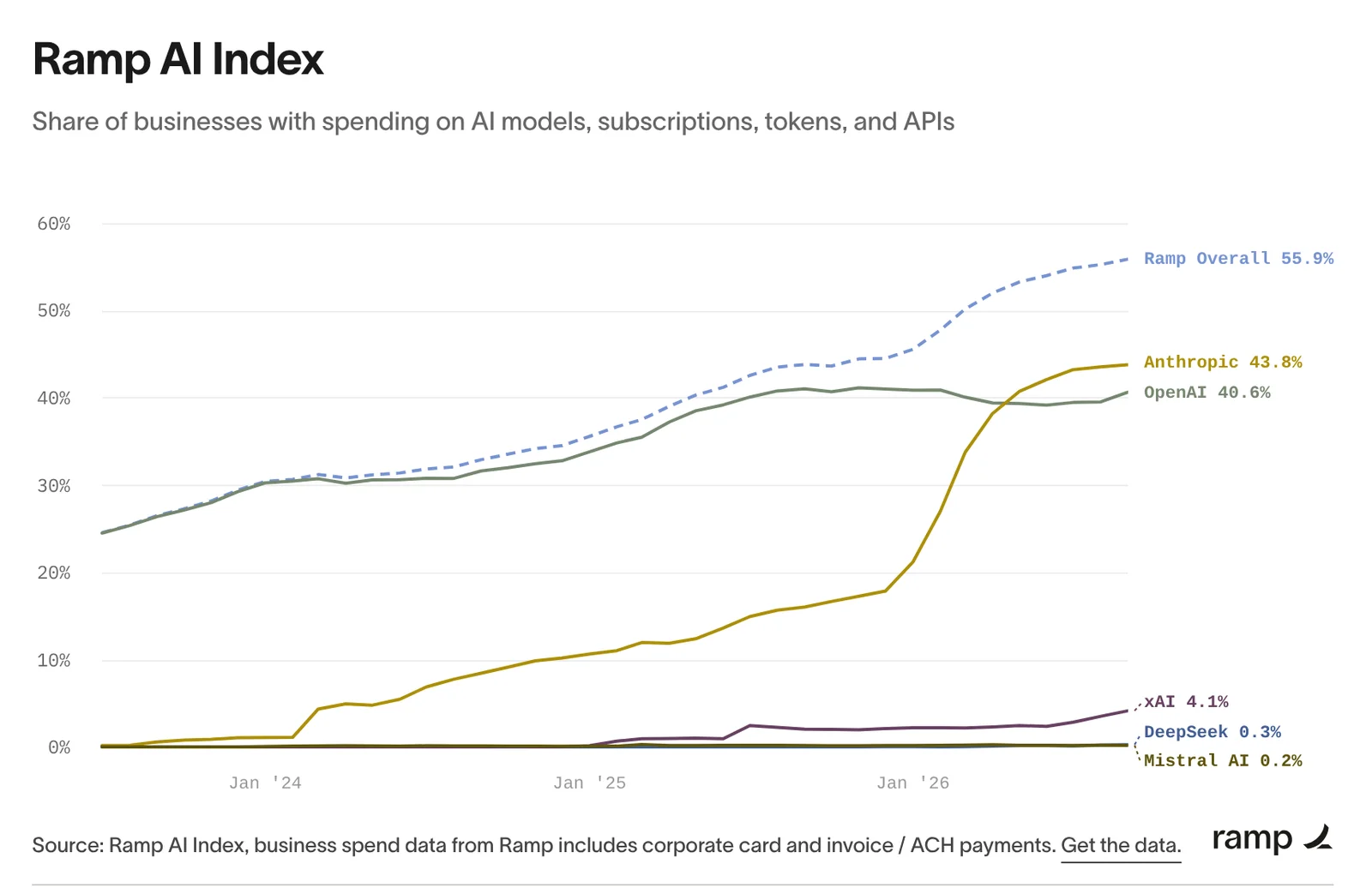
- 3In the United States, 43.8% of the companies tracked by Ramp pay Anthropic, against 40.6% for OpenAI.
- 4In France, 48% of people aged 12 and over used generative AI in 2025, mainly for writing.
Measuring the audience of an AI is not straightforward, because each developer counts in its own way: OpenAI counts its users per week, Google per month, and neither Anthropic nor Mistral AI, the French developer, publishes any user numbers. This ranking therefore rests first on a measure common to all of them: the share of visits to AI websites worldwide, tracked by the web analytics company Similarweb, excluding phone apps. Developers' own statements and public surveys complete it.
1Which AI chatbots are the most used worldwide?
A handful of assistants account for most use, and they set the habits of hundreds of millions of people. In September 2026, 3 assistants alone make up more than 90% of web traffic to AI sites: ChatGPT, Gemini and Claude. The others share a few points, and some, such as Meta AI, live mainly inside other apps.
Share of global web traffic to AI assistants, September 2026
Share of visits to the assistants' websites, phone apps not counted. The grey mark shows October 2025, and the 'Year on year' column the change in points. On the right, the number of users each developer reports.
| Assistant | Share of web traffic | Year on yearin points | Reported by the developer | |
|---|---|---|---|---|
| 1 | ChatGPT | 56.4% | −15.4 pt | More than 1.2 billion a week (Oct. 2026) |
| 2 | Gemini | 25.0% | +11.4 pt | 1 billion a month, app (Oct. 2026) |
| 3 | Claude | 9.6% | +7.3 pt | Not published |
| 4 | DeepSeek | 3.4% | −0.7 pt | Not published |
| 5 | Grok | 2.3% | −0.5 pt | 117 million a month, including X (Mar. 2026) |
| 6 | Copilot | 1.5% | −0.5 pt | 30 million paid business licences |
| 7 | Perplexity | 0.9% | −1.6 pt | Not published |
Claude quadrupled its share in a year and Gemini almost doubled its own; ChatGPT remains far ahead. Meta AI, built into WhatsApp and Instagram, does not appear in the Similarweb data.
Sources: Similarweb, web traffic to generative AI sites (apps not counted), Oct. 2025 and Sept. 2026; OpenAI; Alphabet; SpaceX; Microsoft. Change in percentage points.
ChatGPT is still far ahead, but losing ground
OpenAI reports more than 1.2 billion users a week in October 2026, 50% more than a year earlier. ChatGPT is still the world's leading AI site, with 56% of visits, but its share has fallen by 15 points in a year, from 72% to 56%, mainly to the benefit of Gemini.
Gemini has nearly doubled its share, Claude has quadrupled it
Google announced more than 1 billion monthly users for the Gemini app on 28 October 2026, and its share of visits to AI sites rose from 13.6% to 25% in a year. Claude did better in proportion: its share quadrupled, from 2.3% to 9.6%, although Anthropic publishes no user numbers at all.
Meta AI and Grok also count people who come across them without looking
Meta reported more than 1 billion monthly users for Meta AI in October 2025. That figure counts everyone who used it once in the month, in WhatsApp, Instagram or Messenger, where it is built in by default, which inflates the total. Grok's 117 million or so users likewise include people who come across it on X.
The ChatGPT boycott mostly benefited Claude
On 28 February 2026, OpenAI announced an agreement with the Pentagon, the US defence ministry, a few days after Anthropic had turned one down. The call to leave ChatGPT, dubbed QuitGPT, sent its uninstalls in the United States soaring, +295% in a single day according to the app analytics company Sensor Tower. Claude rose to number 1 on the US App Store.
The boycott accelerated a rise of Claude that was already under way, with no visible effect on ChatGPT, which has gained 300 million weekly users since. Our ranking of the most ethical AI assistants looks at what triggered it.
2A national case: how is AI used in France?
Taken as a national case, France shows generative AI taking hold in 2 years, but not among everyone. 48% of people aged 12 and over used it in June 2025, the latest figure published, up from 20% in 2023, according to the Digital Barometer (Baromètre du numérique) produced by Crédoc, a French research centre on living conditions, for Arcep, the French electronic communications regulator. The gap between age groups is huge: 85% of 18 to 24-year-olds, against 15% of people aged 70 and over.
AI assistants used in France, by share of users and of time spent
Share of users aged 12 and over who name the tool among their 3 main ones, June 2025.
8 users in 10 name ChatGPT; Le Chat, from Mistral AI, comes 3rd, and only 4% name Claude.
Sources: Crédoc (a French research centre) for Arcep, Baromètre du numérique 2026 (fieldwork June 2025); Arcom and Médiamétrie, audience barometer of AI services, April 2026.
Users often name several tools. ChatGPT is named by 79% of them, followed by Gemini, named by 31%, ahead of Vibe, the assistant from Mistral AI, at 14%. In time spent, measured in April 2026 by Médiamétrie, the French audience measurement company, for Arcom, the French audiovisual and digital regulator, ChatGPT takes 76% of the time, and Claude 5%, already ahead of Gemini.
Use also follows occupation: 77% of self-employed people and 76% of managers and professionals use generative AI in France, against 38% of manual workers, according to Crédoc. Our article on the impact of AI on jobs puts figures on what this use changes in each occupation.
3Why do people choose each AI?
The ranking does not say why people choose one AI over another. Each assistant has its own way in, a habit, a phone, office software or a messaging app, and that explains the ranking better than the quality of the answers, which usage studies do not measure.
ChatGPT out of habit, Gemini and Copilot because they are already installed
ChatGPT is the default tool. The first to arrive, in November 2022, it gave its name to generative AI, and its free version is enough for most people: only 19% of French users pay for a subscription, all tools combined.
Nobody had to go looking for Gemini. Google put it into its search engine, into Android and into its office software. In the United States, 58% of AI users use it in 2026, up from 36% a year earlier, according to Menlo Ventures, a fund that invests in Anthropic, the developer of Claude. That is only just below ChatGPT.
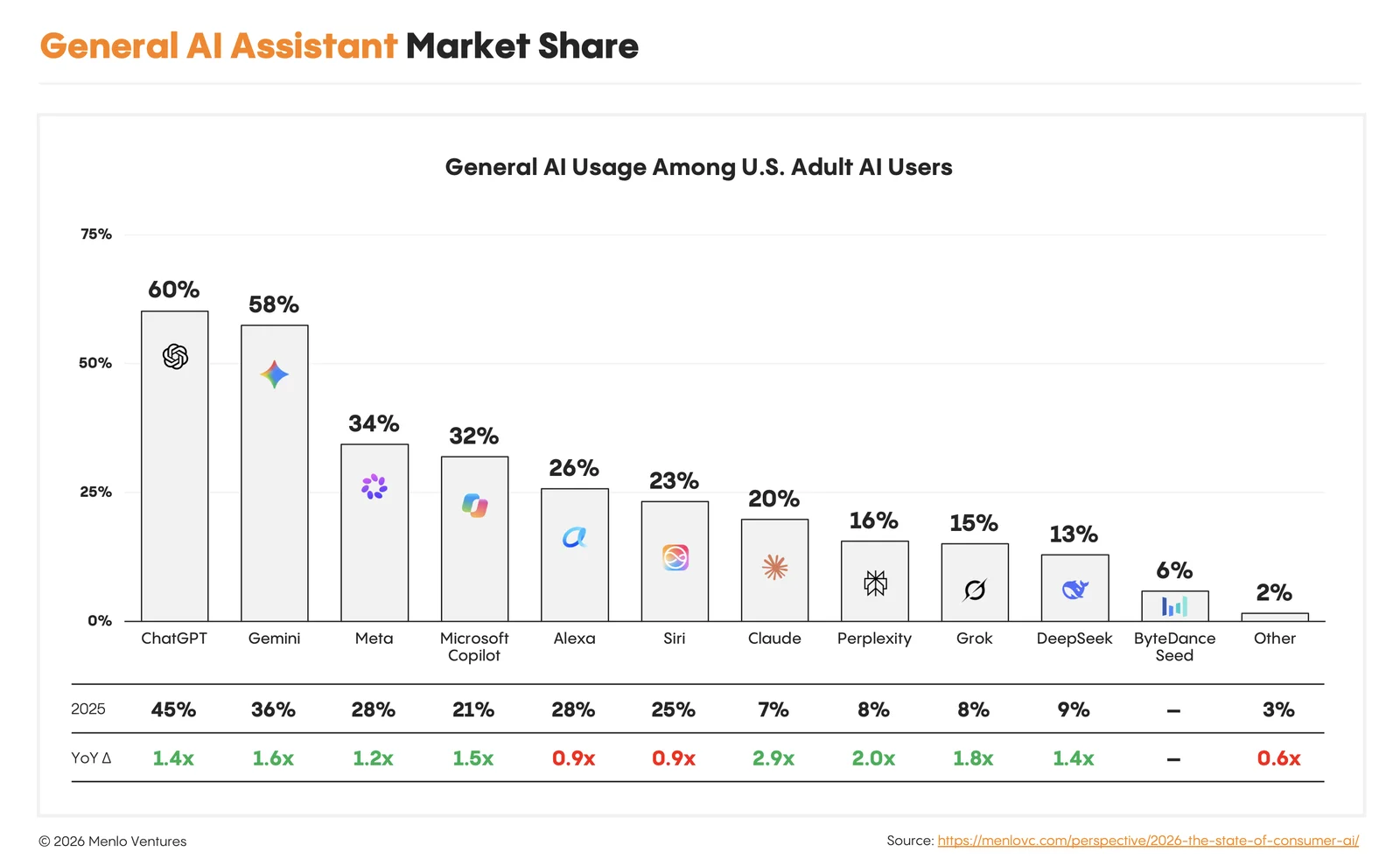
Copilot likewise arrives with Windows, Outlook and Word, in companies that already pay for their Microsoft licences: Microsoft claims more than 30 million paid licences. Meta AI turns up in WhatsApp, Instagram and Messenger without anyone installing it, and 34% of US AI users use it.
Claude is chosen for work
Claude's users are more often highly qualified professionals in tech or finance, and 82% pay for a subscription, according to the same fund. Developers have adopted it for Claude Code, a tool that writes and fixes code for them. Claude generates neither images nor video.
The others bet on search, Europe or being free
Perplexity presents itself as an answer engine that cites its sources, and its share of US AI users has doubled in a year, to 16%. Vibe, the former Le Chat from Mistral AI, is named by 22% of 60 to 69-year-olds in France, which Crédoc links to older people's attachment to products made in France. DeepSeek, which is free, is named by 15% of 12 to 17-year-olds.
4What do people use AI chatbots for?
What people ask an AI shows what it replaces. In France, AI has taken writing away from the search engine: to write, translate or correct a text, 42% of users turn to an AI first. To look up information, 55% still go to the search engine first, according to Crédoc.
What people ask AI to do, in France and on ChatGPT
Tool people turn to first for 6 activities, among French users of generative AI, June 2025.
To write, French users turn to AI first; to look up information, they still choose the search engine 2 times as often.
Based on Crédoc for Arcep, Baromètre du numérique 2026, chart 4 (fieldwork June 2025, 2,002 users). Other answers (the 2 tools, neither) are not shown.
On ChatGPT, 73% of messages have nothing to do with work, according to a study by OpenAI and Harvard economists published in September 2025 on 1.1 million conversations. Practical guidance, information seeking and writing make up most of them, and code barely 5%.
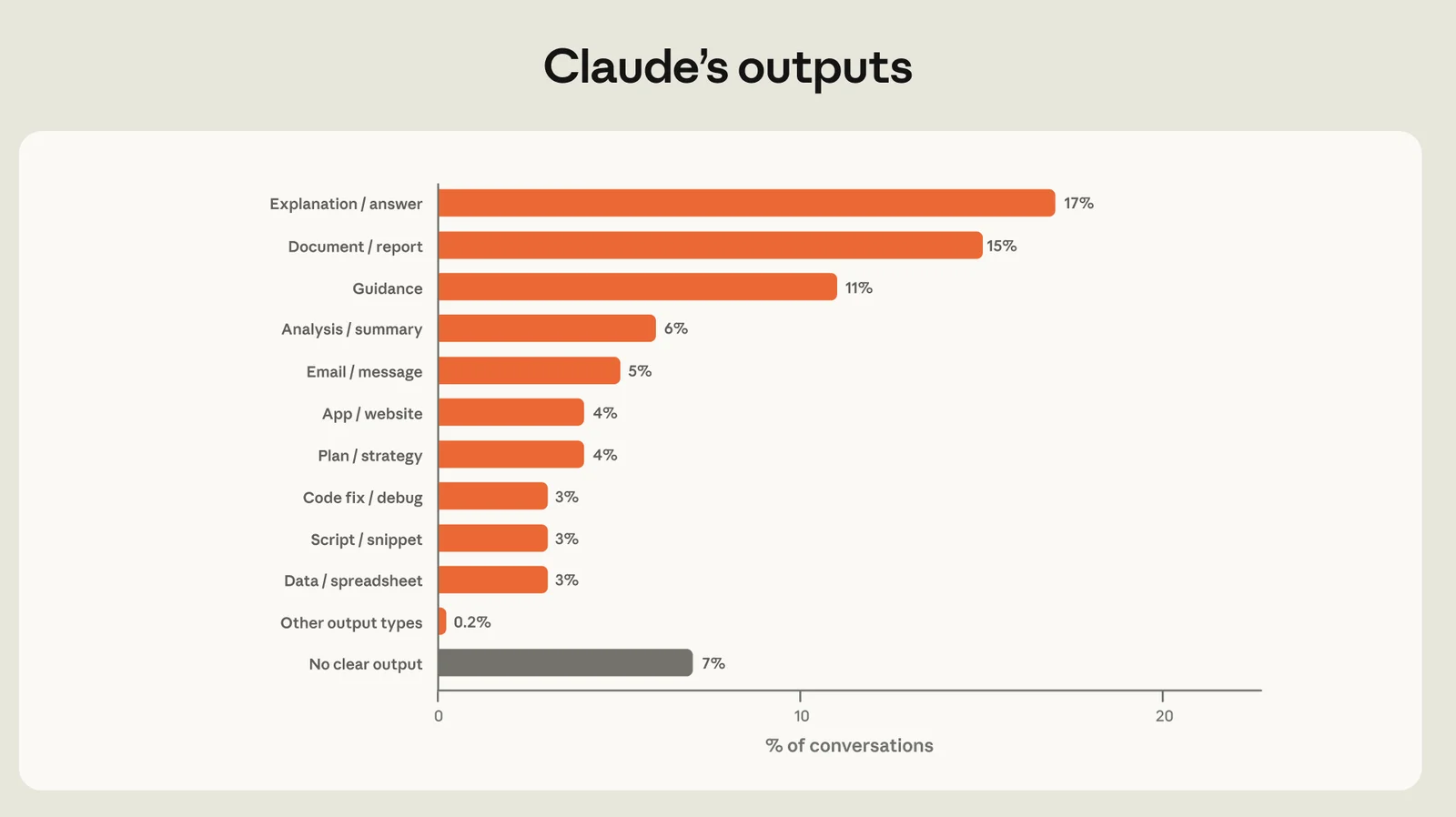
Claude leans towards work. According to the Anthropic Economic Index, which Anthropic draws from its own conversations, 93% of conversations produce something, mainly explanations, documents and advice. Computer and mathematical occupations account for 35% of them.
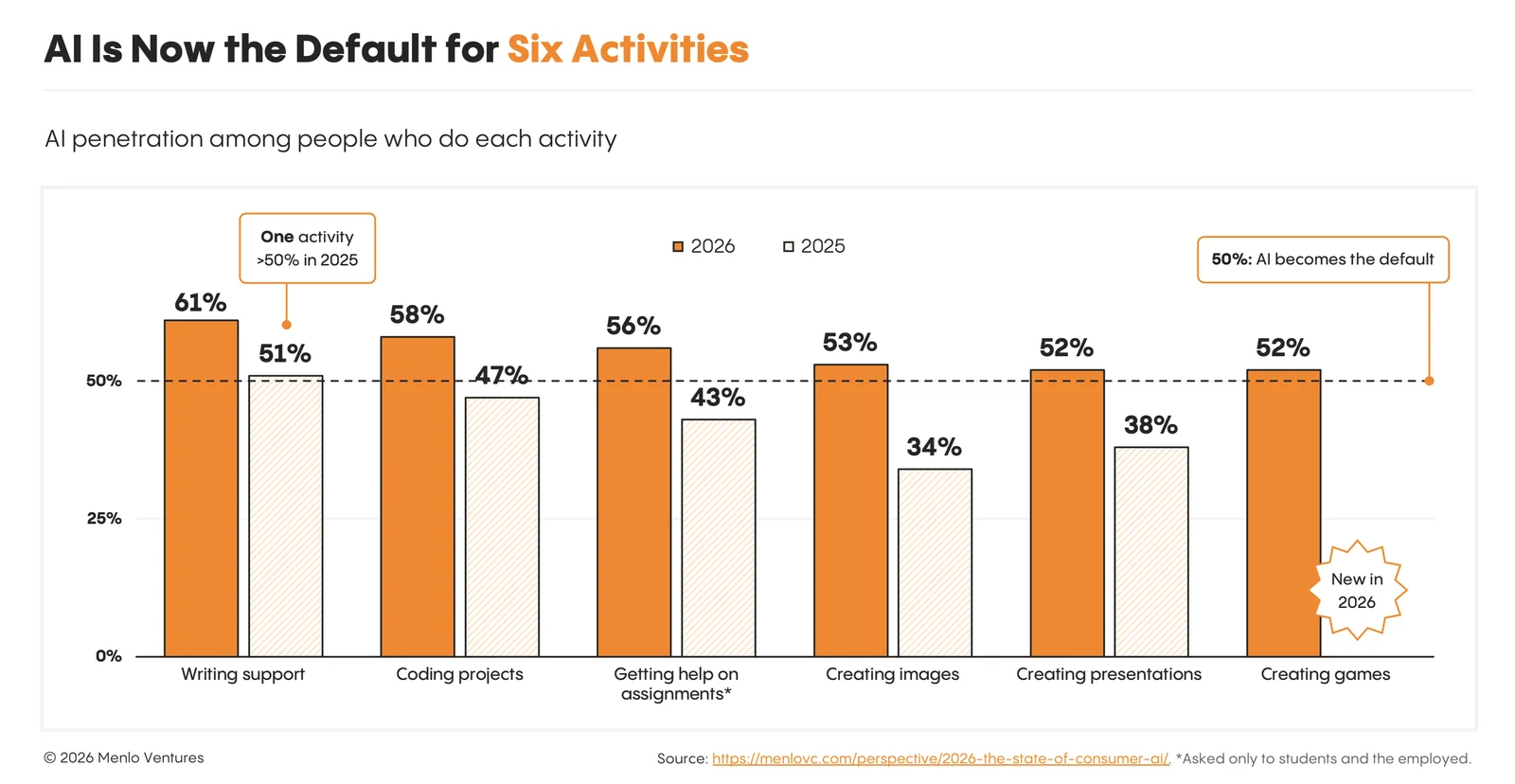
In the United States, AI became the default tool for several activities in 2026, according to Menlo Ventures: 61% of people who write do so with an AI, and 58% of those who code. No independent study yet shows which assistant serves which occupation, apart from developers.
5Which AI do companies use?
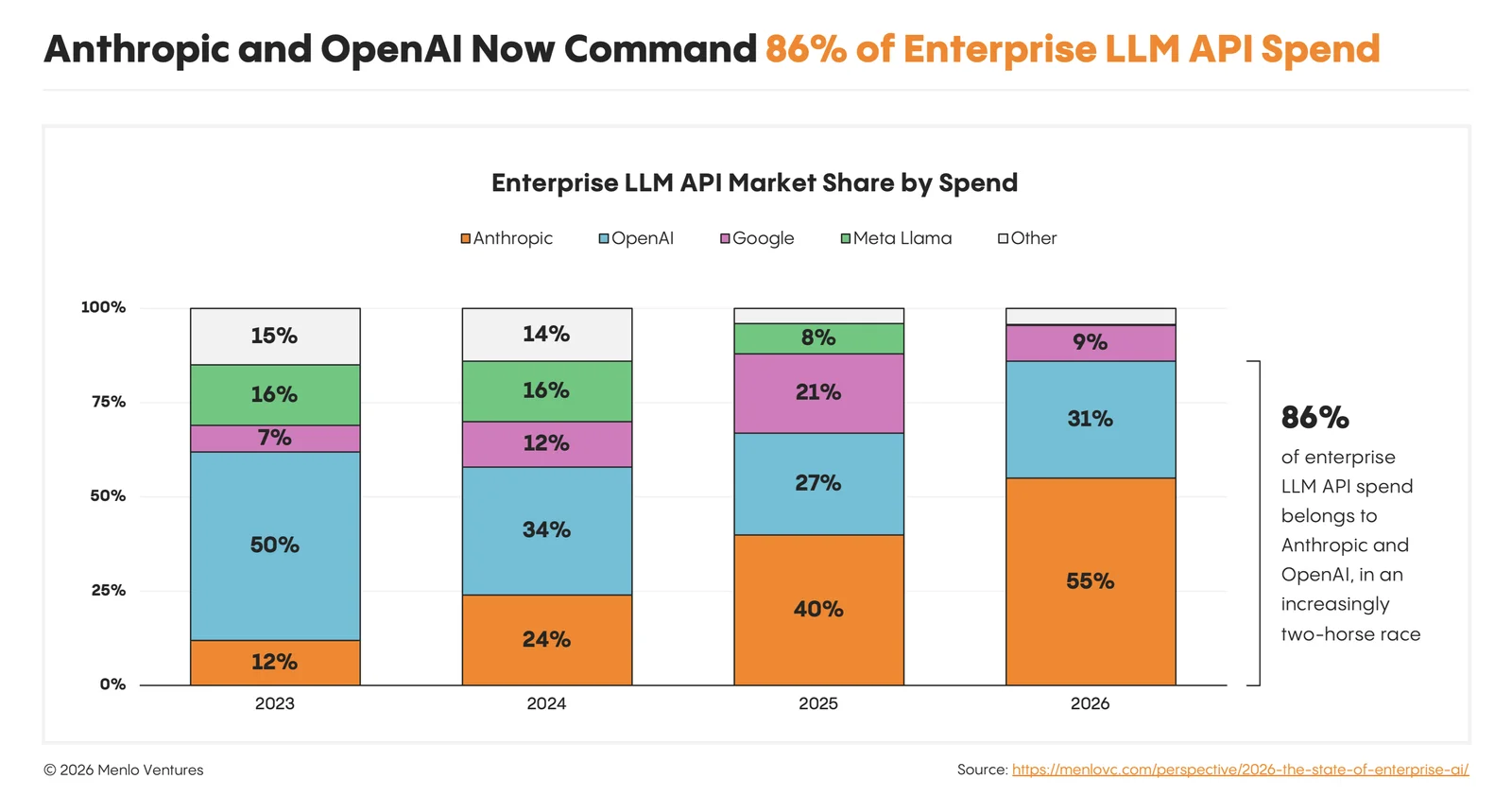
In companies, Claude has become the reference work tool, while ChatGPT remains the tool of the general public. US companies pay Anthropic, its developer, first, according to 2 sources that measure different things and point in the same direction.
Anthropic has overtaken OpenAI in business spending
The first counts the companies that pay. Ramp, a payment card company, sees the invoices of 85,000 US companies and draws the Ramp AI Index from them: in September 2026, 43.8% of them pay Anthropic, slightly more than pay OpenAI, whereas Anthropic was below 20% at the end of 2025.
The second counts the money. According to Menlo Ventures, a fund that invests in Anthropic, the company receives 55% of the sums that businesses pay to build an AI model into their own tools, far more than OpenAI. Coming from an investor, this figure should be read alongside Ramp's.
Developers have adopted Claude Code, and French managers have adopted AI
Among developers, the measure is a survey. Of those who use a coding assistant, 66% use Claude Code, up from 41% a year earlier, according to the 2026 annual survey of Stack Overflow, the large programmers' help site.
In France, 50% of managers and professionals used generative AI at least once a week in March 2026, up from 35% a year earlier, according to Apec, the French association for executive employment. Insee, the French national statistics institute, counts 58% of companies with 250 or more employees using it in 2025. Our article on a company's digital footprint places AI among the other items.
6How much electricity do these questions use?
An audience of this size has an electricity cost, which is why each of our rankings covers it: the more an AI is used, the more its footprint matters, even when each question weighs little. A quick question uses about 0.3 Wh (watt-hour) of energy, as much as an LED bulb lit for 2 minutes, according to Projet Celsius's AI Database, and roughly as much as a Google search.
Yet ChatGPT was receiving 2.6 billion messages a day in June 2025, according to OpenAI. Over a year, these messages use as much electricity as 60,000 French households.
This calculation counts every message as a simple question: images, video, reasoning mode and coding agents multiply the energy used, and these are the uses that are growing in companies. The detail is in our article on ChatGPT's energy use, the global scale in AI electricity consumption, and the trend in AI by 2030.
An organisation's footprint depends less on the assistant it chooses than on the number of questions and the heavy tasks it gives it.
7Our verdict
The audience ranking does not tell you which AI to choose, but it does show what each one does best.
The AI footprint calculator gives a first order of magnitude, and our method for bringing AI into your Bilan Carbone®, the French carbon accounting method, makes it possible to track it over time. Our article on the carbon footprint of AI in your company shows what an hour of a coding agent weighs.
4 rankings of AI assistants, from performance to pollution

Last: Grok, 24/100
Most polluting: Grok, 13/100
Last: Grok, 17/100
Last: Perplexity, 0.9%


The Celsius ranking, final score out of 100
8Key takeaways
- ChatGPT is still the most used AI in the world, with more than 1.2 billion users a week and 56% of web traffic to AI assistants in September 2026.
- Gemini has nearly doubled its share of traffic in a year, to 25%, driven by Android and Google, and Claude has quadrupled its own, to almost 10%.
- US companies pay Anthropic first: 43.8% of the companies tracked by Ramp pay it in September 2026, and it receives 55% of the sums paid for models according to Menlo Ventures, its investor.
- In France, 48% of people aged 12 and over use generative AI, 8 users in 10 name ChatGPT, and AI has taken writing away from the search engine.
- Each AI has its own way in: habit for ChatGPT, the phone for Gemini, work for Claude, Office for Copilot, messaging apps for Meta AI.
To choose on other criteria, see our ranking of the most polluting AI assistants and our ranking of the most ethical AI assistants. The ranking of the best AI of 2026 brings our 3 rankings together.
- Similarweb, shares of web traffic to generative AI sites, October 2025 to September 2026, published on 12 October 2026 and reported by OfficeChai
- Alphabet, third-quarter 2026 results, 28 October 2026
- Menlo Ventures, 2026: The State of Consumer AI, 16 September 2026, Morning Consult survey of 5,067 US adults (Menlo Ventures is an investor in Anthropic)
- Menlo Ventures, 2026: The State of Enterprise AI, 3 November 2026 (Menlo Ventures is an investor in Anthropic)
- Ramp, AI Index, September 2026 data, accessed on 5 November 2026
- Anthropic, Anthropic Economic Index, June 2026 report, 26 June 2026
- Anthropic, Anthropic Economic Index, March 2026 report
- Aaron Chatterji et al. (OpenAI and Harvard), How People Use ChatGPT, NBER Working Paper 34255, September 2025
- Sensor Tower, ChatGPT uninstalls surge amidst deal with US Department of War, March 2026
- Stack Overflow, Developer Survey 2026, AI, 6 October 2026
- a16z, Top 100 Gen AI Consumer Apps, 7th edition, 5 October 2026
- Crédoc for Arcep, Arcom, the CGE and the ANCT, Baromètre du numérique, 2026 edition (in French), charts 4 and 5, fieldwork in June 2025
- Arcom and Médiamétrie, Baromètre d'audience des services d'intelligence artificielle, 1st edition (in French), 16 June 2026
- Reuters Institute, Generative AI and News Report 2025, October 2025
- Insee, Insee Première No. 2120 (in French), 21 July 2026
- Apec, Cadres et IA (in French), May 2026
- Projet Celsius, AI Database (Base IA): quick question 0.3 Wh, global electricity 458 gCO2e/kWh (Ember), November 2026; for ChatGPT messages, about 290 million kWh and 130,000 tCO2e a year
- QuestMobile, via TechNode, monthly users of AI apps in China, May 2026
- Fortune, Microsoft Copilot, 21 May 2026, and Microsoft, results of 29 July and 28 October 2026
- Microsoft Research, Working with AI, arXiv 2507.07935