

- 1Exposed: nearly 40% of jobs worldwide according to the International Monetary Fund, an estimate that counts no job eliminations.
- 2US payroll records: a 19% employment gap among 22-25 year olds between the most exposed occupations and the others.
- 3France, end of 2025: IT employment of 15-29 year olds, excluding work-study trainees, down 7.4% over 1 year.
- 4Forecast by 2030 worldwide (World Economic Forum): 11 million jobs created by AI, 9 million eliminated.
The figures circulating on the impact of AI on jobs fall into 3 levels: the share of jobs exposed is an estimate, observed gaps are measurements and announcements are forecasts. In the United States, one study follows the payroll records of several million employees. Taking the number of jobs held by 22-25 year olds in November 2022 as 100 for each group of occupations, it counts about 89 in the most exposed occupations in June 2026, against 110 in the others, or 19% fewer. Its authors say that they do not establish the cause, and total employment in their sample rose over the period.
Exposed, observed, forecast: 3 levels of figures
An estimate, a measurement and a forecast cannot be compared with one another.
ExposedEstimate
ObservedMeasurement
ForecastForecast
In France, Insee (the French national statistics office) has recorded a fall in IT employment among people under 30, which it considers impossible to attribute directly to AI alone. This page was last updated on 5 October 2026.
1How many jobs are exposed to AI?
Nearly 40% of jobs worldwide are exposed to AI according to the International Monetary Fund (IMF, January 2024), and 1 job in 4 is exposed to generative AI, the kind that produces text, images or code, according to the International Labour Organization (ILO, May 2025). Exposed means that some of the tasks in an occupation could be carried out or assisted by AI. The 2 figures do not measure the same thing: the IMF considers AI in the broad sense and ranks occupations relative to one another, whereas the ILO considers only generative AI and scores occupations task by task. Neither of the 2 counts job eliminations.
In advanced economies, where it puts exposure at about 60% of jobs, the IMF estimates that about half of the exposed jobs could be harmed by AI, while the others could benefit from it through higher productivity.
The ILO states that its figures measure exposure, which it distinguishes from the actual effect on employment: they set a ceiling that would be reached if the technology were fully deployed. Its most exposed category, in which most of the tasks in an occupation could be automated, accounts for 3.3% of global employment.

According to a note of June 2026 from the French Treasury (Direction générale du Trésor), the share of jobs exposed ranges from 5% to 60% depending on the study. Of these jobs, it writes, only some could be replaced by AI; in the others, tasks would change without the job disappearing.
For France, the French Treasury cites a study published in 2026 by the credit insurer Coface: 3.8% of work content would be at risk of being automated by generative AI, and up to 16.3% within 2 to 5 years. The Treasury explains that this indicator measures a share of the tasks performed across all occupations and does not indicate the share of jobs threatened with elimination, so it cannot be compared with the IMF's 40%.
Citing this study, an information report of the French Senate dated 28 April 2026 states that, when agentic AI is massively deployed, 16.3% of French employment would be under threat within two to five years, or nearly 5 million people (our translation). Agentic AI means AI systems able to carry out chains of tasks on their own. At the French National Assembly on 8 April 2026, Axelle Arquié, co-author of the study, had made clear that it does not speak of 5 million jobs destroyed but of a percentage of potentially automatable tasks (our translation).
2What has been observed in the United States and France
In the United States, employment among 22-25 year olds in a sample of payroll records fell by about 11% in the occupations most exposed to AI between November 2022, the month ChatGPT launched, and June 2026, and rose by about 10% in the others. These are the findings of 3 economists at Stanford University, in a study updated in August 2026 that draws on the payroll records of 3.5 to 5 million employees, supplied by ADP, a US payroll provider.
The study sorts occupations into 5 groups according to their exposure to AI and compares the 2 most exposed with the other 3: employment of 22-25 year olds is 19% lower in the more exposed groups (89 against 110). Using data up to July 2025, the same calculation gave 15%. Older employees showed no comparable gap.
Employment among young people falls in the occupations most exposed to AI
US payroll records from ADP. Base 100 in November 2022; latest point in August 2026.
-13%in the most exposed group
since November 2022
These curves describe a change; they do not establish its cause.
Over the same period, total employment in the sample rose by about 6%, and the authors found no sign of widespread job destruction there. The sample includes only companies present throughout the period, which may inflate the increase. Among 22-25 year olds, the gap arose through slower hiring; the authors found no sign that departures explain it. The decline was concentrated in occupations where AI is used mainly to automate tasks.
The authors' first caveat is that the curves for more and less exposed occupations were already partly diverging before ChatGPT, around the pandemic. The second is that, when they accounted for the share of higher-education graduates in each occupation, the estimated difference between the most exposed and the least exposed group fell from 18 to 9 percentage points among companies tracked since 2018. Among those tracked since 2021, it fell from 19 to 6 and could no longer be distinguished from zero. In their view, having a degree may be another explanation, or the channel through which AI would act.
The third caveat is that over 2022-2024 this difference was 13 points in their data, against about 2 in the US Census Bureau's annual survey, a figure that, given its margin of error, cannot be distinguished from zero. The authors write that their work does not estimate a causal effect of AI and caution against extrapolating these orders of magnitude to the whole economy. ADP, which supplies the data, provides financial support to their lab and may review the study to protect its confidential information.
The Budget Lab at Yale University writes, in its monthly tracker updated on 15 September 2026, that the distribution of occupations is not yet changing in a way that clearly matches the arrival of AI. In Denmark, 2 economists ruled out any effect above 2% on wages and hours worked 2 years after the launch of ChatGPT. For young people, a study published in March 2026 by Anthropic, an AI company, found a 14% fall, compared with 2022, in the rate at which 22-25 year olds enter exposed occupations, a result its authors describe as barely statistically significant.
The French Treasury notes that job cuts attributed to AI accounted for between 4.5% and 6.2% of announced layoffs in the United States in 2025, and sees AI as sometimes a pretext that hides other reasons. It concludes that empirical studies cannot determine the total effect of AI on employment.

In France, a sector-by-sector analysis published by Insee in March 2026 shows that employee jobs held by 15-29 year olds, excluding work-study trainees (apprentices and those on professionalisation contracts) fell by 7.4% in IT activities, 5.8% in publishing and 3.7% in management consulting over 1 year to the fourth quarter of 2025. For the same age group, the fall across all non-agricultural market sectors was 0.7% (our reading of Insee's chart).
Insee writes that it is obviously impossible to attribute this change directly to the arrival of generative AI alone (our translation): employment was slowing across the country, and these sectors could have been going through a temporary slowdown. It adds that activity there remained buoyant after 20 years of steady growth in headcount, so that the reversal appears abrupt and coincides fairly closely with the arrival of this new technology (our translation). As in the United States, it writes, the fall seems to come first through entry-level hiring.
3Which jobs, workers and countries are most exposed to AI?
In the estimates we read, exposure is higher in administrative jobs, among women and in rich countries. The ILO places 13 occupations in its most exposed category, which is mostly administrative: data entry clerks, accounting clerks, payroll administrators and office clerks, but also financial analysts and web developers.
In high-income countries, 9.6% of female employment is in the category most exposed to generative AI, against 3.5% of male employment
Share of employment exposed to generative AI, by the 4 exposure categories of the International Labour Organization (ILO). Same scale for all columns.
The most exposed categorymost of the tasks in the occupation have a high automation potential; 13 occupations, mostly administrative jobs
WomenMen
High-income countries
WomenMen
World
Exposed employment, all 4 categories combinedsome of the occupation's tasks could be carried out or assisted by generative AI
High-income countries
World (1 job in 4)
Low-income countries
In high-income countries, this category accounts for 9.6% of female employment against 3.5% of male employment, or 2.7 times the share for men (our calculation); worldwide, the figures are 4.7% and 2.4%. The ILO states that being exposed does not imply the immediate automation of an entire occupation. In most of the countries it studied, the IMF finds a gap in the same direction and notes that exposed women are split roughly evenly between the occupations AI could replace and those it could help; it sees this as both more risks and more opportunities.
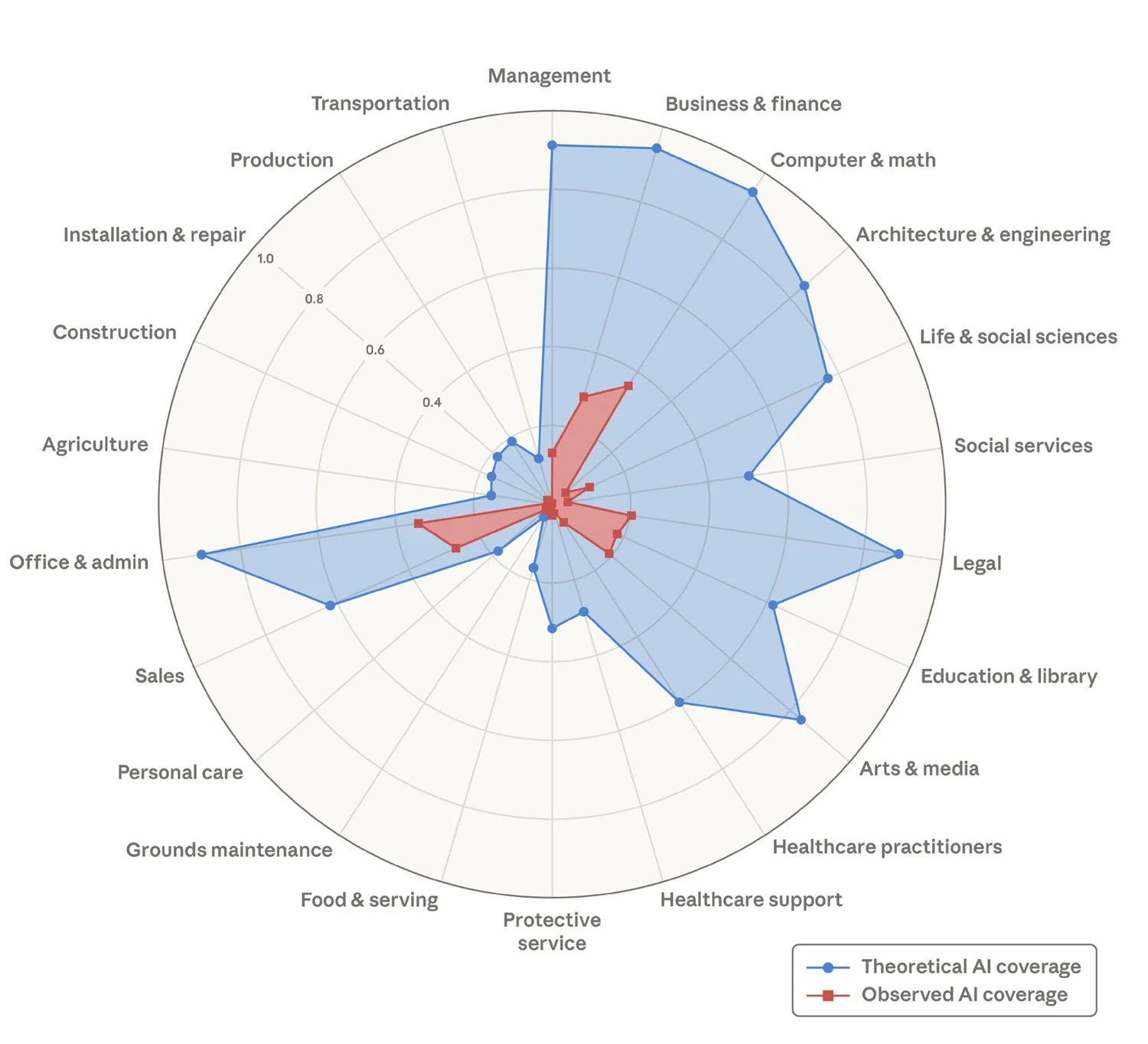
In blue, the share of tasks in each occupational group that a language model could perform in theory; in red, the share covered by the use of Claude in professional contexts. In computing ("Computer & math"), 94% in theory, 33% observed; in office occupations ("Office & admin"), 90% in theory. The authors conclude that AI is far from having reached its theoretical capabilities. The study has 2 limitations: the authors work for the company that develops Claude, and the use measured is that of this one AI only.
Exposure rises with a country's income. The ILO puts it at 34% of employment in high-income countries against 11% in low-income countries; the IMF, at about 60% in advanced economies against 26% in low-income countries. The ILO explains this by the weight, in those economies, of administrative jobs and of jobs in finance and customer service.
4Will AI create or eliminate jobs? What the forecasts say
The forecasts do not cover the same thing: one counts jobs created and eliminated worldwide, the other says that a share of white-collar jobs in the United States could disappear.
By 2030: 170 million jobs created, 92 million eliminated; for AI, 11 and 9 million
World Economic Forum forecasts, between 2025 and 2030, in millions of jobs.
All trends combinednet balance: +78 million
technology, demographics, ecological transition, economy, geopolitical tensions
AI and information processingnet balance: +2 million
one of the technology trends quantified in the report
Separately: 1 statement and 1 estimate from 2013
In the United States, half of entry-level office jobs could disappear within 1 to 5 years, and unemployment could rise to between 10 and 20%
Dario Amodei, head of Anthropic, as worded by Axios, 28 May 2025
47% of US jobs exposed to automation over a horizon of about 10 years
Frey and Osborne, University of Oxford, 2013, figure reported by the French Treasury
In its report of January 2025, the World Economic Forum forecasts 170 million jobs created and 92 million eliminated between 2025 and 2030, or 78 million more jobs created than eliminated. This balance combines all trends: technology, demographics, the ecological transition, economic uncertainty and geopolitical tensions. For AI and information processing, it forecasts 11 million jobs created and 9 million eliminated. These figures extrapolate the responses of 1,043 employers to 1.18 billion workers, a share of global employment.
On 28 May 2025, the US news site Axios reported remarks by Dario Amodei, chief executive of Anthropic, the AI company that develops Claude. According to Axios, Dario Amodei believes that AI could wipe out half of entry-level white-collar jobs in the United States and push unemployment to between 10 and 20% within 1 to 5 years. This sentence is the journalists' wording, drawn from an interview. In the interview, Dario Amodei says he is speaking out to urge public authorities and AI companies to prepare; Axios notes that he is himself building the technology whose effects he forecasts.
The French Treasury points out that in 2013, 2 Oxford researchers estimated that 47% of US jobs were exposed to automation. In its view, the projections of mass job destruction made at the time did not materialise: an exposed task does not necessarily lead to the employee being replaced. It nonetheless does not rule out mass replacement if more autonomous AI becomes widespread. The authors of the Stanford study write that they make no forecast and do not claim that the trend will continue.
5Early-career workers: what studies and employers say
To explain why the gap affects the youngest workers, the authors of the Stanford study put forward a hypothesis: AI would replace codified knowledge, the kind learned in courses and textbooks, more effectively than tacit knowledge, which is acquired through practice. In their data, employment of 22-25 year olds rose less in the occupations that rely most on codified knowledge. Once the share of higher-education graduates in each occupation was taken into account, this link was no longer established statistically, and the authors present it as descriptive.

According to the French Treasury, AI can speed up the acquisition of skills early in a career, but it also automates tasks that follow explicit rules, which are often most of the assignments given to young employees. This raises concerns, it writes, about their entry into employment and, in the longer term, about the next generation of experienced employees.
Among the employers surveyed by the World Economic Forum, 77% plan to train their employees to work with AI and 40% plan to reduce their headcount where AI can automate tasks; 7 in 10 companies consider analytical thinking essential. These responses describe intentions.
The sources we read do not say whether the gap measured in the United States is caused by AI, whether the young people who are not hired in these occupations work elsewhere or return to education, or whether a comparable gap will be measured in France. None of them can tell you which career to choose.
Also in this series: the impact of AI on the brain; whether to boycott AI, which includes jobs among its 5 risk categories; the environmental impact of AI; how to reduce the impact of your AI use; and how to choose a more eco-friendly AI. For a company that deploys AI, see AI in the Bilan Carbone® (the French carbon accounting method).
6Key takeaways
- Exposed: nearly 40% of jobs worldwide according to the IMF and 1 in 4 for generative AI according to the ILO; neither estimate counts job eliminations.
- Observed in the United States: in a sample of payroll records, every 100 jobs held by 22-25 year olds in November 2022 had become about 89 in the most exposed occupations by June 2026, against 110 in the others, with no cause established; total employment in the sample rose by about 6%.
- Observed in France: a fall of 7.4% over 1 year to the end of 2025 in employee jobs held by 15-29 year olds, excluding work-study trainees, in IT activities, which Insee considers impossible to attribute directly to AI alone.
- Forecast worldwide: for AI, 11 million jobs created and 9 million eliminated by 2030, according to the World Economic Forum.
- Forecast in the United States: half of entry-level white-collar jobs could disappear within 1 to 5 years, according to Dario Amodei, chief executive of the AI company Anthropic (remarks reported by Axios, May 2025).
- The Stanford study: Brynjolfsson, Chandar and Chen, Canaries in the Coal Mine?, Stanford Digital Economy Lab, August 2026 version, data to June 2026; study page. The curves in our chart come from the lab's dashboard (AI Economic Indicators), file dated 17 September 2026, data to August 2026.
- The exposure estimates: IMF, Gen-AI: Artificial Intelligence and the Future of Work, Staff Discussion Note SDN/2024/001, January 2024. ILO, Generative AI and Jobs: A Refined Global Index of Occupational Exposure, Working Paper No. 140, May 2025.
- In France: Insee, special feature of the Note de conjoncture (economic outlook) of 24 March 2026, by Raphaële Adjerad and Gaston Vermersch. Direction générale du Trésor (French Treasury), Artificial intelligence: what effects on employment?, Trésor-Éco No. 391, June 2026; the Coface study it cites (Arquié, Duthoit and Subileau, The Next Automation Frontier, April 2026) could not be opened on Coface's website. National Assembly, social affairs committee, minutes No. 62 of the round table of 8 April 2026. Senate, Enterprise 5.0: the impact of artificial intelligence on companies, information report No. 572, 28 April 2026, which cites a study by Coface and the Observatoire des emplois menacés et émergents (observatory of threatened and emerging jobs). The pages cited in this item are in French and their titles are our translation.
- The forecasts: World Economic Forum, Future of Jobs Report 2025, 7 January 2025: summary, chapter 2, chapters 3 and 4, appendix. Axios, Behind the Curtain: A white-collar bloodbath, 28 May 2025: the sentence about half of entry-level white-collar jobs was written by the journalists, Jim VandeHei and Mike Allen ("AI could wipe out half of all entry-level white-collar jobs - and spike unemployment to 10-20% in the next one to five years"); among the words of Dario Amodei that Axios puts in quotation marks: "Cancer is cured, the economy grows at 10% a year, the budget is balanced - and 20% of people don't have jobs."
- The other studies: The Budget Lab at Yale, Tracking the Impact of AI on the Labor Market, page published on 16 July 2026, updated on 15 September 2026; first version: Evaluating the Impact of AI on the Labor Market: Current State of Affairs, 1 October 2025. Humlum and Vestergaard, Still Waters, Rapid Currents: Early Labor Market Transformation under Generative AI, NBER (National Bureau of Economic Research), Working Paper No. 33777, May 2025, revised in March 2026; abstract only. Massenkoff and McCrory, Labor market impacts of AI: A new measure and early evidence, Anthropic, 5 March 2026; presentation page only.
- Images: Opening photo: Neil Owen, Wikimedia Commons, CC BY-SA 2.0, cropped. La Défense seen from the Arc de Triomphe, January 2023: Arthur Weidmann, Wikimedia Commons, CC BY-SA 4.0. France Travail agency in Altenstadt, May 2025: Didivo67, Wikimedia Commons, CC0. François Perroux lecture theatre, Jean Moulin Lyon 3 University, May 2026: Sebleouf, Wikimedia Commons, CC BY-SA 4.0, cropped.
- Update: Page updated on 5 October 2026. The data change every quarter: we will review this page whenever the Stanford study is updated and whenever an Insee economic outlook note covers the subject.