
- 1In a high school trial, classes using an AI that answers freely scored 17% lower in the exam.
- 2With the AI that gives hints, the same trial found no measurable difference in the exam.
- 3In a preprint of 54 people, electrode recordings found brain signals less linked to one another with ChatGPT.
- 4Lasting effect on the brain: not measured. The longest follow-ups, of up to 30 months, track grades.
The 3 studies we selected on the impact of AI on the brain measured 3 different things, during a task or just after it: grades, answers to a questionnaire and electrical activity in the brain. The study with the strongest evidence is a randomised controlled trial, an experiment in which groups are assigned at random. Run in 2023 at 1 high school in Turkey, it found that classes that revised mathematics with an AI that answers freely scored 17% lower in the exam than classes without AI. None of the 3 studies goes beyond 4 sessions.
3 studies, none longer than 4 sessions: none measures a lasting effect
From the most solid to the most fragile: the solid, outlined or dashed circle shows the level of evidence.
The only one of the 3 to record brain activity covers 54 people and has not yet appeared in a peer-reviewed journal. Follow-ups of between 1 semester and 30 months were posted online in 2026 without peer review; they look at grades, and none measures the brain. This page was updated on 5 October 2026.
1The 3 studies: 1 published trial, 1 survey, 1 preprint
The first of the 3 studies selected, all from 2025, is a trial published in a peer-reviewed journal, meaning that other researchers check the work before publication. The second is a questionnaire survey, published in conference proceedings that are also peer-reviewed. The third is an experiment with random assignment on a small sample; it is a preprint, posted online without that check.
The trial appeared in June 2025 in the US scientific journal Proceedings of the National Academy of Sciences (PNAS). In autumn 2023, at 1 high school in Turkey, nearly 1,000 students revised mathematics over 4 sessions of 90 minutes. Classes were assigned at random to work without AI, with an AI that answers freely (GPT-4 in a chat interface, like ChatGPT) or with an AI that gives hints without handing over the answer, drawing on solutions prepared by teachers. Each session ended with an unaided exam.
Compared with the classes without AI, the AI that answers freely raised scores on the exercises by 48% and lowered them by 17% in the exam: 27 out of 100 instead of 32 (our calculation). Allowing for statistical uncertainty, the drop lies between about 3% and 30% (95% confidence interval, our calculation). The AI that gives hints raised scores on the exercises by 127%, with no measurable difference in the exam from the classes without AI. The authors write that they measured only short-term effects.
With the AI that answers freely, the score rose on the exercises and fell in the exam
Nearly 1,000 high school students in Turkey, in mathematics. Average score out of 100, all 6 bars on the same scale.
On the exerciseswith the intended help
In the examwith no help at all, in the same session
No AI
28 reference
32 reference
AI that answers freely
42 +48%
27 -17%
AI that gives hints
65 +127%
32 no measurable difference
level of the classes without AI
The survey was presented in April 2025 by 7 researchers from Microsoft Research and Carnegie Mellon University. It covered 319 people who use AI at work at least once a week; between them they described 936 examples of use. The more they said they trusted AI, the less they reported exercising critical thinking; the more self-confidence they had, the more critical thinking they reported. This statistical link between self-reports does not establish cause and effect.
The third study, "Your Brain on ChatGPT", was posted online in June 2025 by 8 researchers from the Massachusetts Institute of Technology (MIT) and 2 other institutions. It randomly assigned 54 people, mostly students, to 3 groups of 18: ChatGPT, a search engine or no tool. Each participant wrote 3 texts of 20 minutes while wearing electrodes on the scalp.
At the end of session 1, 15 of the 18 participants in the ChatGPT group could not quote a sentence from their text, against 2 of 18 in each of the other 2 groups. On the question that followed, none of the 18 gave an exact quotation.
In sessions 2 and 3, 4 then 6 participants out of 18 in the ChatGPT group did not provide an exact quotation, against 2 of 18 in each of the other groups. The authors report no statistical test for these 2 sessions; they write that the difficulty persisted but eased, and that the question may have surprised participants the first time.
Quoting your own text: 18 of 18 failed in the 1st session with ChatGPT, then 4 and 6 in later sessions
Right after writing, each participant had to quote a sentence from their text. Solid dot: a participant with no exact quotation.
With ChatGPT
With a search engine
With no tool
1st session
2nd session
3rd session
2What brain imaging shows: signals less linked with ChatGPT, in a preprint
Only 1 of the 3 studies selected recorded brain activity while AI was being used. Using an electroencephalogram (EEG) on 54 people in 3 groups of 18, it measured signals less linked to one another with ChatGPT than with no tool. Our search of 5 October 2026 found 2 MRI studies (magnetic resonance imaging), also preprints, in which we found no comparison between work done with and without AI.
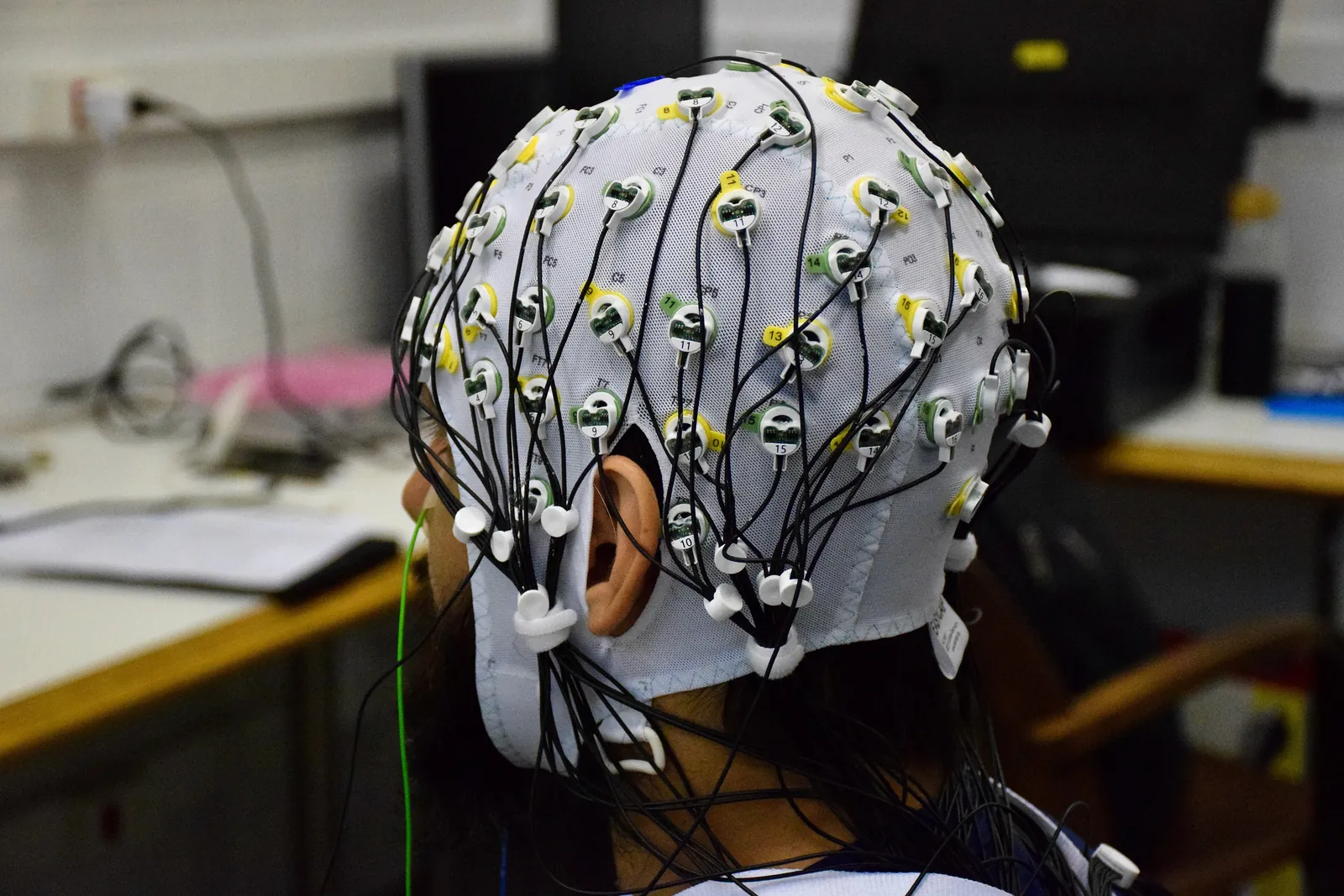
In "Your Brain on ChatGPT", 32 electrodes placed on the scalp record the brain's electrical activity. This technique does not produce an image of the anatomy, and the authors ask readers not to use the term "brain scans". From the recordings they derive a measure of connectivity, which is the degree to which the signals picked up by the different electrodes are linked to one another during the task.
This connectivity was strongest in the group with no tool, intermediate with the search engine and weakest with ChatGPT: according to the authors, up to 55% lower than with no tool in some of the signals. In their abstract, they infer "a likely decrease in learning skills" from their results. Their discussion refers to long-term costs, which their protocol of 3 sessions of 20 minutes did not measure.
The authors write that EEG does not precisely locate the deep structures of the brain, and name functional MRI, which tracks brain activity, as their next step. Every page of their document is marked "Preprint, under review", and on 5 October 2026 its entry on arXiv, the site where it is posted, listed no journal.
On 29 December 2025, 4 researchers from the universities of Vienna and Dresden posted a commentary online, also a preprint. By their calculation, a design of this kind would need about 159 participants, nearly 3 times the size of the study (our calculation). They note that some results are reported in contradictory ways from one page to another and that, in some of the signals, engagement was stronger with ChatGPT than with no tool. They judge some interpretations overstated and find no strong evidence that using AI degrades performance itself.
The first of the 2 MRI studies, posted online in November 2025, had 15 children aged 6 and 7 and 16 adults converse with ChatGPT for 5 minutes inside the MRI scanner. The brain networks that support control and attention were less linked to one another in the children than in the adults. We found no group without AI in this study: a comparison between 2 ages does not show what AI changes.
The second of these MRI studies compares the brain activity of 12 people judged expert at writing prompts for an AI with that of 10 people at an intermediate level, recorded with no task to perform. A third preprint, using near-infrared spectroscopy (another way of measuring brain activity), recorded, in 20 people, no physiological change linked to the assistant in Word.
3Does AI have a lasting effect on the brain? None of the studies measures it
None of the studies we have read measures a lasting effect on the brain; those that run for several months track grades. The high school trial consists of 4 sessions of 90 minutes, with an exam on the same day. In "Your Brain on ChatGPT", each participant wrote 3 texts of 20 minutes; the 4 months cited in the abstract refer to the length of the data collection. Neither of these 2 studies measures whether the ability to learn or to memorise changed afterwards.
The MIT study includes a session 4, the only session in which the tool changes: 18 volunteers came back, 9 former ChatGPT users wrote with no tool and 9 participants from the no-tool group used ChatGPT. On recall of the text, the study counts 7 failures out of 9 in one group and 1 out of 9 in the other, but its pages do not agree on which group, as the critical commentary points out.
Only the results on exams or tests come from published trials
The results of the studies read, from the most solid to the not measured.
Measured in published trials
Randomly assigned groups, peer-reviewed journal
- Turkey: -17% on the exam with the AI that answers freely
- Turkey: with the AI that gives hints, no measurable difference
- Harvard: an AI tutor did better than a lesson, on the test straight after
- Brazil, test at 45 days: 57.5% with ChatGPT, 68.5% among the others
Observed, to be confirmed
Preprint with a small sample, or self-reported answers
- Brain signals less linked to one another with ChatGPT
- 15 of 18 could not quote their text, 1st session with ChatGPT
- More confidence in AI, less reported critical thinking
Not measured
None of the studies read on generative AI measures it
- A lasting effect on the brain
- A change in the anatomy of the brain
- An effect on the brains of children
A trial from Brazil, published in late 2025, measured memory after several weeks. It gave a surprise test to 85 students who had worked on the same subject 45 days earlier, with or without ChatGPT: 57.5% correct answers with ChatGPT, against 68.5% without. Of the 120 students assigned at random, 35 did not take this test.
The authors of "Your Brain on ChatGPT" call for studies that follow the same people over time. Our search of 5 October 2026 found 3 follow-ups of 1 semester or more on generative AI, posted online in 2026. They are working papers, not peer-reviewed, and they track grades.
In 1 county in China, a 30-month follow-up of 26,811 middle and high school students, with no random assignment, finds that adopting an AI is associated with an 18% rise in homework grades and a 20% fall in monthly exam scores within 6 months. The loss is small among AI users whose homework time stayed close to that of non-users. In an op-ed, the authors caution that these orders of magnitude do not carry over directly to other settings, though they see them as a warning.
In 18 middle schools in Tennessee, a 2-year trial had students work on the Khan Academy exercise platform with its AI tutor, set up to guide. It found a small gain in mathematics, which its authors judge close to the gain from the platform used without AI; the students made little use of the tutor.
At a large public university in the United States, a trial with 2,379 students gave some of them access, for 1 semester, to an AI tutor whose default setting gave the explanation directly. Between groups within the same course, the final grade was 0.37 standard deviations lower with this access (a standard deviation is a measure of how spread out grades are); across all students, the gap is smaller and statistically less certain. This final grade is the one the instructor awards for the course, with no independent test, and the authors judge it hard to infer an effect on learning from it.
4Are schoolchildren and university students more exposed? The studies do not say
None of the studies cited here measures whether AI affects schoolchildren more than adults. In the high school trial, the students who had the AI that answers freely most often asked it for the answer; the authors see this as a crutch and give it as their explanation for the drop in the exam. When the authors put each of the 57 exercises to it 10 times, this AI gave the right answer in only 51% of cases.
The students were not aware of the drop: those in the group with the AI that answers freely did not think they had done worse in the exam, and those in the group with the AI that gives hints thought they had done better, although their scores did not bear this out.
The design of the tool changed the result. With the AI that gives hints, the exam score stayed on a par with that of the classes without AI. At Harvard, a trial published in June 2025 covered 194 students in an introductory physics course: those who followed a lesson at home with an AI tutor whose instructions were written by teachers did better in the test they took straight afterwards than those who followed the same lesson in class, in groups. Its authors do not assume that this result holds in every context.
In January 2026, Inserm, the French public medical research institute, published the opinions of 3 researchers; the page cites no study on the brain. The neurobiologist Jean-Philippe Lachaux describes cognitive offloading, the act of entrusting a mental task to a tool. In his words (our translation, as for the other opinions below), this delegation encourages the loss of skills that go unused. He suggests that students predict the answer before asking the AI, so as to learn from the gap. Cédric Naudet, a specialist in education sciences, fears that the educational divide will widen. The researcher Margarida Romero considers that everything depends on the tool and how it is used.
Only 1 of the studies we read involves primary school pupils: one of the 2 MRI preprints, which compares 15 children aged 6 and 7 with adults. The participants in the other studies are middle school students, high school students, university students or working adults. In France, the framework for the use of AI in education published by the Ministry of National Education in June 2025 provides for awareness-raising without hands-on use of generative AI in primary school. It authorises its use in class from the 4e class (the third year of collège, the French lower secondary school), under the teacher's supervision. The framework treats as fraud the use of an AI to do homework without permission and without personal work.
5Learning with AI: only answers versus hints were tested
The studies we read tested only 1 difference in use: receiving the answer or receiving hints. Trying on your own before asking rests on an opinion and a hypothesis; checking the answers rests on what users reported.
Of 3 approaches to learning with AI, only 1 has been tested in a trial
The 3 approaches, from the weakest support to the strongest.
- What was measured or said
- With the AI that gives hints, no measurable difference on the exam compared with classes without AI; with the AI that answers freely, 17% lower.
- What was not tested
- The case of a student who asks for a hint from an AI that answers freely.
The authors of the high school trial write that hints designed by teachers may mitigate the negative effect; they did not test the case of a student who asks an AI that answers freely for a hint. The authors of "Your Brain on ChatGPT" have a hypothesis about starting without a tool; it rests on the 18 participants in their session 4 and on a result that their document reports in 2 contradictory ways.
In the same series: the impact of AI on jobs, its environmental impact, whether to boycott AI, reducing its impact and choosing a more eco-friendly AI. The MIT study devotes a section to the energy cost of a query, which we detail in how much energy a ChatGPT query uses.
6Key takeaways
- High school trial: 17% lower in the exam with the AI that answers freely, compared with classes without AI; no measurable difference with the AI that gives hints.
- Study with electrodes: brain signals less linked to one another with ChatGPT, in a preprint with 3 groups of 18 people.
- Quoting your own text: 18 of 18 participants in the ChatGPT group gave no exact quotation in session 1, then 4 and 6 in the next sessions, against 2 or 3 out of 18 in the other groups.
- Lasting effect on the brain: not measured. The follow-ups of between 1 semester and 30 months posted online in 2026 concern grades, and they are working papers that have not been peer-reviewed.
- The 3 studies: Bastani et al., Generative AI without guardrails can harm learning: Evidence from high school mathematics, PNAS, vol. 122, No. 26, 25 June 2025, and the manuscript posted online by the author. Lee et al., The Impact of Generative AI on Critical Thinking, proceedings of the CHI conference, April 2025. Kosmyna et al., Your Brain on ChatGPT: Accumulation of Cognitive Debt when Using an AI Assistant for Essay Writing Task, arXiv preprint, version 1 of 10 June 2025, version 2 of 31 December 2025, with the project website and its FAQ.
- The critical commentary: Stanković, Hirche, Kollatzsch and Doetsch, Comment on: Your Brain on ChatGPT, arXiv, 29 December 2025. It is also a preprint. We have not read a response from the authors of the study; their version 2 was posted 2 days later, and nothing we have read indicates that it responds to the commentary.
- The other studies: Kestin et al., AI tutoring outperforms in-class active learning, Scientific Reports, 3 June 2025: 194 students included out of 233 enrolled, 2 lessons, test taken straight after each lesson. Barcaui, ChatGPT as a cognitive crutch: Evidence from a randomized controlled trial on knowledge retention, Social Sciences & Humanities Open, vol. 12, 2025: 120 students assigned at random, 85 tested at 45 days. Working papers, not peer-reviewed: Strömberg, Lei and Wu, The Generative AI Learning Penalty: Evidence from Chinese Secondary Education, CEPR, 2 June 2026, and their op-ed on VoxEU, 4 September 2026; Oreopoulos and Low, One Click Away: AI Tutoring with Khanmigo in a Two-Year School Experiment, NBER, August 2026; Liu et al., The Effects of Course-Integrated AI Tutoring on Student Performance and Engagement, EdWorkingPaper 26-1598, posted online on 30 September 2026. Imaging preprints: Horowitz-Kraus et al., Lower engagement of cognitive control, attention, modulation networks and lower creativity in children while using ChatGPT: an fMRI study, bioRxiv, November 2025; Al-Khalifa et al., The Prompting Brain, arXiv, 2025; Russell et al., Neural and Cognitive Impacts of AI, arXiv, June 2025.
- In France: Inserm, Quel est l'impact de l'IA sur l'éducation ? (What is the impact of AI on education?, in our translation), 5 January 2026: opinions of Jean-Philippe Lachaux, Margarida Romero and Cédric Naudet. Ministry of National Education, Cadre d'usage de l'IA en éducation (Framework for the use of AI in education, in our translation), 13 June 2025. Both pages are in French.
- Images: Opening photo: John Campbell, Wikimedia Commons, CC BY 2.0, cropped. Electroencephalography cap: Thaismay, Wikimedia Commons, CC BY-SA 4.0. Exam desks: Jérémy Barande / École polytechnique, Wikimedia Commons, CC BY-SA 2.0.
- Update: Page updated on 5 October 2026. We will revisit it each time a new study is published in a journal.