

- 1A short query uses ~0.3 Wh, roughly the energy of a Google search.
- 2The measurements converge: Gemini at ~0.24 Wh and GPT-4o at ~0.43 Wh (withdrawn from ChatGPT in 2026) fall in the same low range.
- 3Reasoning or a long prompt raises the figure sharply: up to several tens of Wh.
- 4The main issue is volume: billions of queries every day.
When you type a question into ChatGPT, you are not looking up a page that has already been written: you are triggering a live calculation, an inference query, in which an already trained model produces an answer. That calculation runs on specialised processors in a data centre and uses energy. A typical text query consumes around 0.3 Wh, or ~0.02 g of CO2 if it is processed in France. This article sets out where that figure comes from, why it can be 100 times higher and what you can do with it.
A year of your queries, converted into kWh, kilometres and light-bulb hours
Choose your daily usage rate and the electricity mix of the data centre: the electricity used over a year is converted live, with the factors shown.
= 25 queries × 365 days × 0.3 Wh, that is ≈ 151 gCO2e (French mix)
Even at 100 queries a day, a year of usage comes to ~11 kWh, 0.2% of a household's electricity. The country's electricity mix changes the CO2 by a factor of 8; the issue lies in the billions of daily queries taken together.
The 0.3 Wh figure is an order of magnitude, not an audited measurement: proprietary model providers such as OpenAI publish almost nothing official. We therefore work in ranges, looking at how the figure is built, what makes it vary by a factor of a hundred and, above all, the global volume that your query adds to. The converter above already gives the annual equivalents of your daily usage.
1How much energy does a ChatGPT query use? What the published figures say
For a short text query on a mass-market model, published figures converge on about 0.3 Wh. Google measured a median query to its Gemini assistant at ~0.24 Wh (arXiv 2508.15734); Sam Altman, the chief executive of OpenAI, cited ~0.34 Wh for an average ChatGPT query (The Gentle Singularity); and an independent benchmark put GPT-4o, then the mass-market model behind ChatGPT, at around 0.43 Wh ("How Hungry is AI?"). These 3 independent methods land in the same low range, which gives the following reference points:
Where the "~0.3 Wh" comes from: 3 independent figures, one range
A provider's measurement, an executive's statement, an academic benchmark: 3 methods that do not cite one another arrive at the same low range.
The only production measurement published by a provider: median query on the Gemini apps, August 2025.
The figure put forward by Sam Altman in June 2025, with no published methodology to support it.
Independent benchmark "How Hungry is AI?" (2025), when GPT-4o was running ChatGPT; it was withdrawn from it in February 2026. Epoch AI reaches ~0.3 Wh with a different method.
None of these figures is an audit: OpenAI publishes no official measurement, and only Google has quantified its production. The convergence of 3 independent methods, between 0.2 and 0.5 Wh per short query, nonetheless makes the order of magnitude solid.
- Energy: ~0.3 Wh per short query, enough to power a 10 W LED bulb for around 2 minutes.
- Digital equivalent: about as much as a Google search (Epoch AI).
- In France: ~0.02 g of CO2 (electricity mix ~55 g/kWh), less than a metre travelled by car.
- In the United States: ~0.12 g of CO2 (mix ~400 g/kWh): the same Wh emits up to 8 times more depending on the country where the data centre is located.

The figure everyone cites for the average consumption of a ChatGPT query comes from a blog post by Sam Altman, The Gentle Singularity: 0.34 Wh, "about what an oven would use in a little over one second", and about 0.32 mL of water. It has no published methodology, no detailed scope and no audit: it is a statement, not a measurement. Its one merit is that the order of magnitude agrees with independent estimates.
You obtain the CO2 emitted by a query by multiplying its energy by the carbon intensity of the electricity grid that supplies the data centre. A query processed in a French data centre, supplied by a heavily nuclear electricity mix, emits a fraction of what the same query emits in the United States. This gives a useful rule when setting a digital energy figure against other carbon orders of magnitude (in French): a Wh means nothing until you know where it is consumed. Our AI carbon footprint calculator does this calculation model by model, including the country of the data centre.
Energy is not the only resource at stake: the same Google measurement also reports ~0.26 mL of water per median query, or 5 drops, detailed in the water footprint of an AI query.
2Why the figure varies so much: tokens, model, prompt length and reasoning
The "0.3 Wh" figure applies to a short query on an optimised model. Change the model or lengthen the prompt and the figure can be multiplied by a hundred. Three variables explain most of the gap.
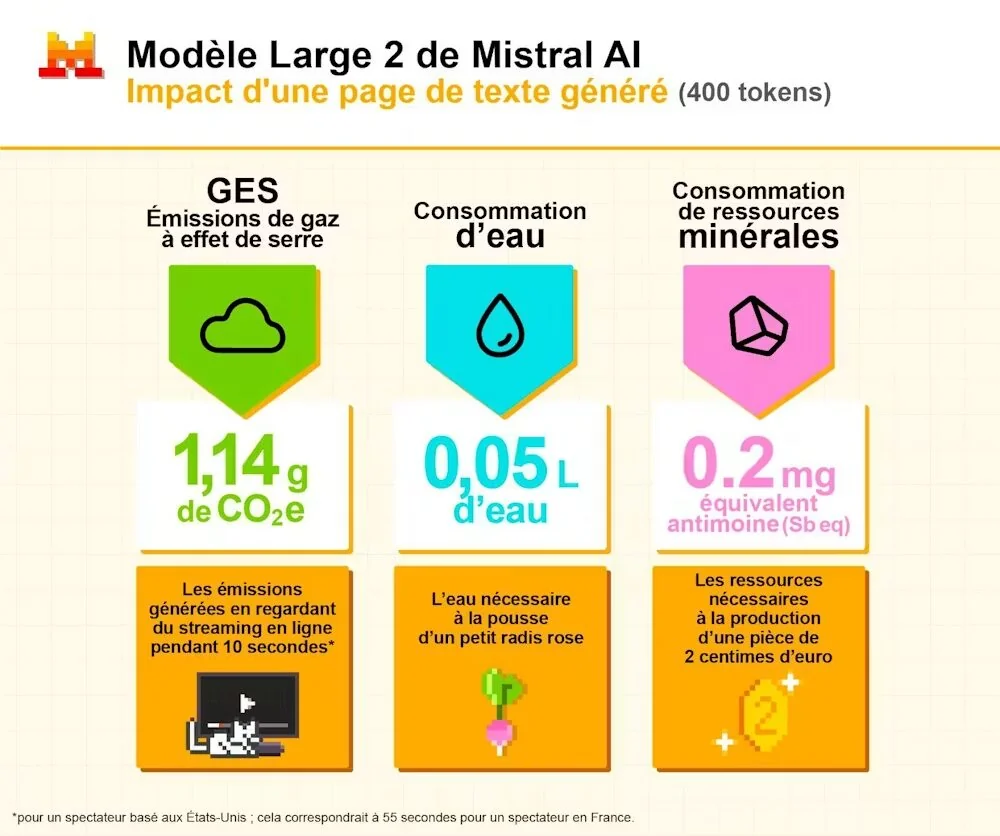
Mistral is the only major provider to have published a full life cycle assessment of its model, carried out with Carbone 4 and ADEME (the French Agency for Ecological Transition) and reviewed by third parties (Resilio and Hubblo): a 400-token response from Large 2 through Le Chat comes to 1.14 gCO2e, 45 mL of water and 0.16 mg Sb eq, server manufacturing included. Where other providers report energy in watt-hours, Mistral measures the whole life cycle: it is the sector's methodological reference.
The number of tokens
Consumption is counted in tokens, the basic unit that an AI processes: a fragment of a word, equivalent in French to about 0.75 words. The model reads your input tokens, then builds its answer one token at a time, and every token produced uses energy. Energy therefore follows the volume of tokens, especially on the output side: an exchange of 1,000 input tokens and 1,000 output tokens uses about three times more than one of 100 input tokens and 300 output tokens. What counts is the combined length of what goes in and what comes out, far more than the number of questions.
The model running behind ChatGPT
"ChatGPT" is an interface behind which OpenAI runs very different models. Since August 2025, ChatGPT has run on the GPT-5 family, with a fast mode and a thinking mode that uses far more tokens. The public figures date from 2025, when GPT-4o ran most of ChatGPT (0.3 to 0.4 Wh), and OpenAI has published none for the current models. A more capable model has more parameters, hence more computation per token and more energy: for the same task, moving from a small model to a large one already multiplies consumption by 10 to 50. It is like choosing an engine: nobody takes the V8 out to fetch a loaf of bread. The detailed comparison by model puts figures on the gap brand by brand.
Prompt length and reasoning
Two situations make consumption rise sharply. The first is long prompts: attaching a 200-page document (~100,000 tokens) pushes a query towards ~40 Wh, whatever the model. The second is reasoning models: before answering, they write an internal monologue (also known as thinking tokens) that you do not see: a long run of tokens in which they work through their reasoning step by step. This hidden draft often amounts to 3 to 15 times as many tokens as the final answer, which takes a query to 15-33 Wh (independent benchmark).
Prompt length matters as much as the choice of model
Switch from a short prompt to a long one. Energy follows the number of tokens: a long prompt on a small model can consume more than a short prompt on a large one.
Prompt: ~1,000 tokens, a long email or a summary
Between a short prompt and a long prompt, energy use is multiplied by 10 to 15. Shortening an instruction or removing an unnecessary attachment matters as much as changing model.
A complete agentic workflow (the AI chains together dozens of calls to carry out a task from start to finish) accounts for roughly 150 to 600 Wh per task, about 1,000 times a simple chat query (source: The Climate Brink, Hausfather, August 2026).
Between a short query and this extreme case, the factor exceeds 100, even though the action, typing a question, looks the same. A "per query" figure is therefore meaningless without its context: the myth that a ChatGPT query uses 10 times more energy than a Google search arose from a calculation that assumed responses 4 times too long.
3Why global volume matters more than your own query
A single query uses little energy, but billions are sent every day, and it is the total that counts. The following 2 facts show the scale.
An AI query compared with everyday actions
0.3 Wh does not mean much. Expand the comparison, then switch the display to query equivalents: a one-minute electric shower is worth more than 500 short ChatGPT queries.
One query, a fleet, a world: 3 scales that must not be confused
The consumption of a single query seems negligible. Change the scale to see what happens when queries are aggregated.
One question put to ChatGPT (OpenAI figure, June 2025).
That is the energy of a phone charging for 1 minute.
Between a single query and the global consumption of generative AI, the gap is of the order of 40,000 billion. Measuring AI at the "per query" scale is like measuring road traffic by looking at a single journey.
Inference now outweighs training
First, inference, in other words the use of models, now dominates training. Training is a one-off cost; inference is repeated with every query, across hundreds of millions of users. Every new mass-market use (assistants, agents, AI-augmented search) therefore adds a permanent energy load.
Billions of queries a day: added together, that 0.3 Wh drop in the ocean becomes one of the drivers of the doubling of data centre electricity consumption by 2030 (International Energy Agency, IEA).
Data centres at ~3% of global electricity by 2030
Second, volume is growing steeply. The number of tokens processed worldwide is projected to rise 24 times between 2026 and 2030 (Goldman Sachs), and data centre electricity consumption is set to more than double in six years, from ~415 TWh in 2024 to ~945 TWh in 2030, or ~3% of global electricity, a little more than Japan's, according to the IEA, Energy and AI. That consumption has already grown four times faster than total electricity demand since 2017, to the point that the IEA estimates that one data centre project in five is at risk of delay for lack of a grid connection.
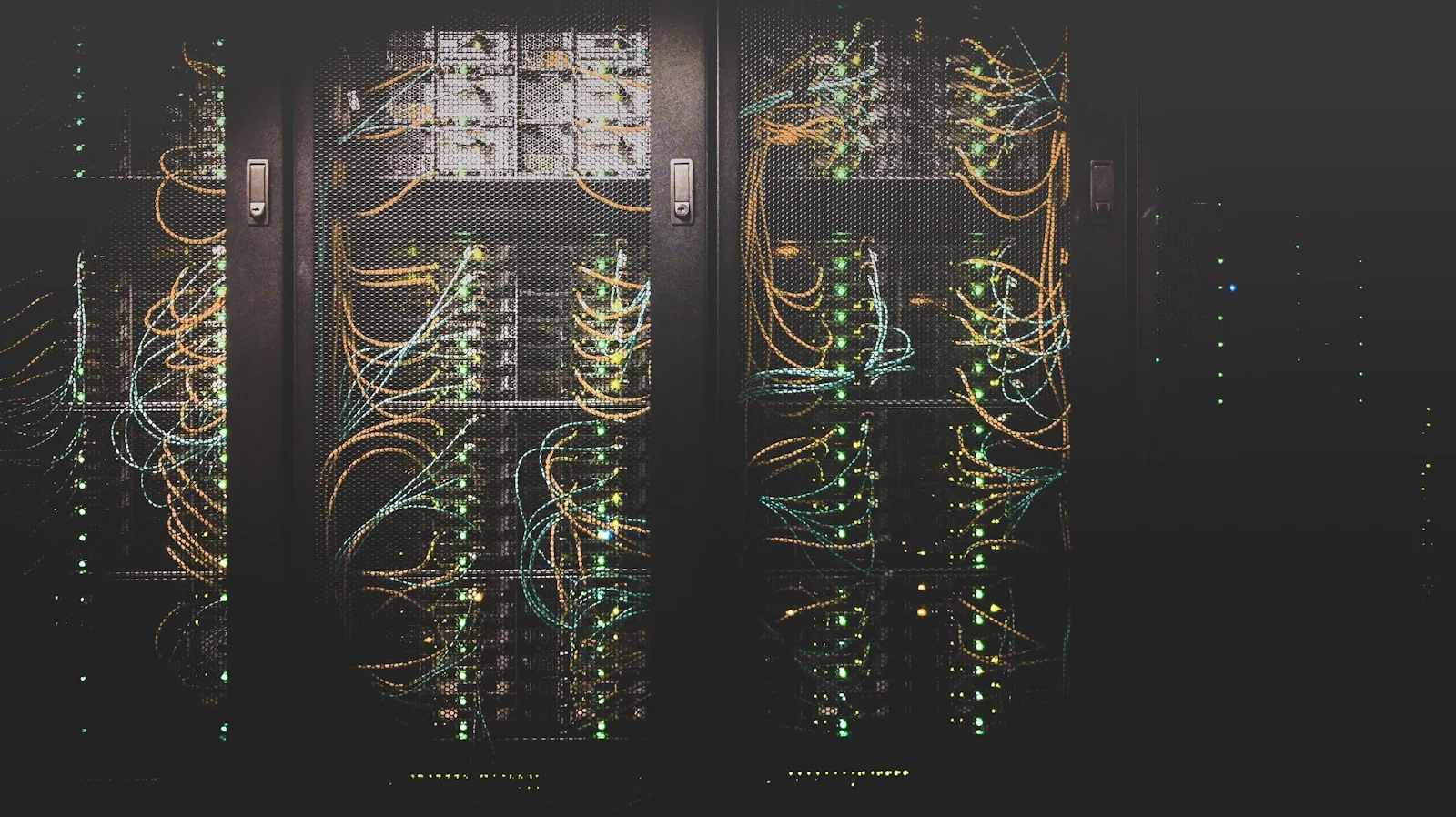
That is why you need to think in terms of volume when you include AI in a Scope 3 carbon footprint: within an organisation, AI falls within the company's digital emission category, and the figure depends on aggregate volume of use far more than on the individual query.
4How to reduce the energy your queries use
The 0.3 Wh reference point first puts things in perspective: for an individual, using ChatGPT accounts for a tiny fraction of their footprint, far behind transport or food. In an organisation where use cases are multiplying, a few simple habits cut the energy bill without any loss of quality. The calculator in this section works out the figures for your own texts, model by model.
How much energy and CO2 does your text use?
Choose a model, a hosting country and a text length. The conversion from words → tokens → energy → CO2 is done live.
Moving from France to the United States multiplies the CO2 by ~8. The hosting country matters as much as the choice of model.
- Match the model to the task: to summarise, classify, write a draft or answer a simple question, a light model is enough and uses 10 to 50 times less energy than a large one.
- Reserve reasoning for hard problems: switching on a reasoning model for an ordinary query wastes energy and money, for a result that is often identical.
- Keep prompts concise: fewer tokens in and out mechanically means less energy, and there is no need to paste in 10 pages when 2 paragraphs are enough.
- Measure before you reduce: at company scale, mapping who uses which models is the starting point of a proper digital usage policy, and the input data for the Scope 3 of your carbon footprint (in French).
None of these habits costs anything or degrades the experience. There is no need to feel guilty over every query: the aim is to match the tool to the need, especially when use reaches thousands of queries a month.
5Key takeaways
- A short ChatGPT query uses ~0.3 Wh (Google reports 0.24 Wh for Gemini and Sam Altman 0.34 Wh), about the energy of a Google search or of an LED left on for 2 minutes.
- In CO2 terms, expect ~0.02 g in France and ~0.12 g in the United States: the same Wh emits up to 8 times more depending on the electricity mix that supplies the data centre.
- The figure varies by a factor of 100 depending on the number of tokens, the size of the model (small or large) and whether reasoning is used, which can push a query to 15-40 Wh.
- These are orders of magnitude: OpenAI publishes almost nothing, only Google has measured a query and the rest comes from independent benchmarks.
- Volume matters more than your own query: inference now dominates training, and data centre electricity consumption is set to double by 2030, reaching ~3% of global electricity.
The 0.3 Wh figure only makes sense alongside the model, the prompt and the country behind it. For more detail, the comparison of ChatGPT, Claude and Gemini gives the figures model by model, the overview of the carbon footprint of AI puts it all at the scale of an organisation, and the method for counting AI in your carbon footprint turns it into a quantified emission category.