
- 1Anthropic publishes neither the energy use nor the size of its models: every figure is an estimate.
- 2A single conversation emits from 0.03 gCO2e with Haiku to 1.1 g with Fable.
- 3An agent session uses 27 to 67 times as much energy as a conversation with the same model.
- 4The effort level multiplies the tokens spent on the same task by 3 to 20.
A short conversation with Claude Haiku 4.5 uses about 0.08 Wh (watt-hour) and emits 0.03 gCO2e, the same as a 10 W LED bulb left on for 30 seconds. With Claude Opus 5, the same conversation uses 20 times more, 1.6 Wh. And with that same Opus 5, an agent session that codes for 1 to 2 hours uses 43 Wh, as much as 27 conversations.
Energy, CO2 and water by use, model by model
A conversation (one question, 1 or 2 follow-ups).
Claude, by Anthropic
ChatGPT and Gemini, same method
Sonnet 5, 1 conversation per day, comes to 0.83 Wh, 0.32 gCO2e and 0.21 mL of water, the same as a 10 W LED bulb left on for 5 minutes. In an agent session, Sonnet 5 uses as much as 38 conversations.
Published by the providers, for a single question
Gemini - 0.24 Wh and 0.26 mL of water per question, measured by Google (May 2025)
ChatGPT - 0.34 Wh and 0.32 mL per query, stated by OpenAI (June 2025)
Mistral Large 2 - 1.14 gCO2e and 45 mL per answer, over the life cycle (July 2025)
Estimated with CLEER, for the same number of tokens, in an average US data centre, CO2 at 384 g per kWh (United States, 2025) and water at 0.36 L per kWh of IT energy, calculated by Projet Celsius. Data sources: CLEER, Sustainable AI Group (29/09/2026, CC BY-NC 4.0), index from Artificial Analysis (Sept 2026) · Our World in Data · LBNL (Dec 2024) · Google (Aug 2025), OpenAI (June 2025), Mistral AI (July 2025).
These are estimates: Anthropic publishes neither the energy use nor the size of its models, and the only database that estimates them version by version, CLEER (Closed-model Latent Energy Estimation Range), was published on 29 September 2026 by independent researchers. Intelligence does not track energy: GPT-5.6 Luna, which scores like Sonnet 5, is estimated to be 5 times more frugal, although that estimate is extrapolated. The sections below go through these figures model by model, then look at what makes them vary.
1How much energy does each Claude model use?
The CLEER database is published by the Sustainable AI Group, around Nidhal Jegham, Chan Young Koh, Boris Gamazaychikov and Sasha Luccioni, one of the most cited researchers on the energy use of AI. For a closed model such as Claude, it estimates the size of the model from its knowledge score, its context window and its release date. It then matches it to 5 open models measured on recent graphics cards, and calibrates it against its public output speed.
The result covers the total energy of an average US data centre, cooling included, for the same session and the same number of tokens whatever the model.

From Haiku to Fable, a factor of 35
CLEER gives a value for each version of Claude, based on a typical conversation: one question, one answer, then 1 or 2 follow-ups. The latest estimated version of each model family ranks as follows:
- Claude Haiku 4.5, released in October 2025, uses 0.08 Wh; CLEER matches it to open models with 20 to 120 billion parameters in total, of which 3 to 5 billion are active.
- Claude Sonnet 5 uses 0.83 Wh, after 0.74 Wh for Sonnet 4, 1.20 Wh for Sonnet 4.5 and 0.72 Wh for Sonnet 4.6.
- Claude Opus 5 uses 1.61 Wh, within a range of 1.37 to 1.88 Wh across the 7 versions of Opus released since May 2025.
- Claude Fable 5 uses 2.80 Wh, an extrapolated value, because Fable outstrips every open model used as a reference.
Opus 5 therefore uses about 2 times as much as Sonnet 5 and 20 times as much as Haiku 4.5. The current models, Haiku 5.5, Sonnet 5.5, Opus 5.5 and Fable 5.1, released in September and October 2026, have no estimate yet: CLEER updates its data every quarter. For the orders of magnitude of AI in general, from the single query to the data centre, our article on the carbon footprint of AI is the place to start.
What about CO2 and water?
The CO2 depends on the electricity that powers the data centre. Average US electricity emits 384 gCO2e per kWh over its life cycle in 2025, according to Our World in Data. A conversation then emits from 0.03 gCO2e with Haiku 4.5 to 1.1 gCO2e with Fable 5, close to 8 metres in a petrol or diesel car. On French electricity, at 41 g per kWh, it emits 9 times less. By default, CLEER uses a heavier case, gas turbines installed on site, at 640 g per kWh.
Water follows electricity. CLEER does not quantify it. Cooling in US data centres used an average of 0.36 litre per kWh of IT energy up to 2023, and 0.45 to 0.48 since, according to the Lawrence Berkeley National Laboratory. With the low value, our calculation gives from 0.02 mL with Haiku 4.5 to 0.7 mL with Fable 5 per conversation, the same order as the 0.26 mL Google measured for a question to Gemini.
The water used by the power plants that generate this electricity weighs more than 10 times as much, about 4.5 litres per kWh according to the same laboratory: our article on the water footprint of AI explains these 2 scopes.
How reliable these estimates are
CLEER gives each model a confidence score from 0 to 1: high above 0.85, good from 0.55 to 0.85, lower from 0.30 to 0.55, extrapolated below that. Haiku 4.5 (0.68) and Sonnet 5 (0.75) are well estimated, Opus 5 (0.47) less so, and Fable 5 (0.13) remains an extrapolation. The database has not been peer reviewed.
The study "How Hungry is AI?", co-authored in 2025 by Nidhal Jegham, gave 0.95 Wh for a short query to Claude 3.7 Sonnet, and slightly more for Claude 3.5 Haiku, for lack of a size assumption specific to each model. The figures that circulate for "Claude" therefore mix model families whose energy use spans a ratio of 1 to 35.
2Why does Opus use more energy than Haiku?
Producing 1 token takes about 2 computing operations per active parameter of the model, according to Epoch AI, and electricity follows computation. The energy of an answer therefore comes down to a product: the energy per token, set by the model and its hardware, multiplied by the number of tokens processed, set by how it is used. On the first term, Anthropic publishes neither the size of its models, nor their architecture, nor their energy use.
Model size, which nobody publishes
The model cards in Anthropic's Transparency Hub describe training and safety testing, without any figure on size, energy or water. The EcoLogits method assumed about 2 trillion parameters for Claude 3 Opus, of which 200 to 600 billion are active for each token, based on a "mixture of experts" architecture that activates only part of the network. At the other end of the range, CLEER matches Haiku 4.5 to open models of 20 to 120 billion parameters in total, of which only 3 to 5 billion are active.
Output speed, an imperfect clue
Generation speed gives an indirect clue. According to measurements by Artificial Analysis in early November 2026, Haiku 5.5 produces about 3 times as many tokens per second as Fable 5.1, and Sonnet 5.5 slightly more than Opus 5.5. A slower model generally does more computation per token, but speed also depends on how the model is served: Anthropic sells a more expensive fast mode for Opus, which serves the same model faster.
Hardware and request batches
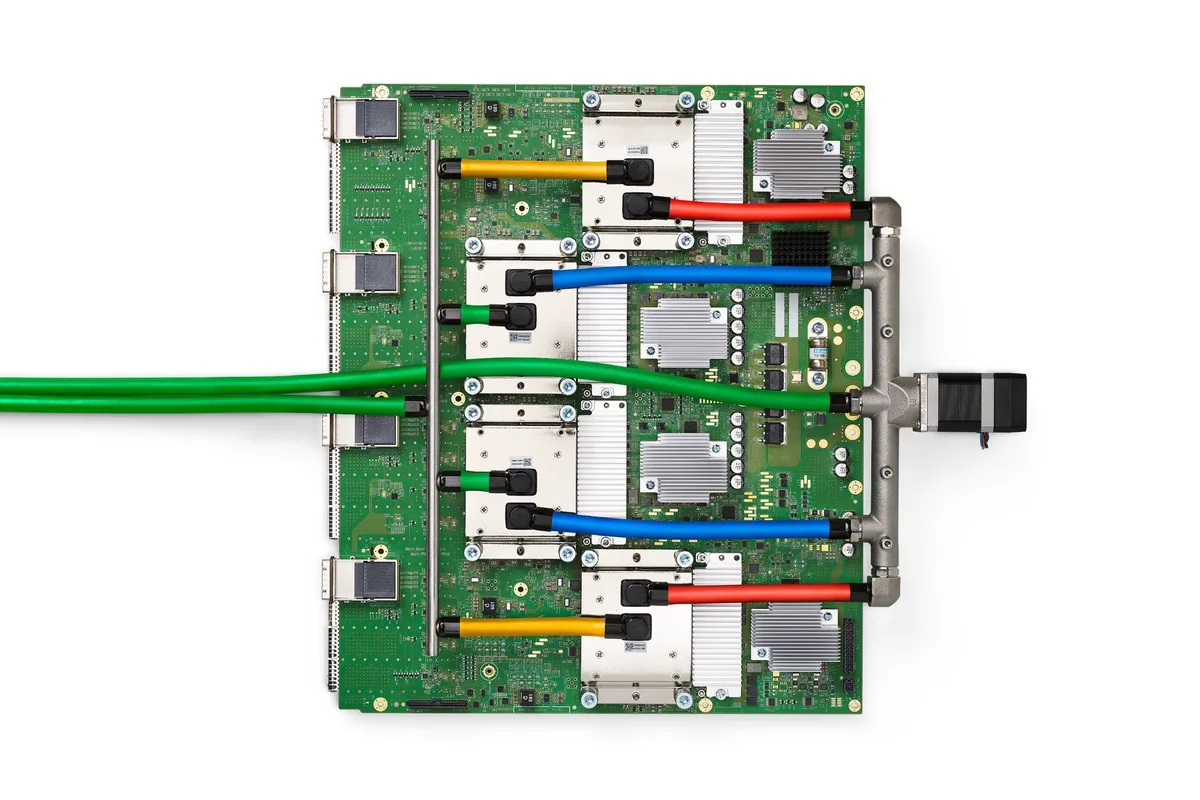
Claude runs on 3 families of chips. Anthropic has announced the use of up to 1 million Google TPUs and more than 1 million AWS Trainium2 chips, and rents NVIDIA cards in Microsoft data centres. The split between them is not published.
The number of requests processed together, called a batch, also matters: a larger batch spreads the fixed cost of the machines and narrows the efficiency gap between small and large models. Our article on why AI is bad for the environment traces these chips back to their manufacture.
These efficiencies are improving fast, but a recent model is not necessarily more frugal than its predecessor. Of 14 recent models tested by Hugging Face's AI Energy Score, 8 used at least as much energy as a model of similar size tested in February 2025.
3Why does an AI agent use so much energy?
An agent such as Claude Code does not answer once. It reads files, runs commands, checks its work, and each step sends the model the whole conversation from the start. The Claude Code documentation says so: a one-line question, in a session left open all day, uses tokens for the whole conversation. As early as June 2025, Anthropic measured that an agent spends about 4 times the tokens of a conversation, and a multi-agent system about 15 times.
Energy of a session by model and use, in Wh
One shade per order of magnitude, each 10 times more energy-hungry than the one before.
Each model processes the same number of tokens: only the model changes.
Use ↓Haiku 4.5HaikuSonnet 5SonnetOpus 5OpusFable 5Fable
Opus 5, a day of agents: 167 Wh, the same as a 10 W LED bulb left on for 17 hours, or 64 gCO2e on US electricity.
Sources: CLEER, Sustainable AI Group (29/09/2026, verbosity of 30/10/2026, CC BY-NC 4.0); CO2 at 384 g per kWh, US electricity in 2025 (Our World in Data): calculation by Projet Celsius.
The diagram reads in 2 directions. For the same use, moving from Haiku 4.5 to Fable 5 multiplies energy by 35. With the same model, moving from a single question to a day of agents multiplies it by nearly 370: from 0.46 Wh to 167 Wh for Opus 5, a 10 W LED bulb left on for 17 hours.
According to CLEER, a typical agent session uses 27 to 67 times as much as a conversation depending on the model, and a day of agents more than 100 times: in proportion, use weighs most on the small models.
Context reread at every step
Reread tokens make up most of the count. Over 8 weeks of heavy Claude Code use, the climate scientist Zeke Hausfather counted 3.2 billion tokens. 96% were cache reads, context already seen that the model rereads at each call, and 0.4% was generated text.
Anthropic charges these reads at 10% of the input price, 5% on Opus 5.5 and Sonnet 5.5, and 2.5% on Fable 5.1: cheaper per token, they make up most of the volume. Their weight in energy rests on an assumption, that a reread token costs about 10% of the energy of a new token, with bounds of 1 to 25% in Hausfather's work.
Length also matters for a single query. In "How Hungry is AI?", moving from a short query, 100 input tokens and 300 output tokens, to a long one, 10,000 and 1,500, multiplies by 6 the estimated energy of a query to Claude 3.7 Sonnet. The context window of current models reaches 1 million tokens, and Anthropic multiplies the price of Haiku 5.5 by 5 beyond 100,000 tokens. This role of tokens, rather than of the "query" alone, is explained in our article on AI electricity consumption.
What Claude Code users measure
The published measurements cover individual users, each with their own assumptions:
- Simon Couch, a developer, estimates his median Claude Code session at 41 Wh, 24 queries and 592,000 tokens, and his median day at 1.3 kWh.
- Zeke Hausfather arrives at about 150 Wh per typed instruction, 3 kWh for an average day and 370 kgCO2e per year, for heavy use on the US grid.
- Anthropic puts the average cost of Claude Code in companies at $13 per developer per active day, and below $30 for 90% of users.

Anthropic itself lists the habits that reduce this consumption. Its documentation recommends Sonnet for most coding tasks, Haiku for simple subagents, the "/clear" command between 2 unrelated tasks, and precise requests, since a vague request triggers an exploration of the whole codebase. It notes that unexpected spending generally comes from sessions that are never cleared or from Opus left as the default model. For a whole workstation, these figures can be read alongside our article on a company's digital carbon footprint.
4What difference does the effort level make?
Current Claude models think before they answer. On Opus 5.5, Sonnet 5.5, Haiku 5.5 and Fable 5.1, this thinking cannot be switched off, and its tokens are billed as output text, up to tens of thousands per query. According to Anthropic, the effort level, from "low" to "max", sets how many tokens Claude spends, thinking and tool calls included.
Cost of the same task by effort level, model by model
Cost of the task as a multiple of the low level; at a fixed price per token, it tracks tokens, not energy.
Cost ×10.2 from low to max, for an index from 35 to 58
The setting weighs as much as the model family. The same task costs $0.98 with Opus 5.5 at low (index 35), and $1.64 with Sonnet 5.5 at high, its default setting (index 41).
Sources: Artificial Analysis, cost per task of the intelligence index (26 October 2026); Anthropic, documentation on effort (read on 2 November 2026); interpretation by Projet Celsius.
On the Artificial Analysis benchmark, the same task with Opus 5.5 costs about 10 times more at "max" effort than at "low" effort, from $0.98 to $10.04. The gap is the same for Haiku 5.5, reaches 20 times for Sonnet 5.5 and stays close to 3 times for Fable 5.1.
Since the price of a token is fixed for a given model, we read this gap as a gap in tokens, not in measured energy. Opus 5.5's intelligence index, for its part, rises from 35 to 58, on the current Artificial Analysis index, which is more recent than the one in the opening table.
The setting can even reverse the ranking of model families. Opus 5.5 at "low" effort cost less than Sonnet 5.5 at "high" effort, $0.98 against $1.64 per task, for a slightly lower index. By default, Anthropic sets Opus 5.5 and Haiku 5.5 to "medium", and Sonnet 5.5 and Fable 5.1 to "high": that is the setting a team keeps if it never changes it.
The effort setting weighs as much as the choice of model.
Thinking, tokens you do not see
Direct measurements point the same way. In the first version of "How Hungry is AI?", in May 2025, Claude 3.7 Sonnet with extended thinking used 2 to 4 times the energy of the same query without thinking.
Across 22 open models, the measurements published in May 2026 by Arcep, the French telecoms regulator, show 92% more energy use on average with reasoning mode on. The AI Energy Score, for its part, finds 154 to 697 times more for the same model, across 3 models and counting the graphics card only. Our article on the habits that reduce the impact of AI draws the practical rule: do not leave the most advanced reasoning on by default.
Each model's own verbosity
With the token count held equal, CLEER compares models, but each has its own way of answering. On the Artificial Analysis benchmark, Sonnet 5 produces nearly 3 times as many tokens as the median model for the same task, Opus 5 1.8 times and Haiku 4.5 less than half. With this verbosity, published by CLEER on 30 October 2026, the gap between Sonnet 5 and Opus 5 falls from 1.9 to 1.2 times, 2.3 Wh against 2.8 Wh per conversation. Choosing a more frugal AI is therefore a matter of testing on real tasks.
5Does a model's price reflect its energy use?
On the same models, price understates the energy gap: from Haiku 4.5 to Fable 5, the price of output tokens is multiplied by 10, from $5 to $50 per million, and estimated energy by 35. According to CLEER, in about 1 in 5 comparisons between 2 models, the cheaper one uses more energy.
Price and estimated energy of Opus, version by version
On the left, the list price of output tokens; on the right, the estimated energy of a typical conversation.
From Opus 4.1 to Opus 4.5, the price is divided by 3; the estimated energy of a conversation stays stable (1.46 Wh, then 1.48 Wh). Price does not tell you how much energy a model uses.
Sources: Anthropic, Pricing (read on 2 November 2026); CLEER, Sustainable AI Group (29/09/2026, CC BY-NC 4.0), estimates; intelligence index from Artificial Analysis as used by CLEER.
Price reflects computation well for open models, sold by several competing hosting providers. For a closed model, CLEER's technical report states that this link no longer holds: the margin may reflect a subsidy, a commercial strategy or platform lock-in.
Opus, a price divided by 3
Opus is a case in point. From Opus 4.1 to Opus 4.5, in November 2025, Anthropic divided its price by 3, from $75 to $25 per million output tokens, while its estimated energy stayed around 1.5 Wh per conversation. Between Haiku 4.5 and Opus 4.5, price is multiplied by 5 and energy by 19. Among the closed models in CLEER, the energy bought with $1 ranges from 3 Wh for Haiku 4.5 to more than 40 Wh for several OpenAI models, according to our calculation.
Version after version, Opus uses almost the same energy, 1.37 to 1.88 Wh, while its intelligence index rises from 21 to 51. Part of this stability comes from the method, which infers size from the model's capabilities: capability progresses faster than estimated energy, without any measurement to confirm it. Since Opus 4.7, the new tokenizer counts about 35% more tokens for the same text: at an equal price per token, that text therefore costs more.
Between model families, a useful guide
Within the same generation, the most expensive family does more computation: Opus 5 costs 2.5 times the price of Sonnet 5 and uses about 2 times as much energy. Price remains a useful guide between families, much less so from one version to the next. Methods that convert dollars into kilowatt-hours, to quantify Claude Code from the invoice, inherit this limit. To count AI in a Bilan Carbone® (the French carbon accounting method), under scope 3 purchased services, token logs are better than invoices.
6What about ChatGPT, Gemini or Mistral?
Claude's competitors follow the same structure in 3 model families. CLEER finds a gap of nearly 4 times on average between the top family and the light one, less than the gap between the latest Claude versions (20 times from Haiku 4.5 to Opus 5).
For a typical conversation, GPT-5.6 Sol uses 1.36 Wh, GPT-5.6 Terra 0.55 Wh and GPT-5.6 Luna 0.17 Wh, and Gemini 3.7 Flash, calibrated on Google's chips, 0.50 Wh. Gemini's top families and Mistral's models are not in the database. Our comparison of ChatGPT, Claude and Gemini says which to choose for which use.
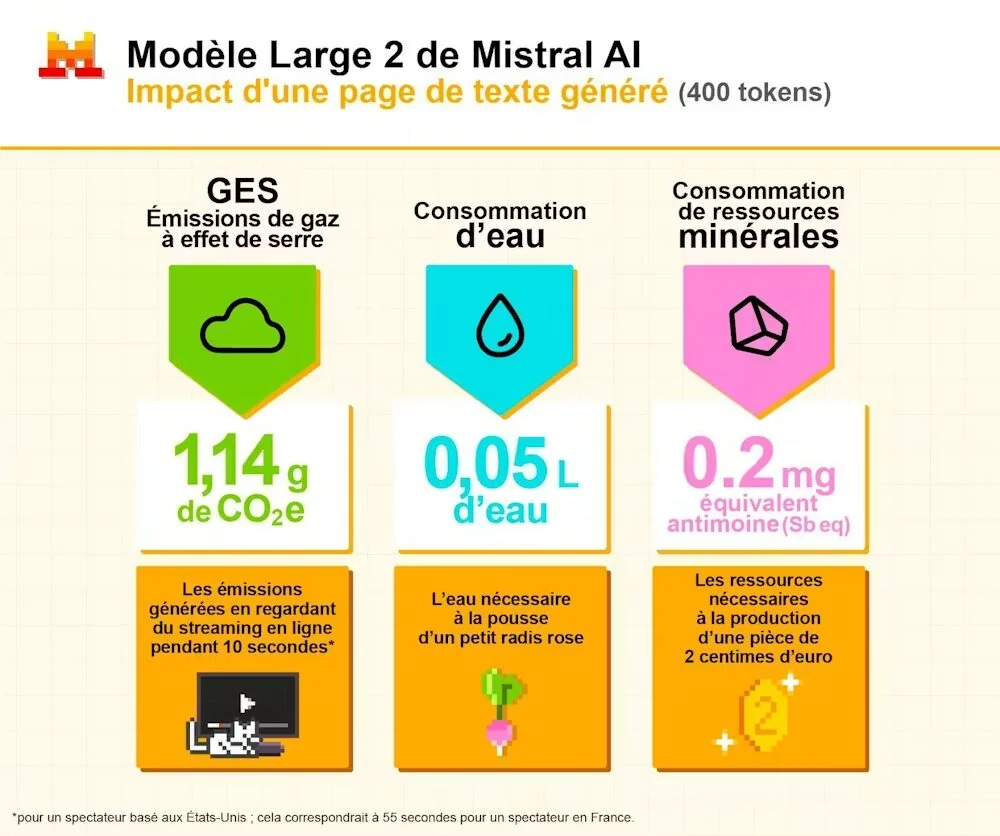
The only life cycle assessment published by an AI provider, carried out with ADEME (the French Agency for Ecological Transition) and reviewed by third parties. For a 400-token answer: 1.14 gCO2e and 45 mL of water, server manufacturing included. This scope, wider than electricity, cannot be compared with the rows of the opening table.
These 3 providers have, for their part, published a figure, each within its own scope:
- Google measured in production 0.24 Wh, 0.03 gCO2e and 0.26 mL of water for the median text prompt to Gemini, in May 2025, in a study by its engineers. It is the only provider measurement published.
- OpenAI stated 0.34 Wh and 0.32 mL for an average ChatGPT query, in June 2025, without a published method. Our article on the ChatGPT query traces its origin, and the one on ChatGPT versus a Google search compares the two.
- Mistral AI published the life cycle assessment of a 400-token answer from its Large 2 model: 1.14 gCO2e and 45 mL of water, server manufacturing included. This life cycle assessment (LCA) scope goes well beyond electricity.

The models in service in early November 2026, GPT-6 Astra and GPT-6.1 Sol at OpenAI, Gemini 4 Argon at Google, Opus 5.5 and Fable 5.1 at Anthropic, have no public estimate yet. These provider figures apply to a single question: for one question, CLEER estimates 0.14 Wh for Gemini 3.7 Flash, the same order as Google's measurement. For the same model family, ChatGPT and Gemini stay in the same order of magnitude as Claude, 0.1 to 3 Wh per conversation: as much as a generated image for the largest models, far less than a generated video.
At Projet Celsius, we use Claude among other tools. For us, the choice that matters is between uses, model families and effort levels, far more than between providers, which stay in the same order of magnitude for the same family. Leaving Opus at maximum effort, on agents that run all day, weighs more in a team's energy use than a change of provider. The useful step is to set a default model and effort level, Sonnet or Haiku for subagents, and to clear the context between 2 tasks.
The question to put to Anthropic is the one Google has already answered: the median energy of a query, model by model, measured in production.
7Key takeaways
- Anthropic publishes neither the energy use nor the size of its models: the only per-version values are independent estimates, those of CLEER in September 2026.
- A conversation emits from 0.03 gCO2e with Haiku 4.5 to 1.1 gCO2e with Fable 5 on the US grid, for 0.08 to 2.8 Wh; Sonnet 5 and Opus 5 are at 0.8 and 1.6 Wh.
- An agent rereads its whole context at every step: a typical session uses 27 to 67 times as much as a conversation, and a day of agents more than 100 times.
- Depending on the model, the effort level multiplies the tokens spent on the same task by 3 to 20, and Opus 5.5 at low effort spends less than Sonnet 5.5 at high effort.
- Price is a poor guide to energy: Opus's price was divided by 3 in November 2025 without its estimated consumption moving.
To place Claude within the full set of AI impacts, climate, electricity, water and metals, see our article on the environmental impact of AI, and to quantify your own use, the AI footprint tool.
- Sustainable AI Group (Nidhal Jegham, Chan Young Koh, Boris Gamazaychikov, Sasha Luccioni), CLEER: Closed-model Latent Energy Estimation Range, technical report, version CLEER-Text-0926, 29 September 2026, and CLEER dataset, data of 29 September 2026, verbosity from the 30 October 2026 update, licence CC BY-NC 4.0, accessed 2 November 2026; values rounded, CO2 and water recalculated by Projet Celsius
- Sustainable AI Group, CLEER, launch page, 29 September 2026
- Anthropic, Models overview and Pricing, documentation, accessed 2 November 2026
- Anthropic, Effort, documentation, accessed 2 November 2026
- Anthropic, Manage costs effectively, Claude Code documentation, accessed 2 November 2026
- Anthropic, How we built our multi-agent research system, 13 June 2025
- Anthropic, Transparency Hub, accessed 2 November 2026
- Anthropic, computing capacity announcements with Google Cloud (23 October 2025), Microsoft and NVIDIA (18 November 2025) and Amazon (20 April 2026)
- Artificial Analysis, Anthropic: intelligence, output speed and cost per task by effort level, accessed 2 November 2026
- Jegham N. et al., How Hungry is AI? Benchmarking Energy, Water, and Carbon Footprint of LLM Inference, version 6 of 24 November 2025, and version 1 of 14 May 2025
- Epoch AI, How much energy does ChatGPT use?, 7 February 2025
- EcoLogits, Methodology for proprietary models, accessed 2 November 2026
- Google, Measuring the environmental impact of delivering AI at Google Scale, August 2025
- Sam Altman, The Gentle Singularity, June 2025
- Mistral AI, Our contribution to a global environmental standard for AI, 22 July 2025
- Simon P. Couch, Electricity use of AI coding agents, 20 January 2026
- Zeke Hausfather, The real energy use of agentic AI, The Climate Brink, 5 August 2026
- Lawrence Berkeley National Laboratory, 2024 United States Data Center Energy Usage Report, December 2024
- Our World in Data, Carbon intensity of electricity generation, 2025 data
- Arcep, AI and environment report (in French), May 2026
- Hugging Face, AI Energy Score v2, 4 December 2025
- OpenAI, Models, and Google, Gemini models and Gemini API changelog, accessed 2 November 2026