
 Electricity18 November 2026
How much water and electricity does Grok use?
The 2 Memphis sites read through their permits, and a question to Grok estimated with the AI Impact Database
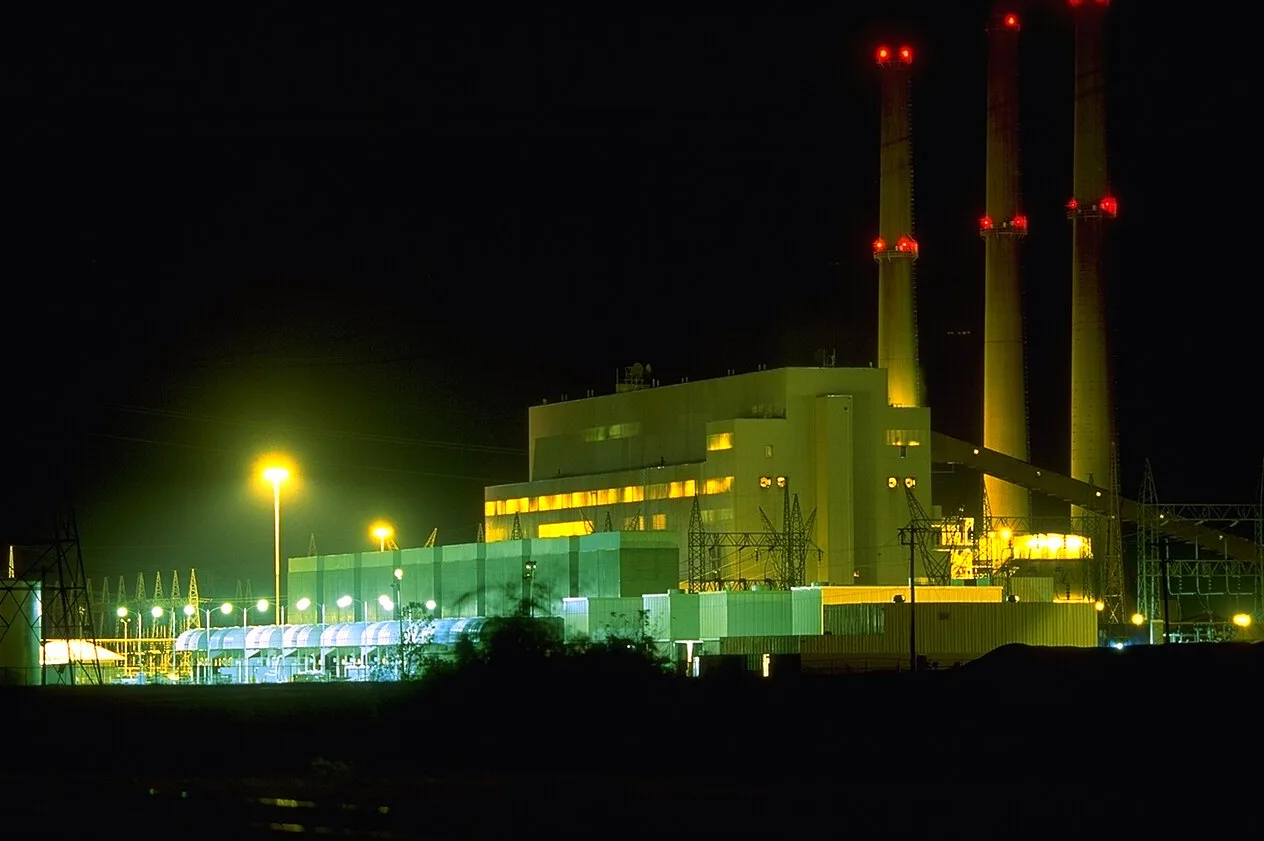
The TVA Allen coal plant, in the Memphis industrial park where Colossus 1 stands, since replaced by a gas plant. Undated photo, Tennessee Valley Authority, public domain, via Wikimedia Commons.
SpaceX Super Intelligence, formerly xAI, publishes no electricity or water figure for Grok. Its Memphis sites can, however, be read in public documents: Colossus 2, where Grok is trained and answers and which Anthropic also uses, is air-cooled and can run entirely on its own gas plant, according to SpaceX; the permanent plant, permitted in March 2026, has 41 turbines totalling 1,240 MW. By our estimate, a question to Grok would use about 1.2 Wh and 0 to 1.4 mL of water on site. The millions of litres of water per day cited in Memphis are those of Colossus 1, cooled by towers, which has run Claude since May 2026.
Contents
On Paul R. Lowry Road, in south-west Memphis (Tennessee), Electrolux started producing cookers in November 2013, in a 266 million dollar plant. Since 2024, the building has housed Colossus, xAI's flagship computing centre, between a TVA gas plant, the city's wastewater treatment plant and a steelworks. Gas arrives there through a 16-inch pipe from MLGW, the Memphis municipal utility. According to the appeal filed in July 2025 by the NAACP, mobile gas turbines were installed there as early as June 2024 without a permit; at the peak there were 35 of them, totalling more than 420 MW. The Shelby County health department permitted 15 of them on 2 July 2025, for at most 247 MW, and the appeal was dismissed in December 2025.
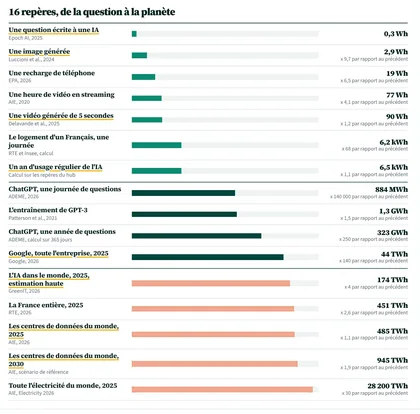
The grid supplies the site with 150 MW, and TVA approved 150 more in February 2026. Since May 2026, the site has been leased to Anthropic for Claude: the company announced on 6 May it would use all of its computing capacity, more than 300 MW. Grok is trained and served by SpaceX's other centres in Memphis, on Tulane Road, and across the Mississippi border, in Southaven, grouped under the name Colossus 2. SpaceX also leases part of the computing there to Anthropic, according to its IPO filing, and Epoch AI counts Cursor among its users. The next infographic reduces Colossus 2 and one question to Grok to a few reference points.
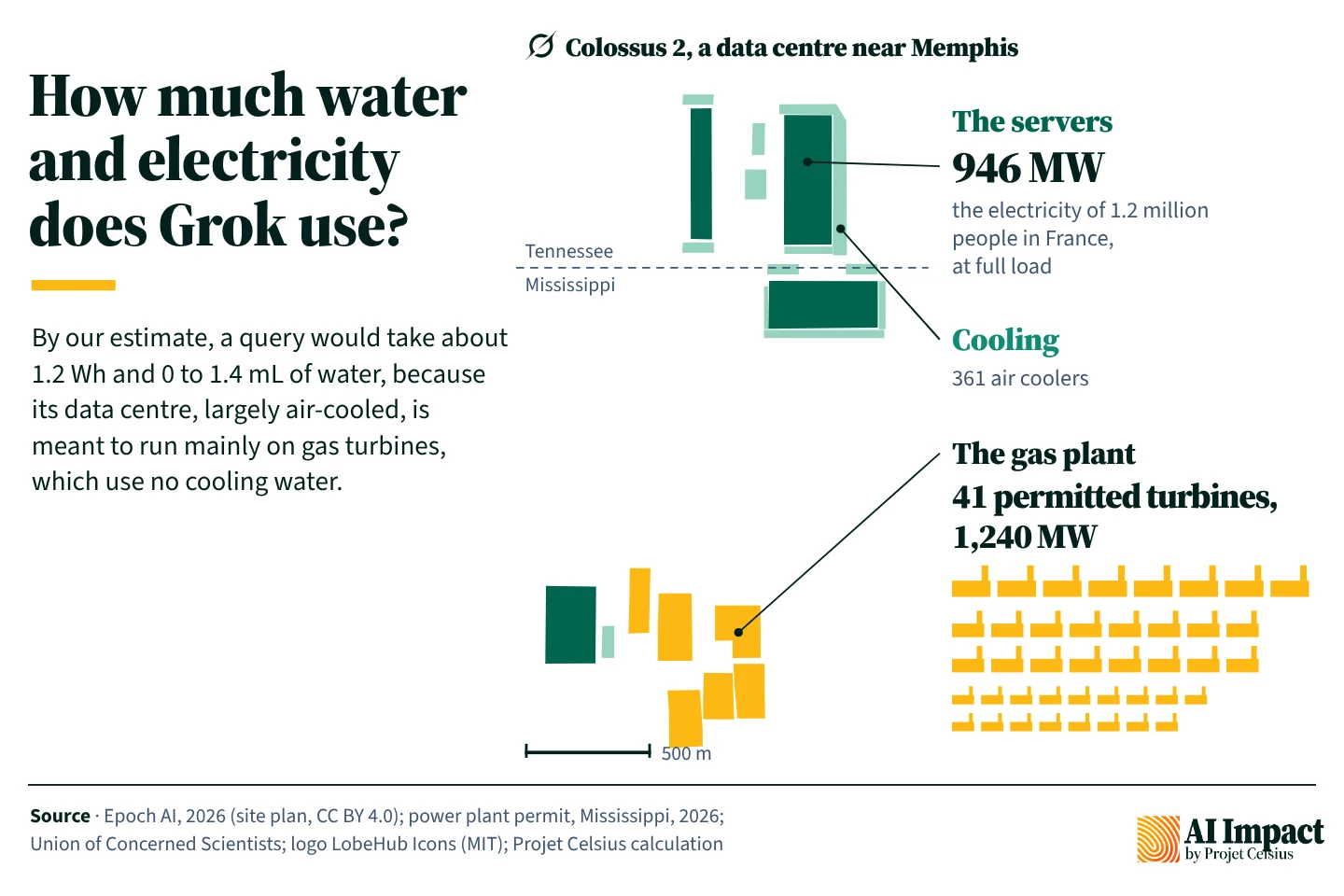
SpaceX publishes no per-question figure for Grok
SpaceX Super Intelligence publishes neither the electricity nor the water of a question to Grok, nor an environmental report, nor a target; Stanford's transparency index gives it 14 out of 100. Our ranking takes this into account: Grok has the lowest environmental score of the 10 assistants.
SpaceX's IPO filing, filed with the SEC on 20 May 2026, gives a power figure and its definition:
- Colossus and Colossus 2 "collectively provide approximately 1.0 gigawatt of compute power" on 31 March 2026, against 0.8 at the end of 2025;
- this power is the number of installed graphics cards (GPUs) multiplied by the power of each; according to SpaceX, it represents neither actual consumption nor utilisation, and counts neither cooling nor losses.
Epoch AI, which tracks the large centres by satellite, puts the server power of Colossus 946 at 2 MW on 15 June 2026, and at 1.5 GW at the start of 2027. Running at full load all year, 946 MW would come to about 8.3 TWh, 1.8% of the electricity consumed in France in 2025 (our calculation). As the utilisation rate is not published, this is a maximum.
Colossus 2 can run entirely on gas burned on site
In its filing, SpaceX writes that Colossus 2 is "capable of operating entirely" on its own gigawatt-scale gas plant, installed behind the meter, and that it will be powered mainly by it, supplemented over time by the grid. Other large US data centres also generate their electricity from gas on site; our analysis of gas lists several.
The plant permitted in Southaven
The permit issued on 11 March 2026 by the Mississippi environmental authority to MZX Tech, a SpaceX subsidiary, authorises 41 simple-cycle turbines at 2875 Stanton Road, in Southaven:
- 17 Solar Titan 130 of 16.5 MW;
- 16 Solar Titan 350 of 35 MW;
- 8 ProEnergy 6000PE of 50 MW.
They total 1,240 MW (our calculation). The appeal by the NAACP and local associations against this permit was dismissed on 10 November 2026. Until the plant is ready, the site runs on mobile turbines, which the NAACP has been challenging in federal court since April 2026: SpaceX says it will remove 69 of them by July 2027, under an agreement with the Mississippi authority of 30 July 2026. In its rule of 15 January 2026 on turbines, the EPA notes that it has so far treated combustion turbines, even transportable ones, as stationary sources subject to permitting.
The gas burned by the turbines
The permit gives the thermal power of each turbine. At full power, the 41 would burn about 8.6 million m3 of gas per day (our calculation, at the average calorific value of US gas in 2025). The permit caps CO2 at 120 pounds per million BTU of gas, or 578 g per kWh produced. At full power all year, the plant would emit at most 6.3 million tonnes of CO2, the footprint of 760,000 people in France. These are maximums: the turbines do not always run at full power, and part of the electricity will come from the grid.
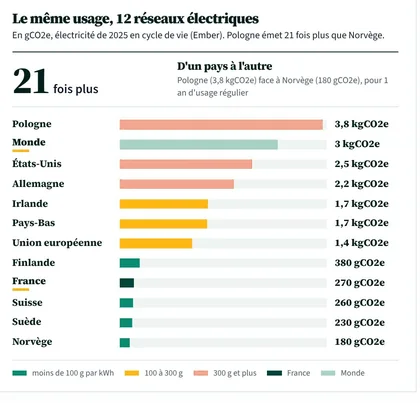
The 578 g per kWh count only combustion. The AI Impact Database uses 384 gCO2e per kWh for the US grid, over the life cycle, gas extraction and transport included: even with this wider scope, the grid emits about a third less per kWh than these turbines.
A question to Grok would use about 1.2 Wh, by our estimate
Without SpaceX data, we estimated a question with the engine of the AI Impact Database: the Database's quick question, 100 tokens read and 400 written, about half a page of answer. The model that answers is not published: an Auto mode chooses, and Grok 4.7, the frontier model, is offered as a choice. We place Grok among the large models, an assumption.
| Case | Electricity | On-site water | CO2, Southaven turbines |
|---|---|---|---|
| Medium model, if Auto mode picks a light model | 0.3 Wh | 0 to 0.3 mL | 0.2 g |
| Large model, without reasoning (central assumption) | 1.2 Wh | 0 to 1.4 mL | 0.7 g |
| Large model, medium reasoning | 2.3 Wh | 0 to 2.6 mL | 1.3 g |
| Reference: one question to Gemini, Google's measurement | 0.24 Wh | 0.26 mL | non calculé |
Projet Celsius estimates with the engine of the AI Impact Database (version 0.3): 100 tokens read and 400 written, data centre included. On-site water ranges from 0 (air cooling) to 1.15 L per kWh. The CO2 is that of burning gas at the Southaven permit cap, 578 g per kWh. Gemini: median measured by Google in May 2025.
In the central assumption, a question to Grok would use about 1.2 Wh, 5 times the 0.24 Wh that Google measured for a question to Gemini, and about 6% of a phone charge. Produced by the Southaven turbines, these 1.2 Wh would emit about 0.7 g of CO2.
Grok also produces videos. Grok Imagine generated 1.245 billion of them in 30 days, according to xAI in February 2026. At the cost the Database uses for a clip of 5 seconds, 99 Wh, this would come to about 171 MW continuously (our calculation). Neither the duration nor the model of these videos is published; the result gives an order of magnitude.
Water is counted in millilitres at Colossus 2 and in millions of litres at Colossus 1
The 2 sites are not cooled in the same way, and the water cited in Memphis does not mean the same thing depending on the site.
Colossus 2 is air-cooled
On satellite images, Epoch AI counts air coolers and condensers at Colossus 2, which do not evaporate water. In May 2025, MLGW wrote that the Tulane Road site did not consume water significantly. The firm SemiAnalysis sees a hybrid system, with adiabatic units that evaporate water in hot weather, and estimates it at 0.9 million gallons a day for 400 MW, chip-manufacturing water included, or 0.51 L per kWh by its calculation. Simple-cycle turbines, for their part, have no steam to condense and use no cooling water.
For one question, the water evaporated on site would range from 0 to 1.4 mL, taking as the upper bound the Database's reference value, 1.15 L per kWh measured by Google. Google measures 0.26 mL for a question to Gemini.
Colossus 1 draws on the Memphis aquifer
Colossus 1 has been cooled only by towers since February 2026, according to Epoch AI. In 2024, MLGW planned up to 1 million gallons a day, about 3.8 million litres. The bills show a peak of 381,000 gallons a day from early August to early September 2025, according to the Daily Memphian; in September 2026 SpaceX gives about 820,000 gallons a day, 3.1 million litres, or about 0.38 L per kWh of server energy (our calculation).
- cooling towers, which evaporate water
- 340 MW of servers; Claude since May 2026
- 946 MW of servers; Grok, and a share for Claude and Cursor
- simple-cycle turbines, no cooling water
To reduce withdrawals from the aquifer, xAI committed to building at its own expense a recycling plant which would treat up to 13 million gallons a day, about 49 million litres, of wastewater from the Maxson plant, for xAI, TVA, Nucor and other industrial users in the park. Announced at 80 million dollars, it was paused in 2026; according to the Memphis mayor, xAI committed in June to resume work in the 1st quarter of 2027. Our analysis of AI's water use explains why the cooling mode turns a centre from using a great deal of evaporated water to almost none.
Our view
Grok's water seems to us a minor subject: a few millilitres at most per question, and even less at Colossus 2, which is air-cooled. The large quantities of water in Memphis are those of Colossus 1, which now serves Claude. The Grok issue is electricity: a centre of about 1 GW of servers, shared with Claude, powered mainly by turbines burning gas on site, which emit more per kWh than the average US grid. 3 pieces of information are missing to go further:
- the number of questions and videos that Grok handles each day;
- the share of Colossus 2 electricity that comes from the grid and the share from the turbines;
- the water consumed at Colossus 2, read from the meter.
The per-question figures are Projet Celsius estimates, made without any SpaceX data, on an assumption about model size. The gas and CO2 of the Southaven plant are maximums at full power, not measured consumption.

He holds a PhD in nanophysics from Aix-Marseille Université and an engineering degree from the Institut d'Optique, and co-founded Projet Celsius, where he heads the Marseille office.
His page and articles →Contact him →LinkedIn ↗
An engineer from UTBM and life cycle assessment trainer at the Institut de Formation Carbone, he carries out the life cycle assessments at Projet Celsius.
His page and articles →Contact him →LinkedIn ↗Sources
24 documents
- SpaceX, Form S-1 (IPO filing), filed with the SEC on 20 May 20262026entry 627
- Mississippi Department of Environmental Quality, PSD permit no. 0680-00119 for MZX Tech LLC, 2875 Stanton Road, Southaven, 11 March 20262026entry 628
- Epoch AI, Frontier Data Centers, Colossus 2 profile, updated 30 July 20262026entry 629
- Epoch AI, Frontier Data Centers, Colossus 1 profile, updated 16 June 20262026entry 630
- Anthropic, Higher usage limits and a SpaceX compute deal, 6 May 20262026entry 624
- MLGW, xAI Update, 5 May 20252025entry 626
- MLGW, xAI Project Quick Facts2024entry 625
- NAACP and Young, Gifted & Green, appeal against permit no. 01156-01PC of the Shelby County health department, 15 July 20252025entry 611
- Projet Celsius, AI Impact Database, environmental database of artificial intelligence, engine 0.3.12026entry 144
- Elsworth et al. (Google), Measuring the environmental impact of delivering AI at Google scale2025entry 14
Every figure was read in its source; the hub's methodology is described in Methodology and sources.
Clément Reynaud and Sébastien Pierfederici, How much water and electricity does Grok use?, AI Impact, Projet Celsius, 18 November 2026. https://projetcelsius.com/en/ai/analyses/grok-water-and-electricity/