
 Electricity18 November 2026
Fouju data center: how much electricity and water will it use?
The Campus IA project in Seine-et-Marne, read in its impact assessment, the opinion of the environmental authority and the orders of 29 July 2026
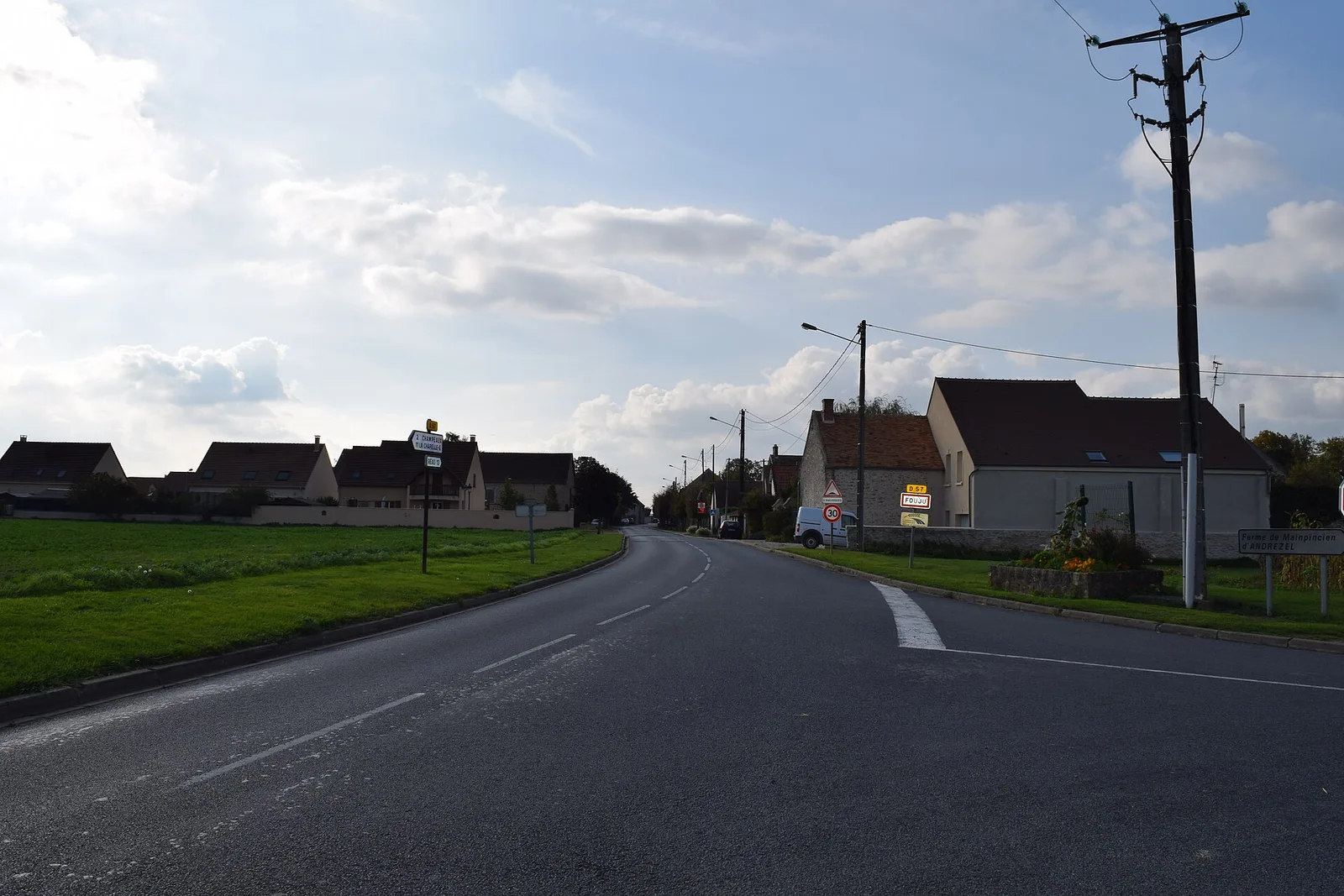
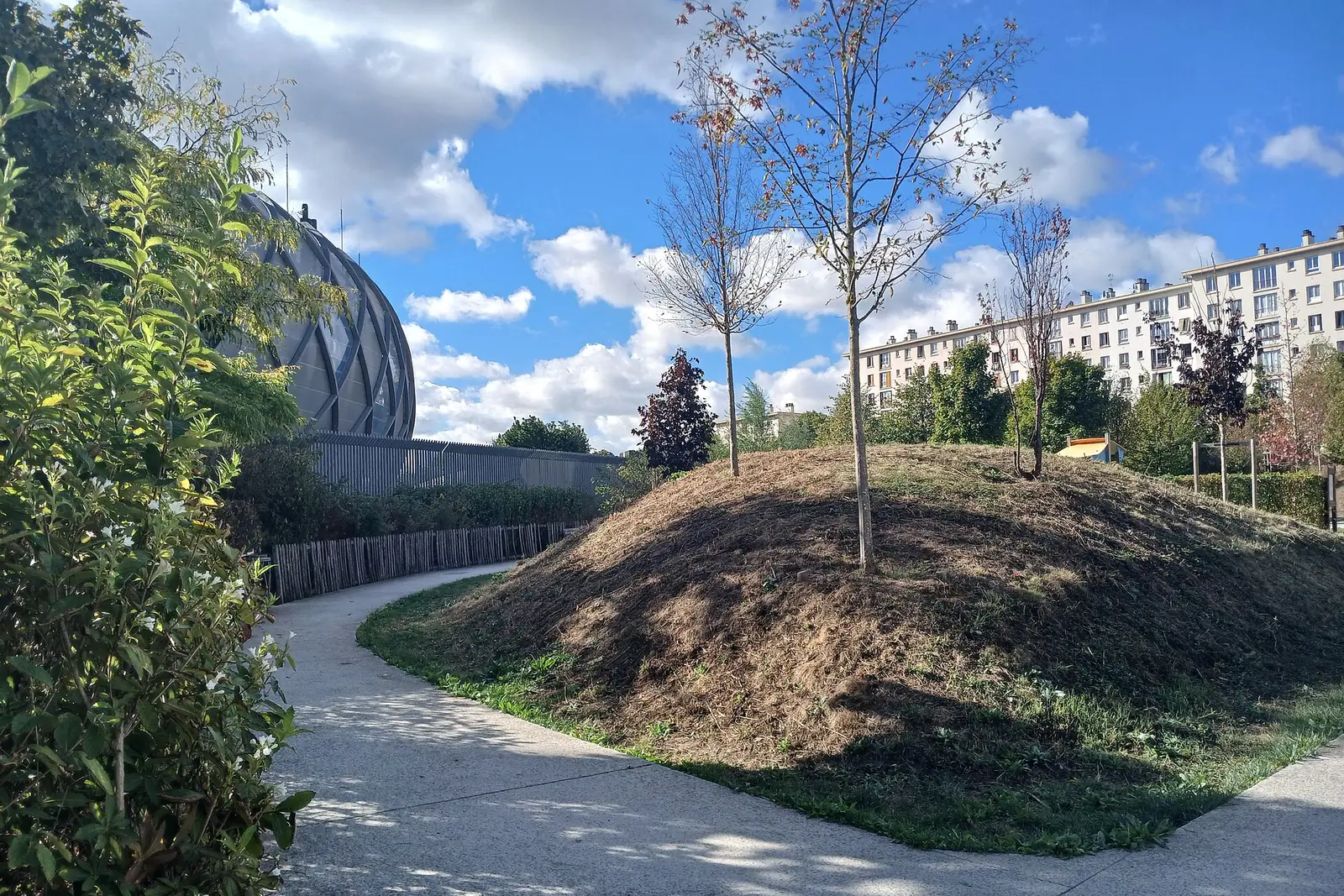
The entrance to the village of Fouju, in October 2015. The Campus IA project is being built on 89 hectares of the commune's farmland, at the place called Les Bordes. Photo Cyrille Largillier, CC BY-SA 4.0, via Wikimedia Commons.
At full power, the data centre campus planned at Fouju, in Seine-et-Marne, would consume about 10.5 TWh of electricity a year according to the environmental authority, as much as 16% of the consumption of Île-de-France and 2.3% of that of France in 2025. It is due to ramp up until 2038, and its actual consumption will depend on the share of its power that it draws: at the average rate RTE measures today, 22%, it would be about 2.7 TWh. Air-cooled, it will not withdraw water from the environment to cool its first phase; its chillers will contain 514 tonnes of a fluid from the PFAS family.
Contents
Fouju is a village of 631 inhabitants, 40 km south-east of Paris; farmland occupies 87% of its area. At the place called Les Bordes, near the A5 motorway, the company Campus IA, owned by the Emirati fund MGX, Bpifrance, Mistral AI and Nvidia, is building on about 89 hectares of farmland what the Île-de-France environmental authority calls the "largest data centre campus in Europe" (our translation):
- 11 data centre buildings 20 metres high, for 848 MW of IT capacity;
- a 9.4-hectare electrical substation, connected to a 400,000-volt line;
- 613 backup generators and 680 rooftop chillers.
The prefect issued the environmental authorisations on 29 July 2026, including the one to operate the first 3 buildings. Work on the first phase began in September, and these buildings are due to enter service in early 2028, according to the timetable published by the community of communes. Mistral AI, the first announced customer, has reserved up to 200 MW of computing capacity there. The next infographic sets the consumption of the finished campus against that of the region and the country.
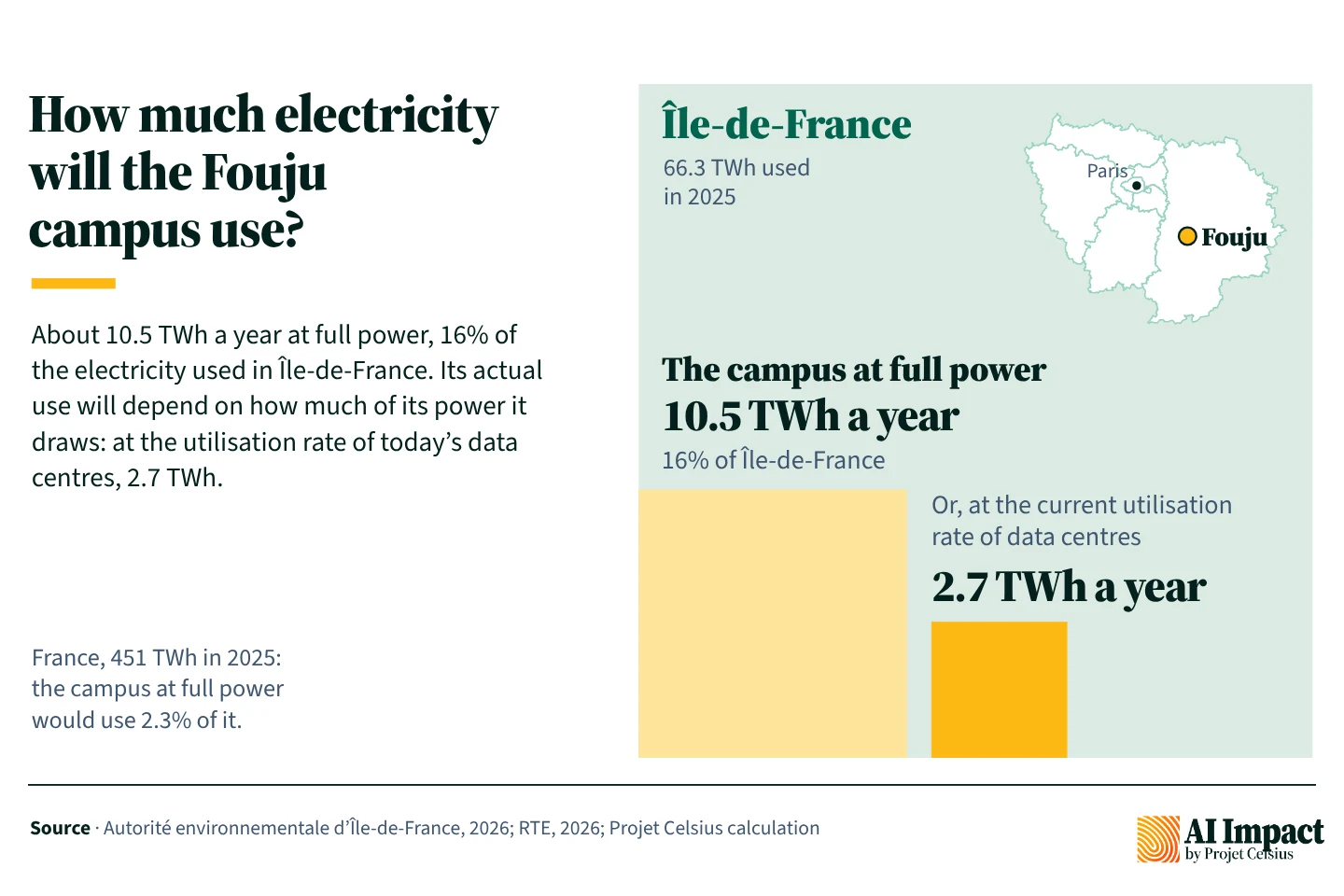
At full power, about 10.5 TWh a year
The project file does not give a single value. 3 figures are in circulation, and they do not count the same thing.
| Consumption per year | What it counts | Source |
|---|---|---|
| 9.7 TWh | 848 MW of IT load, multiplied by a PUE of 1.3, all year | impact assessment, cited by the environmental authority |
| 10.5 TWh | 1,200 MW drawn for 8,760 hours, excluding auxiliaries and losses | environmental authority, opinion of 8 April 2026 |
| 12.3 TWh | 1,400 MW, the maximum connection capacity planned with RTE, all year | our calculation |
The whole campus built, at full power. PUE is the ratio of a centre's total electricity to that of its servers; the developer announces 1.18 to 1.3 depending on the building.
The hub uses about 10.5 TWh a year at full power, the environmental authority's value, within a range of 9.7 to 12.3 TWh. It is the value used in our analysis of contested projects, which compares Fouju with 2 other French projects. Set against 2025 consumption, it equals 16% of that of Île-de-France, according to RTE's regional footprint, and 2.3% of that of France (our calculation). It is also about 2 times the consumption in 2024 of all French data centres on dedicated sites, 4 to 5 TWh according to RTE, and more than 12 times the energy consumed in 2022 by the community of communes where the campus is being built.
A unit error in the opinion
The opinion states that the project will increase the energy consumption of the area by "9,657 MWh" (our translation). It should read GWh: 848 MW multiplied by a PUE of 1.3 and by 8,760 hours gives 9,657 GWh, or 9.66 TWh, to the digit (our calculation). The accompanying note keeps the same unit for the area, whereas elsewhere the opinion gives 841 GWh for its 2022 consumption. The ratio of 1,422% it draws, the 9,657 of the project against the 679 targeted in 2030 by the area's climate plan, does not depend on the unit.
The other figures in circulation
- "200,000 households" (our translation): the opinion compares more than 10 TWh with the consumption of 200,000 households, counting 4,800 kWh per household. With this assumption, 10 TWh corresponds to about 2 million households (our calculation).
- "17% of Île-de-France consumption" (our translation) : a written question to the Senate relates 10 TWh to Île-de-France. Of the 66.3 TWh of 2025, 10 TWh make 15%.
Actual consumption depends on the pace of construction and on utilisation
The campus will not run at full power for a long time. The contract signed with RTE on 26 January 2026, the first application of the accelerated connection procedure, provides for 240 MW by the end of 2027, 700 MW before the end of 2029, then up to 1,400 MW eventually. The developer's reply memorandum, of 24 April 2026, staggers the commissioning of the 11 buildings from 2027 to 2038.
| Step | Buildings | Power drawn | End of commissioning | Per year, at 22% | Per year, at 100% |
|---|---|---|---|---|---|
| Phase 1 | DC1, DC2, DC4, DC11 | 466 MW | 2030 | 0.9 TWh | 4.1 TWh |
| Phases 1 and 2 | and DC8, DC9, DC10 | 802 MW | 2034 | 1.5 TWh | 7.0 TWh |
| Whole campus | and DC3, DC5, DC6, DC7 | 1,258 MW | 2038 | 2.4 TWh | 11.0 TWh |
Power drawn per building and start-of-operation dates: Campus IA reply memorandum, table 1, added up by us. Energy over the year: our calculation, cumulative power multiplied by the utilisation rate and by 8,760 hours. The environmental authority notes inconsistencies between the timetables in the file.
Only 3 buildings are currently entitled to operate. The orders of 29 July 2026 authorise the operation of DC1, DC2 and DC4, 346 MW between them 3; at full power all year, they would consume 3 TWh (our calculation). The operation of the 8 other buildings is not yet authorised.
Utilisation rate, the main unknown
A data centre does not draw its connection capacity continuously. According to RTE's Bilan électrique 2025, the centres connected to the transmission grid use on average today 22%, with a long ramp-up; RTE reports that operators expect about 80% in 10 to 15 years. Applied to the 1,400 MW of maximum connection capacity, these rates give consumption ranging from 1 to 4.5.
Annual consumption of the campus at 1,400 MW of connection capacity, by utilisation rate (our calculation).
The utilisation rate weighs as much as the number of buildings built, and the file states neither the expected rate nor the intended use of the machines: model training, answering users' questions or hosting. The 22% is measured on existing centres; a campus devoted to training could run closer to its capacity. Our analysis on the electricity shortage explains why reserved power matters as much, for the grid, as the energy consumed over the year.
No water withdrawn to cool the first buildings
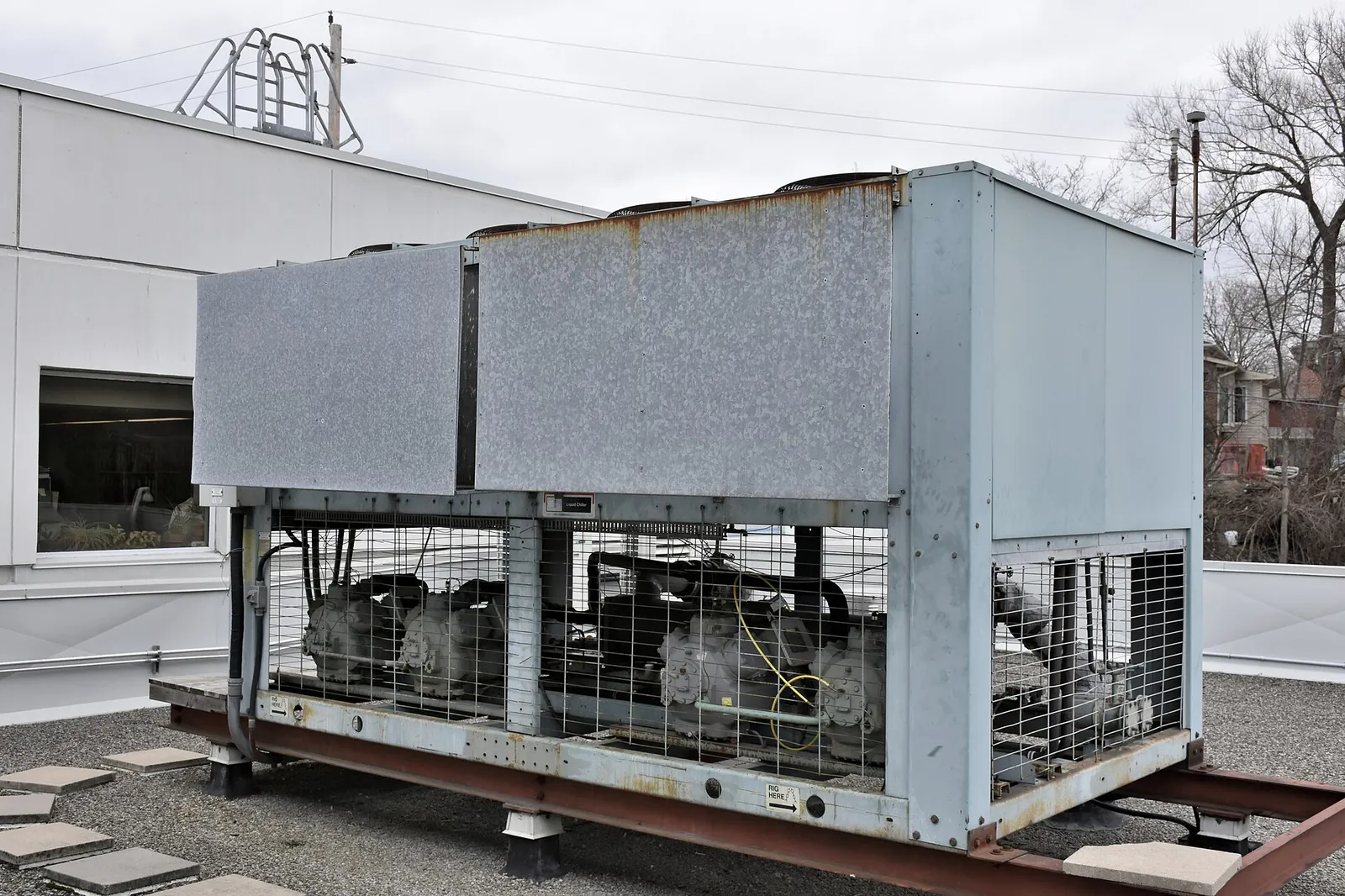
The first buildings will be air-cooled. Their rooftop chillers compress a refrigerant in a closed circuit and reject the heat into the outside air, without evaporating water. The developer justifies this choice by the sensitivity of the Champigny aquifer, whose water distribution zone covers the commune. It pays for it in electricity: according to its reply memorandum, air cooling consumes slightly more than evaporative cooling, hence a PUE of 1.18 to 1.3, which the environmental authority judges to be below current industry standards.
The order authorising DC1 draws its rules from it. The building is connected to the public drinking water network for sanitary uses, the fire reserve and watering, and no withdrawal from local resources is authorised for its cooling. Groundwater is pumped only during construction, to dry out the excavations: from 0 to less than 200,000 m³ a year between 2026 and 2035, according to the same order.
Air cooling does not settle the whole water question:
- for the later phases, the file indicates that some buildings could use mixed cooling, which consumes water; the environmental authority then asks for the impact assessment to be updated;
- the water evaporated by the power plants that produce the campus's electricity is not counted in the file. Our analysis of AI's water use explains why this indirect water often exceeds that of the sites; the hub does not yet put a figure on it for France.
514 tonnes of refrigerant
Dry cooling relies on a refrigerant. The campus's chillers will contain 514.3 tonnes of R-1234ze, according to the opinion of the environmental authority. This fluid does not attack the ozone layer and its direct greenhouse effect is very low, but it belongs to the PFAS family: as it breaks down in the atmosphere, it forms trifluoroacetic acid, which is hard to remove from water, and it leads to the production of HFC-23, a greenhouse gas 14,800 times more powerful than CO2.
3% a year of the campus's 514.3 tonnes, according to the impact assessment cited by the environmental authority.
The impact assessment judges these micro-leaks not significant. The environmental authority asks for a health risk assessment of these leaks, breakdown products included, and notes that the file's greenhouse gas footprint counts the leaks, 9.8 ktCO2e over 50 years, without their breakdown in the atmosphere. The developer replies that the fluid circulates in a closed, sealed circuit, and that only accidental micro-leaks are possible.
Our view
Fouju's consumption reads as a range: from 2.7 TWh a year at the current utilisation rate to 10.5 TWh at full power, depending on a rate the developer does not publish. On water, dry cooling spares the aquifer; the trade-off is a fluid from the PFAS family and a slightly higher PUE. The file would benefit from publishing the expected utilisation rate and the cooling method of the 8 buildings whose operation remains to be authorised. Our questions about a data centre project apply to Fouju, and our analysis of how data centres are hosted raises the question of hosting them at the scale of France. 3 questions remain open:
- what utilisation rate does the developer expect, and for what uses?
- how will the buildings of phases 2 and 3 be cooled?
- how will refrigerant leaks be measured and published?
The consumption figures on this page are values from the project file or our calculations; none is measured. Power is not energy: 1,400 MW of connection capacity amount to 12.3 TWh only if the campus draws it all year.

He holds a PhD in nanophysics from Aix-Marseille Université and an engineering degree from the Institut d'Optique, and co-founded Projet Celsius, where he heads the Marseille office.
His page and articles →Contact him →LinkedIn ↗
An engineer from UTBM and life cycle assessment trainer at the Institut de Formation Carbone, he carries out the life cycle assessments at Projet Celsius.
His page and articles →Contact him →LinkedIn ↗Sources
11 documents
- Mission régionale d'autorité environnementale d'Île-de-France, opinion on the project for a data centre campus at Fouju (77), 8 April 20262026entry 347
- Campus IA, mémoire en réponse à l'avis de l'autorité environnementale sur le campus de Fouju, 24 April 20262026entry 601
- RTE and Campus IA, press release on the fast-track grid connection of Campus IA, 26 January 20262026entry 339
- Préfecture de Seine-et-Marne, Fouju, projet Campus IA : décisions, arrêtés du 29 juillet 20262026entry 602
- Préfet de Seine-et-Marne, arrêté n° 2026-31/DCSE/BPE/IC autorisant l'exploitation du centre de données DC1 à Fouju, 29 July 20262026entry 603
- RTE, Bilan électrique 2025 en Île-de-France, 9 July 20262026entry 604
- RTE, Bilan électrique 2025, full report2026entry 333
- RTE, Bilan prévisionnel 2025, consumption2025entry 8
- RTE, Les data centers en chiffres clés, page updated on 1 June 20262026entry 332
- Communauté de communes Brie des Rivières et Châteaux, calendrier du projet Campus IA2026entry 600
Every figure was read in its source; the hub's methodology is described in Methodology and sources.
Clément Reynaud and Sébastien Pierfederici, Fouju data center: how much electricity and water will it use?, AI Impact, Projet Celsius, 18 November 2026. https://projetcelsius.com/en/ai/analyses/fouju-data-center-electricity-and-water/