
 Electricity19 November 2026
Does bitcoin use more electricity than AI?
The 2 curves in terawatt-hours per year, from 2023 to 2030, with what each one counts, and the mining sites leased to AI
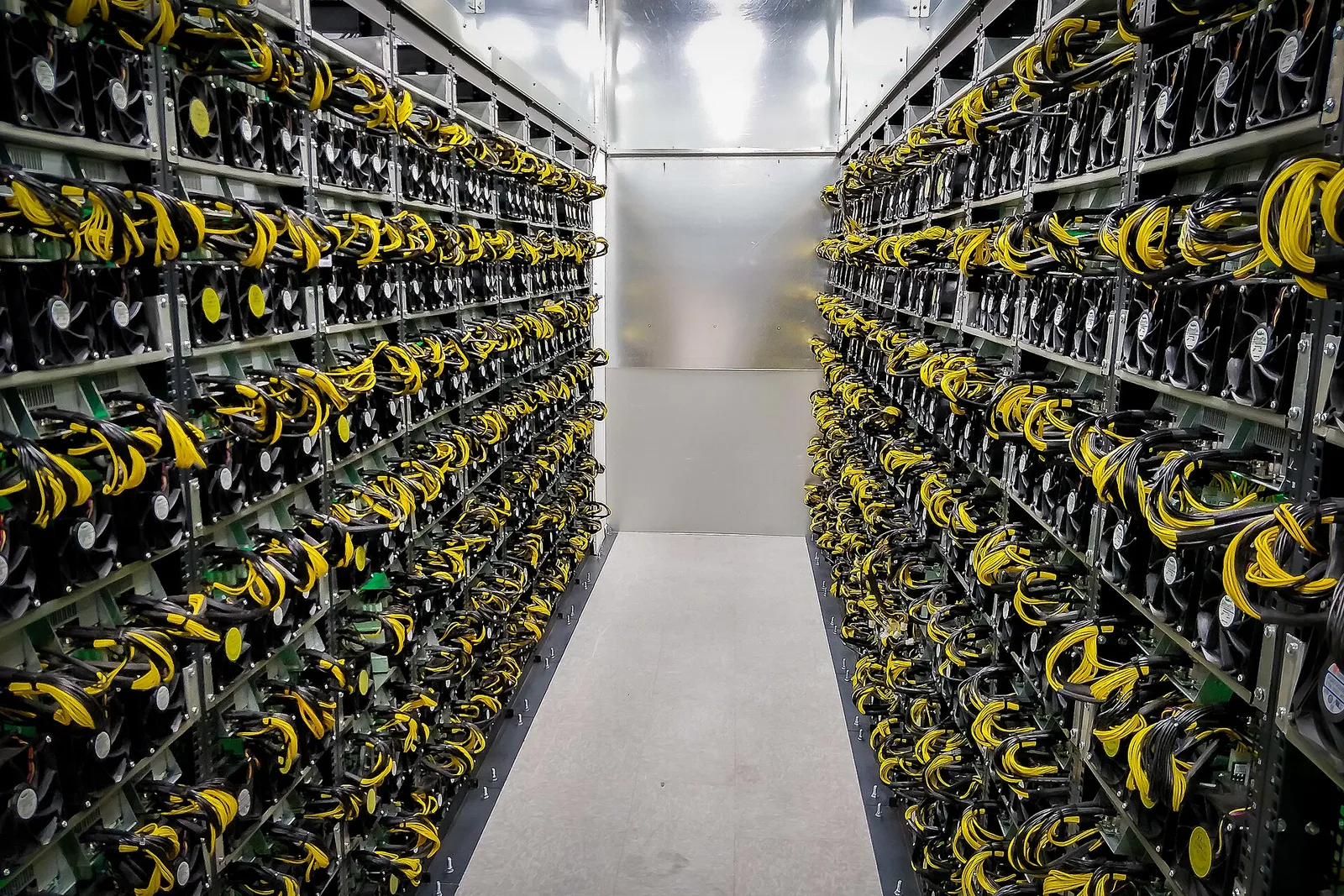
Argo Blockchain mining machines in Mirabel, Quebec, in August 2018. Photo MikeBogosian, CC BY-SA 4.0, cropped, via Wikimedia Commons.
In 2024, bitcoin mining consumed 2 to 3 times more electricity than AI: from 137 to 183 TWh per year according to the University of Cambridge, against about 62 TWh for AI servers. In 2025, the 2 figures are of the same order, with AI at 100 to 174 TWh according to published estimates, and the curves cross in 2025 or 2026, by our reading. For 2030, the International Energy Agency sees AI-focused data centres at 465 TWh, about 2.5 times bitcoin at the end of 2024. Part of this growth is settling on former mining sites.
Contents
Put in the same unit, the terawatt-hour (TWh) per year, the 2 curves read as follows. The bitcoin network consumed about 120 TWh in 2023, then from 137 to 183 TWh per year over the course of 2024, according to the University of Cambridge index. AI, which no statistic separates from the rest of data centres, would have consumed about 62 TWh in 2024 and 100 to 174 TWh in 2025, according to the estimates the hub uses. The next chart shows where they meet: in 2025 or in 2026, depending on the AI estimate used.
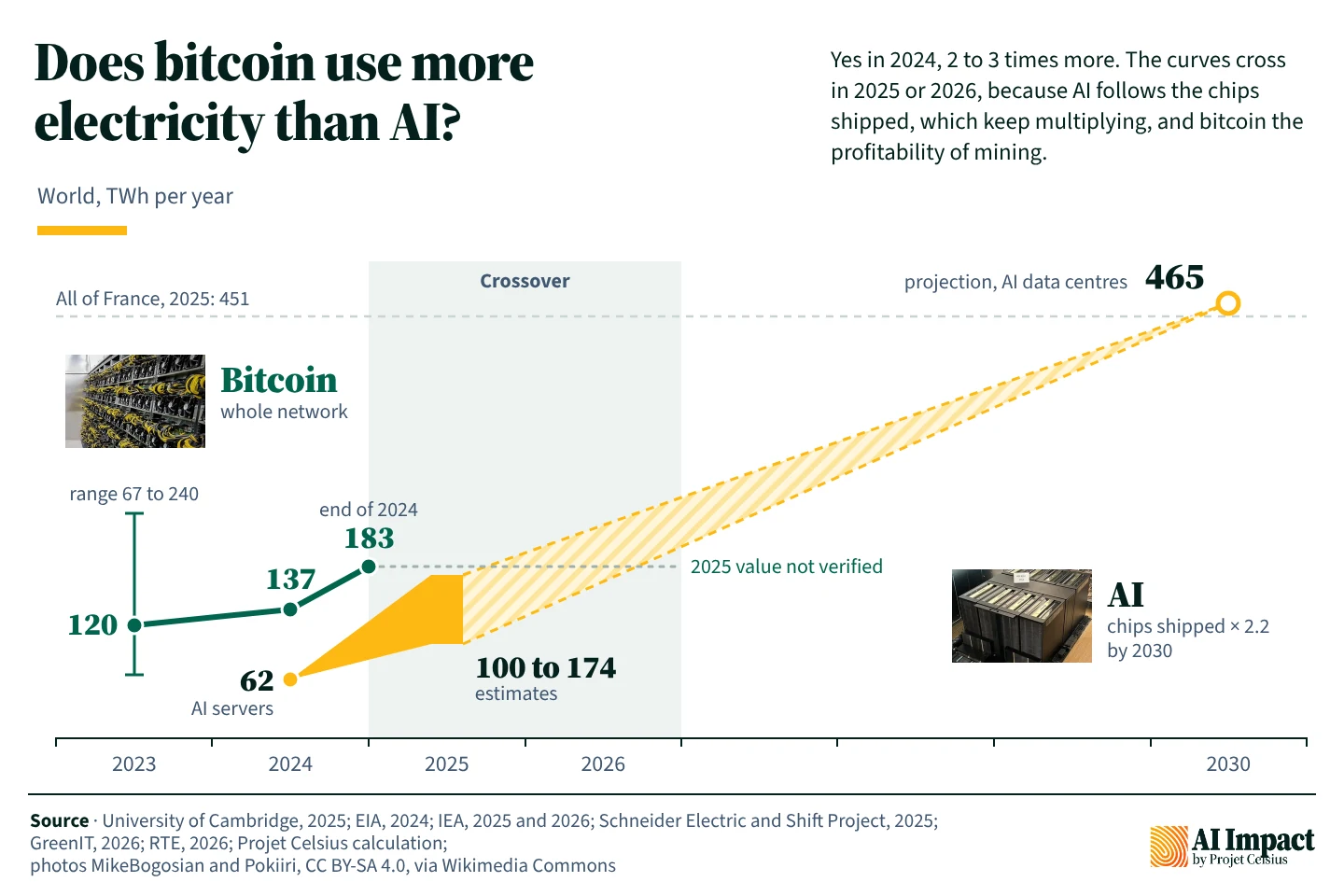
In 2024, bitcoin mining consumed 2 to 3 times more than AI
The Cambridge index (CBECI) serves as the reference for bitcoin; the IEA and the US Energy Information Administration take it up. For 2023, it estimates 120 TWh, within a range of 67 to 240 TWh, or 0.2 to 0.9% of world electricity demand (EIA). On 30 June 2024, the network was running at 137 TWh per year, and a survey of 49 mining companies, which account for nearly half of the network's computing power, gave 138 TWh, about 0.54% of the world's electricity (Cambridge report, April 2025). At the end of December, the network's computing power had grown by a further 42% and consumption reached 183 TWh per year, despite more efficient machines.
For AI, no statistic exists. The IEA takes accelerated servers as its indicator, those that carry graphics cards (GPUs) or equivalent chips: they made up 15% of data centre consumption in 2024, out of 415 TWh (Energy and AI). That makes environ 62 TWh (our calculation), 2 to 3 times less than bitcoin in the same year. The next table brings together the values of the 2 curves with what each one counts; the carbon footprint of bitcoin per euro invested is covered on our blog.
| Scope | Value | Date | Source |
|---|---|---|---|
| Bitcoin, whole network, sites included | 120 TWh (67 to 240) | 2023 | Cambridge, taken up by the EIA |
| Bitcoin, annualised network rate | 137 TWh | 30 June 2024 | Cambridge |
| Bitcoin, annualised network rate | 183 TWh | 31 December 2024 | Cambridge |
| All cryptocurrencies | 110 TWh, then about 125 TWh | 2022, 2023 | IEA |
| AI, accelerated servers only | environ 62 TWh | 2024 | our calculation from the IEA |
| AI, published estimates | 100 to 174 TWh | 2025 | Schneider Electric, GreenIT |
| AI-focused data centres, projection | 465 TWh | 2030 | IEA |
An annualised rate is the consumption of a year at the level of the day indicated, not the average of the calendar year. The IEA figures for cryptocurrencies include bitcoin and the other mined currencies.
The 2 curves cross in 2025 or 2026
In 2025, AI consumed 100 to 174 TWh according to published estimates: the lowest comes from Schneider Electric, taken up by the Shift Project, the highest from GreenIT. The IEA does not publish a value for AI alone in 2025, but it writes that the consumption of AI-focused data centres rose by 50% over the year (Key Questions on Energy and AI).
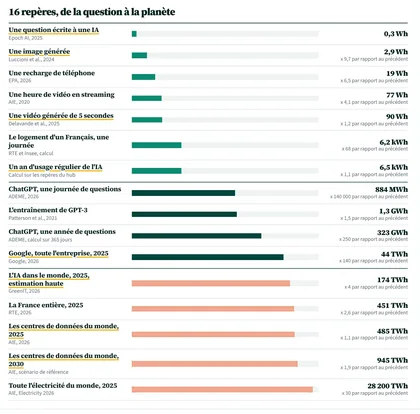
For bitcoin, we could not check a 2025 value at its source. The last point published by Cambridge, 183 TWh per year at the end of 2024, is enough to locate the crossover: with the low estimate, AI stays below bitcoin in 2025; with the high one, 174 TWh, it comes within 5% of it. The curves therefore cross in 2025 or in 2026, depending on the AI estimate used (our deduction). At this scale, the 2 each consume about a third of the electricity of France, 451 TWh in 2025.
In 2030, AI would consume about 2.5 times bitcoin at the end of 2024
For 2030, the IEA projects 465 TWh for AI-focused data centres, in its base case, half of the 945 TWh of all data centres. That is about 2.5 times the bitcoin rate at the end of 2024 (our calculation). For bitcoin, the only projection checked is the IEA's, published in January 2024: about 160 TWh in 2026 for all cryptocurrencies (Electricity 2024). Bitcoin alone had already exceeded it at the end of 2024. The IEA reports of 2026 no longer cover cryptocurrencies.
- whole network, mining sites included
- University of Cambridge estimate
- IEA base case
- data centres dominated by accelerator servers
The 2 figures do not measure the same thing
The bitcoin figure comes from a model. Its methodology starts from the network's computing power, known at all times, and assumes that miners use only machines that are profitable at the electricity price. The low bound takes the most efficient machines and sites with almost no losses (power usage effectiveness, or PUE, of 1.01); the high bound, the least efficient machines that are still profitable and a PUE of 1.20. The figure covers the whole network, including the cooling of the sites.
The AI figure has no equivalent. Operators do not publish what their servers devote to AI, and each estimate draws the line elsewhere, as set out in the Database entry on AI in data centres :
- accelerated servers (IEA, 2024): the servers alone, without cooling, some of which do scientific computing and not AI;
- AI-focused data centres (IEA, 2025 and 2030): whole data centres, where these servers dominate;
- the AI server fleet (GreenIT, 2025): about 13 million GPUs, assumed to be used at 69% of their capacity all year.
What drives the rise of the 2 curves
The 2 curves do not rise for the same reasons. Bitcoin's consumption does not depend on the number of transactions: according to Cambridge's method, it follows the computing power that miners judge profitable to commit, and therefore the bitcoin price, the electricity price and the efficiency of the machines. AI's consumption follows the number of servers shipped and their use: the IEA bases its projection on shipments of accelerator chips, which it sees multiplying by 2.2 from 2025 to 2030.
Mining sites are being leased to AI
According to the Cambridge report, miners have what AI is looking for: experience of large computing centres, electricity contracts already signed and sites that adapt faster than new ones can be built. In June 2024, they still devoted almost everything to bitcoin: 98.5% of the power reported by the miners surveyed, against 0.46% to high-performance computing. The block reward had just been divided by 2, in April 2024, for the 4th time. The same report puts a figure on the gap that is pushing the change:
- a megawatt-hour earns $80 to $151 in mining, $120 to $400 in AI server hosting and $1,600 to $4,000 when the company sells the computing itself;
- it requires an investment of $0.24 to $1.2 million per megawatt in mining, $9 million in hosting and $40 million in computing sold.
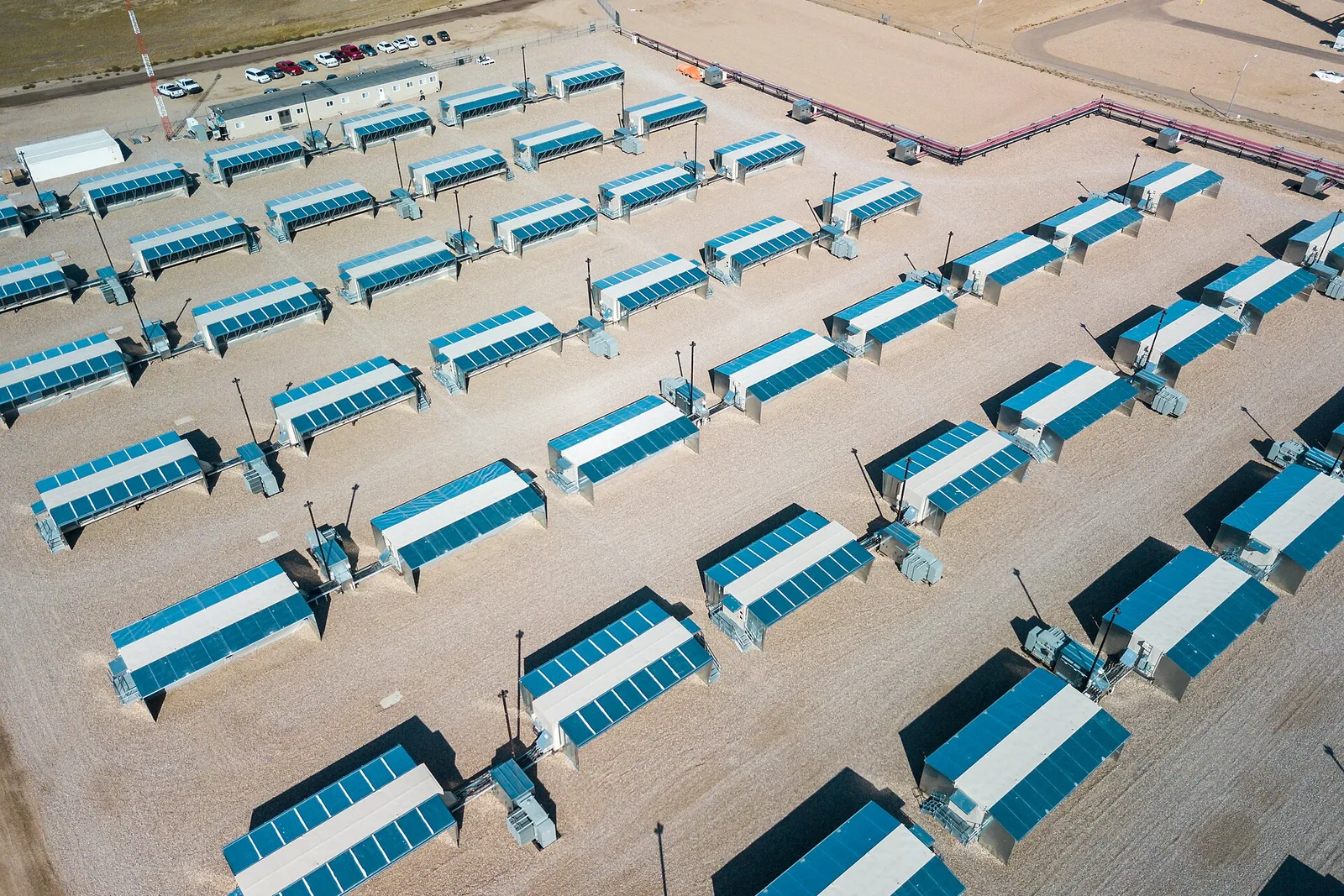
At Lake Mariner, 83% of revenue already comes from computing rental
TeraWulf mines bitcoin at its Lake Mariner site in New York State, where it signed in August 2025 2 contracts of 10 years with Fluidstack, a computing provider for AI: more than 200 MW of IT load, for about $3.7 billion, of which Google guarantees $1.8 billion in rent. In the 3rd quarter of 2026, this rental made up 83% of its revenue, with 102 MW leased and 336 MW under construction; the company writes that part of its mining infrastructure is being repurposed.
For the 2 curves, the consequence is simple: a repurposed megawatt moves from the bitcoin column to the AI column, and it does not disappear. Bitcoin's consumption, for its part, falls only if the network's computing power falls, which depends on the miners that remain active, wherever they are.
Our view
The comparison gives the right order of magnitude: in 2025, bitcoin and AI each consume about a third of the electricity of France. What separates them is the trajectory. Bitcoin's follows its price and the efficiency of the machines; AI's follows the servers shipped, and the IEA sees it more than tripling by 2030, partly on sites that mining frees up. Our analysis of the French grid shows that the question also arises in terms of power and location, and our comparison with aviation puts it in terms of CO2. Faced with a figure that pits bitcoin against AI, ask 3 questions:
- is AI counted in servers, in whole data centres or in the installed fleet?
- is bitcoin an annual average or a rate on a given date?
- is the year estimated after the fact or projected?
Bitcoin is given as an annualised rate at 2 dates in 2024, AI as estimates for a year or as a projection, with different scopes: the crossover is dated to within 1 year. The IEA figures for cryptocurrencies count all of them, bitcoin included.

He holds a doctorate from École polytechnique and an engineering degree from ESPCI Paris, and co-founded Projet Celsius, which he chairs. He is a lead trainer in Bilan Carbone® and life cycle assessment at the Institut de Formation Carbone.
His page and articles →Contact him →LinkedIn ↗
He holds a PhD in nanophysics from Aix-Marseille Université and an engineering degree from the Institut d'Optique, and co-founded Projet Celsius, where he heads the Marseille office.
His page and articles →Contact him →LinkedIn ↗Sources
10 documents
- Cambridge Centre for Alternative Finance, Cambridge Digital Mining Industry Report: Global Operations, Sentiment, and Energy Use2025entry 667
- Cambridge Centre for Alternative Finance, Cambridge Bitcoin Electricity Consumption Index (CBECI), methodology2026entry 668
- U.S. Energy Information Administration, Tracking electricity consumption from U.S. cryptocurrency mining operations, 1 February 20242024entry 669
- IEA, Electricity 2024, Analysis and forecast to 20262024entry 670
- IEA, Energy and AI2025entry 1
- IEA, Key Questions on Energy and AI2026entry 2
- The Shift Project, Intelligence artificielle, données, calculs : quelles infrastructures dans un monde décarboné ?2025entry 4
- GreenIT, Impacts environnementaux et sanitaires de l'intelligence artificielle dans le monde en 2025 et 20302026entry 6
- TeraWulf, TeraWulf Signs 200+ MW, 10-Year AI Hosting Agreements with Fluidstack, press release of 14 August 20252025entry 671
- TeraWulf, TeraWulf Reports Third Quarter 2026 Results, press release of 6 November 20262026entry 672
Every figure was read in its source; the hub's methodology is described in Methodology and sources.
Guillaume Pakula and Clément Reynaud, Does bitcoin use more electricity than AI?, AI Impact, Projet Celsius, 19 November 2026. https://projetcelsius.com/en/ai/analyses/bitcoin-vs-ai-electricity/