
 Electricity19 November 2026
Why are there so many data centers in Marseille?
The subsea cables, the data centres of the port and the north of the city, their electricity, their water and what they bring in
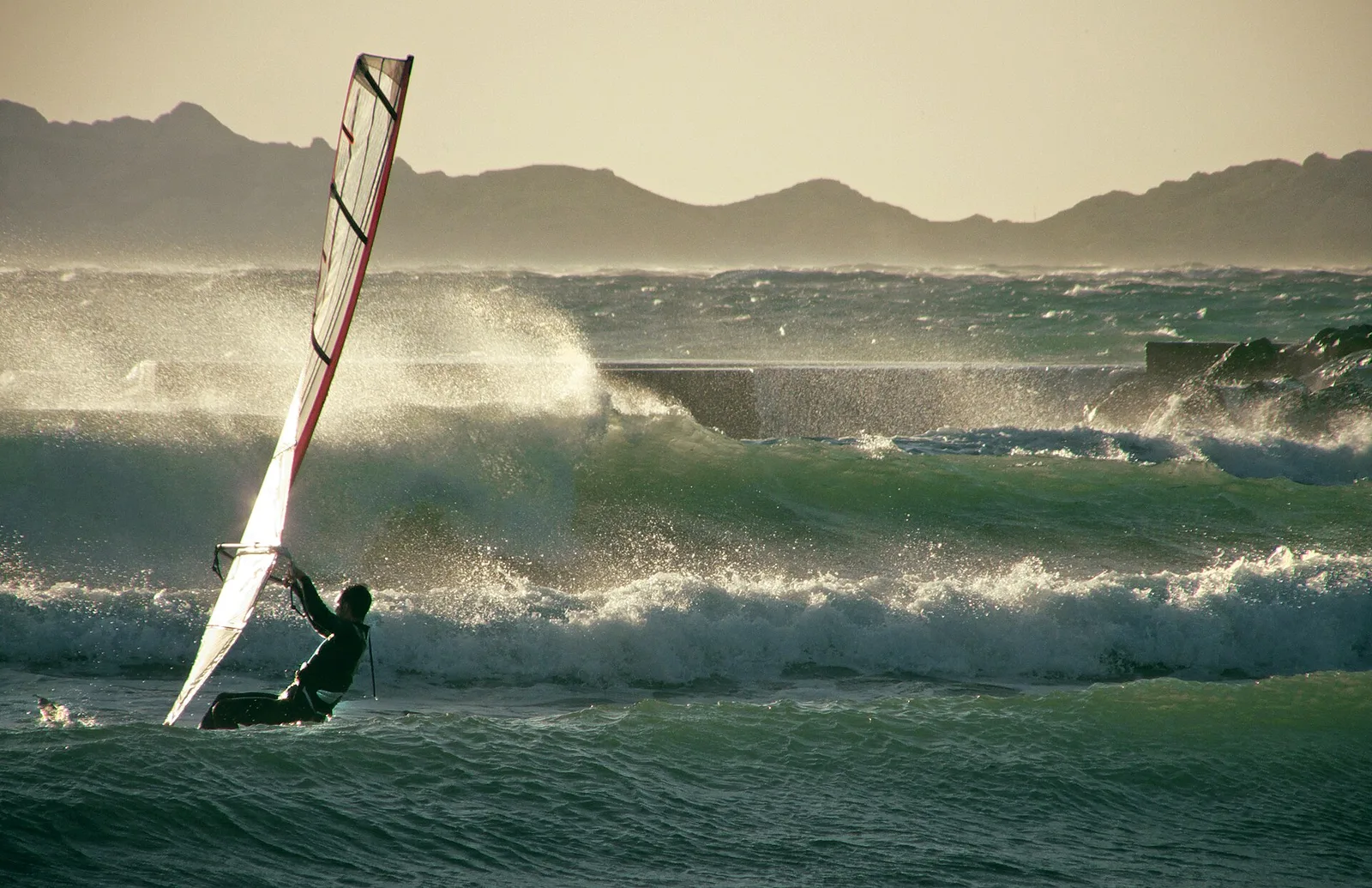
Prado beach, in Marseille, in the mistral, in March 2009. The SEA-ME-WE 6 cable comes ashore on this beach. Photo Alpha du centaure, CC BY 2.0, via Wikimedia Commons.
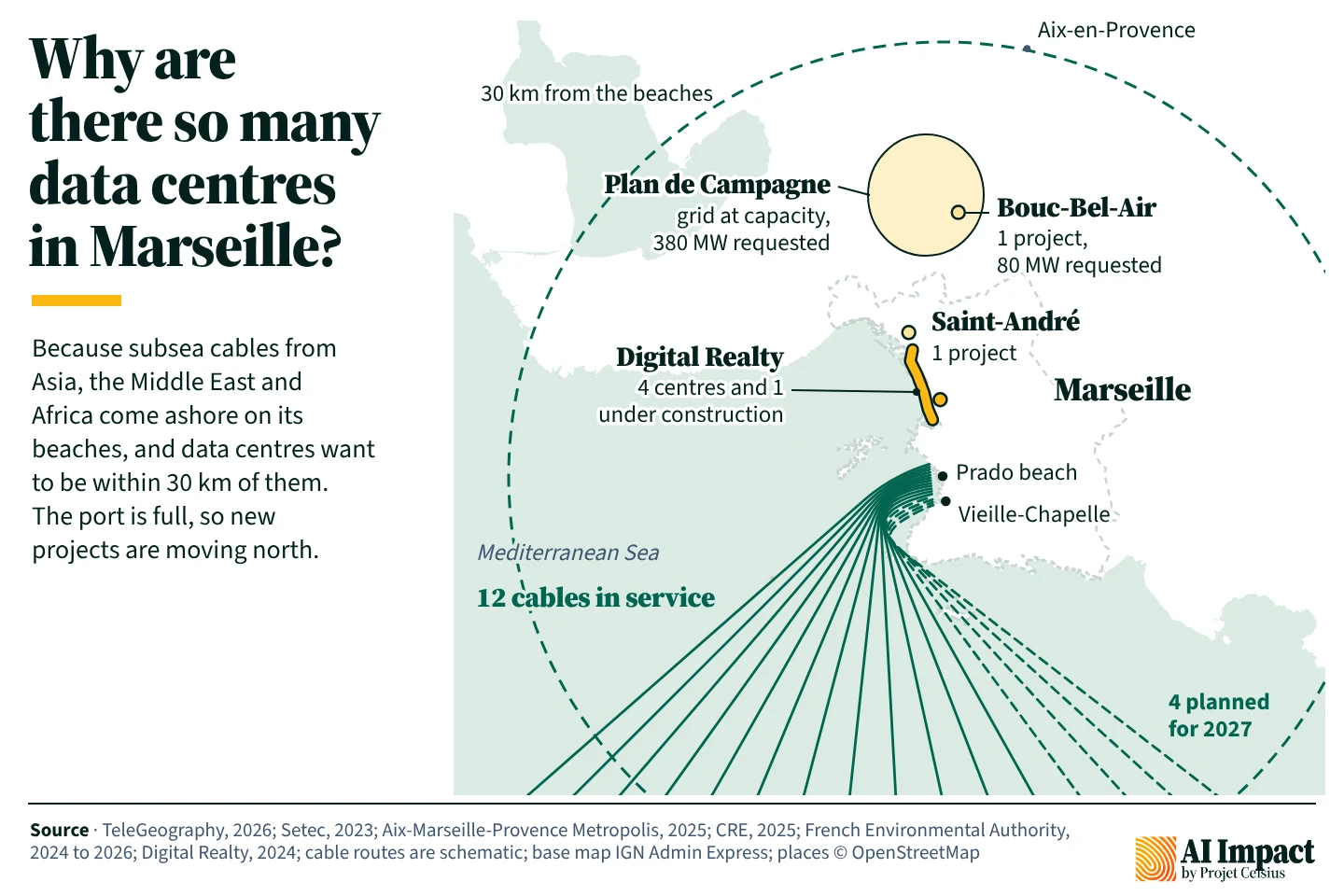
Marseille hosts data centres because subsea cables from Asia, the Middle East and Africa come ashore on its beaches: 12 cables in service arrive there in November 2026 according to TeleGeography, and operators want their servers within 30 km of these landing points. Digital Realty operates 4 data centres there, 3 of them in the port, and is building a 5th. With the port full, projects are moving to the north of the city, where the electricity grid has no available capacity left: RTE has received 380 MW of requests there. The port's data centres are cooled with water from a former mine, and the tax revenue they bring in is not published.
Contents
On Prado beach, south of Marseille, the SEA-ME-WE 6 cable comes out of the sea and enters an existing buried landing chamber. It links Singapore to Marseille over nearly 19,200 km, with branches to India, Pakistan, Saudi Arabia and Egypt, according to the environmental assessment of its landing. At the Vieille-Chapelle site, also in Marseille, the Medusa cable lands in the same way. The TeleGeography's map counts 12 cables in service that arrive at Marseille in November 2026, and 4 others announced for 2027.
These cables attract data centres. A server installed near a landing point exchanges data faster with the countries the cable links: the Aix-Marseille-Provence Metropolis puts this advantage at less than 30 km from the landing points, and describes its territory as a gateway serving Southern Europe and North Africa. The next infographic locates the cables, the port's data centres and the projects in the north of the city.
Marseille receives between 12 and 19 cables, depending on the count
The number of cables varies from one source to another, depending on the date and the territory counted; only TeleGeography's map gives the list. All the counts give an order of magnitude of 12 to 19 cables, most of them to Asia, the Middle East and Africa.
| Source | Date | Cables counted |
|---|---|---|
| TeleGeography, subsea cable map | November 2026 | 12 in service at Marseille, 4 announced for 2027 |
| Aix-Marseille-Provence Metropolis | end of 2024 | 18 in the metropolitan area, of which 5 since 2017 |
| Environmental Authority, opinion on MRS6 | June 2025 | 15, and 2Africa as the 16th |
| Commission de régulation de l'énergie | December 2025 | 16 major intercontinental cables |
| Digital Realty | 2024 to 2026 | 17 (brochure of 2024), 18 linked to its campus (page in 2026), 19 (builder of MRS5, 2025) |
Published counts, read on 18 November 2026. They differ by date and by territory (the city or the metropolitan area); only TeleGeography publishes its list.
According to our count of the landing points on TeleGeography's map, the 12 cables in service link Marseille to 54 other countries; the CRE counts 43. The cable with the most, 2Africa, commissioned in 2024, has 50 landing points on 3 continents. Marseille received its first subsea cable in 1870, for the telegraph.
Digital Realty operates 4 data centres in Marseille, is building a 5th and preparing a 6th
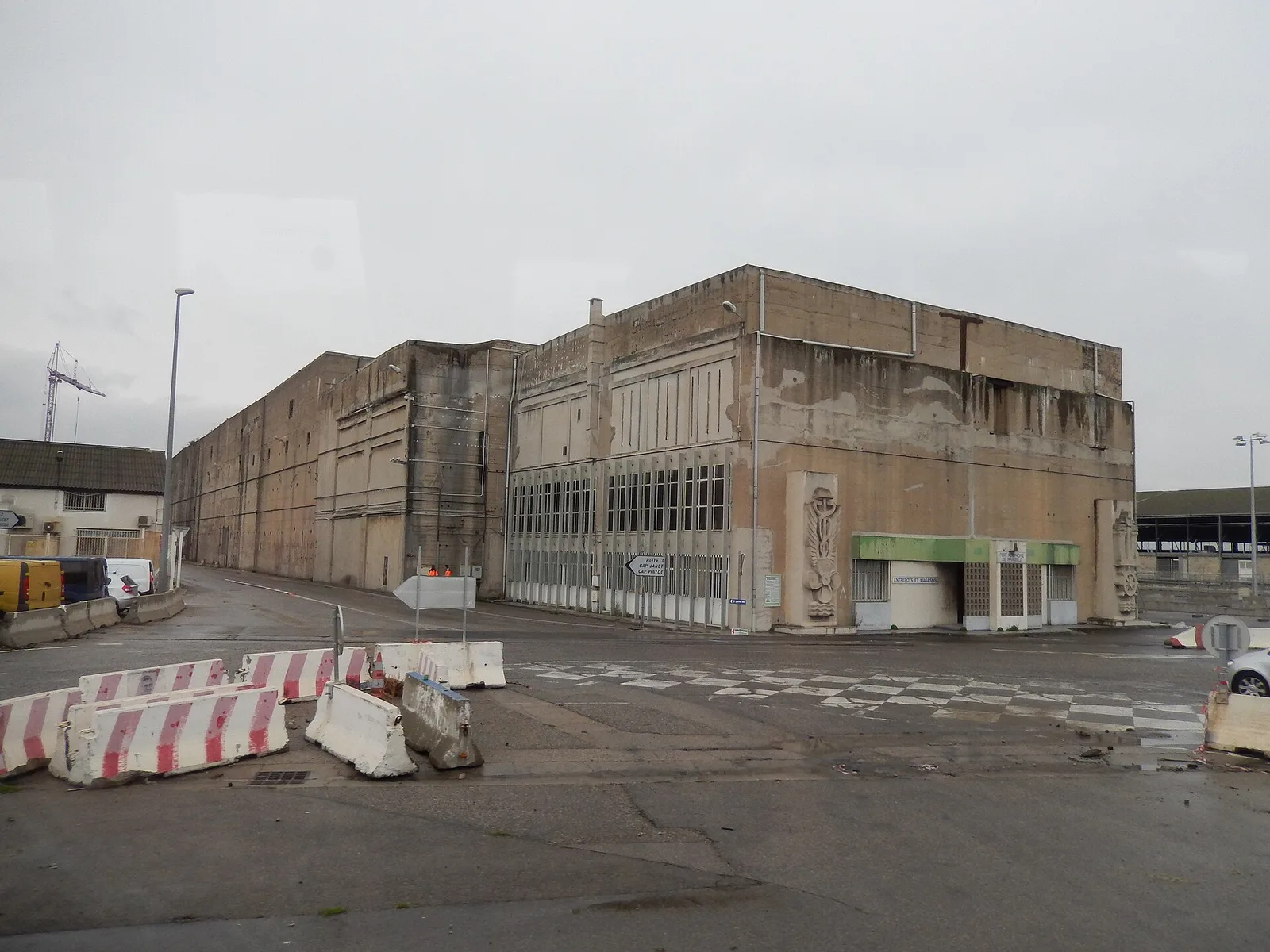
The city's leading operator is Digital Realty, long present under the name of its subsidiary Interxion. It operates 4 data centres, MRS1 in the city and MRS2 to MRS4 within the port, and is building a 5th, MRS5, on the former sugar silo in the Calade district. The published capacities:
- MRS3, partly commissioned in July 2020 in the former German submarine base of the port: 16.5 MW;
- MRS4: 20 MW of grid connection, according to its 2022 data sheet;
- MRS5, delivery planned for December 2026: 22 MW of IT power, 231 GWh per year announced.
The 231 GWh assume the servers run at full power all year: Digital Realty's submission allots them 192.7 GWh, which is exactly 22 MW over 8,760 hours (our calculation).
The new projects are moving north of the city
According to the environmental authority, the available land in the port has been used up. The next projects are setting up in the north: MRS6, Digital Realty's 6th data centre, in a former logistics warehouse in Bouc-Bel-Air, with 80 MW of grid connection and 245 GWh per year announced; a data centre of about 23,000 m² in the Saint-André business park; others around Plan de Campagne. The buildings are getting bigger: the main data centres built in the Metropolis from 2013 to 2023 occupied 6,350 m² on average, and the projects under way approach 17,000 m², according to the Metropolis.
North of Marseille, the electricity grid has no available capacity left
In the port, MRS5 will be supplied at 20,000 volts from a substation built for MRS4. In the north, the Plan de Campagne area depends on the 400,000-volt Réaltor substation, in Cabriès. According to the Energy Regulatory Commission (CRE), the existing lines cover current consumption and offer no more capacity to new industrial consumers; the area even has an occasional deficit. RTE ranks Marseille North, with the south of the Île-de-France region, among the 2 accelerated electrification zones linked to digital technology.
Since 2022, RTE has received in this area connection requests from data centres and from a distribution system operator for 380 MW. In December 2025, the CRE authorised it to build structures in advance to accommodate:
- 320 MW in 2030;
- 550 MW in 2032, for €72.7 million, of which the applicants pay a share of €92,500 per MW after reduction.
Capacity requested or planned north of Marseille, in MW.
380 MW, about 2% of French reservations
These 380 MW make up about 2% of the 18 GW reserved in France by data centre projects in May 2026 (our calculation). At the average utilisation rate of data centres connected to the transmission grid, 22% according to RTE, the 550 MW of the area would use about 1.1 TWh per year; at 80%, the rate operators expect, about 3.9 TWh (our calculation), almost as much as all the data centres on dedicated sites in France in 2024. The constraint is the capacity of the grid north of Marseille.
On the coast, the same electricity must also supply shore power to ships at the quayside, including ferries and ships under repair, which keep their engines running during their stopover. In January 2023, Sébastien Barles, ecologist deputy mayor, estimated according to AFP that data centre demand was "casting uncertainty" (our translation) over this project. In June 2025, the Metropolis limited new data centres in dense urban areas and on the coast to projects of less than 12 MW, citing the decarbonisation of transport and port activities.
The port's data centres are cooled with water from a former mine
The Galerie de la Mer is an underground tunnel of nearly 15 km that runs from the former Provence coalfield, near Gardanne, to the commercial port of Marseille. Since 2010, BRGM it has pumped the water from the old mines at the Puits Gérard shaft and discharged it into the sea at a depth of 30 m, so that the iron it contains does not discolour the waters of the port. In 2023 it pumped 5.7 million m³, 653 m³ per hour on average, using 2.5 GWh of electricity.
Digital Realty passes part of this water, which is not drinkable and stays at about 14 °C all year according to the operator, through heat exchangers that cool MRS2, MRS3 and MRS4: this is known as "river cooling". The data centres release their heat into it without consuming the water.
2 flow rates that do not measure the same thing
In February 2025, the head of Digital Realty in France mentioned pumping of about 3,000 m³ per hour for the 3 data centres. BRGM publishes 653 m³ per hour of mine water pumped in 2023. The 2 figures do not describe the same circuit, and the public documents we read do not allow them to be reconciled.
| Quantity | Value | Source |
|---|---|---|
| Mine water pumped at the Puits Gérard shaft and discharged into the sea | 653 m³ per hour on average, 5.7 million m³ | BRGM, 2023 |
| Water pumped for the 3 port data centres | about 3,000 m³ per hour | Digital Realty, February 2025 |
| Share of MRS5's cooling supplied by the tunnel | 50% | environmental authority, 2024 |
| Electricity saved by MRS5 thanks to the tunnel | 10.4 GWh per year, 4% | Digital Realty submission, our calculation |
The BRGM flow rate is measured and annual; the operator's is stated to the press, with no time period.
MRS5 will draw half of its cooling from the tunnel. According to Digital Realty's submission, the tunnel reduces its consumption from 241 to 231 GWh per year, a saving of 10.4 GWh (our calculation). Heat from the port data centres could feed the Massileo heating network, depending on the needs of that network, which is run by Dalkia, and heat from MRS5 is offered free of charge to warm future municipal swimming pools; no volume is published. Our analysis of data centre heat explains why it remains little used.
The City of Marseille and a local association accuse Digital Realty of monopolising this water, according to AFP in February 2025; a member of the association cites other possible uses: local farming, street cleaning, watering parks.
Jobs number in the tens per data centre, and tax revenue is not published
The jobs announced are the operator's figures:
- MRS5: 40 direct jobs and 160 indirect, according to the project brochure, for 22 MW;
- the campus: more than 400 direct and indirect jobs already created, according to the 2024 brochure; in January 2023, the operator spoke of nearly 500 jobs, 85 of them direct;
- the MRS5 construction site: 150 workers a day on average and more than 180 companies, according to its builder.
Once in operation, a data centre needs relatively few local interventions, the Metropolis notes: monitoring and updates are done remotely. None of the documents we read gives a figure for tax revenue. The Metropolis asks the operator to confirm through a tax ruling that the data centre is classified as an industrial establishment, on which, in its view, revenue for local authorities depends. On land, Laurent Lhardit, deputy mayor for the economy and digital affairs, cited in January 2023 about fifty companies in the productive sector, around 3,000 jobs, that could not have set up or expanded in Marseille, according to AFP.
Local debates since 2023
- January 2023: Sébastien Barles, with the Green MEP David Cormand, calls for a moratorium on new data centres while "eco-conditions" are defined (our translation); the city council asks the Metropolis for a master plan.
- 20 October 2023: the city council votes for a "municipal strategy for the planned and regulated siting of subsea cables and data centres" (our translation), according to the local press.
- Fin 2023: the collective "Le nuage était sous nos pieds" (The cloud was under our feet), which includes La Quadrature du Net, begins to document the city's data centres; in 2024 it contributes to the public inquiry on MRS5, which our analysis of contested projects reads the file.
- June 2025: the Metropolis sets its guidelines until 2030: brownfield sites first, less than 12 MW on the dense coastline, at most 50 hectares outside brownfield sites in 5 years, and projects of more than 25 MW directed to dedicated sites.
Our view
In our view, Marseille shows what happens when the location of a data centre is set by cables. Projects are concentrated within a 30 km radius, in the port and then to the north, where they meet a grid and a land supply that the port, industry and transport also need. Our analysis of where data centres are located compares the other criteria; the Metropolis's rule, which reserves the coast for small projects, responds to this competition. To judge it, 2 public figures are missing: the measured consumption of data centres in operation and the revenue they pay to local authorities. For a new project, 3 questions, which our list of questions on a data centre project completes:
- which substation will it connect to, and which other projects are waiting on that substation?
- how far from the landing points does it need to be, and for which customers?
- what measured consumption will it publish once in operation?
The capacities, consumption and jobs are announced by the operator or taken from the authorities; no measured consumption is published. The number of cables depends on the date and on how they are counted.

He holds a PhD in nanophysics from Aix-Marseille Université and an engineering degree from the Institut d'Optique, and co-founded Projet Celsius, where he heads the Marseille office.
His page and articles →Contact him →LinkedIn ↗
An engineer from UTBM and life cycle assessment trainer at the Institut de Formation Carbone, he carries out the life cycle assessments at Projet Celsius.
His page and articles →Contact him →LinkedIn ↗Sources
22 documents
- TeleGeography, Submarine Cable Map, Marseille landing point, accessed 18 November 20262026entry 673
- Aix-Marseille-Provence Metropolis, Orientations stratégiques territoriales pour un accueil vertueux des datacenters, annex to the resolution of 30 June 20252025entry 676
- Commission de régulation de l'énergie, délibération n° 2025-274 du 17 décembre 2025 sur la mutualisation des raccordements dans la zone de Plan de Campagne2025entry 677
- Environmental Authority, avis délibéré n° 2025-058 du 12 juin 2025 sur le centre de données MRS6 à Bouc-Bel-Air2025entry 678
- BRGM, Département prévention et sécurité minière, compte rendu annuel régional d'activité 2023, Provence-Alpes-Côte d'Azur, 14 June 20242024entry 682
- Mission régionale d'autorité environnementale Provence-Alpes-Côte d'Azur, opinion no. 2024APPACA16 on Digital Realty's MRS5 project, 4 April 20242024entry 343
- Digital Realty, response to the environmental authority's opinion on MRS52024entry 344
- Setec, expertise environnementale sous-marine de la route du câble SEA-ME-WE 6 atterrissant sur la plage du Prado à Marseille, 28 March 20232023entry 674
- AFP, L'explosion des data centers fait débat à Marseille, carrefour des flux de données numériques, 24 January 2023, republished by Connaissance des Énergies2023entry 688
- AFP, Data centres chase water, energy savings as AI race ramps up, février 2025, repris par The Star2025entry 313
Every figure was read in its source; the hub's methodology is described in Methodology and sources.
Clément Reynaud and Sébastien Pierfederici, Why are there so many data centers in Marseille?, AI Impact, Projet Celsius, 19 November 2026. https://projetcelsius.com/en/ai/analyses/why-so-many-data-centers-in-marseille/