
 Electricity13 November 2026
Is AI using more or less energy over time?
The energy of a prompt, the volume processed and total electricity, at Google from 2024 to 2026




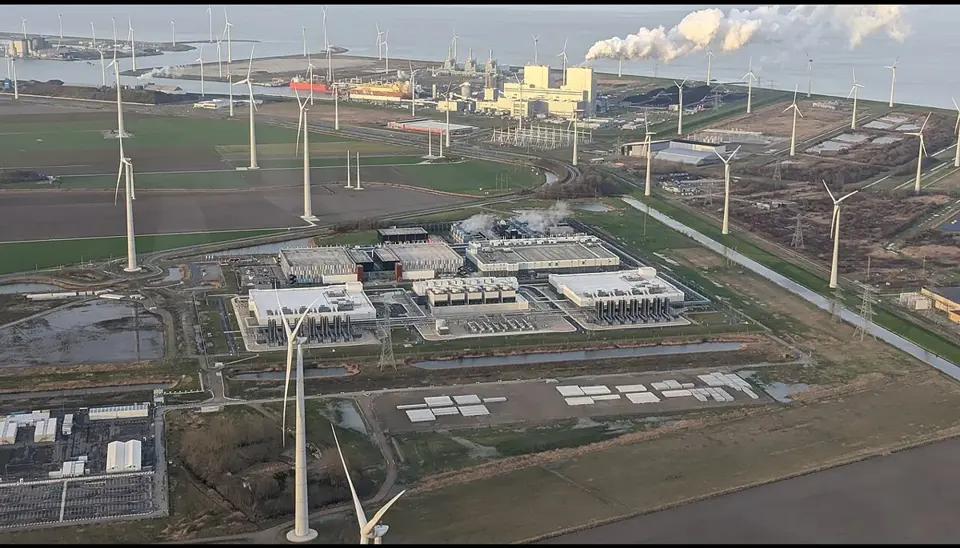
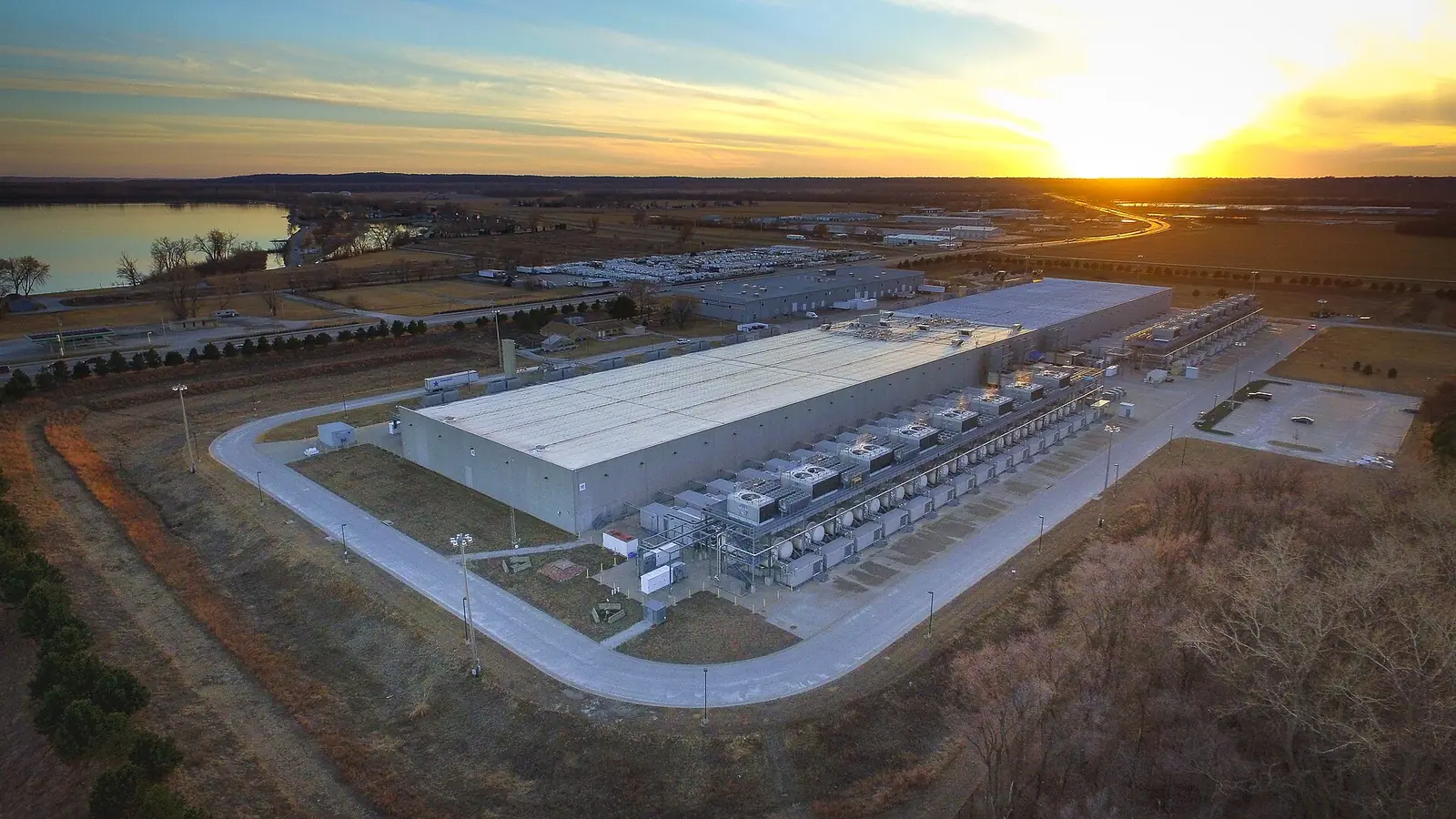
Google's data centre at Eemshaven, in the Netherlands, in January 2023. Photo: Wvdp, CC0, via Wikimedia Commons.
At Google, the energy of the median text prompt to Gemini was divided by 33 between May 2024 and May 2025. Over the same period, the text processed each month by the company was multiplied by 50, and its electricity use rose by 37% in 2025.
Contents
In August 2025, Google published a study on the energy of its Gemini assistant, accompanied by a blog post: in 12 months, the energy consumed by the median text prompt to the app was divided by 33. In June 2026, the same company published its annual environmental report: its electricity rose from 31.7 TWh in 2024 to 43.6 TWh in 2025, 37 % more. The 2 figures come from Google, and they describe 2 different quantities: the energy of a unit of service, and total consumption.
Google is, to our knowledge, the only provider to publish both 2 over neighbouring years, along with the volume of text processed. This is why this analysis relies on its figures. Microsoft, Meta and the International Energy Agency publish the same rise in the total; none publishes the energy of a query.
The energy of a median prompt was divided by 33 in one year
Google's study, a preprint by authors employed by the company, not peer reviewed, measures 0.24 Wh for the median text prompt to the Gemini app in May 2025. The boundary is that of the data centre: the AI chips, the rest of the server, the machines kept in reserve and the cooling. With the chips alone, Google would have obtained 0.10 Wh; the method used gives a value 2.4 times higher. The internet network, the user's device and the training of the models remain outside the count.
The study attributes the reduction to software: a factor of 23 comes from the models, a factor of 1.4 from better use of the machines. Our analysis of AI decarbonisation details these levers. 2 caveats limit the scope of the figure. The value is a median: the study states that small sets of long queries, or queries served by little-used models, "consume a disproportionate amount of energy", and the average is not published. And the comparison runs from May 2024 to May 2025: we found no energy-per-prompt measurement published since. The 2026 report gives a 78% reduction in the serving cost of Gemini in 2025, which is a cost and not an energy figure.
The text processed was multiplied by 50 over the same period
In May 2024, Google was processing 9,700 billion tokens per month across its products and APIs, a token being the unit of text that models handle. In May 2025, more than 480,000 billion, 50 times more. In May 2026, more than 3.2 quadrillion, a further 7 times more. These figures are announcements by its chief executive, Sundar Pichai, with no published method.
| Series | May 2024 | May 2025 | May 2026 | Scope |
|---|---|---|---|---|
| Energy of the median Gemini prompt | 33 times that of 2025 | 0.24 Wh | unpublished | Gemini app, text |
| Text processed per month, in tokens | 9,700 billion | 480,000 billion | 3.2 quadrillion | all Google products and APIs |
| Google's electricity, over the calendar year | 31.7 TWh (2024) | 43.6 TWh (2025) | the whole company, all uses |
Google study on Gemini (August 2025), speeches by Sundar Pichai at the I/O conferences of 2025 and 2026, Google 2026 environmental report. The 3 series do not have the same boundary and cannot be divided by one another.
The 2 factors cannot be divided by one another. The first applies to a median prompt to an application; the second covers all of the company's products and its APIs, and the number of tokens per prompt may have changed. They show that volume has grown much faster than the measured efficiency. The only total published, electricity, confirms this.
Heavy uses are growing, and they weigh more per query. On a benchmark of open models, Hugging Face measures that reasoning models consume on average 30 times more energy than models without reasoning, and 150 to 700 times more for the same model tested with and then without reasoning. Anthropic counts, in its own data, about 4 times more tokens for an agent than for a conversation, and about 15 times more when several agents work together. Google's median is not sensitive to this type of query; the mean, which is not published, is.
Google's electricity use rose most sharply in 2025
The 2026 environmental report states that in 2025 the company experienced "the largest load growth in its history": 37% more electricity, after 27% in 2024. Its data centres rose from 17.4 TWh in 2021 to 42.4 TWh in 2025, 2.4 times more. The report links this rise to all of its products, AI included, and states that the pace was "tempered" by its efficiency gains on AI, without saying by how much, or what share of the total is AI.
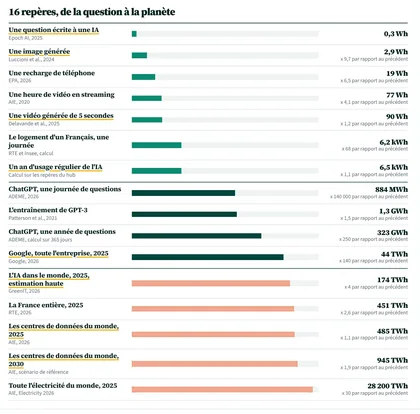
The movement is not limited to Google. Microsoft's electricity use rose by 24% over its financial year ended June 2025, and Meta's by 20% in 2024. Worldwide, the International Energy Agency counts 485 TWh for all data centres in 2025, compared with 415 in 2024, and projects 945 in 2030 in its base case scenario; the projections chart for 2030 compares this scenario with the others, and our analysis of the electricity shortfall relates it to France's demand.
 Electricity
 use of Google and Microsoft
Electricity used by the company, in TWh a year · 2020 to 2025, published years
Source: Google, 2026 report; Microsoft, 2026 data sheet · projetcelsius.com/en/ai · CC BY 4.0
The chart counts all of Google's electricity, offices included: 43.6 TWh and + 37% in 2025; its data centres alone, 42.4 TWh.
Emissions follow the total, depending on the accounting method used
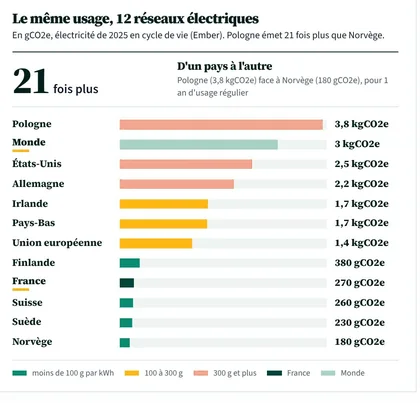
Google's emissions table gives 2 values for its electricity in 2025. Calculated with the carbon content of the contracts and certificates that the company buys, they fall by 3%, to 2.82 million tCO2e; this is the figure that the text of the report puts forward. Calculated with the average carbon content of the grids where its servers run, they rise from 11.07 to 15.15 million tCO2e, 37% more (our calculation). The difference between the 2 accounts, and what an electricity contract does or does not change, is explained in our analysis of AI decarbonisation.
The rebound effect
In 1865, the economist William Stanley Jevons argued that more economical use of coal raises its consumption: if a blast furnace burns less of it per tonne of pig iron, the price of iron falls, demand increases, and the number of blast furnaces ends up more than offsetting the saving made by each. In Scotland, he noted, the coal burned per tonne of iron had fallen to less than a third, and total consumption had increased tenfold. At Google, the 2 movements go together; no published figure says what share of the rise in volume comes from the fall in cost.
For AI as a whole, the question remains debated. In the journal Joule, Microsoft researchers estimate in 2026 that progress in models, software and hardware could divide energy by 8 to 20, without saying, in the published abstract, from what starting point, and help keep demand at a manageable level; the same article notes that long reasoning and agents multiply the energy of a query by more than 10. Sasha Luccioni, Emma Strubell and Kate Crawford, in 2025, write that rebound effects "undermine the assumption that technical efficiency alone guarantees a net reduction in environmental harm". Our view on surface AI and deep AI draws the consequences for uses without an interface.
For us, at Projet Celsius, the energy of a prompt says nothing on its own about emissions, which depend on the total and on the carbon content of the electricity. A provider would make it possible to follow the real trend by publishing each year the average energy of a query, not only its median, and the electricity attributed to AI; neither Google, nor Microsoft, nor Meta publishes the second.
The 33-fold reduction applies to a median prompt to the Gemini app, from May 2024 to May 2025, within the data centre boundary; the average is not published, and no more recent measurement is published.
Sources
13 documents
- Elsworth et al. (Google), Measuring the environmental impact of delivering AI at Google scale2025entry 14
- Google, 2026 Environmental Report2026entry 13
- Sundar Pichai, Google I/O 2025: From research to reality, Google blog, 20 May 20252025entry 326
- Sundar Pichai, I/O 2026: Welcome to the agentic Gemini era, Google blog, 19 May 20262026entry 327
- Hugging Face, AI Energy Score v22025entry 26
- Anthropic, How we built our multi-agent research system, 13 June 20252025entry 328
- Microsoft, 2026 Environmental Sustainability Report, Data Fact Sheet2026entry 15
- Meta, 2025 Environmental Data Index2025entry 16
- IEA, Energy and AI2025entry 1
- IEA, Key Questions on Energy and AI2026entry 2
- William Stanley Jevons, The Coal Question, London, Macmillan, 1865, chapter VI1865entry 329
- Oviedo, Kazhamiaka, Choukse et al. (Microsoft), Energy use of AI inference, efficiency pathways, and test-time scaling, Joule2026entry 198
- Luccioni, Strubell and Crawford, From Efficiency Gains to Rebound Effects: The Problem of Jevons' Paradox in AI's Polarized Environmental Debate, ACM FAccT 20252025entry 330
Every figure was read in its source; the hub's methodology is described in Methodology and sources.
AI Impact, Projet Celsius, "Is AI using more or less energy over time?", 13 November 2026. https://projetcelsius.com/en/ai/analyses/is-ai-using-more-or-less-energy-over-time/