
 Electricity13 November 2026
What does "100% renewable electricity" mean for a data centre?
Contracts, guarantees of origin and electricity consumed hour by hour




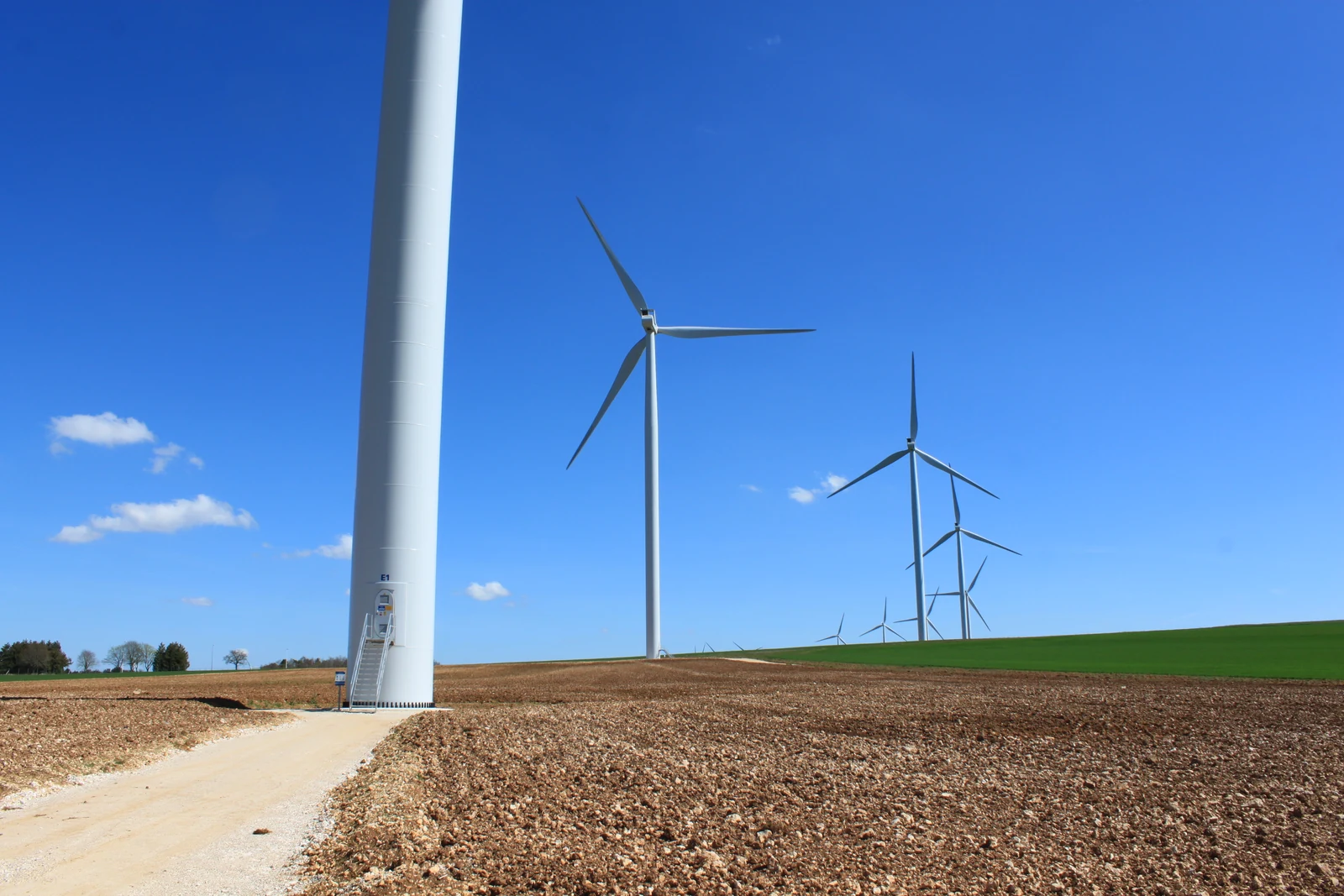
The Chitry-Quenne wind farm, in the Yonne. Photo Christophe Finot, CC BY-SA 3.0, via Wikimedia Commons.
A company that announces "100% renewable electricity" counts, over the year, as many renewable megawatt hours as it consumed: its contracts, its certificates and the renewable share of the grids where it consumes, with no condition on the hour and, at Google, "regardless of the market". Hour by hour, the count is different: Google, which publishes it, covered 65% of its consumption in 2025 with carbon-free electricity, from its contracts or from the grid, from 5% in Singapore to 98% in Finland.
Contents
Google, Microsoft, Meta and Amazon all state that they cover 100% of their electricity consumption with renewable electricity: Google since 2017, Amazon for the 3rd year in 2025, Microsoft in its financial year 2025. Their data centres nonetheless remain connected to grids that burn gas or coal at certain hours. The 2 claims count different things.
The "100% renewable" figure is counted over the year
The figure is a ratio between 2 annual volumes. The numerator is the renewable electricity bought by contract, produced on site or present on the grids where the company consumes; the denominator is its total consumption. Google says so in its 2026 report: the numerator counts all the renewable electricity bought, "regardless of the market" in which the electricity was consumed, and wind purchases in Europe offset the lack of purchases in Asia. Amazon and Microsoft describe the same method.
Purchases take 2 forms. A power purchase agreement, often called a PPA, commits the company to buy, over several years, the output of a specific wind or solar farm. A guarantee of origin, in Europe, is an electronic document proving that a quantity of electricity was produced from renewable sources; in France, each one is worth 1 MWh produced during a given month. It is sold separately from the electricity: at the French auctions of July 2026, where the State sells the guarantees of the installations it supports, a wind guarantee of origin was worth €1.76 per megawatt-hour. In 2025, 1,091 TWh of guarantees of origin were issued in the European AIB system, of which 82% for renewable electricity.
A long-term contract with a generator: the company buys the output of a specific plant, and the guarantees that come with it.
Proof that a renewable megawatt-hour was produced during a month; it says nothing about the hour or the place where the buyer consumes.
Hourly count of carbon-free electricity
A data centre consumes day and night; a solar farm produces during the day. Our calculation for an actual day, 21 June 2025 in France: a 100 MW data centre, with constant consumption, buys a solar contract that produces over the day exactly as much as it consumes. The count for the day is 100%. Hour by hour, the solar power bought covers 51 % of its consumption: almost nothing from 21 h to 7 h, more than 2 times its needs at 14 h. The other half comes from the grid, and the midday surplus goes onto the grid for other consumers.
| Hour | Data centre consumption | Solar power bought | Share covered |
|---|---|---|---|
| 0 h | 100 MW | 0 MW | 0 % |
| 6 h | 100 MW | 1 MW | 1 % |
| 9 h | 100 MW | 119 MW | 100 % |
| 14 h | 100 MW | 272 MW | 100 % |
| 18 h | 100 MW | 156 MW | 100 % |
| 20 h | 100 MW | 39 MW | 39 % |
| 22 h | 100 MW | 0 MW | 0 % |
| Day | 2,400 MWh | 2,400 MWh | 51 % |
Our calculation: hourly profile of French solar generation on 21 June 2025 (RTE, éCO2mix, final data), scaled so that over the day it equals the consumption of a 100 MW data centre assumed to be constant. The longest day of the year is among the most favourable for solar; a wind contract gives a different curve. In France, grid electricity is itself largely carbon-free: the example shows the mismatch between the hours of generation and of consumption.
Google publishes this count for its own data centres, with the contracts it has signed and the carbon-free electricity present on each grid. In 2025, it covered 65% of its consumption worldwide hour by hour, 66% in 2024. The gap between regions depends on the grid and on contracts. In Finland, Google reaches 98%: the grid there is 95% carbon-free, and its contracts alone cover 75% of its consumption, hour by hour. In Singapore, it reaches 5%: the grid there is 5% carbon-free, and no contract delivered carbon-free electricity to it in 2025. In the MISO grid, in the central United States, it reaches 88% on a grid that is 36% carbon-free, thanks to its contracts. Google itself writes that companies at 100% over the year continue to depend on fossil plants at the hours and in the places where carbon-free electricity is lacking.
The 2 methods of scope 2
The GHG Protocol, the standard companies follow for their emissions inventory, has since 2015 required the emissions of electricity to be published in 2 ways: according to the average intensity of the grid where the electricity is consumed, and according to the contracts and certificates bought. The gap reaches a factor of 4,400 at Meta, which reports 1,358 tonnes of CO2e for its 2024 electricity according to its contracts, and 5.97 million tonnes according to the grid. Our note on Meta's 1,358 tonnes details this gap, and the analysis of AI decarbonisation gives Google's hourly figure.
The 2015 rules only require a certificate to be issued "as close as possible" to the consumption period, in practice the year. The GHG Protocol put out for consultation, from October 2025 to January 2026, a revision that would require each certificate to correspond to the same hour as the consumption. It received nearly 1,100 responses. In July 2026, its standards board said it was in majority favourable to 2 market-based methods: one with hourly matching, on the same grid and with new plants, the other compliant with the 2015 rules, allowed until a date still to be set. In October 2026, the GHG Protocol announced a new consultation in the 2nd quarter of 2027 and a common standard with ISO in the 4th quarter of 2028. Until then, the annual count remains allowed.
The effect of contracts on grid emissions
The remaining question is whether a company's purchases lower grid emissions. 2 modelling studies answer it. Jesse Jenkins's team at Princeton concludes that, under current US policies, annual matching has little or no effect on the long-term emissions of the power system, and that hourly matching lowers them markedly, at an extra cost that can exceed 20 dollars per megawatt-hour. Riepin and Brown, at the Technical University of Berlin, model buyers who have new plants built in their area, in Ireland: in 2030, if they represent 10% of corporate and services demand, they would reduce grid emissions by up to 0.4 MtCO2 a year with hourly matching, against 0.2 Mt with annual matching. None of the 2 studies measures the effect of certificates bought from existing plants.
In the 2 studies, hourly matching, on the grid where the electricity is consumed, reduces emissions more than annual matching. In February 2025, Microsoft stopped buying the short-term certificates from existing plants that had supported its annual "carbon neutrality" claim.
Our reading
For us at Projet Celsius, a data centre cannot be carbon neutral, and neither can a company. ADEME has said so since 2022: carbon neutrality only makes sense at the scale of the planet, and an organisation can only contribute to collective neutrality; Carbone 4's Net Zero Initiative adopts the same rule. Contracts for carbon-free electricity have their place. The 2 studies cited above find them to have more effect on grid emissions when they fund a new plant on the data centre's grid and their output is matched hour by hour. An annual "100%" adds up purchases and the renewable share of grids over the year; Google's hourly rate, 65%, says what share of each hour of consumption is covered by carbon-free electricity. In the hub, we calculate the electricity of data centres with the intensity of the grid; in an emissions inventory, we ask for both of the 2 figures.
The 100 MW day is an illustrative calculation: the consumption of a data centre is assumed to be constant, for lack of published measurements, and the solar profile is that of the whole of France on the longest day of 2025. The hourly rate of 65% is published by Google alone; Microsoft, Meta and Amazon do not publish an hourly rate. Google did not count in 2025 the hourly certificates bought on the market; with them, its rate would be 69%, and it will count them from 2026.
Sources
16 documents
- Google, 2026 Environmental Report2026entry 13
- Google, 24/7 Carbon-Free Energy: Methodologies and Metrics2021entry 412
- Microsoft, 2026 Environmental Sustainability Report, Data Fact Sheet2026entry 15
- Meta, 2025 Environmental Data Index2025entry 16
- GHG Protocol, Scope 2 Guidance2015entry 59
- GHG Protocol, Scope 2 Public Consultation, consultation document2025entry 413
- GHG Protocol, Scope 2 market-based method update: 2025-2026 public consultation current status, 16 October 20262026entry 414
- AIB, Annual Report 20252026entry 415
- EEX, enchères françaises de garanties d'origine d'électricité, résultats de juillet 20262026entry 416
- RTE, éCO2mix, données nationales consolidées et définitives, portail ODRE2025entry 419
- Xu, Ricks, Manocha, Patankar and Jenkins (Princeton ZERO Lab), System-level Impacts of Voluntary Carbon-free Electricity Procurement Strategies, working paper, published in Joule in 20242023entry 418
- Riepin and Brown (TU Berlin), On the means, costs, and system-level impacts of 24/7 carbon-free energy procurement, arXiv preprint2023entry 417
- ADEME, Utilisation de l'argument de « neutralité carbone » dans les communications, avis d'experts2022entry 420
- Carbone 4, Référentiel Net Zero Initiative, résumé2020entry 421
- Amazon, 2025 Sustainability Report2026entry 320
- GHG Protocol, Scope 2 Public Consultation, Summary of Feedback, 25 August 20262026entry 422
Every figure was read in its source; the hub's methodology is described in Methodology and sources.
AI Impact, Projet Celsius, "What does "100% renewable electricity" mean for a data centre?", 13 November 2026. https://projetcelsius.com/en/ai/analyses/what-100-percent-renewable-means-for-data-centers/