
- 1Since 12 August 2026, PFAS (forever chemicals) have been limited in food packaging.
- 23 thresholds, from 25 micrograms to 50 milligrams per kilogram, are set by the text.
- 3No sell-through period: stock filled after 12 August must meet the limits.
- 4Request a total fluorine measurement from the supplier, product reference by product reference.
If you fill or buy food-contact packaging, a new question appeared in specifications this summer. The European packaging regulation, known as the Packaging and Packaging Waste Regulation (PPWR), which has applied since 12 August 2026, prohibits placing food packaging on the Union market if its per- and polyfluoroalkyl substances (PFAS) content reaches any of its 3 thresholds: 25 parts per billion (ppb) for a given PFAS, 250 ppb for the sum of PFAS measured individually and 50 parts per million (ppm) for all PFAS, including polymers.
The 3 PPWR thresholds compared with PFAS-treated paper
Concentration per kilo of packaging. Each tick mark is 10 times the previous one: the thresholds run from micrograms to milligrams per kilo, while a fluorinated treatment is measured in grams.
These limits are low enough to rule out any intentional fluorinated treatment of paper or cardboard, while allowing traces. The challenge is evidence, since no analytical method is harmonised in Europe and responsibility lies with the manufacturer under the regulation, who depends on its suppliers. On 10 October 2026, a European restriction on perfluorohexanoic acid (PFHxA) adds to these rules for food-contact paper and cardboard.
1Why food packaging contained PFAS
PFAS, or per- and polyfluoroalkyl substances, are a family of several thousand synthetic molecules. The PPWR adopts a broad definition: any substance containing at least one fully fluorinated carbon atom in a methyl (CF3-) or methylene (-CF2-) group, with a few structural exceptions. All the substances it covers are very persistent or degrade into substances that are, hence the nickname forever chemicals.
A barrier against grease since the 1950s
According to a report by the Organisation for Economic Co-operation and Development (OECD) published in 2020, food-contact paper and cardboard have been treated with PFAS since the 1950s to stop grease and water passing through the fibre, particularly for fatty foods, food heated in its packaging or food stored for long periods: wrappers for chips and burgers, microwave popcorn bags, baking paper, cake cases, butter wrappers and animal feed bags.
The fluorinated agent, added to the pulp or applied to the surface, was permitted at up to 0.2 to 1.5% of the paper's weight, depending on the substance, under the US and German authorisations identified by the OECD. Long chains of 8 to 12 carbon atoms gave way from the 2000s to chemistries mainly based on C6, which the European PFHxA regulation of 2024 notes were used in large quantities for food-contact paper and cardboard.

Why the regulation targets food contact first
The PPWR recitals identify food-contact materials as among the sectors most affected by tonnage and note that their presence inevitably leads to human exposure. As these substances' hazards have no inherent threshold, this exposure constitutes an unacceptable health risk. Announcing the start of application, the European Commission cited takeaway containers, fast-food wrappers, bakery paper and pizza boxes.
2The 25 ppb, 250 ppb and 50 ppm thresholds and what each measures
Article 5, paragraph 5 of Regulation (EU) 2025/40 sets 3 limits applying together: food-contact packaging is prohibited from being placed on the market as soon as it reaches any one of them. The units are mass-based: 1 ppb is 1 microgram per kilogram of packaging, while 1 ppm is 1 milligram per kilogram, or 1,000 times more.
- 25 ppb for each PFAS measured by targeted analysis, meaning a named substance sought in the laboratory, excluding polymeric PFAS.
- 250 ppb for the sum of PFAS measured by targeted analyses, where needed after precursor degradation, making substances invisible to direct analysis measurable; polymers remain excluded.
- 50 ppm for all PFAS, including polymers. Above 50 mg/kg of total fluorine, upstream suppliers under Registration, Evaluation, Authorisation and Restriction of Chemicals (REACH) must provide evidence on request of the share attributable to PFAS.
Thresholds 40 to 300 times lower than authorised treatment levels
For a tonne of paper, these thresholds require content below 25 milligrams of a given PFAS, 250 milligrams for their sum and 50 grams of PFAS overall. The US and German authorisations identified by the OECD capped the fluorinated agent at 2 to 15 kilograms per tonne, depending on the substance, or 40 to 300 times the 50 ppm threshold. The ppb limits therefore concern traces: ink or glue residues, impurities and recycled fibres from paper treated in the past.
Including traces in inks and glues
The Commission FAQ confirms that the regulation makes no distinction between PFAS added intentionally and PFAS present through contamination. It notes that preliminary analyses found exceedances only in intentionally treated packaging.
The threshold applies to the entire packaging unit, including inks, varnishes, glues and adhesives, and every substance meeting the definition counts, with no published list. The guidance also specifies that there is no exception for recycled materials, whether paper or plastic, while the regulation requires recycled plastic content from 2030.
At the 50 ppm threshold, food packaging must contain less than 50 grams of PFAS per tonne, 40 times less than the lowest authorised limit for a fluorinated agent in paper.
3The thresholds cover all packaging intended for food contact
Paragraph 5 covers packaging intended to come into contact with food, whatever its material, whether sales, grouped, transport or service packaging. The Commission guidance published in June 2026 includes packaging already in contact with food, within the scope of European food legislation.
Where PFAS were found in food packaging, and what applies
Click on a packaging item: why it was treated, the rule that applies today and the PFAS-free alternatives.
- Why a fluorinated treatment
- The cardboard stays in contact with hot, greasy dough throughout transport.
- What applies
- Service packaging, placed on the market empty: its manufacturer is responsible for the thresholds, unless the box carries the pizzeria's brand.
- PFAS-free alternatives
- Fluorine-free coatings, natural greaseproof paper liner.
Paper, cardboard and moulded fibre are most exposed
Risk varies considerably by material. A study published in Foods in 2026 ranks greaseproof paper, moulded fibre and coated cardboard among the most exposed, with recycled paper at the top of its risk scale and glass and untreated paper at the bottom. Plastics are also involved, as fluorinated processing aids are used when extruding some polyolefin films.
Where the definition of packaging ends
Annex I resolves several borderline cases: a cake case sold with the cake is packaging, whereas paper moulds sold empty, cake cases sold alone and wrapping paper sold separately are not. Disposable plates and cups count only if designed to be filled at the point of sale.
A roll of baking paper, sold to a private individual or a professional buyer, is itself the product bought: by analogy with separately sold wrapping paper, which the annex excludes, it appears to fall outside the scope of the PPWR, although the Commission has not clarified this. It remains a food-contact material subject to the PFHxA restriction from 10 October 2026.

Animal feed: scope remains to be confirmed
Animal feed bags, which the OECD identifies as one of the most demanding uses, raise a scope question. Under Union law, food excludes feed (Regulation (EC) No 178/2002, Article 2). The Commission links paragraph 5 to the scope of food legislation, and when the PPWR covers the 2 categories, it names food and feed separately (Article 29). This packaging therefore appears outside the thresholds, although the Commission has not stated this, and the universal PFAS restriction being prepared may cover it.
4Who must prove packaging conformity?
The PPWR assigns responsibility for conformity to one party, the manufacturer, among the roles defined by the regulation. This is the company that has the packaging designed or manufactured under its own name or trademark, which is not always the factory producing it. It is distinct from the producer, who finances each country's EPR schemes (extended producer responsibility) and displays its unique identifier (identifiant unique, or IDU).
Sales packaging: the company filling it
For sales or grouped packaging, the manufacturer is in principle the company filling it, often the product's brand. A biscuit maker buying bags from a converter is therefore responsible for their PFAS content: it prepares technical documentation and the EU declaration of conformity, retained for 5 years for single-use packaging. If the contracting company is a micro-enterprise and its supplier is established in the same Member State, the supplier becomes the manufacturer.
Service packaging: its manufacturer, unless it bears the customer's logo
Packaging filled at the point of sale, such as pizza boxes, chip cones and sandwich bags, is service packaging placed on the market empty. Its manufacturer is in principle the company producing it. The user becomes the manufacturer if the packaging clearly bears its name or trademark: a pizza chain printing its logo on its boxes is then responsible for the thresholds and must prepare technical documentation, except under the micro-enterprise exception.

The supplier cannot refuse to provide information
Article 16 requires packaging and material suppliers to provide the manufacturer with all necessary documentation, and the Commission FAQ confirms that they cannot avoid this obligation. Further upstream, substance manufacturers, importers and users under REACH must, on request, provide evidence of the share attributable to PFAS when total fluorine exceeds 50 mg/kg.
Stock predating 12 August
The regulation provides no sell-through period for PFAS: packaging placed on the market before 12 August 2026 may remain there, but all food packaging placed on the market afterwards must meet the thresholds, even if manufactured earlier. As sales packaging is generally placed on the market once filled, a stock of empty bags bought in spring can no longer be used if it exceeds the limits. For an imported product, the relevant date is release for free circulation.
5How can I prove that packaging meets the thresholds?
There is no harmonised method in Europe for measuring PFAS in food packaging. The Commission recommends a 3-step approach and is preparing a common protocol with national authorities, industry and the Union reference laboratory for food-contact materials.
The Commission's recommended 3-step method
The first step measures total fluorine, without looking for a specific molecule: below 50 mg/kg, the packaging may be considered compliant, and all samples passing this test also passed the subsequent tests, according to the Commission. Above this, pyrolysis coupled with chromatography and mass spectrometry establishes whether the fluorine is organic or inorganic: below 50 mg/kg of organic fluorine, the sample remains compliant. As a final step, a total oxidisable precursor (TOP) analysis checks the 25 and 250 µg/kg thresholds.
The guidance does not say how to interpret organic fluorine above 50 mg/kg when targeted analyses pass. A PFAS always weighs more than the fluorine it contains: if this fluorine comes from PFAS, particularly polymers, the 50 ppm threshold is exceeded, and only evidence of its non-PFAS share, which upstream suppliers must provide on request, can still establish conformity.
The testing pathway recommended by the Commission
Indicate the result of each step: the next step opens only if the previous one is not enough to conclude.
Combustion of the sample, without looking for a specific molecule.
Pyrolysis coupled with chromatography and mass spectrometry: organic or inorganic fluorine?
Each PFAS measured individually, after oxidation of the precursors: thresholds of 25 and 250 µg/kg.
Presumed compliant
Below 50 mg/kg of total fluorine, the Commission considers the sample compliant: every sample that passes this test has also passed the later ones.
For the technical documentation
The total fluorine report, giving the laboratory, method, date and batch.
The documents to request from the supplier
Technical documentation must contain test reports (Annex VII), which a generic PFAS-free statement cannot replace. For each food-contact product reference, it is useful to include:
- A signed, dated declaration of compliance with Article 5, paragraph 5 specific to the product reference, tied to a precise specification.
- A total fluorine analysis report identifying the laboratory, method, date and batch tested, supplemented above 50 mg/kg by steps 2 and 3 and, if organic fluorine also exceeds that level, by written evidence of its non-PFAS share.
- The composition of added layers, coating, inks, varnishes and glues, which count just as much as the fibre.
- A testing frequency proportionate to risk, more frequent for recycled fibres and moulded fibre, where the material varies.
- A commitment to notify you before any change in formulation, material or site, which may require a new conformity assessment (Article 15, paragraph 4).
At Projet Celsius, we see the costliest mistake as sending the same standard letter to every supplier: it produces generic replies that are difficult to rely on when dealing with an authority. It is better to rank product references by risk, starting with greaseproof papers, moulded fibre and recycled fibres, with glass last, and concentrate total fluorine measurements where they change the decision. Our PPWR support handles this classification and the supplier specification.
What a company risks during an inspection
Absent or incomplete technical documentation is formal non-compliance (Article 62): the authority first requires it to be remedied, and the FAQ advocates support during the initial period. Packaging that exceeds the thresholds, however, is packaging presenting a risk (Article 58): if corrective measures are not taken within the set deadline, the authority may prohibit, withdraw or recall it.
National penalties must be set by 12 February 2027 at the latest (Article 68). In France, the competent PPWR authority is the risk prevention directorate (DGPR), according to French customs. The DGCCRF (the French consumer protection authority) checks food-contact materials, and according to the Commission these checks may also cover PFAS thresholds.
6What other legislation governs PFAS in packaging?
The PPWR applies insofar as placing on the market is not already prohibited by another Union text. The best-known PFAS, perfluorooctanesulfonic acid (PFOS), perfluorooctanoic acid (PFOA) and perfluorohexanesulfonic acid (PFHxS), have thus been banned for several years as persistent organic pollutants.
The PPWR among the legal texts that limit PFAS, from 2020 to 2030
Situation as at 28 September 2026. Filled cards are dates set by a legal text; dashed cards are expected deadlines.
Scroll the timeline to the right
The PFHxA restriction on 10 October 2026
Regulation (EU) 2024/2462 restricts PFHxA, its salts and related substances under REACH, the C6 chemistry that replaced long chains. From 10 October 2026, food-contact papers and cardboard may no longer contain 25 ppb or more of PFHxA and its salts, or 1,000 ppb or more of related substances.
This text covers fewer molecules than the PPWR but also objects that are not packaging, such as rolls of baking paper and cake cases sold empty; items already on the market on that date remain permitted.
National rules in France and Denmark
Law No 2025-188 of 27 February 2025 has banned cosmetics, ski wax, clothing, footwear and waterproofing products containing PFAS since 1 January 2026, extending to all textiles in 2030. It covers neither packaging nor cooking utensils, but its decree of 28 December 2025 adopts the 3 PPWR thresholds as tolerated residual levels in the products it bans.
Denmark acted earlier: since 1 July 2020, it has banned food-contact paper and cardboard to which PFAS have been added, directly or through inks and recycled paper. Its food authority uses an indicative value of 20 micrograms of organic fluorine per gram of paper, below which the presence is treated as background contamination.
The universal restriction, still under discussion
Prepared by 5 European countries, the restriction on all PFAS under REACH also covers food-contact materials and packaging. The European Chemicals Agency (ECHA) Committee for Risk Assessment adopted its opinion in March 2026. Under the timeline presented by the agency in February, the final opinion is due to reach the Commission by the end of 2026 at the latest, for a decision with Member States in 2027. The PPWR provides for an assessment by 12 August 2030 to avoid duplication.
7What can replace PFAS in food packaging?
Alternatives exist for most uses, and some predate PFAS. Natural greaseproof paper owes its resistance to intensive pulp refining, producing a dense sheet with very fine pores, while vegetable parchment owes its resistance to a sulphuric acid bath that bonds the fibres.
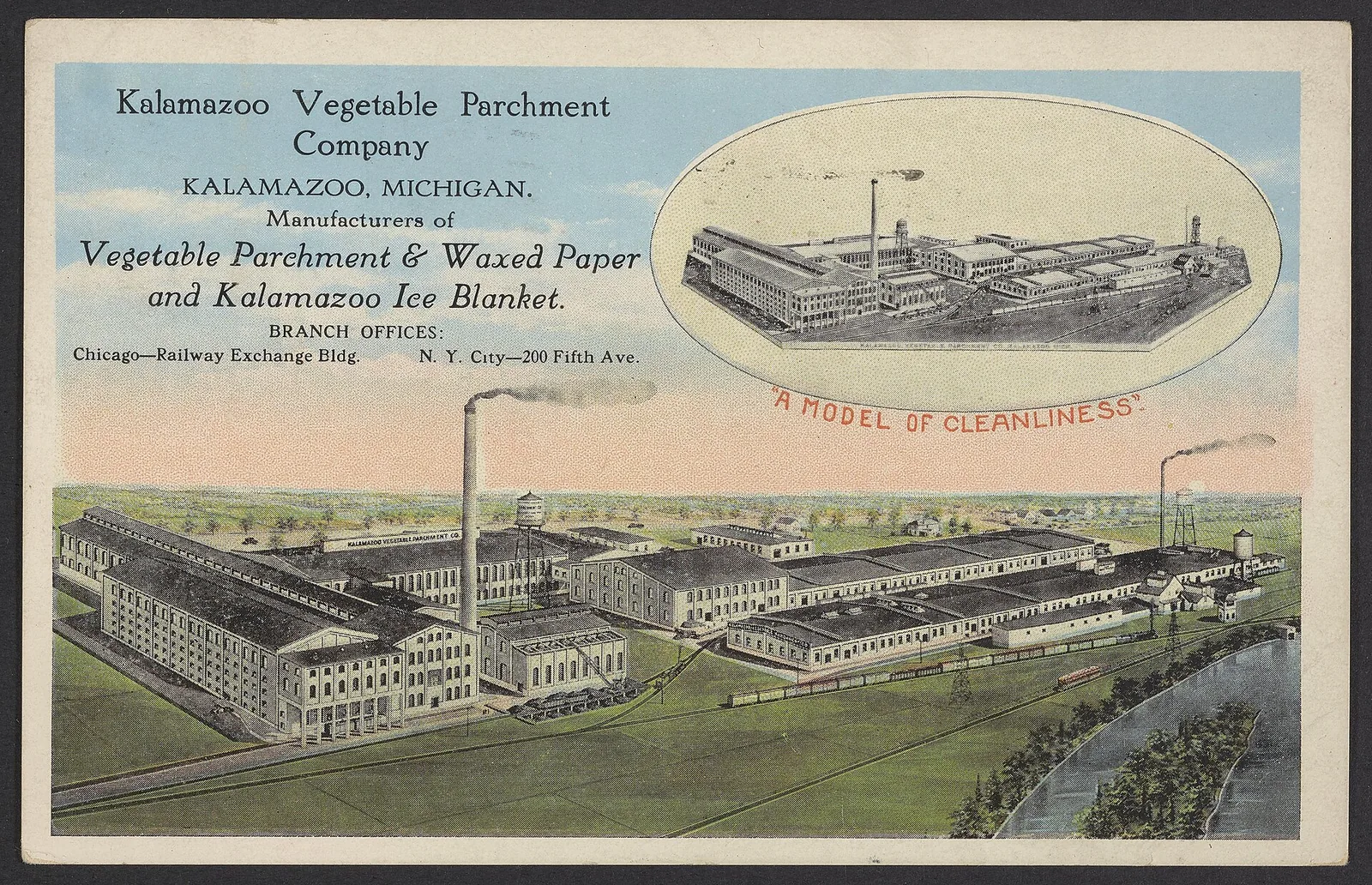
For chemical barriers, the OECD lists starch, carboxymethyl cellulose and polyvinyl alcohol coatings, waxes and the silicone used on baking paper. Laminating a plastic or aluminium film also works but, according to the OECD, produces material that is difficult to recycle. A first product life cycle assessment (LCA) (in French) helps compare options beyond PFAS alone, and public funding (in French) may finance part of it.
The Kit test and the cost premium for alternatives
The industry assesses grease resistance with the Kit test: 12 increasingly aggressive solutions are applied to the paper, and the strongest that leaves no stain gives the score, around 5 for chip paper and 12 for an animal feed bag. Designed for fluorinated papers, the test does not work well for alternatives, the OECD notes, making tests under real conditions of temperature, duration and grease useful.
The OECD's indicative 2020 estimate was that a PFAS-free chemical coating could cost 11% more than fluorinated paper, and natural greaseproof baking paper 32% more per tonne. For a muffin case, the difference fell to less than half a cent. PFAS producers considered these differences underestimated: they said the cost of using a fluorine-free barrier could reach 2 to 3 times that of a fluorinated barrier.
The pitfalls of substituting too quickly
Replacing a fluorinated treatment with a plastic layer may change the packaging category: under Commission guidance, paper-based packaging containing 5% plastic or more falls under banned formats from 1 January 2030, such as a laminated burger box used for consumption on the premises. Recyclability required in 2030 points in the same direction, and switching to bioplastics (in French) calls for the same assessment, as our bioplastics review (in French) shows.
The marketing argument needs the same care: the Empowering Consumers for the Green Transition (EmpCo) Directive prohibits presenting a legal requirement applying to all products in the category as a distinguishing advantage. Its recital gives the example of a product promoted for the absence of a substance already banned. France has not yet transposed it, but a PFAS-free statement may also be inaccurate, as the regulation allows traces. The list of banned environmental claims (in French) and our method for substantiating a claim (in French) set out defensible wording.
8Key takeaways
- Since 12 August 2026, food-contact packaging is prohibited at 25 ppb for a PFAS, 250 ppb for their sum or 50 ppm overall.
- These thresholds rule out any intentional fluorinated treatment, whose authorised levels were 40 to 300 times higher. They also cover traces, including in inks, glues and recycled fibres.
- The manufacturer under the regulation bears the burden of proof: the company filling sales packaging or producing service packaging, unless it bears the customer's logo.
- Total fluorine is the first test: below 50 mg/kg, the Commission considers the packaging compliant.
- On 10 October 2026, the PFHxA restriction adds to these rules for all food-contact paper and cardboard, including baking paper.
PFAS thresholds are only one part of packaging conformity: the EU declaration of conformity records them alongside other requirements, the PPWR timeline sets out subsequent deadlines from harmonised labelling to the 2030 recyclability criteria, and our complete PPWR guide puts all these requirements in context.
- PPWR regulation: Regulation (EU) 2025/40 of 19 December 2024 on packaging and packaging waste, Article 3 (definitions), Article 5 (paragraphs 2, 5 and 6), Articles 15, 16, 25, 29, 58, 62 and 68, Annexes I, V and VII; recitals 20 and 21.
- Commission interpretation: Communication C/2026/3084, guidance document on Regulation (EU) 2025/40, Official Journal of the European Union C of 10 June 2026, points 2, 5, 16 and 17; PPWR FAQ, second edition, August 2026, questions III.12 to III.20, X.4, X.5 and XVI.1; Commission news of 11 August 2026.
- REACH and persistent organic pollutants: Regulation (EU) 2024/2462 of 19 September 2024 (PFHxA, entry 79 of REACH Annex XVII); Regulation (EU) 2019/1021 on persistent organic pollutants, amended by Delegated Regulations (EU) 2020/784 (PFOA) and 2023/1608 (PFHxS); universal restriction assessment timeline presented by ECHA on 4 February 2026, Committee for Risk Assessment opinion adopted in March 2026.
- Food and contact materials: Regulation (EC) No 178/2002, Article 2; specific European measures for food-contact materials; DGCCRF guidance on food-contact materials, updated 4 January 2026; French customs, New packaging regulation enters into force, 10 August 2026 (competent authority).
- France and Denmark: Law No 2025-188 of 27 February 2025, Article 1 (Article L. 524-1 of the French Environmental Code); Decree No 2025-1376 of 28 December 2025, Article D. 525-4; Fødevarestyrelsen, guidance on the PFAS ban in paper and cardboard food packaging, August 2024 (Danish ministerial order No 681 of 2020).
- Uses, alternatives and costs: OECD, PFASs and alternatives in food packaging (paper and paperboard), 2020, chapters 2 and 3; Wack et al., Development of a Risk Matrix for Assessing PFAS in Food Packaging, Foods, 2026.
- Claims: Directive (EU) 2024/825 (EmpCo), Annex I, point 10a, and corresponding recital.