
- 1A consultancy sets the boundary and builds the action plan together with the company.
- 2With software, data collection is still left to the company's internal team to do.
- 3Below 500 employees, the Diag Décarbon'Action leaves €6,000 excl. VAT for the company to pay.
- 4The regulatory assessment is still due above 500 employees, despite the scaled-back CSRD.
A customer asks for your Bilan Carbone® (the French carbon accounting method), or a call for tenders scores it: the first question is who will do it. The assessment measures an organisation's greenhouse gas emissions across its 3 scopes, then leads to a plan to reduce them. It is carried out in 5 stages, from setting the boundary to annual monitoring, and 6 types of provider handle all or part of it.
Which kind of support should you choose for your Bilan Carbone®?
Pick a stage: who does it for you, and at what price level.
You decide what the assessment counts: the entities, the sites, the reference year and the scope 3 categories included. It is written down, with the reason for each choice.
Below 500 employees, the Diag Décarbon'Action (a Bpifrance-subsidised carbon footprint programme for companies established in France) funds 40% of a supported assessment. Our eligibility test tells you in 30 seconds whether your company qualifies.
1Is a Bilan Carbone® mandatory in 2026?
Directive (EU) 2026/470, known as the Omnibus directive and published on 26 February 2026, now limits European sustainability reporting under the Corporate Sustainability Reporting Directive (CSRD) to companies with more than 1,000 employees and €450 million in turnover. It does not affect the French regulatory assessment, and other requests remain: those of buyers, customers and banks. For SMEs, the European Commission has recommended a voluntary reporting standard since July 2025, the VSME: its basic module asks for scope 1 and 2 emissions, and large companies are invited to refer to it when they question their suppliers.
Who asks companies for a Bilan Carbone®?
The law, buyers, banks and senior management do not expect the same thing from it.
More than 200 large buyers asked more than 45,000 suppliers for their data through CDP in 2025.
CDP is only one channel among others.
CDP, Supply Chain page.
Sources: French Environmental Code; Service Public Entreprendre; CDP; La Banque Postale; checked on 6 November 2026.
The regulatory BEGES and the voluntary Bilan Carbone®
Article L229-25 of the French Environmental Code requires an emissions report, the BEGES (bilan d'émissions de gaz à effet de serre), France's mandatory greenhouse gas emissions report, from companies with more than 500 employees (250 in overseas France) and from public bodies with more than 250 staff. It is published with a transition plan, every 4 years for a company. Failure to comply exposes the company to a fine of up to €50,000, and €100,000 for a repeat offence, as set out in our guide to the mandatory BEGES. The Bilan Carbone®, by contrast, is a method: created in 2004 by ADEME (the French Agency for Ecological Transition) and maintained since 2011 by the ABC, it is applied on a voluntary basis, by any organisation, and it is also used to produce a BEGES.
Public buyers and customers
Since 21 August 2026, every new public contract carries an environmental performance condition and, if bids are scored, at least one environmental criterion, as Service Public Entreprendre pointed out on 18 August 2026. A company that quantifies its emissions and its actions has what it needs to respond to this criterion. In the private sector, the CDP supply chain programme contacted more than 45,000 suppliers in 2025 on behalf of more than 200 large buyers, and a customer asking for your carbon data expects figures you can justify.
Banks and internal management
Some banks link part of their lending to carbon: the decarbonisation loan from La Banque Postale requires a carbon footprint assessment and a reduction pathway, and reduces the rate if the company meets its targets. For senior management, finally, the assessment is a way to choose where to act: it shows the emission categories that weigh most, often in scope 3, and it quantifies the levers of a reduction plan.
The scaling back of the CSRD affects neither the regulatory assessment of large companies nor the environmental criterion in public contracts.
2How much of the assessment can software do?
Part of the work always falls to the company, whether it is supported or not. The energy bills, the general ledger, the fleet records and the purchases are held by the company, and its own team gathers them. What can be done alone then depends on one condition: a person trained in the method who has time to devote to it.
The calculation and annual monitoring
Carbon accounting software applies emission factors to the data it is given, sorts the results by emission category and by scope, then tracks the following years. It produces a first figure quickly, and it makes annual monitoring easy. Mission Transition Écologique, the French public service that supports companies, puts an assessment carried out on a platform at €2,000 to €5,000, against around €10,000 with a consultancy for an SME.
The boundary, the data and the plan
Software sets neither the boundary, nor the data quality, nor the plan. These are the situations that most often go beyond a team working alone:
- A first assessment, when nobody in-house has yet decided which sites, entities and scope 3 categories to include, or the reference year.
- Purchases recorded in euros, converted with monetary ratios that will never show the gain from switching supplier or material.
- Supplier data received through questionnaires, which must be checked before it is included, at the risk of distorting the emission categories that weigh most.
- An action plan to defend before senior management or a customer, with a quantified saving in tCO2e, a cost and an owner for each lever.
Our article on doing the assessment yourself sets out the stages of this route, and the comparison of software and consultancy helps you choose. A customer who asks you to explain the figure expects a written boundary and an action plan, which a total on its own does not give.
3What happens without a reliable assessment?
The risk depends on why the assessment is requested. For a company under the obligation, it is first of all the fine: the regional prefect serves formal notice to publish, then may impose a penalty of up to €50,000 (€100,000 for a repeat offence). For all other companies, the risk is commercial.
- A public tender scored lower, because the bid says nothing measured about the company's emissions or its reduction actions.
- A large customer's questionnaire left unanswered, or filled in with figures the company cannot justify when the buyer asks about the method.
- An assessment that has to be redone 2 years later, for lack of calculation files, dated factors and written assumptions to update it.
- An action plan without figures, which makes it impossible either to track progress or to answer a bank that finances the transition.

An assessment that is going to leave the company benefits from a review: our article on verifying an in-house assessment explains when an outside review becomes necessary.
4Which providers carry out a Bilan Carbone®?
6 types of provider carry out Bilan Carbone® assessments, from large climate strategy consultancies, which serve groups, to a trained in-house team. What sets them apart most is setting the boundary and the action plan, which software leaves to the company.
Large climate strategy consultancies
Carbone 4, founded in 2007, offers carbon footprint and transition plan services, strategy, adaptation and life cycle assessment. It has offices in Paris, Lyon, Toulouse, Rennes and the Benelux. It builds bespoke data collection templates and hands over a management tool for tracking emissions independently. It publishes no prices and mainly serves organisations whose assessment commits a group strategy.
Consultancies for SMEs and mid-caps
Projet Celsius carries out the Bilan Carbone® together with the company: setting the boundary, guided data collection with the internal contacts, calculation across the 3 scopes, presentation to senior management and a costed action plan. We hand over the report, the plan and the calculation model, which the client can go on editing. We also prepare the applications for the Diag Décarbon'Action, and our price is given further down, with the other cost benchmarks.
Guillaume Pakula, who scopes the engagements, trains people in the Bilan Carbone® for the Institut de Formation Carbone (IFC). He also teaches carbon accounting at the Institut Polytechnique de Paris. We do not publish software, and a group that consolidates dozens of subsidiaries across several continents will find larger teams at the large consultancies. To compare other consultancies, the directory of the Association pour la transition Bas Carbone (ABC) lists 363 of them in carbon accounting as at 6 November 2026.
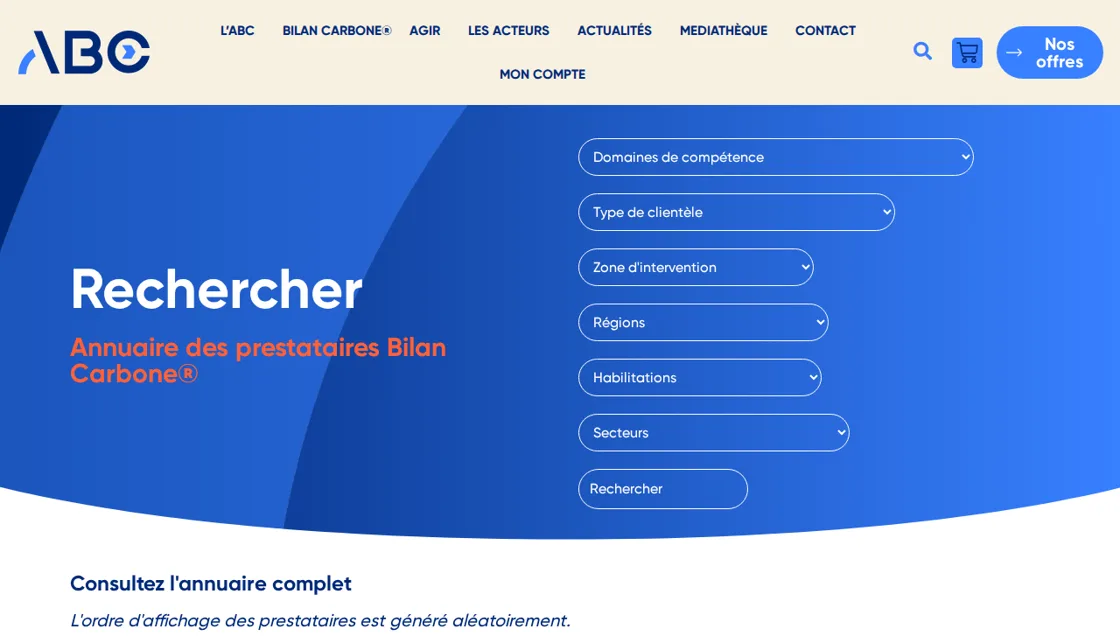
On 6 November 2026, it listed 363 providers in carbon accounting. It can be filtered by region, client base, approval and sector; the display order is randomised. Being listed is not a certification.
Platforms with a consultant
Sami combines software and consultants: its website states that your consultant works in the same platform as you. It claims more than 2,000 clients in Europe and key-account capabilities at SME and mid-cap prices, with no published price. Tennaxia adds more than 90 in-house experts to its carbon, HSE and ESG software suite, for leading companies. These offers suit companies that want a lasting tool and help using it.
Stand-alone software
This software calculates emissions and tracks them from one year to the next, but publishers rarely publish their prices:
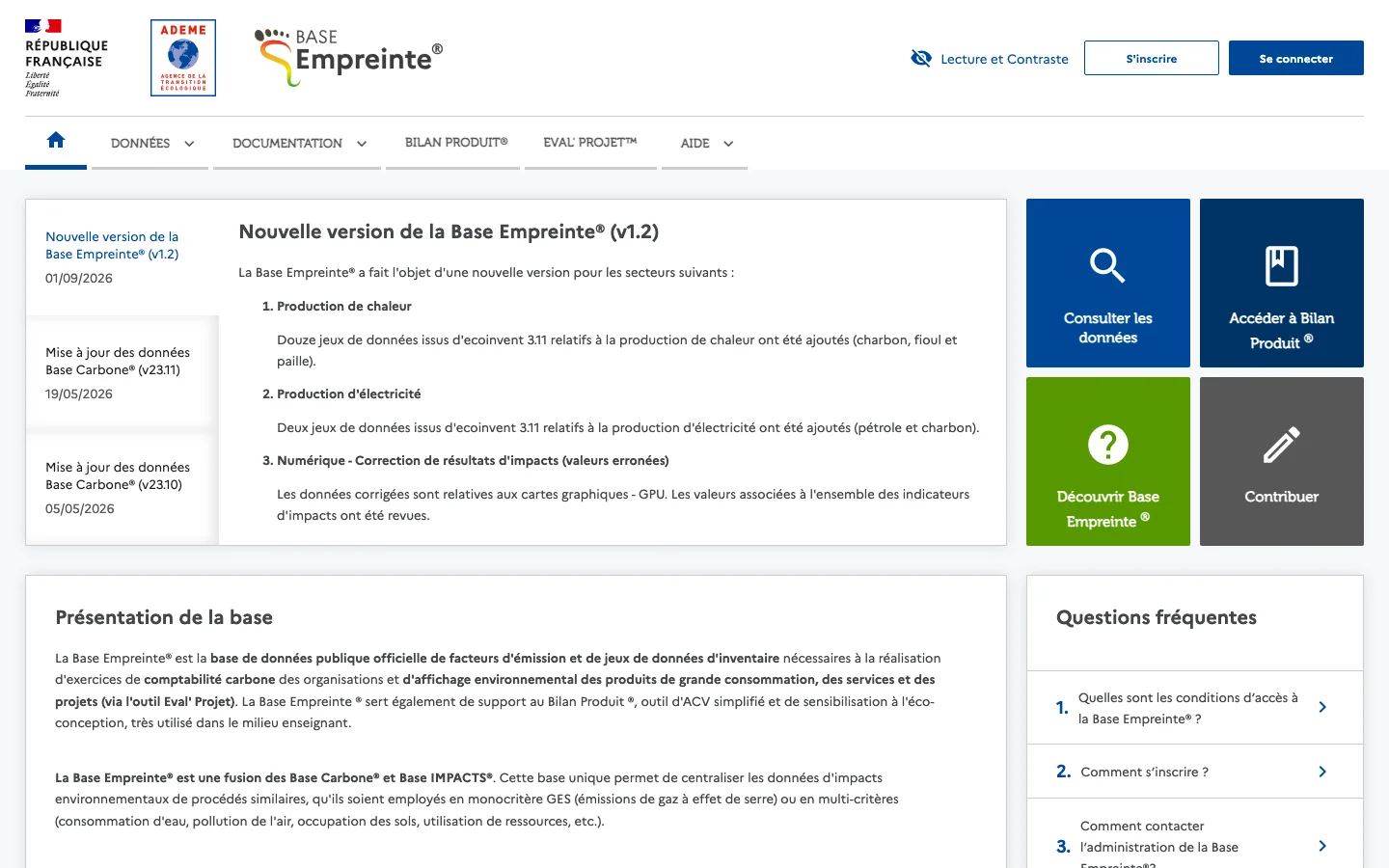
The home page presents the Base Empreinte® as the official public database of emission factors. On 17 October 2026, it announced version 23.11 of the Base Carbone®, dated 19 May 2026, while the open dataset on data.ademe.fr was at version 23.6. The version of each factor is therefore noted next to the calculation.
- Greenly claims 4,000 clients, from SMEs to large groups, generates a personalised decarbonisation plan and gives its prices on quotation.
- Sweep targets large groups, mid-caps and SMEs and financial institutions, and collects supplier data, with no published price.
- Carbo publishes its prices: from €972 a year on a self-service basis, €1,080 with onboarding support and €1,404 with a dedicated expert, for 2 employees, prices that rise with headcount.
Chartered accountants and the in-house team
A few chartered accountancy firms add the assessment to their CSR (corporate social responsibility) offering, such as Hayot Expertise, in Paris, which offers a scope 1-2-3 carbon footprint assessment to SMEs and mid-cap companies (ETI in French). They have the accounting data to hand, and the assessment is one service among others. Finally, the company can train an employee: the ABC Initiation module, mandatory to become a provider, costs €1,300 excl. VAT, according to its training page. Our guide to Bilan Carbone® training (in French) (in French) compares the 5 approved training organisations.
Other consultancies, often CSR generalists, fold the assessment into full CSR support: the report under the VSME standard, customer questionnaires, a label application, strategy. The advantage is a single point of contact for all these topics. It remains to check who performs the calculation, whether they are trained in the Bilan Carbone® method, and whether the action plan is costed lever by lever.
To decide between 2 consultancies, the selection criteria are set out in our article How to choose a Bilan Carbone® consultancy.
5How much does a supported Bilan Carbone® cost?
No official fee schedule sets the price of a Bilan Carbone®: each provider prices its own work. The public benchmarks nevertheless sit on a single scale, shown below.
Bilan Carbone® price benchmarks, from software to consultancy
On your own
Supported
Below 500 employees, the Diag Décarbon'Action is the cheapest supported route. The price of software does not include the team's data collection time. Amounts excl. VAT where the source states it; Carbo: for 2 employees.
Sources: Carbo (pricing); ABC (training); Mission Transition Écologique; Bpifrance; checked on 6 November 2026.
The consultancy
Mission Transition Écologique puts the full assessment of an SME with a consultancy at around €10,000. The order of magnitude observed in 2026 runs from €10,000 to €30,000 excl. VAT, depending on the sites, the state of the data and the depth of scope 3, as our article on the cost of a Bilan Carbone® explains. At Projet Celsius, allow €12,000 to €18,000 excl. VAT for a full Bilan Carbone® across the 3 scopes, and €5,000 to €8,000 excl. VAT for a simplified supported format, depending on the sites and the data. The action plan and the handover of the calculation files are among the items to look for in a quote.
The Diag Décarbon'Action
Below 500 employees, the Diag Décarbon'Action from Bpifrance (the French public investment bank) leaves €6,000 excl. VAT to pay, after a 40% subsidy. This price covers an assessment and an action plan carried out by an approved expert, in 12 days of work over 10 months at most. The company must have existed for at least 1 year. Other regional funding schemes are sometimes added on top.
Software and internal time
A subscription costs less than an engagement, but it only pays for the tool: data collection, checks and analysis are counted in employee days. On top of that come training, and a review if the figure is going to leave the company. The more complex the boundary, the more these internal days weigh in the comparison.
The essential deliverables
Whichever provider you choose, a Bilan Carbone® that can be reused the following year and defended before a customer contains 5 elements:
- A written boundary: the entities, the sites, the reference year, and the scope 3 categories included or excluded, each with its reason.
- The 3 scopes, including the significant scope 3 emission categories, which the regulatory BEGES has also required since 1 January 2023.
- Dated, sourced emission factors, taken from ADEME's Base Empreinte® where they appear there, with the assumptions written down alongside.
- The calculation file handed over to the company in editable form, so the assessment can be redone the following year without starting from scratch.
- An action plan in which each lever carries a saving in tCO2e, a cost, an owner and a deadline.
For other profiles, other providers are a better fit: a large climate strategy consultancy for an international group, and software alone for a company in which a trained person has the time to carry out the assessment.
For us at Projet Celsius, the question to ask any provider is: what will you be able to redo on your own the following year? Good support leaves behind a team that knows how to collect the data, open files and a plan that senior management has approved. We describe how we work on the page for our Bilan Carbone® support.
6Key takeaways
- A regulatory emissions report (BEGES) remains mandatory above 500 employees, and public buyers, large customers and banks ask other companies for one.
- The boundary, data checks and the action plan require trained people, whom no software replaces.
- 6 types of provider carry out Bilan Carbone® assessments, and they differ above all on setting the boundary and the action plan.
- Allow around €10,000 with a consultancy for an SME according to the French State, €2,000 to €5,000 on a platform, less with the Diag Décarbon'Action.
- For a first SME or mid-cap assessment, we recommend a consultancy that builds the plan with you, then software for monitoring.
To compare 2 quotes, see the cost of a Bilan Carbone®, and to know how often to redo it, our article on how often to carry out the assessment.
- Mission Transition Écologique, Carrying out a GHG assessment, cost of an assessment with a consultancy and on a platform, accessed 6 November 2026.
- Bpifrance, Diag Décarbon'Action, amount, duration and eligibility, accessed 6 November 2026.
- French Environmental Code, Article L229-25, greenhouse gas emissions report and penalty, amended by Law No. 2023-973 of 23 October 2023 on green industry. The Légifrance pages are in French.
- European Parliament and Council, Directive (EU) 2026/470, known as the Omnibus directive, amending the scope of the CSRD, OJEU of 26 February 2026.
- Service Public Entreprendre, public contracts: a mandatory environmental criterion, 18 August 2026.
- CDP, Supply Chain, suppliers contacted in 2025, accessed 6 November 2026.
- La Banque Postale, interview on the decarbonisation loan, 24 April 2026.
- Association pour la transition Bas Carbone, directory of Bilan Carbone® providers and training page, accessed 6 November 2026.
- Websites of Carbone 4, Sami, Tennaxia, Greenly, Sweep, Carbo (pricing) and Hayot Expertise, accessed 6 November 2026.
- European Commission, Recommendation (EU) 2025/1710 of 30 July 2025 on the voluntary sustainability reporting standard for SMEs (VSME).
- Association pour la transition Bas Carbone, the Bilan Carbone® method, accessed 6 November 2026.