
Skip to content
Get in touchFR
Updated in September 2026
Explained

Bilan Carbone® or OEF: differences and when to switch

OEF or Bilan Carbone®: four cases where a multicriteria organisational LCA provides more than a single GHG indicator in 2026.

Sébastien Pierfederici
By Sébastien Pierfederici, LCA and eco-design specialist at Projet Celsius, PEF expert and IFC trainer. He helps manufacturers assess product environmental footprints.
July 2026
Updated September 2026 · 4 min
OEF (Organisational Environmental Footprint, a European methodology derived from PEF) broadens an organisation's environmental assessment to sixteen impact categories, including climate, calculated according to the GHG Protocol. It becomes clearly useful as soon as the impact goes beyond carbon alone - food and water, textiles and resources, chemicals and toxicity - and when you already have a few product LCAs underway, because the same data drive the largest scope 3 sources. Bilan Carbone® remains a recognised French route for BEGES and public funding, but when the budget for a multicriteria LCA is available, it is no longer the best assessment.
Key takeaways
  • 1OEF (methodology: Recommendation (EU) 2021/2279, Annex III) measures 16 impact categories, including climate through GHG Protocol scopes 1+2+3, whereas Bilan Carbone® remains a single GHG indicator.
  • 2Four cases for switching: significant non-climate impact (water, soil, toxicity), existing product LCAs, EU requirements (ESPR, DPP), CSRD ESRS E2 to E5 reporting.
  • 380 to 90% of the data from a Bilan Carbone® can be reused for an OEF: what changes is the impact factors applied, rather than the collection.
  • 4Bilan Carbone® remains a recognised method for BEGES, which also accepts the GHG Protocol or ISO 14064-1, and for public funding (Diag Décarbon'Action); an SBTi pathway, for its part, uses the GHG Protocol. The two coexist, with OEF broadening the assessment.

1Two methods, two scopes

Bilan Carbone® is the reference French method (method v9 · ADEME/ABC · 2024), using a single indicator: greenhouse gases only (kgCO₂e) across scopes 1, 2 and 3. It draws on ISO 14064-1 and ADEME's Base Empreinte for emission factors. The method is used in particular to prepare the statutory greenhouse gas emissions report (BEGES) (Grenelle II law), which must be updated every 4 years for companies subject to it and every 3 years for public bodies.
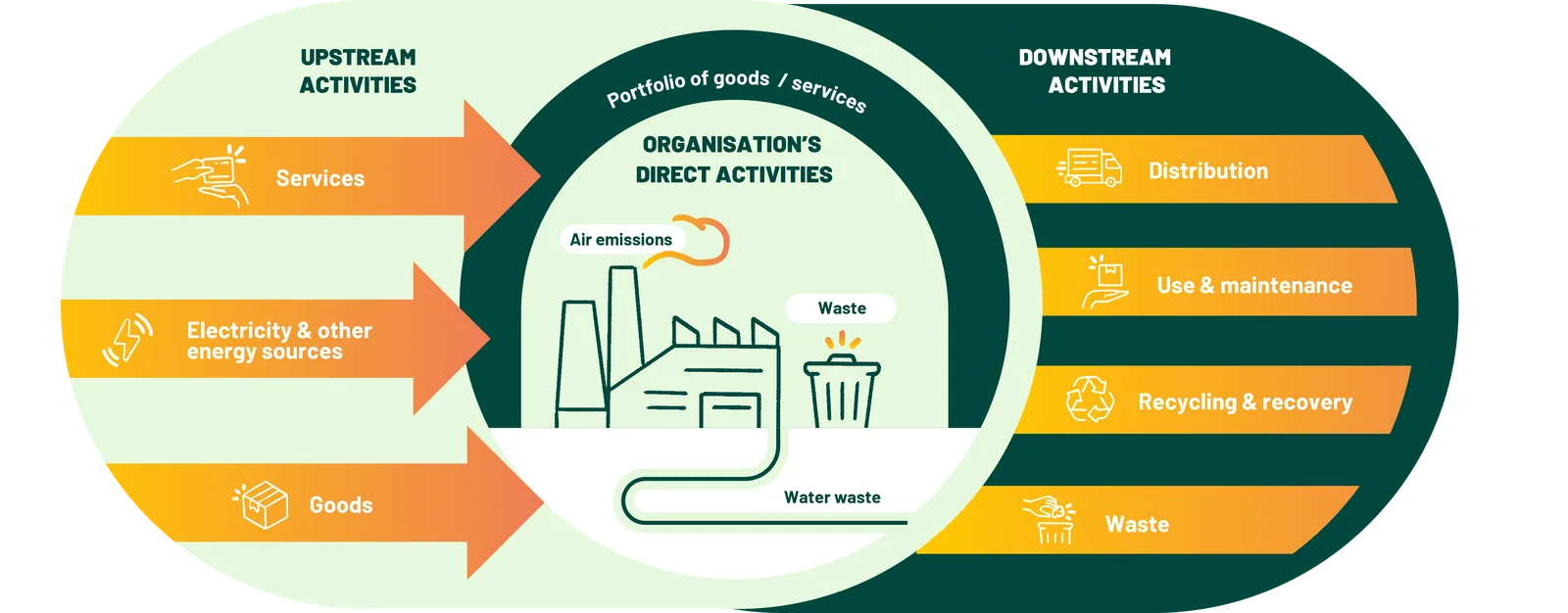
Diagram of OEF system boundaries · organisation, product portfolio, full life cycle
OEF covers the entire life cycle of the organisation and its product portfolio, from cradle to grave. Source: JRC Ispra site OEF study, Pretato et al. 2020.

OEF (Organisational Environmental Footprint) is the European Commission's multicriteria methodology, defined in Annex III of Recommendation (EU) 2021/2279 of 15 December 2021. It is the organisational version of PEF (Product Environmental Footprint). The method follows five stages (Goal and Scope, Life Cycle Inventory, EF Impact Assessment, Interpretation, Reporting/Verification) and measures 16 impact categories from the EF 3.1 method (IPCC AR6 GWP factors since September 2024): climate change, water, land use (biodiversity), fossil and mineral resources, particulate matter, human toxicity (cancer / non-cancer), ecotoxicity, eutrophication (marine, freshwater, terrestrial), acidification, ozone, ionisation and photochemical ozone formation.

2Scope, methodology and deliverable

Scope - Bilan Carbone®, a single indicator (climate). OEF, sixteen environmental indicators. Bilan Carbone® covers carbon alone, while OEF covers the sixteen categories.

Methodology - Bilan Carbone®, emission factors from ADEME's Base Empreinte and ISO 14064-1 assumptions. OEF, LCA data in physical units (kg, m³, MJ, ha·year) + PEFCR (Product Environmental Footprint Category Rules) where they exist for your sector. OEF follows the logic of a multicriteria LCA, rather than a GHG inventory.

Deliverable and use - Bilan Carbone®, a GHG report that feeds into the reduction action plan, the SBTi pathway and the statutory BEGES submission to ADEME. OEF, a multicriteria report that feeds directly into CSRD ESRS E1 to E5 reporting, product environmental labelling (a method derived from PEF), and increasingly the award criteria for EU public procurement. Governance difference · OEF requires verification and validation by an independent third party as soon as the study is used for external communication, whereas neither Bilan Carbone® nor the BEGES submission requires third-party verification.

3What OEF adds

1. Your environmental impact is not limited to carbon. In the food industry, water and land use often carry as much weight as climate in environmental materiality. In textiles, resources and ecotoxicity do. In chemicals, human toxicity and eutrophication do. A single GHG indicator covers none of these categories. OEF puts the sixteen dimensions on the same table and provides the trade-offs that were missing: less CO₂ but more water? Less water but more ecotoxicity?
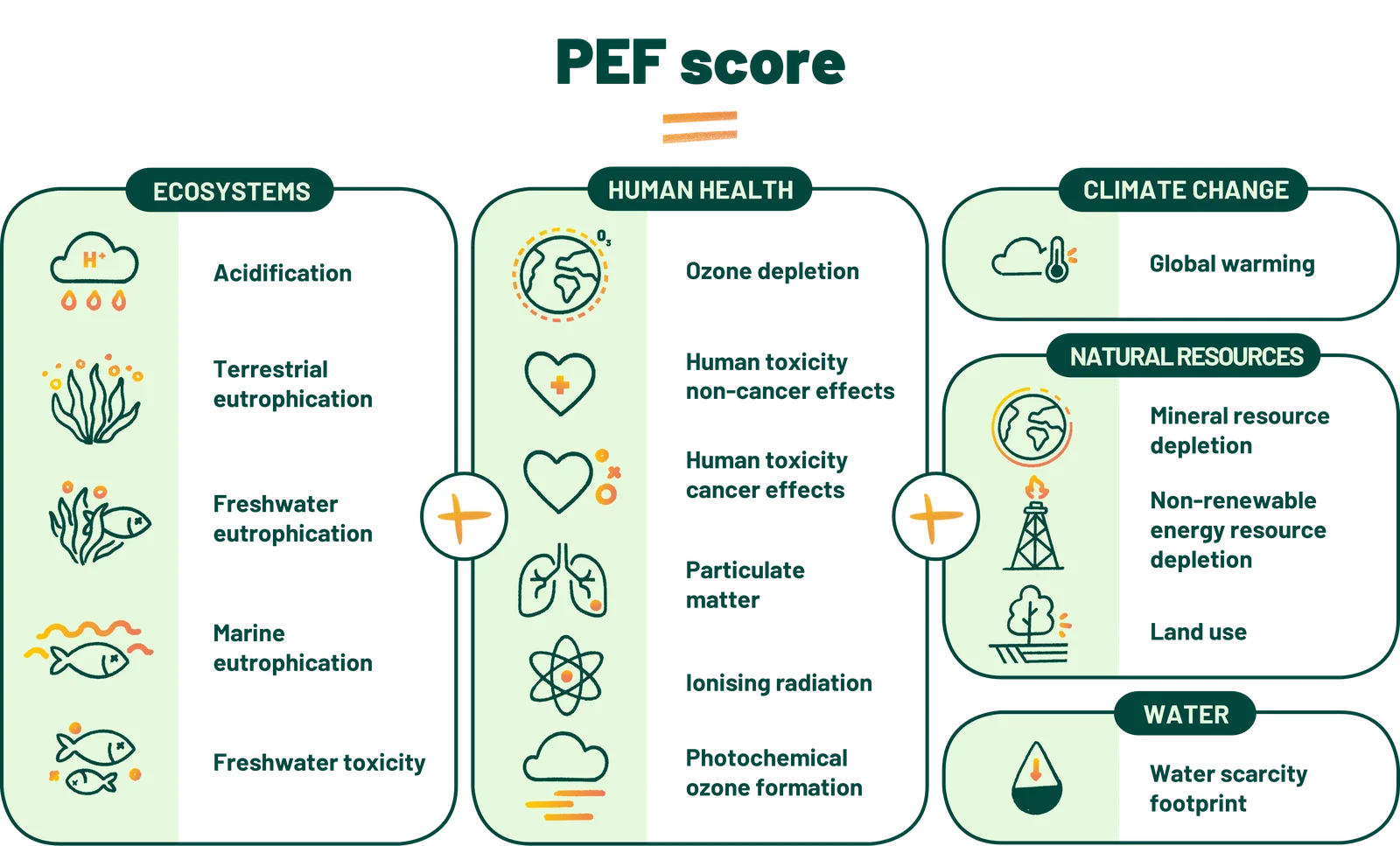
The 16 environmental impact categories in the EF 3.1 method · climate change, water, biodiversity, resources, particulates, human toxicity cancer / non-cancer, ecotoxicity, eutrophication, acidification, ozone, ionisation, photochemistry
The 16 impact categories measured by the EF 3.1 (Environmental Footprint) method applied by OEF. Bilan Carbone® only covers the first row (climate change).

2. You already have a few product LCAs. This is probably the case if you work in textiles (Ecobalyse score), furniture, cosmetics, food or construction. Product LCA data feed directly into OEF (the same Ecoinvent/EF databases, impact categories and allocation rules). You obtain a multicriteria organisational assessment without collecting the data twice, and examine in detail the largest scope 3 sources (supplies, sold products), which Bilan Carbone® can address using physical data but often approaches through spend-based emission factors.

3. You respond to European requirements. The ESPR regulation (Ecodesign for Sustainable Products, 2024) sets the framework for ecodesign requirements, the Digital Product Passport and green public procurement, specified product by product through delegated acts (textiles and furniture are among the priorities in the 2025-2030 working plan). It cites the PEF method as one of the bases for calculating products' environmental footprint but does not require OEF, and the battery passport, required from 18 February 2027, falls under Regulation (EU) 2023/1542. If your sector has an active PEFCR (Apparel & Footwear for textiles, food PEFCRs, batteries) or a national method such as Ecobalyse, OEF aligns your organisational reporting with the product PEF score without running two separate exercises.

4. You are preparing your CSRD ESRS E2 to E5 reporting. The CSRD directive requires reporting on pollution (E2), water (E3), biodiversity (E4) and resources (E5). A single-indicator Bilan Carbone® does not cover them. OEF covers them natively, with an indicator nomenclature that overlaps with half of the environmental ESRS.
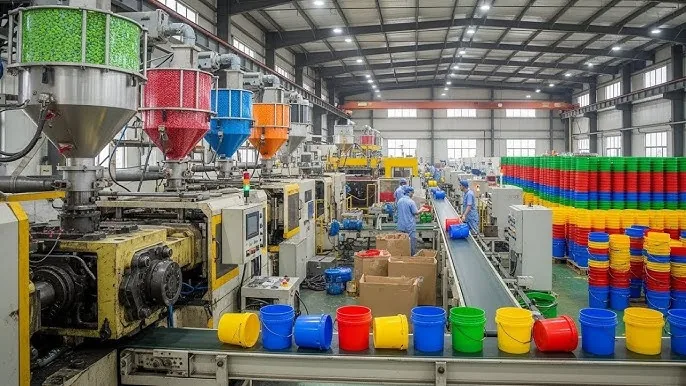
Plastic injection moulding line · the activity data collected for a Bilan Carbone® feed directly into a multicriteria OEF LCA
A switch from Bilan Carbone® to OEF uses the same activity data already collected: the added value comes from the multicriteria approach and the depth of LCA analysis.

4How to decide between the two

Bilan Carbone® remains a recognised French route for BEGES compliance (Grenelle II law requirement for companies with >500 employees, which also accepts the GHG Protocol or ISO 14064-1) and access to public funding (Diag Décarbon'Action, ADEME calls); an SBTi pathway, for its part, relies on an inventory in GHG Protocol format. It is a GHG inventory, rather than the broadest assessment methodology. As soon as the budget for a multicriteria LCA is available, OEF broadens the scope: it includes GHG Protocol climate accounting for scopes 1+2+3, and adds the fifteen other impact categories that the single GHG indicator does not cover.

The switch depends first on your existing data · a well-prepared Bilan Carbone® provides 80 to 90% of the activity data needed for OEF (kg of materials, kWh, tonnes of products, km, m³); what changes is the impact factors applied through an LCA database (Ecoinvent, EF), rather than the data themselves. Then your ability to read a multicriteria report rather than a single-indicator report, which requires LCA knowledge among CSR teams and engineering consultancies. Finally, third-party verification, mandatory for an OEF as soon as it is communicated externally, which sets its own pace.

For internal training, the LCA course delivered with IFC.D combines 4 h online and 14 h with a trainer. The programme covers ISO 14040/44, modelling in OpenLCA, interpretation of results and an introduction to PEF. These foundations help you discuss matters with a provider and scope a multicriteria study; moving to an organisational OEF study requires an appropriate scope and methodological choices. For a team with shared objectives, Celsius can also scope an in-house programme. Any funding must be confirmed by your funding body before enrolment.

5Key takeaways

  • OEF (Recommendation (EU) 2021/2279, Annex III) measures 16 impact categories, including climate through GHG Protocol scopes 1+2+3, whereas Bilan Carbone® remains a single GHG indicator.
  • Four cases for switching: significant non-climate impact, existing product LCAs, ESPR/DPP requirements, CSRD ESRS E2 to E5 reporting.
  • 80 to 90% of the collection is shared: activity data from a Bilan Carbone® feed directly into an OEF; it is the impact factors that change.
  • Bilan Carbone® remains a recognised French route for BEGES and public funding, while the SBTi pathway uses the GHG Protocol. The two coexist, with OEF broadening the assessment.

Further resources

Frequently asked questions

It is not mandatory at this stage. But CSRD ESRS E2 to E5 (pollution, water, biodiversity, resources) requires indicators that overlap directly with OEF, and the ESPR regulation (2024) provides, sector by sector, for environmental information requirements for which the PEF method is a possible calculation basis (textiles and furniture are among the Commission's priorities); the 2027 battery passport, for its part, falls under Regulation (EU) 2023/1542. For large listed groups, the two frameworks will converge rapidly by 2027-2028.
Yes, directly. The OEF method calculates climate impact across scopes 1+2+3 of the GHG Protocol Corporate Standard (WBCSD/WRI), with EF 3.1 GWP characterisation factors (IPCC AR6). An OEF can therefore be used as it stands to define and monitor an SBTi Corporate Net-Zero Standard pathway, without recalculating climate impact. In practice, several industrial companies now define their SBTi pathway using their OEF, benefiting both from the climate accounting required by SBTi and from the multicriteria approach that guides the other environmental dimensions.
In methodological substance: yes. OEF natively incorporates climate accounting for scopes 1+2+3 of the GHG Protocol Corporate Standard (WBCSD/WRI), with EF 3.1 GWP characterisation factors (IPCC AR6), and adds fifteen other impact categories. In French practice: no, BEGES compliance (Grenelle II law) involves a statutory GHG emissions report, which Bilan Carbone® can produce just as the GHG Protocol or ISO 14064-1 can, and Diag Décarbon'Action funds a GHG emissions assessment carried out by an expert certified in Bilan Carbone® or equivalent. The two coexist, with a broader OEF assessment and a statutory GHG emissions report that becomes mandatory as soon as you meet the French criteria.
Yes, to a large extent. Most activity data from a Bilan Carbone® (kg of materials, kWh, tonnes of products, km, m³) can be reused directly for OEF: what changes between a Bilan Carbone® and an OEF is not the activity data, but the impact factors applied (a single climate criterion vs 16 EF 3.1 criteria). The additions specific to OEF are marginal: a few sectoral indicators (precise types of raw material, a few pollutant flows) that were not essential for Bilan Carbone®. In practice, 80 to 90% of the collection is shared between the two formats.
or: [email protected]

More articles to read

View all →
French environmental cost label for clothing: what changed on 1 October 2026
Regulation

French environmental cost label for clothing: what changed on 1 October 2026

6 min read
Which garments can display an environmental cost in France? Timeline and thresholds, 2025-2027
Regulation

Which garments can display an environmental cost in France? Timeline and thresholds, 2025-2027

10 min read
Removable batteries and battery passports: who is affected in 2027?
Regulation

Removable batteries and battery passports: who is affected in 2027?

14 min read

No two situations are exactly alike.

Tell us about yours: your situation, deadline and budget. A senior consultant will reply within 24 working hours with an honest assessment.

Let us discuss it within 24 hours →
Our toolkit

A full range of free assessment tools

Cost estimator, obligation and eligibility checkers, footprint calculator.

Estimate costs and impacts
Ref. 2026·BC·0184REPORT · FINANCIAL YEAR 2026Bilan Carbone®complete 1·2·3Presentation to the Executive Committee · 2027 action planCONTENTS01Executive summaryp. 402Scope and methodologyp. 1203Emissions by scopep. 24042027 action planp. 5605Methodological appendicesp. 78VOLUME84 pages · ConfidentialSTANDARDISO 14064 · GHG ProtocolQUOTATION · BC.2026.0184Issued 05·05·2026 · Valid for 30 daysCelsius consultancy · Paris 3rd arrondissementINDICATIVE COST ESTIMATEYour companyMid-sized company · 180 employees · CSRD 2027SERVICEBilan Carbone®Scope 1·2·3 · 13 weeksBPIFRANCE FUNDING · - 60%INDICATIVE RANGE EXCL. VAT€16,800to €22,400PROJECT DETAILS01 · SCOPING3 weeks~€4,20002 · MODELLING8 weeks~€9,80003 · PRESENTATION2 weeks~€4,800Indicative estimate · Refined after scopingSIRET 891 234 567 00012

Bilan Carbone® cost estimator

Your price range in 1 minute, based on 2026 market rates and public funding.

1 minStart
Estimate costs and impacts
AI FOOTPRINT · MONTHLY USEYOUR TOTAL FOOTPRINT4.2 kgCO₂eq for 1,000 typical prompts · May 2026MODEL COMPARISON · 1,000 TYPICAL PROMPTSGPT-4oOpenAI6.8 kgClaude OpusAnthropic2.1 kgGemini ProGoogle4.5 kgMistral LargeMistral AI · FR1.6 kg

AI carbon footprint calculator

The climate impact of your AI queries, by model and task. Ecologits methodology.

3 minStart
Check an obligation
DIAGDÉCARBON'ACTIONACCELERATE THETRANSFORMATIONOF YOUR COMPANYIN ENERGY ANDTHE ENVIRONMENTOFFICIAL SCHEME · BPIFRANCE × ADEMECHECKER · ELIGIBILITYELIGIBLEYou meet the 3 Diag Décarbon'Action criteria.YOUR FUNDING€10,000 excl. VAT€6,000excl. VATAmount payable by you after the Bpifrance subsidyFUNDING BREAKDOWNBPIFRANCE 40%YOU 60%€4,000€6,000SCHEME SUBSIDISED BY

Diag Décarbon'Action eligibility

Check in 30 seconds whether your business is eligible for Bpifrance funding covering 40% of a Bilan Carbone® assessment.

30 secStart
Check an obligation
FRENCH REPUBLICMinistry for the Ecological TransitionLEGAL REQUIREMENTGreenhouse GasEmissions AssessmentArticle L.229-25 of the French Environmental CodeDecree 2022-982 · published 1 July 2022FREQUENCY · 4 YEARSFILING · ADEMECHECKER · BEGES REQUIREMENTREQUIRED720 employees · BEGES requirementPOTENTIAL PENALTY€50,000maximum fine for failing to complete itart. R.229-50OFFICIAL REFERENCE

BEGES checker

Does the BEGES requirement apply to you? An immediate answer, with the deadline and penalty.

30 secStart
Check an obligation
9:42SCANSCANNING DPP...DPP IDENTIFIEDOrganic cotton T-shirtSKU TX-CB-220 · Batch L-26-04781ESPR COMPLIANT42 DATA POINTS · 5 SECTIONSORIGINIndia · GOTSOrganic cottonFOOTPRINT5.2 kg CO₂eqLCA ISO 14040RECYCLABILITY85%Cotton recycling schemeREPAIRABILITY7.5 / 10Accessible partsEND OF LIFETextile recycling scheme (TLC) · Bordeaux/FRRefashion-approved recovery operatorEU · ESPR 2024/178112.05.2026

DPP checker

Is your product covered by the Digital Product Passport?

1 minStart
Check an obligation
COSTENVIRONMENTAL386POINTS257PER 100 GOfficial methodEcobalyse, v7.0.0CHECKER · ENVIRONMENTAL LABELLINGELIGIBLETextiles · voluntary labellingENVIRONMENTAL COST386 ptsT-shirt 150 g · 257 pts per 100 gExample: Ministry for the Ecological Transition FAQ

Textile environmental labelling 2026

Voluntary labelling, but third parties can publish it from October 2026: where do you stand?

1 minStart