
- 1A local authority's BEGES covers its assets and its statutory responsibilities, every 3 years.
- 2Since 2023, scope 3 has been mandatory: purchases and works weigh heavily in data collection.
- 3A PCAET that incorporates the assessment and the plan exempts the authority from the BEGES obligations.
- 4Published contracts range from €8,250 to €19,765 excl. VAT for a BEGES alone.
The carbon footprint assessment of a local authority, called the BEGES (bilan d'émissions de gaz à effet de serre, France's mandatory greenhouse gas emissions report), covers what the authority manages: its buildings, street lighting, fleet, services, purchases and staff travel. It does not measure the emissions of its whole territory, which fall under the territorial climate, air and energy plan (PCAET). The regulatory method of ADEME (the French Agency for Ecological Transition) applies, and the Bilan Carbone® method (the French carbon accounting method) is one way of following it.
Which support should a local authority choose for its BEGES?
Choose a stage of the assessment: who does it for you, and at what price level.
Since 1 January 2023, significant indirect emissions have been mandatory: purchases, works, waste, travel. They are often calculated from the amounts spent.
A local authority has 3 routes: doing it in-house with a trained staff member, relying on its local energy and climate agency, or launching a public contract. The French public procurement core data show what these contracts cost and to whom they were awarded. For a company, the same question is covered in our article on the Bilan Carbone®.
1What must a local authority do for its BEGES?
Local authorities under the obligation
Article L229-25 of the French Environmental Code places the obligation on the State, the regions, the départements, metropolitan authorities (métropoles), urban communities and agglomeration communities, whatever their size. Municipalities (communes in French, the smallest French administrative unit) and communities of municipalities (communautés de communes) are subject to it above 50,000 inhabitants, and other public bodies above 250 staff, such as a hospital or a university. The assessment and its transition plan are updated every 3 years, compared with 4 years for companies.
The obligation test places a local authority in a few questions, and the BEGES compliance guide covers the other cases.
The boundary: assets and responsibilities
Since 1 January 2023, the assessment has counted direct emissions (scope 1), emissions from purchased energy (scope 2) and significant indirect emissions (scope 3): staff and visitor travel, transport of goods, purchases of supplies, waste management, investments. Mandatory scope 3 changes data collection, because purchases and works are often calculated from the amounts spent.
The assessment comes with a transition plan: objectives, actions and planned resources. From the 2nd assessment onwards, the local authority analyses the results achieved in it and justifies the actions it has not carried out, as the DREAL Provence-Alpes-Côte d'Azur (the State's regional environment authority) points out. This plan often ties in with the adaptation of the territory, led by the same departments.
The BEGES and the PCAET
A local authority covered by a PCAET may incorporate its assessment and its transition plan into that plan, and it is then exempt from the obligations of Article L229-25. The 2 regimes do not overlap: in its reply published on 19 March 2026, the Ministry of Ecological Transition points out that regions and départements do a BEGES without a PCAET, and that intermunicipal bodies of 20,000 to 50,000 inhabitants do a PCAET without a BEGES. The PCAET is revised every 6 years.
Readings differ on filing. The ministry refers to an exemption from separate publication in the year the PCAET is approved, provided it explicitly includes the emissions of the authority's assets and responsibilities. The DREAL Provence-Alpes-Côte d'Azur points out that publication on ADEME's platform is still required. The filing steps are in the guide to the Bilans GES platform.
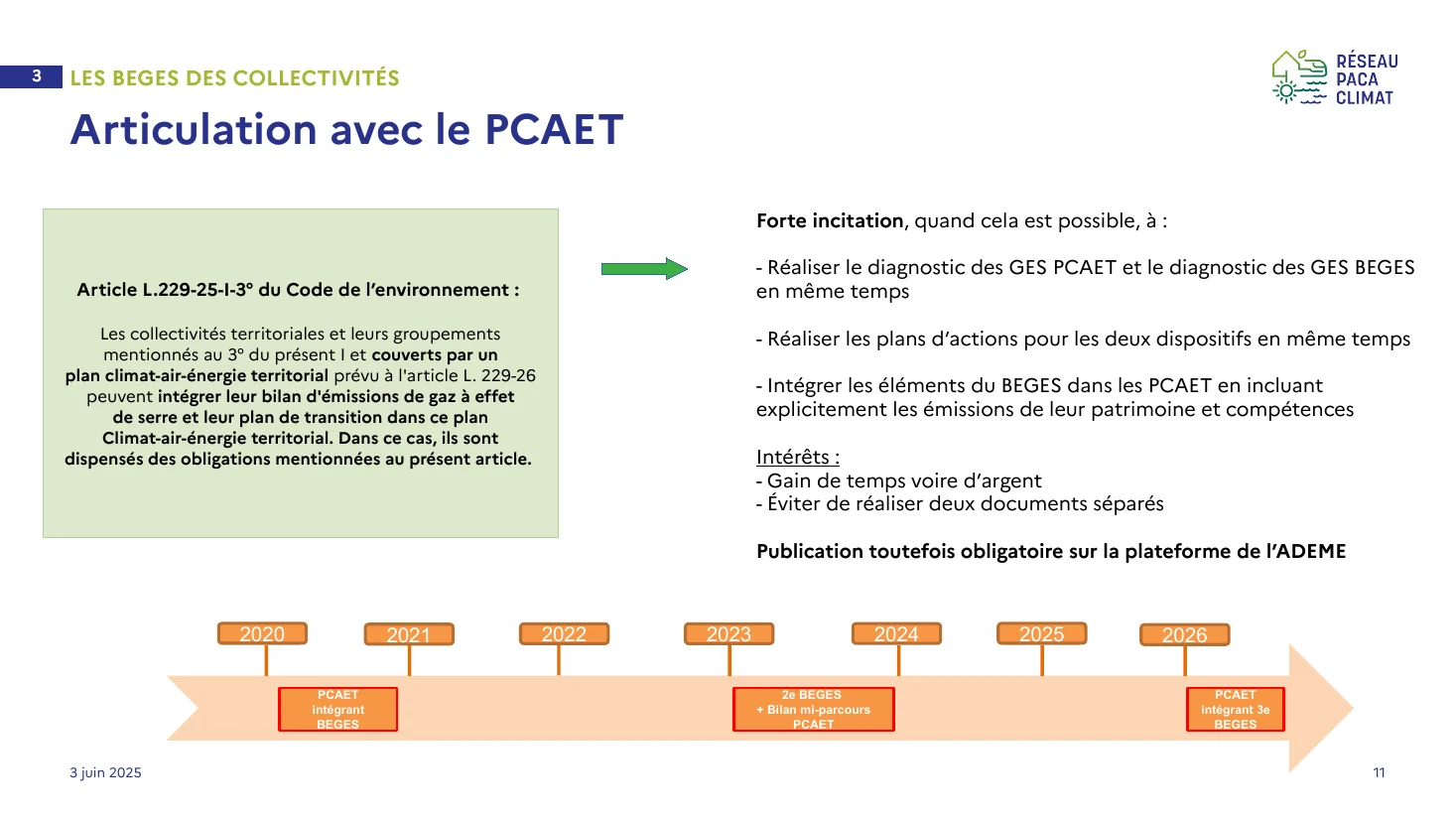
The DREAL encourages carrying out the diagnosis and the action plan of the 2 schemes at the same time, to save time and avoid 2 documents. It adds that publication on ADEME's platform remains mandatory, a reading the ministry qualifies.
2What can the local authority do itself?
The data the local authority already holds
ADEME's regulatory method, in its version 5 of July 2022, and the transition plan guide are free on the Bilans GES platform. Most of the data is already in the departments:
- Energy bills for buildings and street lighting, monitored by the technical departments or by the local energy agency.
- Fleet fuel, in fuel card statements or supply contracts.
- Payment orders for purchases and works, taken from the financial management software, which are used to calculate scope 3.
- Staff business travel and commuting, from expense claims and a survey of the departments.

A staff member trained in the Bilan Carbone® (in French) can carry out the calculation, and the DREAL Provence-Alpes-Côte d'Azur points out that the work may be outsourced or done in-house. The public platform Territoires en transitions, run by ADEME, provides free help in managing an action plan: 1,327 local authorities were registered on it as at 12 November 2026, and it does not calculate an assessment.
Items that call for a specialist
5 points become complicated without experience of the assessment:
- Delegated responsibilities: a public service delegation, a joint body (syndicat) or an in-house operator (régie) require deciding what falls within the assessment, and writing it down.
- Scope 3 for purchases and capital goods, such as roads or a new building, calculated on amounts spent with monetary factors.
- The boundary with the territorial assessment of the PCAET, so that the same emissions are counted neither 2 times nor not at all.
- A costed transition plan, with actions that elected members can vote on and a person responsible for each.
- A 2nd assessment comparable with the first, which requires a written method and retained calculation files.
3What does a local authority risk if it does not do it?
The fine and the formal notice
Article L229-25 provides for a fine of up to €50,000, increased to €100,000 for a repeat offence, for a body that does not prepare or does not submit its assessment. The fine follows formal notice from the regional prefect (the State's representative in the region), and the ministry publishes no count of the penalties imposed.
Compliance is improving. In Provence-Alpes-Côte d'Azur, the share of local authorities in compliance rose from 19% in 2018 and 18% in 2021 to 63% in 2025, according to the DREAL.
The public assessment and elected members' questions
The assessment is public on ADEME's platform, and its absence shows. A question from an opposition councillor, a journalist or a resident can rely on that absence. An assessment without a written method raises another problem: 3 years later, nobody can say whether emissions have fallen, as shown by the frequency of assessments.
The local authority is also a buyer: every tender launched since 21 August 2026 must include an environmental criterion, and how to respond to it matters to its suppliers. An up-to-date BEGES shows it the items on which to weight that criterion.
4Who can support a local authority with its BEGES?
The providers are presented from the largest client to the smallest, under the same headings: who they serve, what they deliver, their price and their limits. The amounts come from published contracts, where the buyer is identified here by its type and the year.
Territorial climate and energy consultancies
Engineering consultancies specialising in territorial planning often do the BEGES and the PCAET under the same contract. B&L évolution won a €30,000 excl. VAT framework agreement over 15 months in 2022 for the assessment and transition plan of a département; the same year, a cooperative in Eybens that also trades as B&L évolution carried out the assessment of an agglomeration and its central town for €8,250 excl. VAT, the lowest amount among the contracts identified.
Akajoule, in Saint-Nazaire, was selected the same year for the mid-term evaluation of a community of municipalities' PCAET and the update of its assessment, for €27,225 excl. VAT. Auddice Environnement carried out in 2022 the BEGES of a municipality of about 40,000 inhabitants, below the threshold, for €15,112 excl. VAT.
Akéa Énergies, the engineering consultancy of the Hellio group, supports local authorities, whether obliged or volunteering, with consultants trained in the Bilan Carbone® and the ACT Pas à Pas approach, on quotation (page of 19 February 2026). In 2021, a large city awarded the "emissions assessment" lot of a support contract for its energy and climate policy to a consortium of 3 engineering consultancies, for €31,850 excl. VAT. These providers know a local authority's responsibilities and the PCAET; their websites do not publish prices.
Carbon consultancies
Projet Celsius carries out BEGES within the public boundary: scoping the boundary with the departments, guided data collection, calculation of the 3 scopes, transition plan presented to senior management, filing on the platform. The digital item, including staff use of AI, is counted with purchases, using the method of measuring AI in an organisation. We leave the calculation model with the local authority, and we can provide in-house training for the staff who will do the next assessment, as part of our tailored training courses. Guillaume Pakula, who scopes the engagements, teaches the Bilan Carbone® for the Institut de Formation Carbone.
We have no local authority among our public references: our public sector engagements concern health, research and higher education institutions, presented in our case studies. We do not publish software.
To compare other providers, the directory of the Association pour la transition Bas Carbone listed 363 in carbon accounting as at 6 November 2026.
Independent consultants
The published contracts show a large share of sole-trader consultants. 2 of them won 5 BEGES contracts between 2019 and 2021, with an agglomeration, a community of municipalities, 2 départements and a city with its metropolitan authority, for €9,860 to €19,765 excl. VAT, with 4 of these 5 contracts below €15,000 excl. VAT. The limit lies in the capacity of a single person and continuity from one assessment to the next.
A city and its metropolitan authority can also order together: in 2020, a metropolitan purchasing body awarded a single contract of €14,100 excl. VAT for the "assets and services" assessment of the 2.
Local agencies and public services
Local energy and climate agencies (ALEC) are territorial engineering bodies, grouped in the FLAME federation, which covers 6,200 municipalities and had 710 staff in 2025. For a member municipality, the agency is close-at-hand public support for energy data on its assets, useful when the assessment is done in-house.
ADEME publishes the method, the transition plan guide and training free of charge on the Bilans GES platform, where the assessment is filed. The DREALs organise webinars and monitor compliance in their region. None of these services does the assessment in place of the local authority.
A well-supported BEGES leaves staff with the method and the files to redo the assessment 3 years later.
The choice depends mainly on the obligation and the PCAET timetable:
- A municipality or intermunicipal body below the threshold, doing a voluntary assessment, can carry it out in-house with a trained staff member and support from its local agency.
- A local authority under the obligation whose PCAET is revised in the same year benefits from awarding the 2 to the same consultancy, under a single contract.
- A local authority under the obligation with no PCAET to revise awards the assessment to a provider that does it with its staff, a consultant or a firm.
- A département, a region or a metropolitan authority, with many delegated responsibilities, looks for a provider that has already dealt with such boundaries, through a purchasing body if needed.
5How much does a local authority's BEGES cost?
Amounts of published contracts
The 7 contracts for a BEGES alone published between 2019 and 2022 range from €8,250 to €19,765 excl. VAT, with a median of €14,100 excl. VAT. The 3 contracts that add the PCAET or broader support range from €27,225 to €31,850 excl. VAT.
Amounts of local authority BEGES public contracts
Contracts published from 2019 to 2022, in euros excl. VAT, before the scope 3 requirement.
BEGES only, 7 contracts, median €14,100 (orange line)
BEGES with the PCAET or broader support
Source: French public procurement core data (data.economie.gouv.fr), read on 12 November 2026. The amount of a framework agreement may be a maximum.
2 points of caution when reading them. The amount of a framework agreement may be a maximum, not the sum paid. Above all, these contracts predate the scope 3 obligation, which came into force on 1 January 2023 and makes collecting data on purchases and travel heavier.
At Projet Celsius, the BEGES of a municipality or intermunicipal body with scope 3 is in the order of €12,000 to €20,000 excl. VAT, a 2026 order of magnitude confirmed on quotation. The cost of a Bilan Carbone® details the items to look for in a quote.
Funding and staff time
The main funding scheme for the assessment, Bpifrance (the French public investment bank) and ADEME's Diag Décarbon'Action (a Bpifrance-subsidised carbon footprint programme for companies established in France), is reserved for companies. ADEME's Territoire Engagé Transition Écologique programme supports local authorities' climate policy, and its tools are free. Staff time comes on top of the contract: data collection involves the technical departments, finance, human resources and senior management.
For us at Projet Celsius, the question to ask any provider concerns the 2nd assessment: with which files and which written method will your staff be able to redo it in 3 years? The other points to compare between 2 offers are in the criteria for choosing a provider.
6Key takeaways
- A local authority's BEGES covers its assets and its responsibilities, with scope 3 and a transition plan, every 3 years.
- Regions, départements, metropolitan authorities and agglomeration communities are obliged with no threshold, municipalities and communities of municipalities above 50,000 inhabitants.
- A local authority covered by a PCAET may incorporate its assessment and its plan into it, provided it counts the emissions of its assets and its responsibilities.
- Data collection is done in-house; delegated responsibilities, scope 3 purchases and the costed plan call for a specialist.
- Published contracts range from €8,250 to €19,765 excl. VAT for a BEGES alone, and from €27,225 to €31,850 excl. VAT with the PCAET or broader support.
Who is obliged, when and with which penalties: it is all in our guide to the mandatory BEGES.
- Légifrance, French Environmental Code, Article L229-25, version in force since 3 May 2025, consulted on 12 November 2026. The Légifrance pages are in French.
- French Senate, written question No. 05482 and reply from the Ministry of Ecological Transition, reply published on 19 March 2026 (in French).
- DREAL Provence-Alpes-Côte d'Azur, "The BEGES of local authorities", slide deck of 3 June 2025 (in French).
- ADEME and Ministry of Ecological Transition, method for carrying out greenhouse gas emissions assessments, version 5, July 2022 (in French).
- ADEME, Bilans GES platform, consulted on 12 November 2026.
- Ministry of the Economy, public procurement core data, decp-v3-marches-valides dataset, contracts 20223500, 2021M016800, 201919PI01100, 2020029AM00, 202220213100, 2022dUE4mdWFdf00, 20212021050700, 202286033300, 20222022S0000300 and 2021M301201, consulted on 12 November 2026.
- ADEME, Territoires en transitions, consulted on 12 November 2026.
- FLAME federation, home page, OBSERV'alec 2025 figures, consulted on 12 November 2026.
- Hellio, "Local authority carbon footprint", updated on 19 February 2026 (in French).
- Association pour la transition Bas Carbone, directory of providers, consulted on 6 November 2026.