
- 1Filing takes place on bilans-ges.ademe.fr, across 9 tabs, after linking the account by SIREN number.
- 2With the file ready, filing takes a few hours; the report itself takes several months.
- 3A filed report is public, and the DREAL of the region concerned may reject it.
- 4Not filing exposes the organisation to a fine of up to €50,000, and may cost it a contract or France 2030 funding.
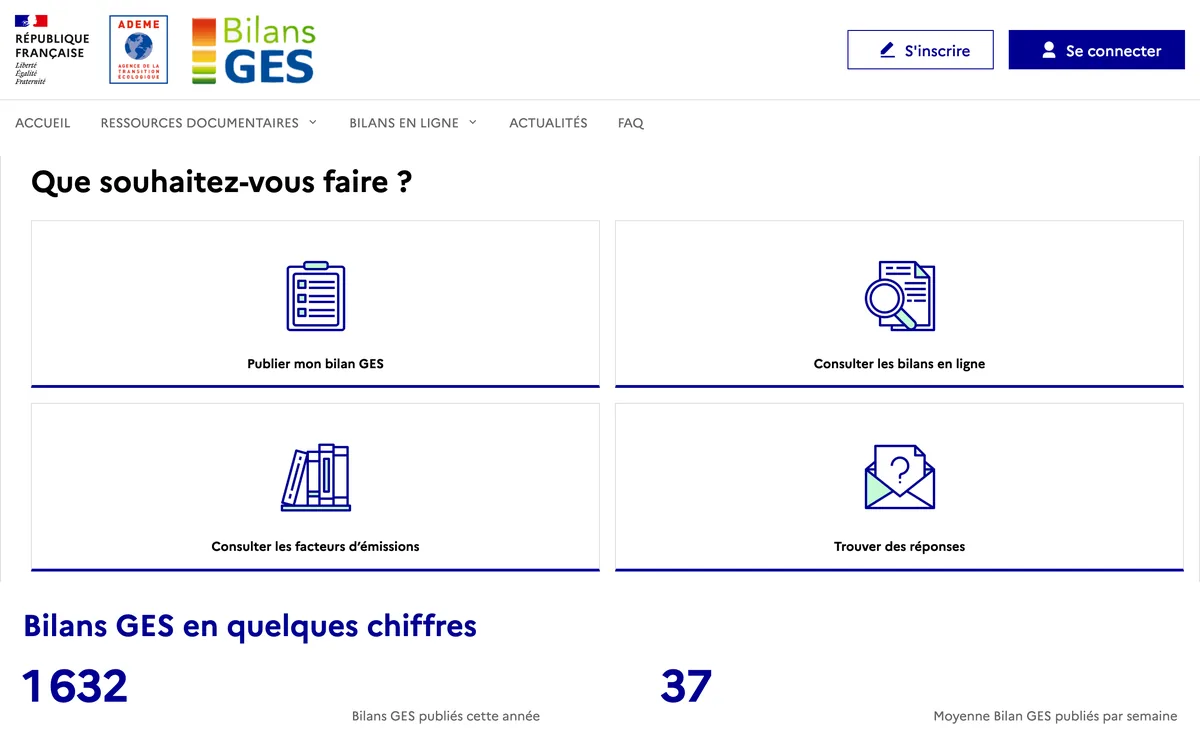
On 2 November 2026, the Bilans GES platform run by ADEME (the French Agency for Ecological Transition) held 12,215 reports open to anyone, and had been receiving an average of 37 a week since January. It is where companies with more than 500 employees, local authorities and State services publish their BEGES (bilan d'émissions de gaz à effet de serre), France's mandatory greenhouse gas emissions report. Until it is filed, the report does not exist as far as the authorities are concerned. The walkthrough below shows its 9 screens.
Filing a BEGES in 9 screens
For each screen: what to have to hand, and who will see the information.
Tab 2 · mandatory
Report the emissions
22 emission categories in 6 groups, entered by hand or imported from ADEME's Excel template.
What to have to hand
The report's emissions table; with the Bilan Carbone® tool, the "Export BEGES-R" sheet is pasted into the template.
Who sees it
Everyone, as a summary and in detail by category.
Sources: ADEME, bilans-ges.ademe.fr, "Comment publier ?" (how to publish) and FAQ, accessed 2 November 2026; screenshots taken the same day.
Once the emissions table, the plan and the methodology are written, filling in the form takes 2 to 4 hours, by our estimate at Projet Celsius. Filing takes 1 to 2 days if the report first has to be reclassified into the 22 regulatory emission categories. What slows a filing down is the documents that are missing when you reach a tab: gather them before you log in.
1What is filing for, and how does it work?
The French Environmental Code requires the report and its transition plan to be made public, and the ADEME platform is the channel provided for this. Once published, a report can be viewed by anyone online, and the regional administration reviews it.
Who must file, and how often
The obligation covers companies with more than 500 employees (250 in overseas France), the State, regions, départements, large local authorities and other public bodies with more than 250 staff. Companies file every 4 years, public bodies every 3 years. The guide to the mandatory BEGES sets out these thresholds, and the BEGES test by SIREN number, the French company identification number, checks a company's position in a few seconds. Hospitals and universities have their own guides: the hospital BEGES and the carbon footprint of higher education institutions.
An organisation that is not required to file, such as an SME, may also publish voluntarily. Conversely, a company subject to the EU sustainability statement under the CSRD (Corporate Sustainability Reporting Directive), which already publishes its inventory and its transition plan for France there, is exempt from the rest of the form. Its report is published as soon as the first tab is saved, as the article do you need a Bilan Carbone® (the French carbon accounting method) for the CSRD? explains.
Filing in 4 stages
The ADEME procedure comes down to 4 stages, which the opening infographic breaks down into 9 screens:
- Create an account with your name, email address and type of organisation; since 8 January 2026, every login has required a code sent by email, valid for 15 minutes.
- Link the account to the organisation by its SIREN number: the first person to register becomes its lead user (référent), and later users ask the lead user for access or report a change of lead user.
- Fill in the 9 tabs of the form, from the identity sheet to the methodology, saving each tab before moving on to the next.
- Click "Publier mon bilan" (publish my report) in the last tab: the report goes online immediately, and it can still be edited from the "Mes bilans" (my reports) area.
What the platform leaves to the DREAL
The platform blocks an empty mandatory field, and nothing more: it will publish without complaint a report on a year that is too old or with no reduction volume. It is then the DREAL, the regional State service in charge of follow-up, that may review the report, send feedback, then approve or reject it, stating its reasons, according to the platform FAQ. No third-party verification is required: the check is administrative.
2What should you prepare before logging in?
The form asks for almost nothing the organisation does not already have, but the documents are spread across accounting, human resources and the team that carried out the assessment. Gathering them before opening the platform avoids leaving a tab half-filled:
- The organisation's identity, from accounting or legal: the main SIREN number and those of the consolidated entities, the NAF code (the French business activity code), and turnover, which is optional but entered in thousands of euros.
- Headcount, from human resources: the form asks for the headcount for the reporting year, across all the SIREN numbers in the report, as well as the company's status with regard to the CSRD.
- The emissions table, from the team or consultancy that carried out the assessment: 22 emission categories in 6 groups, for the previous year or, where data is lacking, the year before that, with the justification for any indirect emission categories left out.
- The transition plan, from senior management: the expected reduction volume in tCO2e, the planned actions with their human and financial resources, and a review of the actions undertaken since the last BEGES.
- The methodology: the emission factors and their sources, the full report as a link or PDF, and the comparison with the baseline report, mandatory since 29 September 2026. For a first report, the form offers the option "Ce bilan est mon premier bilan" (this is my first report).
Two linked users rather than one
The account is personal to one named user. If the only lead user leaves the organisation, their successor must report a change of lead user, which the site administrators approve within two weeks. ADEME also asks users to report a lead user who has left through the site's contact form. Linking 2 people from the outset, a lead user and a contributor, avoids this wait at renewal, 4 years later, when nobody remembers the account any more.
If a consultancy does the data entry
The ADEME FAQ accepts that data entry may be delegated to an engineering consultancy. Tab 7, however, names the person responsible for the report, whom the DREAL may contact, and tab 8 asks whether the report was produced in-house or with a consultancy.
3How long does filing a BEGES take?
Filing itself is quick. The 2 to 4 hours in our estimate assume a finished report and someone who knows it. The 1 to 2 days go on reclassifying the table into the 22 regulatory emission categories, or on writing the transition plan into the form fields when it only exists as a slide presentation.
Working time for a filing, compared with the report that precedes it
In working days of 7 hours, on the same scale; the light part marks the top of the range.
Fill in the 9 tabsthe table, the plan and the methodology are ready
2 to 4 hProjet Celsius estimateRework the report for the formreclassify into 22 categories, write the plan into the fields
1 to 2 daysProjet Celsius estimateProduce an SME's reportDiag Décarbon'Action, over 6 to 10 months, excl. in-house time
12 daysof expert time, BpifranceFiling takes half a day to 2 days, at the end of a project lasting several months. The schedule can be stretched by a wait that involves no work: approval of a change of lead user by the site administrators.
Sources: Projet Celsius estimates for the filing; Bpifrance, Diag Décarbon'Action (12 days of expert time); ADEME, "Comment publier ?" (how to publish), accessed 2 November 2026.
The schedule depends mainly on 2 waiting times that cannot be hurried: approval of a change of lead user by the administrators, and the login code sent by email. A shared mailbox or an overly strict spam filter is enough to lose an afternoon: it is best to test the login a week before the deadline.
The report itself takes months
The Diag Décarbon'Action, the programme run by Bpifrance (the French public investment bank) and ADEME for an SME's first carbon footprint assessment, provides for 12 days of an expert's time, spread over 6 to 10 months according to the public programme sheets. The in-house team's time comes on top. For an organisation with more than 500 employees, the duration depends mainly on data collection, site by site and department by department. Budgets are covered in how much a Bilan Carbone® costs.
The end-2027 wave
Filings follow the renewal cycle. December accounted for 64% of the BEGES reports from companies under the obligation filed in 2019 and 43% of those filed in 2023, against 13 to 27% in other years. Companies renew their report every 4 years, and many do so in the last month. The next wave is expected at the end of 2027, and a last-minute filing leaves little margin if the account, the code or the link to the organisation gets stuck.
4What are the risks of not filing your BEGES?
A fine presupposes an inspection, and the ministry publishes no count of the penalties imposed. A missing report is nevertheless visible on the platform, and it can now cost a public contract or funding.
What an organisation risks without a published BEGES
The 4 consequences set out in the legislation, and what is known of how they are applied.
What the law says
An officer authorised by the regional prefect records the breach. The prefect first serves formal notice to publish, within a time limit the prefect sets, then may impose the fine and make it public.
In practice
The ministry publishes no count of the fines imposed. The law says the authority penalises breaches; the decree leaves the final word to the prefect.
Sources: French Environmental Code, L229-25 and R229-50-1; French Public Procurement Code, L2141-7-2; Finance Act for 2024, Article 235; Citepa for ADEME, 2022; Actionnaires pour le climat, October 2024; Bpifrance.
The fine, after formal notice
The breach is recorded by an officer authorised by the regional prefect (the State's representative in the region), who first serves the organisation with formal notice to publish within a time limit the prefect sets. Only then may the prefect order the fine, up to €50,000, and €100,000 for a repeat offence, then make it public. The law now states that the authority penalises breaches; the decree leaves it to the prefect to order the fine once the time limit has expired. The guide to the mandatory BEGES traces the history of this fine.
A public report, or its absence
The list of reports can be filtered by SIREN number: anyone can check whether a company has filed. At 31 December 2021, only 35% of the organisations under the obligation were compliant, according to the evaluation carried out for ADEME by Citepa (the French technical centre for atmospheric pollution studies), whose summary is published by the Cour des comptes (the French Court of Audit). In October 2024, the association Actionnaires pour le climat served formal notice on 41 companies in the SBF 120, the Paris stock market index of large listed companies, 32 of them with no BEGES less than 4 years old, after looking them up on the platform.
A missing BEGES is visible on the platform, and it can exclude a company from a public contract or from public funding.
Public contracts and funding
Since 25 October 2023, the French Public Procurement Code has allowed a public buyer to exclude a company subject to the BEGES. It is enough that the company has not drawn up its report for the year preceding the call for tenders. Since 1 June 2024, a company subject to the BEGES that has not published its report cannot receive funding from France 2030, the French State's investment plan, for an ecological transition project: Article 235 of the Finance Act for 2024 makes this a condition. Environmental criteria come on top.
The Diag Décarbon'Action: publication expected
An SME that has carried out a Diag Décarbon'Action is not required to file by law. The programme's specifications, published by Bpifrance in 2022, list the GHG report published on the ADEME website among the expected deliverables of the engagement. The balance of the fee is invoiced after the deliverables are handed over, and Bpifrance pays the grant on settled invoices: as long as the report is not published, the grant may be held up. These reports weigh heavily on the platform: 2,005 reports declare Diag funding, and they accounted for 42% of the reports published in 2025.
5How do you fill in the ADEME platform, tab by tab?
Each tab has its mandatory fields, marked with an asterisk, and an "Enregistrer" (save) button at the bottom of the page: a tab that has not been saved counts as empty, even an optional one. The report published in August 2026 by the regional prefecture of Pays de la Loire shows what the public sees, across 7 sections.
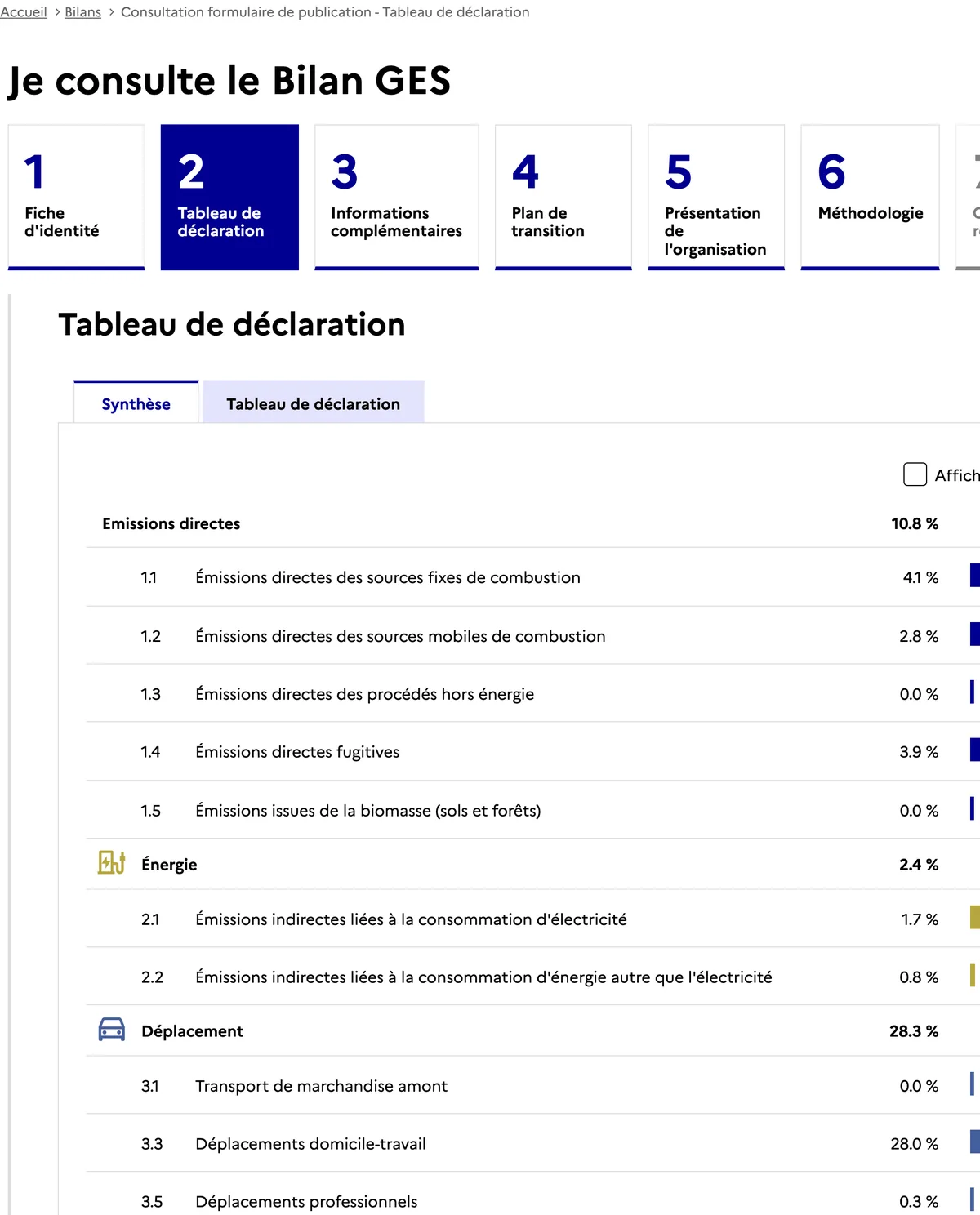
The public view of a filed BEGES: 7 sections, including the emissions table category by category. This is the page a public buyer or a journalist reads. In this report for 2024, commuting and purchased services each account for 28% of emissions.
Tabs 1 to 3: identity and the emissions table
Tab 1 accepts several SIREN numbers for a consolidated group report. Tab 2 takes the table, either entered directly or through the import of ADEME's Excel template. The "Export BEGES-R" sheet of a Bilan Carbone® workbook, produced with the tool of the Association pour la transition Bas Carbone (the French low-carbon transition association), can be pasted in as it is. On an industrial site, processes and refrigerants have their own categories. Tab 3, which is optional, takes avoided emissions and renewable energy.
Tabs 4 to 6: the plan and the methodology
Tab 4 holds the transition plan: the objectives for the next report, the actions and their resources, chosen from costed reduction levers, and an analysis of results since the last report. Tab 5 presents the organisation. Tab 6 describes the methodology and takes the full report; the accepted methods are named there.
Tabs 7 to 9: contact details and publication
Tab 7 gives the person responsible, either visible to the public or restricted to ADEME and the DREAL. Tab 8 is mandatory and hidden from the public: it states whether the report was produced in-house or by an engineering consultancy. Tab 9 holds the "Publier mon bilan" button. At renewal, you create a new report, without editing or withdrawing the old one: the FAQ asks for earlier reports to be kept, as they form the history.
6What do the BEGES reports already published show?
2 filings in 3 pass the 2 basic checks, the reporting year and the reduction volume. The remaining third almost always falls down on the same fields. Our analysis covers the 1,766 BEGES reports from companies and associations under the obligation published under the current method, from 24 February 2023 to 30 October 2026, based on ADEME open data.
What the 1,766 company BEGES reports published since 2023 contain
Each box represents 5% of the reports, published from February 2023 to October 2026.
State a reduction volumerequired of every organisation
3 in 41,317 reportsCover a recent yearthe previous year or the one before
9 in 101,582 reportsCount beyond energyat least one indirect category, transport or purchases
more than 8 in 101,495 reportsHave calculated a baseline yearto compare one report with the next
1 in 5352 reportsCover a year that is too old3 years or more before publication
risingfrom 6 to 15%* Up to 30 October. Source: ADEME, open dataset of published GHG reports, 2 November 2026; Projet Celsius calculations.
3 reports in 4 state a reduction volume, which the code requires of everyone; the article on the transition plan shows what the others lack. 9 in 10 cover a recent year, but the share of reports covering a year 3 or more years earlier has been rising since 2024: 9% of filings in 2023, 6% in 2024, 13% in 2025 and 15% in 2026.
The finding predates the current platform. Researchers from Audencia, TBS Education and Columbia studied reports from unlisted companies published from 2014 to 2021. According to their May 2024 article, 3 plans in 4 did not quantify their measures on direct emissions. Hospital reports have their own mistakes to avoid (in French) (in French).
4 checks before clicking "Publier mon bilan"
These 4 checks take a quarter of an hour, and the platform carries out none of them on behalf of the person filing:
- The reporting year is the previous year, or the year before that if data was lacking, and not the year of the latest report available in the files.
- The plan states a reduction volume in tCO2e, for direct and indirect emissions, and each action has its human and financial resources.
- Indirect emission categories left out are justified, and the threshold chosen covers at least 80% of indirect emissions where Scope 3 is mandatory.
- The public page, reread after filing, shows the correct turnover, the correct headcount and a contact person who can be reached.
For us at Projet Celsius, a filed BEGES is better than a perfect report left in a folder. One filing in 3 has a visible flaw, but a published report meets the obligation to publish, can be corrected afterwards, and the DREAL says what it is missing. The real gap lies elsewhere: at the end of 2021, nearly 2 in 3 organisations under the obligation were not compliant. What deserves care is decided before data collection: the reporting year, the reduction volume and the resources in the plan. On filing day, what remains is to read the public page as a client or a public buyer will read it.
7Key takeaways
- A BEGES is filed on ADEME's Bilans GES platform: an account, the link by SIREN number, 9 tabs, then the "Publier mon bilan" button.
- The file is prepared beforehand: identity and turnover in thousands of euros, headcount, the table of 22 emission categories, a costed transition plan, the methodology and the comparison with the baseline report.
- Filing takes 2 to 4 hours once the file is ready, by our estimate; it is the report, with its data collection, that takes several months, and the next wave of renewals is expected at the end of 2027.
- Without a filing, the organisation faces formal notice, then a fine of up to €50,000 that the prefect may order, and may lose a public contract or France 2030 funding.
- A published report is public and can still be edited: it is better to file on time and correct it afterwards than to wait for a perfect report.
Thresholds, content and the history of the obligation are covered in the guide to the mandatory BEGES.
- ADEME, Bilans GES platform, home page counters and list of reports, accessed 2 November 2026.
- ADEME, Comment publier ? (how to publish) and FAQ of the Bilans GES platform, accessed 2 November 2026; news items of 8 January 2026 (login code) and 29 September 2026 (update v3.23.0).
- ADEME, "Bilan GES" dataset, updated 2 November 2026; V5-format reports from companies and associations under the obligation, Projet Celsius calculations.
- Regional prefecture of Pays de la Loire, GHG report published on 24 August 2026, reporting year 2024.
- French Environmental Code, Article L229-25 and Articles R229-46 to R229-50-1, Légifrance. The Légifrance pages are in French.
- French Public Procurement Code, Article L2141-7-2, Légifrance; Finance Act for 2024, Article 235.
- Ministry of Ecological Transition, method for producing greenhouse gas emissions reports, version 5, July 2022, and the page actions by companies and local authorities for the climate, updated 15 September 2026.
- Citepa for ADEME, 2021 evaluation of the regulations on greenhouse gas emissions reports, November 2022, and its summary sheet by the Cour des comptes.
- Bpifrance, specifications of the call for expressions of interest for the Diag Décarbon'Action, 2022, sections on expected deliverables and on payment terms for the diagnostics; Diag Décarbon'Action programme sheet, updated 12 August 2026; Mission Transition Écologique, Diag Décarbon'Action sheet, accessed 2 November 2026.
- Alexandre Garel, Arthur Romec and Thomas Bourveau, On fait le bilan du bilan carbone (taking stock of the carbon footprint), The Conversation, 13 May 2024.
- Actionnaires pour le climat, formal notice served on CAC 40 and SBF 120 companies in breach of the mandatory BEGES, press kit, version of 29 October 2024.