
- 1The manufacturer signs the declaration alone: a service provider prepares it but does not take responsibility for it.
- 2A company with up-to-date data can carry out its packaging inventory and its EPR membership on its own.
- 3Software produces the documents, but does not tell you which packaging your company is the manufacturer of.
- 4For an SME, we recommend a technical consultancy for the first inventory.
Projet Celsius, which wrote this article, is one of the providers compared. Each provider is described from its public pages as at 6 November 2026, and none has paid to appear here.
Which support to choose for PPWR compliance?
Choose a stage: who does it for you, and at what price level.
We list each packaging item, its materials and its suppliers, and state for each one whether you are its manufacturer within the meaning of the Regulation. This is the most technical stage: all the others depend on it.
If you do not yet know whether your packaging is affected, start with our test PPWR: who is affected?.
1What does the PPWR require of a company?
Regulation (EU) 2025/40 on packaging, known as the PPWR (Packaging and Packaging Waste Regulation), has applied since 12 August 2026 (Article 71). It attaches its obligations to roles: manufacturer, importer, distributor. The manufacturer carries most of them. It places on the market only packaging that complies, assesses that conformity itself or through a third party acting on its behalf, without a notified body, then draws up the technical documentation and the EU declaration of conformity (Article 15), as summarised in our PPWR guide.
One manufacturer per packaging item
The manufacturer is not necessarily the company that produces the packaging. The Commission guidance document of 10 June 2026 states that there is only one manufacturer in a supply chain. For sales packaging, it is in principle the company that fills it, often the brand owner. For transport packaging, such as a shipping box or pallet wrap, it is in principle the company that makes it, unless it bears the name or trade mark of its user. An importer or distributor that sells under its own brand becomes a manufacturer in turn (Article 21).
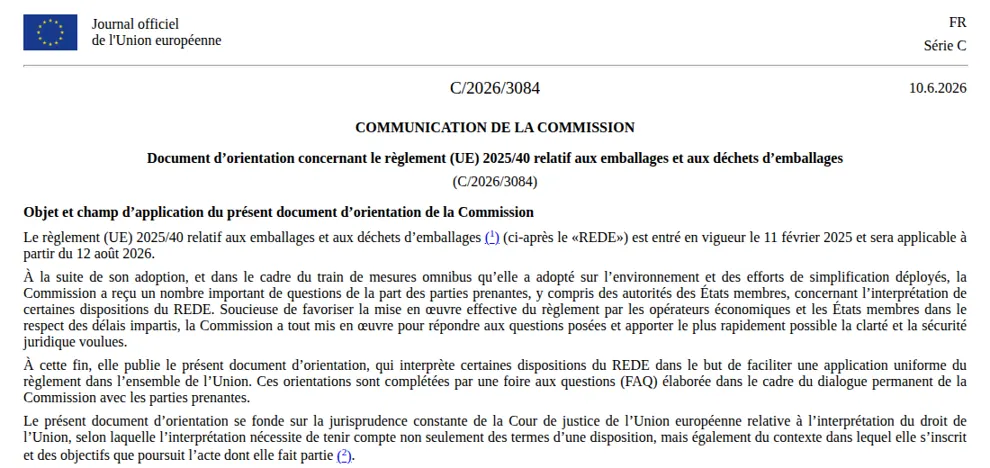
Part 2 defines the manufacturer. There is only one manufacturer in a supply chain, in principle the company that fills the sales packaging. The declaration is drawn up by the manufacturer or on its behalf, but the manufacturer remains solely responsible. The document interprets the Regulation without replacing it: only the Court of Justice gives a binding ruling.
The 6 steps to PPWR compliance
Compliance takes 6 steps, in-house or with a service provider:
- List the packaging placed on the market, type by type, from the body to the label, down to the transport box and film.
- State, for each packaging type, who is the manufacturer, importer or distributor, and who is the producer liable under extended producer responsibility (EPR).
- Gather the evidence from suppliers, who must provide the manufacturer with all the information and documentation needed (Article 16).
- Draw up the technical documentation (Annex VII) and the EU declaration of conformity (Annex VIII) for the types of which the company is the manufacturer.
- Keep these documents for 5 years, or 10 years for reusable packaging, and hand them over within 10 days of a reasoned request from an authority.
- Join a producer responsibility organisation (PRO, éco-organisme in French) of the French EPR scheme for professional (B2B) packaging before 31 December 2026, if the company is its producer.
The documents themselves follow a model set by the Regulation: our article on the PPWR declaration of conformity goes through it heading by heading, and the one on the technical documentation sets out what evidence to request from suppliers. The 2030 recyclability criteria are still awaiting Commission acts, as the PPWR timeline shows, whereas the PFAS limits for food-contact packaging already apply.
Whoever drafts the declaration of conformity, the manufacturer remains solely responsible for it.
2How much of the work can you do in-house?
The inventory and the EPR membership
Part of the work requires no outside expertise, provided your data is up to date:
- The list of packaging, if the ERP or a spreadsheet already tracks the items sold, their components and their suppliers.
- Membership of a PRO of the French EPR scheme for professional packaging, done online on its portal, as described in our comparison of Citeo and Léko (in French).
- A first inventory using the free guides and templates that the PROs make available to their members.
- The request for evidence from suppliers, with a standard letter that covers each component, its production site and the period covered.
The cases that call for a written opinion
The work becomes harder when the answer depends on a contract, a brand or a flow of goods:
- The PPWR manufacturer and the EPR producer are not always the same company, especially for a seller established outside France.
- An importer or distributor that sells under its own brand, or modifies packaging, takes on the manufacturer's obligations without always knowing it.
- A supplier replies with a general certificate that names neither the component, nor the site, nor the period, and therefore proves nothing.
- Within a group, the same packaging can have a different role depending on the subsidiary that buys it, fills it or resells it.
- A micro-enterprise may see the manufacturer's obligations pass to its supplier, subject to conditions.
These cases call for a written opinion, based on an article of the Regulation or of the Commission guidance.
3What are the risks without a declaration of conformity?
Distributors that stop selling
The first risk comes from customers. Before selling, the distributor checks the labelling, the identification of the manufacturer and the producer's registration in the register (Article 19). If it has reason to believe the packaging does not comply, it refrains from selling it until it has been brought into conformity. In practice, a supplier that cannot show its documents to the customer who asks for them risks being delisted.
Withdrawal from the market
A missing or incorrectly drawn up declaration, or incomplete technical documentation, is a formal non-compliance: the Member State requires it to be brought to an end and may, if it persists, restrict the sale of the packaging or have it withdrawn (Article 62). A manufacturer that discovers a non-compliance must itself correct, withdraw or recall the packaging, and inform the authorities (Article 15).
Penalties still to be set
The Regulation leaves it to Member States to set their penalties by 12 February 2027 at the latest (Article 68). As at 6 November 2026, no French penalty specific to the PPWR has been passed: the bill adapting French law to EU law, adopted by the French Senate on 18 February 2026, is still awaiting the National Assembly. Our article on PPWR penalties details what already applies and what is still at the draft stage.
EPR already has its own. The French Environmental Code (Article L. 541-9-5) provides for an administrative fine of up to €7,500 per unit or per tonne of product for a legal entity that fails to meet its EPR obligations, such as membership, and a periodic penalty payment of up to €20,000 per day; the unique identifier (identifiant unique, or IDU), the EPR registration number, must also appear on its documents. The amendment adopted by the Senate would raise this ceiling to 1% of worldwide turnover. These are EPR penalties, not PPWR penalties.
4Which providers offer PPWR compliance support?
7 types of provider help companies with the PPWR, from large audit firms, which serve groups, to producer responsibility organisations, free of charge for their members.
Which PPWR provider for which company size?
Choose the size of the company: the recommended providers appear, in order.
Sources: public offers recorded on 6 November 2026 (details in the article); Regulation (EU) 2025/40, Article 21; Projet Celsius recommendation.
Large audit firms and inspection bodies
They are aimed first at groups operating in several countries. EY advertises role qualification and a roadmap in France; Deloitte and KPMG publish PPWR offers outside France. Inspection bodies add laboratory testing: Bureau Veritas maps roles along the supply chain and reviews the declaration, SGS offers testing and gap analysis. All work on quotation. None publishes prices. They cover several sales countries and integration into reporting, which serves groups first.
Technical consultancies, including Projet Celsius
They target SMEs and mid-cap companies (ETI in French) that want to delegate the work, then take it back. Projet Celsius carries out the 6 steps described above for the company and hands over the packaging table, an example of which, built for this article, is shown here, together with the organisation that will keep it up to date.
An SME's packaging table, with the role and evidence for each item
A fictitious grocery brand, sold in shops and online, and its 5 packaging items.
Of the 5 packaging items, the company signs 2 declarations. The parcel needs a written decision, based on the Regulation, before anything is signed.
Example constructed for the article. Sources: Regulation (EU) 2025/40, Articles 3, 16, 19 and 21; Commission guidance document C/2026/3084, section 2.
Projet Celsius is Qualiopi-certified (the French quality certification for training providers) for its training activities (certificate), and its consultants teach for the Institut de Formation Carbone. The firm does not provide legal advice and does not cover EPR registers on every continent. Other French consultancies work in this segment: RecycleMe sells a PPWR checklist from €995 excl. VAT, and from €3,250 excl. VAT with training; EcoMundo offers to map packaging and roles, on quotation.
Tool-based consultancies and lawyers
Some EPR compliance operators sell advice backed by a tool. The Landbell group offers a role analysis at €1,800 and workshops from €1,999 to €4,999 excl. VAT, covering 2 or 3 packaging items for the first 2 packages. The Dutch firm RegSurance combines advice with its PaxHub platform, on quotation. Lawyers, such as Heuking in Germany, handle a disputed role, a contract or litigation. Their page describes legal qualification, contracts and registrations. A technical consultancy brings them in when a role is disputed.
Software, producer responsibility organisations and training
PPWR software produces the documents from what the company enters, including its role for each packaging item. Generators charge for the declaration from €49 (PPWR-DOC), platforms €29 to €299 a month at PPWR Connect, and up to €799 a month for 10,000 declarations at SimpliDoC. Some carbon accounting platforms add a PPWR module: Greenly advertises importing bills of materials from the ERP, chasing suppliers and exporting declarations, with no published price. The software publisher Polygon One says so itself: assigning roles remains the customer's decision, which the tool maps without qualifying it legally.
The PROs approved in France on 3 June 2026 for professional packaging help their members free of charge. Citeo Pro offers its Cap Emballages Pro kit, Léko Pro its MyLéko space, and Twiice an online diagnostic and EPR declaration templates. Their tools serve the EPR declaration. That leaves training, so that the purchasing and quality team can do the work itself, as set out in our PPWR training programme.
5How much does PPWR compliance cost?
No public price list covers a full compliance project. At Projet Celsius, for an SME, it costs around €5,000 excl. VAT for the inventory and the roles. With EPR, the technical files for the types of which the company is the manufacturer and follow-up, allow €10,000 to €15,000 excl. VAT, depending on the number of product references. Each engagement is priced on quotation, as are the life cycle assessment (LCA) of a packaging item or the pathway towards the 2030 targets when the company asks for them.
The price depends on the number of product references, and above all on the number of packaging types they share:
- The number of distinct packaging types: 30 product references sharing 3 formats are dealt with faster than 10 references with 10 formats.
- The number of suppliers to chase, and the quality of the evidence they have already sent.
- The number of companies and sales countries, which multiplies the cases to examine and the EPR declarations.
- The share of borderline cases: group brand, modified packaging, purchases from outside the Union, flows between subsidiaries.
The headline prices on the market rarely cover the same scope: a generator charges for the document, a workshop covers 2 or 3 packaging items, a subscription gives access to the tool without the qualification work. A comparison only makes sense for the same inventory and the same deliverable. Handling compliance and EPR on the same inventory avoids paying 2 times for the same data collection.
6Where to start, depending on company size
For us at Projet Celsius, a PPWR provider should be judged on 2 points: it tells you, for each packaging item, whether you are its manufacturer, and it leaves you a file your team knows how to update. The criteria for choosing between 2 consultancies are in our article on choosing a PPWR consultancy.
Software comes afterwards, once the inventory is done: it keeps the declarations up to date. To train the team that will take over, our PPWR training programme details the modules.
7Key takeaways
- Since 12 August 2026, every packaging type must have its technical documentation and its EU declaration of conformity, drawn up by its manufacturer.
- A company with up-to-date data can handle the inventory, EPR membership and evidence requests on its own. Working out which packaging it is the manufacturer of more often requires help.
- The immediate risk is commercial, because a distributor that doubts the conformity of a packaging item must refrain from selling it.
- 7 types of provider offer help, from the large audit firm to the producer responsibility organisation. The right choice depends on the size of the company and the number of packaging types.
- At Projet Celsius, allow around €5,000 excl. VAT for an SME in the simple version, and €10,000 to €15,000 excl. VAT with EPR, the files and follow-up.
To compare 2 consultancies, our article on the PPWR compliance audit gives the questions to ask and the deliverable to require.
- European Parliament and Council, Regulation (EU) 2025/40 of 19 December 2024 on packaging and packaging waste, Articles 3, 15, 16, 19, 21, 39, 62, 68 and 71, Annexes VII and VIII.
- European Commission, guidance document on Regulation (EU) 2025/40 (C/2026/3084), 10 June 2026, section 2 on the definition of the packaging manufacturer.
- European Commission, DG Environment, FAQ on Packaging and Packaging Waste Regulation, 3 August 2026.
- French Senate, amendment No. 513 rect. to the bill adapting French law to European Union law (in French), adopted on 16 February 2026; National Assembly, legislative file (in French), consulted on 6 November 2026.
- Légifrance, French Environmental Code, Article L. 541-9-5, version in force since 25 August 2021 (extended producer responsibility penalties), consulted on 6 November 2026. The Légifrance pages are in French.