
- 1CCS is an industrial reality: in mid-2025, 77 operational facilities totalled 64 MtCO₂/year of capacity (+25% in one year) and the pipeline reached 513 Mt/year. This capacity would still need to increase around 90-fold to reach the 6 GtCO₂/year targeted by the IEA in 2050.
- 2There are 3 technology families: capture from industrial flue gases (95% of tonnage, $15 to $120/t depending on flow concentration), DAC ($340 to $1,000/t today, $125 to $335/t targeted after 2030) and BECCS, which theoretically produces negative emissions but competes with other land uses.
- 3Its use is justified in hard-to-abate industries (cement, steel, chemicals), remains debatable for fossil fuel electricity and becomes illegitimate when justifying new fields. In every case, it complements emissions reductions.
- 4The 4 main controversies concern EOR, which uses captured CO₂ to produce oil; the gap between announcements and results (Gorgon captured only 30% of CO₂ extracted from its reservoir in 2023-2024, against an 80% target); storage permanence and liability for late leaks; and fossil fuel producers' use of CCS as an excuse.
CCS occupies a distinctive place in the climate debate. IPCC AR6 and the IEA Net Zero scenario place it among the essential levers for keeping to 1.5°C in hard-to-abate sectors. Some civil society groups, by contrast, see it as a Trojan horse prolonging the fossil fuel era.
In mid-2025, according to Global Status of CCS 2025, the 77 operational facilities worldwide totalled capture capacity of 64 MtCO₂/year. The IEA estimates the need at around 1 GtCO₂/year by 2030, then 6 GtCO₂/year in 2050 for a 1.5°C-compatible trajectory: current capacity would need to increase around 90-fold in 25 years.
1What is carbon capture and storage (CCS)?
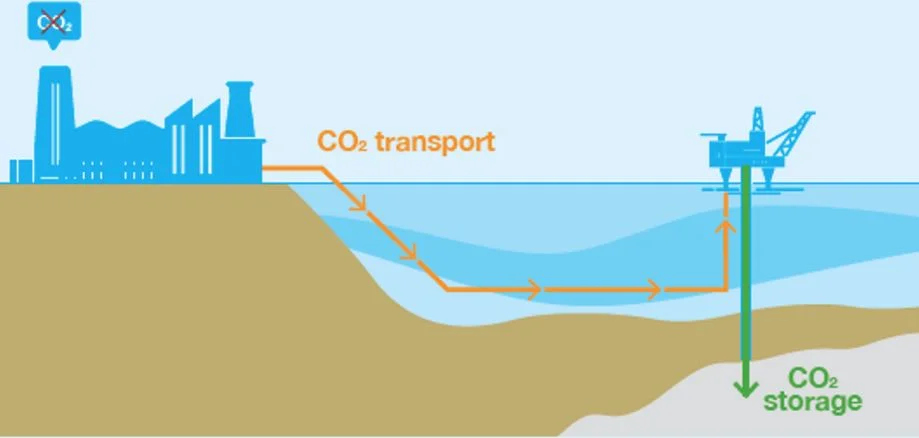
CCS (Carbon Capture and Storage) describes technologies that capture CO₂ at source or from ambient air, transport it and then store it permanently underground. Three families coexist, with very different economics: point-source capture from industrial flue gases (95% of current tonnage), Direct Air Capture (DAC) directly from ambient air and BECCS (biomass + CCS).
For storage, deep geological storage (saline aquifers, depleted oil reservoirs) beyond 800 metres remains the benchmark, keeping CO₂ in its supercritical phase. Mineralisation (basalt, e.g. Carbfix in Iceland) is newer but promising for permanence. The controversial use is Enhanced Oil Recovery (EOR): captured CO₂ is injected into ageing oil wells to extract the remaining fractions. The CO₂ stays stored there, and injection serves to extract more oil from the well.
Three neighbouring acronyms must be distinguished: CCS covers capture + storage; CCUS adds CO₂ utilisation (notably EOR, synthetic fuels); CDR (Carbon Dioxide Removal) covers atmospheric CO₂ removal methods (DAC, BECCS, afforestation, biochar). Capturing an emission (CCS) differs from removing CO₂ from the atmosphere (CDR): the two are accounted for differently.
3 families with very different economics
Average cost per tonne captured (bar and range on the right). The more diluted the CO₂ (ambient air at 428 ppm), the higher the energy and financial cost. Each family expands to show flow concentration, 2025 capacity, use cases and the structural limitation.
2Where industrial deployment stands in 2026
According to Global Status of CCS 2025, published in October 2025 (data up to July 2025), 77 facilities are operational worldwide, compared with 50 a year earlier (+54%). Their combined capture capacity reaches around 64 MtCO₂/year, up 25% year on year. The pipeline across all stages totals 513 MtCO₂/year, including 44 Mt/year under construction. The gap with needs remains wide: following the IEA Net Zero scenario would require capacity to increase around 16-fold by 2030 and 90-fold by 2050.
The factor of 90: current CCS capacity versus 2050 needs
Operational capture capacity worldwide (mid-2025) and the IEA Net Zero scenario targets for 2030 and 2050, compatible with 1.5°C. Logarithmic scale. Each row expands to show its source and context.
Three flagship projects give a concrete sense of scale. Sleipner (Norway, Equinor) has captured CO₂ associated with natural gas since 1996 and injected it into the Utsira saline aquifer beneath the North Sea: 1 MtCO₂/year, a cumulative total of more than 23 MtCO₂ at the end of 2023, with no leakage detected in 30 years.
Northern Lights (Norway) carried out its first injection on 25 August 2025, Europe's first open CCS hub, where manufacturers ship liquefied CO₂ by sea (Equinor / Shell / TotalEnergies joint venture). Phase 1: 1.5 MtCO₂/year; phase 2 FID in March 2025 for 5 MtCO₂/year from 2028.
Boundary Dam (Saskatchewan, Canada) is one of the 2 coal-fired power stations with post-combustion capture in commercial operation, alongside Petra Nova in Texas, restarted in 2023 (around 1.4 MtCO₂/year of capacity, CO₂ used for enhanced oil recovery). Boundary Dam captured 848,000 tCO₂ in 2024, its annual record, with 85% availability and a cumulative 6.4 MtCO₂ since 2014. Its early years, between 2015 and 2017, fell well short of announcements (around 40% availability).
In France, 2 projects shape the map. The 3D pilot (DMX Demonstration in Dunkirk, with IFPEN, Axens, ArcelorMittal and TotalEnergies) tested DMX capture technology at the Dunkirk steelworks, at 0.5 tCO₂/hour (around 4,000 tCO₂/year), until the European project's end in October 2024. The move to an industrial unit of around 1 MtCO₂/year, the first building block of a Dunkirk-North Sea cluster targeting 10 Mt/year in 2035, has no announced date. The Air Liquide / ArcelorMittal partnership (2.85 MtCO₂/year of avoided emissions announced in 2021) was postponed in November 2024, a sign of these projects' economic fragility.
CarboClearTech (Holcim / Lafarge, Martres-Tolosane cement works in Occitanie) targets 700,000 tCO₂/year captured, with commissioning planned for late 2030 and onshore storage in the Pyrenean foothills. The project secured €120 million from the EU Innovation Fund. These 2 projects fall within the European Net Zero Industry Act (EU Regulation 2024/1735, June 2024): 50 MtCO₂/year of injection capacity by 2030, with the obligation borne by oil and gas producers.
3Four controversies to know before investing in CCS
There is no consensus on CCS, and 4 debates recur in any critical reading of the subject. The first concerns EOR: some captured CO₂ is used to extract more oil. The second is the gap between announcements and results: at the Gorgon gas site in Australia, only 30% of CO₂ extracted from the reservoir was captured in 2023-2024, against an 80% target (IEEFA). The third concerns storage permanence and who will pay for a late leak. The last is the risk of moral hazard: fossil fuel producers use CCS as an argument to justify maintaining production.
4 controversies before investing in CCS
There is no consensus on CCS. 4 debates shape a critical reading of the subject, between a legitimate decarbonisation tool and an insurance policy allowing business as usual.
Some CO2 stays stored, but the extracted oil will be burnt. Depending on retention rate and the footprint of the displaced oil, the outcome may be positive or negative.
IPCC AR6 WG3 warns: scenarios relying heavily on CCS to achieve 1.5°C carry a significant risk of failure.
EU Directive 2009/31/EC: transfer of responsibility to the state after 20 years. Financial provision ≥ 30 years. Issues: site selection, insurance cover, long-term monitoring (MMV).
The IEA Oil and Gas in Net Zero report (2023) is explicit: relying on massive future CCS to justify present fossil fuel investment transfers climate risk onto technologies unproven at this scale.
These 4 controversies converge on the same risk, CCS as an excuse: relying on future capture to justify present emissions shifts climate risk onto technologies whose actual performance remains below announcements. The IPCC (AR6, Working Group III) is explicit: no 1.5°C-compatible scenario works without absolute upstream emissions reductions. CCS has a role in treating residual emissions once decarbonisation at source has begun.
4For which sectors is CCS legitimate?
In line with the IPCC (AR6) and France's High Council on Climate, CCS complements emissions reductions, and its legitimacy depends on the sector and available alternatives. It is strong in so-called hard-to-abate industries (cement, steel, chemicals), where some emissions come from the process itself, such as limestone calcination in cement works, and do not disappear with a change in energy source. CCS at a fossil fuel power station remains a grey area, defensible at best as a transitional solution. It becomes illegitimate when used to justify new fields or new fossil fuel power stations.
3 zones of CCS legitimacy
CCS complements emissions reductions without replacing them. The IPCC and France's High Council on Climate framework distinguishes uses where the tool makes sense, those requiring case-by-case assessment and those where it serves as an excuse. Each zone expands to show its criteria.
5How to account for CCS in a Bilan Carbone®
CCS intersects with three frameworks that must be coordinated without contradiction. Under Bilan Carbone® ABC method v9, point-source capture at a facility within the organisational boundary translates into a scope 1 reduction equal to the CO₂ actually injected and verified in the well, never nominal capacity. The process's additional energy consumption (typically 15 to 20% of the facility's energy in combined-cycle gas, 25 to 30% for coal) remains residual emissions to be accounted for.
The SBTi Corporate Net-Zero Standard requires an absolute reduction of at least 90% before removals for the residual 10%, and distinguishes point-source capture (avoidance) from atmospheric removal (DAC, BECCS, afforestation). The GHG Protocol Land Sector and Removals Standard, published in January 2026 (operational Guidance in June 2026), explicitly prohibits double counting between the company capturing CO₂ and the one buying the credit. In finance, the PCAF financed emissions methodology allocates stored CO₂ to the portfolio according to its share in the project.
These rules apply differently according to your position (emitter, funder, credit buyer) and the relevant framework (Bilan Carbone®, SBTi, CDP, CSRD). Celsius defines quantification of the capturable flow, selection of the main framework, MMV traceability and coordination with the transition plan. An initial 15-minute discussion to set out your situation.
6Key takeaways
- CCS is an industrial reality: in mid-2025, 77 operational facilities totalled 64 MtCO₂/year of capacity (+25% in one year) and the pipeline reached 513 Mt/year. This capacity would still need to increase around 90-fold to reach the 6 GtCO₂/year targeted by the IEA in 2050.
- There are 3 technology families: capture from industrial flue gases (95% of tonnage, $15 to $120/t depending on flow concentration), DAC ($340 to $1,000/t today, $125 to $335/t targeted after 2030) and BECCS, which theoretically produces negative emissions but competes with other land uses.
- Its use is justified in hard-to-abate industries (cement, steel, chemicals), remains debatable for fossil fuel electricity and becomes illegitimate when justifying new fields. In every case, it complements emissions reductions.
- The 4 main controversies concern EOR, which uses captured CO₂ to produce oil; the gap between announcements and results (Gorgon captured only 30% of CO₂ extracted from its reservoir in 2023-2024, against an 80% target); storage permanence and liability for late leaks; and fossil fuel producers' use of CCS as an excuse.
- In a Bilan Carbone®, on-site capture reduces scope 1 by the CO₂ injected and verified, including additional consumption. For SBTi, this capture counts as reduction: only atmospheric CO₂ removals (DACCS, BECCS, but also nature-based solutions) can neutralise residual emissions. Version 2.0 of the Net-Zero Standard, published in June 2026, may be used for targets submitted from 2027.
For industrial mid-cap executives, CFOs and CSR managers developing a net-zero trajectory including CCS, the challenge is twofold: document a credible absolute reduction before any capture and define accounting to avoid scope errors. See also Why you should no longer say a company is carbon neutral and our Bilan Carbone® scope 3 guide. If you are preparing an investment in a CCS project or buying associated carbon credits, please contact us: we help you ask the right questions before committing capital and establish sound methodological scoping.