
- 1A 1 MB email emits about 2.5 gCO2e according to ADEME's reference value, which includes the manufacture of the devices.
- 2At 2.5 g each, it takes about 2,000 emails to emit as much as a beef meal.
- 3ADEME's figure for an email has fallen from 19 g in 2011 to 2.5 g in 2022.
- 4Without an attachment, each minute spent writing an email on a phone adds about 0.5 g to its footprint (our calculation).
The carbon footprint of an email, also known as its carbon cost, is about 2.5 gCO2e (grams of CO2 equivalent) for a 1 MB email (megabyte), according to the reference value of ADEME (the French Agency for Ecological Transition). That value includes the emissions from manufacturing the devices. An email without an attachment, written in 3 minutes on a phone, comes to 1.6 g by our calculation; ADEME's simulator shows 0.11 g, a figure that leaves out the manufacture of the phone. These amounts are tiny: it takes about 2,000 emails at 2.5 g each to emit as much as a single beef meal.
How many emails does it take to equal a meal, a journey or a flight?
Choose a benchmark.
A beef meal4.97 kgCO2e
2,000emails
at 2.46 g each, the ADEME reference value, for a 1 MB email. That is 4 months of emails, at 30 per working day.
Estimates of the carbon footprint of an email have been revised downwards by the people who made them. ADEME's figure for a 1 MB email fell from 19 g in 2011 to 2.5 g in 2022, and the author of the 4 g figure of 2010 has since revised his estimate. For an email without an attachment, the footprint comes mainly from the time spent on the device, and the manufacture of devices is also the largest source of digital pollution.

1Carbon footprint of an email: ADEME's figures in 2026
Impact CO2, ADEME's tool for the general public, shows 2 values for an email (accessed on 3 October 2026). The reference value for "1 email", which the tool uses for comparisons, is 2.46 gCO2e. The simulator shows 0.11 gCO2e by default for an email without an attachment, written in 3 minutes on a phone connected to Wi-Fi.
The first value includes the manufacture of the devices and corresponds to a 1 MB email, according to our cross-check against ADEME's published calculation rules. The second value leaves out the manufacture of the phone. Recalculated with those rules, the same email without an attachment comes to 1.6 gCO2e with manufacture included: this is our own calculation, described in the sources.
Where the 4 grams and the 19 grams come from
The 4 g figure comes from the book How Bad Are Bananas?, published in 2010 by the researcher Mike Berners-Lee: 4 g for an ordinary email, 50 g with long attachments. The 19 g figure comes from an ADEME study of July 2011 and applies to a 1 MB email sent to 1 recipient and read for 5 minutes on screen. In 2014, Base Carbone, ADEME's emissions database, recorded 4 g for "1 email" and 35 g for an email with an attachment; these 2 values were still listed there on 3 October 2026.
A 1 MB email according to ADEME: 19 g in 2011, 2.5 g since 2022
Estimates published since 2010, in gCO2e per email. The area of each disc is proportional to its value.
Figures revised by their own authors
According to the Carbon Literacy Project, the 2020 edition of Mike Berners-Lee's book gives 0.2 to 0.3 g for a short email and 17 g for a long email written in 10 minutes. That same year, in remarks reported by the BBC (read in a republished version of its article), the author described his 2010 estimate as a back-of-the-envelope calculation, useful for starting the discussion.
In 2022, ADEME put a new calculator online. According to an article on the AlloForfait website dated 22 November 2022, it gives 2.5 g on average for an email with a 1 MB attachment, which is nearly 8 times lower than in 2011. The assumptions have changed: the current calculation rules count 3 minutes of writing and 10 seconds of reading, whereas the 2011 study assumed 5 minutes of reading.
2How an email compares with a beef meal, a car journey and a flight
Using ADEME's reference points, a beef meal (4.97 kgCO2e) is equivalent to about 2,000 emails at 2.46 g each, and a return flight between Paris and New York (2.06 tonnes of CO2e per passenger) to 840,000 emails. Conversely, an email is equivalent to a car journey of 17 metres. For the footprint of a flight, see the carbon budget for flights (in French).

In 2011, ADEME put the emissions from an employee's emails at 136 kgCO2e a year, based on 33 emails of 1 MB sent each working day. The same calculation with its current reference value gives 18 kgCO2e a year, which is fewer than 4 beef meals and 0.2% of the carbon footprint of a person in France (8.2 tCO2e in 2024). Without attachments, the annual total ranges from 12 kg on a phone to 18 kg on a desktop computer (our calculation).
At the reference value, 10 emails a day come to 5.4 kgCO2e a year and 100 emails a day to 54 kgCO2e; we have not found a recent measurement for an employee in France.
Worldwide, the Radicati Group forecast that 376 billion emails would be sent and received every day in 2025. According to the Carbon Literacy Project, Mike Berners-Lee estimated that emails as a whole could reach 150 million tonnes of CO2e in 2019, or about 0.3% of the global carbon footprint.
3What accounts for the footprint of an email: time spent on the device
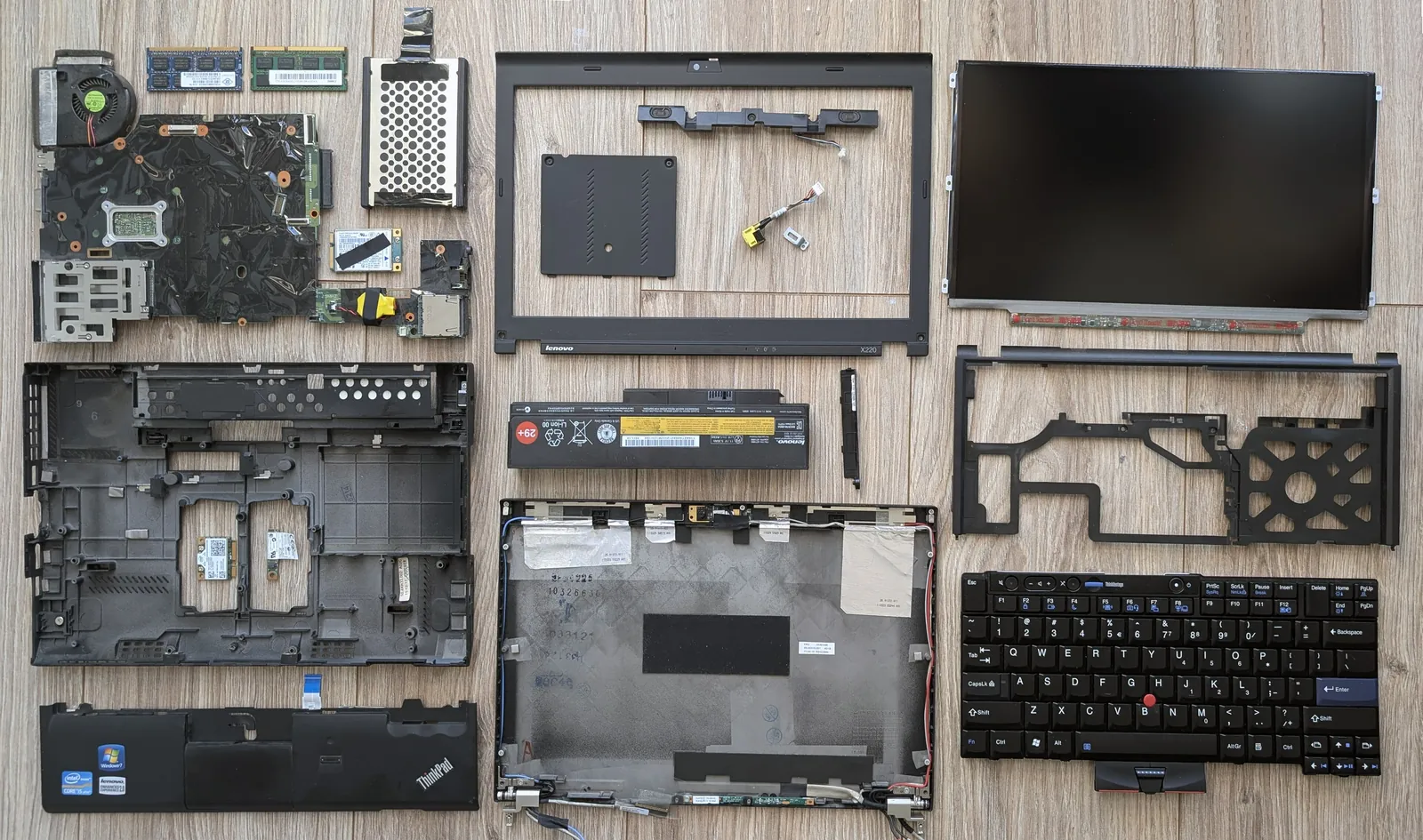
ADEME's calculation rules allocate to each email a share of the emissions from manufacturing the device, in proportion to the time spent writing and reading it. On a phone, that comes to about 0.5 g per minute by our calculation, or 94% of the footprint of an email without an attachment written in 3 minutes; the network accounts for less than 1% of it. This is an accounting allocation: the phone has already been made, and writing faster does not reduce its emissions. Professor Chris Preist of the University of Bristol told the BBC in 2020 that not sending an email avoids well under 1 g, because devices and networks run regardless.
The effect of an attachment is much less certain. The same rules add about 1 g per megabyte, assuming the email is kept for 10 years in 6 copies, 3 held by the sender and 3 by the recipient; their authors note that this storage calculation needs explaining. ADEME also publishes a storage reference point, 0.24 g for 1 GB (1,000 MB) kept for 1 year, which gives about 70 times less for the same duration and number of copies (our calculation).
The footprint of an email tracks the time spent writing it: about 0.5 g per minute on a phone
An email written on a phone, in gCO2e, by writing time.
- Phone manufacturing
- Electricity, network and data centres
- 1 MB attachment: range between the 2 storage assumptions
- Written in 1 minute · manufacturing: 85%0.66 g
- Written in 3 minutes · manufacturing: 94%1.6 g
- Written in 10 minutes · manufacturing: 97%5.1 g
- In 3 minutes, with a 1 MB attachment1.7 to 2.7 g
The same uncertainty applies to deleting emails. The authors of a Canadian study from 2022 write in The Conversation that deleting 1,000 emails avoids about 5 gCO2e. For 1,000 emails of 1 MB kept for 10 years in 6 copies, ADEME's storage reference point gives about 14 g and its email calculation rules about 1 kg, or about 20% of a beef meal.
The best-established effect comes from device lifespan. By our calculation, keeping a phone for 4 and a half years instead of 2 and a half brings an email without an attachment down from 1.6 g to 1 g. According to ADEME, manufacturing a laptop emits 182 kgCO2e, so keeping it for 7 years instead of 5 avoids 10 kgCO2e a year. The ADEME page of October 2025 that advises clearing out your inbox also recommends keeping your computer for 4 years rather than 2, and French law provides for a right to repair (in French).
4An email, an AI question and an hour of video
In Impact CO2, the reference value for 1 hour of video streaming is 64 gCO2e, equivalent to 26 emails at 2.46 g, while a web search comes to 1.2 g. These values include devices, as the email value does. How much an hour of video emits depends mainly on the screen and the network.
A written question to an AI emits about 0.13 gCO2e on the server side with global average electricity, based on an energy use of 0.3 Wh (watt-hour) estimated by Epoch AI. That is the same order of magnitude as the 0.11 g of an email without an attachment, with the manufacture of the device excluded from each of the 2 cases. The 2 figures do not cover the same emission sources and do not say which emits more: see how much energy a ChatGPT query uses.
Taken one by one, these uses are measured in grams. The environmental impact of AI plays out at the scale of data centres, and can be reduced through other actions.
5Key takeaways
- A 1 MB email emits about 2.5 gCO2e according to ADEME's reference value, which includes the manufacture of the devices; an email without an attachment, written in 3 minutes on a phone, emits 1.6 g by our calculation.
- It takes about 2,000 emails at 2.5 g each to match a beef meal, and 840,000 to match a return flight between Paris and New York.
- Without an attachment, most of the footprint of an email is a share of the emissions from manufacturing the device: about 0.5 g for each minute of writing on a phone, by our calculation.
- Keeping your devices for longer has the best-established effect: using a laptop for 2 more years avoids 10 kgCO2e a year.
Further reading: the digital carbon footprint of a company, the carbon footprint of a website and the carbon footprint of an AI-generated image.
- The current figure: ADEME, Impact CO2, "Email" simulator and API values, digital usage, accessed on 3 October 2026; ADEME, calculation rules publicodes-acv-numerique, version 2.1.2, and Impact CO2 site code for the simulator's default settings, read on 4 October 2026; ADEME, Impact CO2, data storage and laptop, accessed on 3 October 2026. The Impact CO2 site is in French.
- The history of the figure: Mike Berners-Lee, How Bad Are Bananas? The Carbon Footprint of Everything, 2010 and revised edition of 2020, values read in The Carbon Literacy Project, The Carbon Cost of an Email, 2018, and The Carbon Cost of an Email: Update!, 2022; ADEME and BIO Intelligence Service, Comparative analysis of the environmental impacts of electronic communication (in French), July 2011; ADEME, Base Carbone, version 23.6, values "1 email" and "1 email with an attachment" (entry names translated from French), created on 5 November 2014; AlloForfait, Digital impact: ADEME revises its figures downwards (in French), 22 November 2022; BBC News, Can sending fewer emails really save the planet?, 19 November 2020, read in the republished version by the Paper Industry Technical Association.
- Putting it in perspective: ADEME, Impact CO2: beef meal, combustion-engine car, Paris-New York return flight, video streaming, web search, accessed on 2 and 3 October 2026; SDES (the statistics service of the French Ministry of Ecological Transition), France's carbon footprint from 1990 to 2024 (in French), 2025; The Radicati Group, Email Statistics Report, 2023-2027, 2023; Rodrigues Viana et al., Sending fewer emails will not save the planet!, Sustainable Production and Consumption, 2022, of which we read only the abstract, and the article by the same authors in The Conversation, date not read; ADEME, How to limit the impacts of digital technology at the office? (in French), 31 October 2025; Epoch AI, How much energy does ChatGPT use?, 2025; IEA (International Energy Agency), Electricity 2026.
- Images: Opening photo: SarKaLay, Wikimedia Commons, CC0, cropped. Rib of beef: Arnaud 25, Wikimedia Commons, CC0. Boeing 777: Eric Salard, Wikimedia Commons, CC BY-SA 2.0. Disassembled laptop: Siarhei V, Wikimedia Commons, CC BY-SA 4.0.