

- 1For its CSRD report, a customer can only require energy use and scopes 1 and 2.
- 2This cap protects suppliers with 1,000 employees or fewer, even those established outside the EU.
- 3CBAM requires the verified emissions of the plant for 6 product groups.
- 4The PPWR, the EUDR and the GHG Protocol impose no emissions data on the supplier.
A Turkish steel tube manufacturer supplying a German industrial group can receive 2 requests for carbon data in the same month. Its customer's purchasing department sends a questionnaire that cites the CSRD and "scope 3". The importer clearing the tubes through customs asks for the emissions of its plant, verified, for CBAM. The first concerns the company as a whole, the second each tonne delivered, and they do not rest on the same text.
Data each EU text asks of a supplier
Only CBAM asks for a plant's emissions. For its report, a customer subject to the CSRD can only require energy and scopes 1 and 2 from a supplier with 1,000 employees or fewer.
Sources: Directive (EU) 2026/470; Delegated Regulation (EU) 2026/1560, Annex II (CSRD thumbnail, document cited); Regulations (EU) 2025/2083, 2025/2621, 2025/40 and 2023/1115; GHG Protocol, Scope 3 Standard.
EU law sets a limit on the first and a method for the second. For its sustainability statement, a customer subject to the CSRD can only require from a supplier with 1,000 employees or fewer the information in the voluntary standard, even when that supplier is established outside the EU. The sections below take the texts one by one, then the response that covers them all.
1What scope 3 data requests does a supplier receive?
Carbon data requests fall into 3 groups: the company's footprint over a year, the footprint of a product and the emissions of a delivery. Our article on how to answer a customer who asks for your carbon data describes each one and how to calculate it. What mainly changes from one customer to the next is the text behind the request, and therefore what the supplier can refuse.
4 EU texts and 1 voluntary framework keep appearing in the questionnaires an EU customer sends its suppliers:
- The Corporate Sustainability Reporting Directive (CSRD), amended by the Omnibus Directive of 24 February 2026, which applies to the customer and limits what it can require from its suppliers.
- The Carbon Border Adjustment Mechanism (CBAM), which makes the importer pay for the carbon emitted outside the EU to manufacture 6 product groups.
- The Packaging and Packaging Waste Regulation (PPWR), applicable since 12 August 2026, which requires packaging suppliers to document conformity.
- The EU Deforestation Regulation (EUDR), applicable on 30 December 2026, except to micro and small enterprises, which requires the exact origin of 7 commodities.
- The GHG Protocol, a private, voluntary framework that most large customers follow to calculate their scope 3, and which explains the shape of their questions.
A single questionnaire often mixes these sources without naming them. The supplier's work therefore starts by linking each question to its text, because the text says whether an answer is owed, to whom and in what form. A question with no text behind it is a matter of contract or of the commercial relationship.
2What can a CSRD customer require from its suppliers?
Under the Omnibus Directive, from financial years 2027 the CSRD only covers companies with more than 1,000 employees and more than €450 million in turnover. It requires them to describe their value chain, and this obligation is what produces the questionnaires. The same directive limits what they can require from their suppliers.
The value chain cap for 1,000 employees or fewer
Directive (EU) 2026/470 creates a category of protected undertakings: those with an average of 1,000 employees or fewer over the previous financial year that are part of the value chain of a reporting customer. The customer may rely on their self-declared size without checking it, unless it knows the declaration to be clearly false. For its sustainability statement, it cannot ask them for more than the voluntary standard adopted by the Commission.
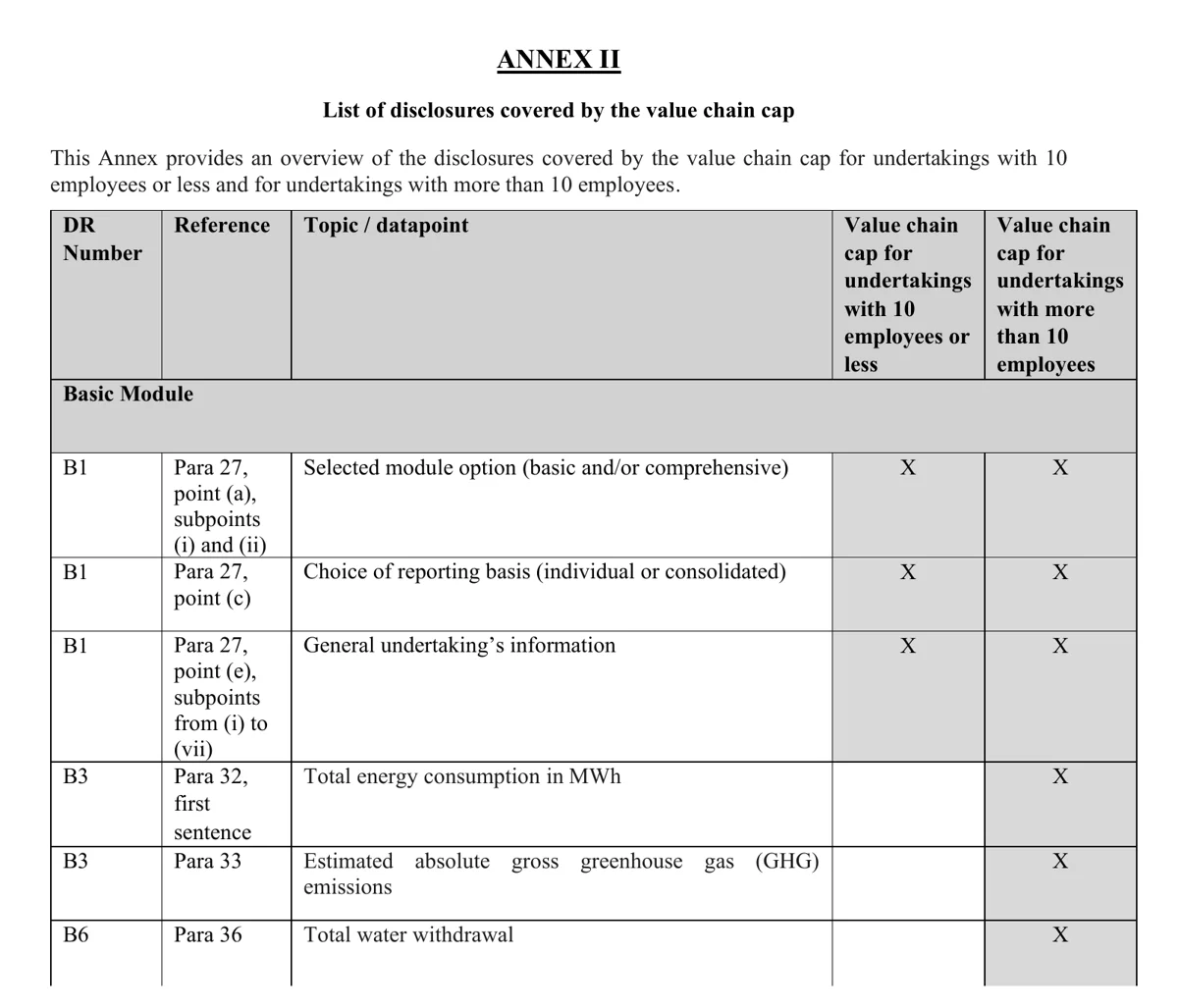
That standard is Delegated Regulation (EU) 2026/1560 of 3 July 2026, derived from EFRAG's VSME standard. Its Annex II sets the exact list of information that may be required. On climate, it is limited to energy consumption in megawatt hours (MWh) and gross scope 1 and 2 emissions, with scope 2 calculated on a location basis. For a company with 10 employees or fewer, it includes no climate data at all.
The cap applies to financial years starting on or after 1 January 2027, and Member States must transpose the directive by 19 March 2027 at the latest. A customer that asks for more must tell the supplier which information goes beyond the standard and remind it of its right to refuse. A contract clause that goes further, for reporting purposes, is not binding.
Requests outside the cap
The cap only applies to requests made for the sustainability statement. The directive excludes 3 situations:
- Voluntary sharing of information, in particular information that a sector already routinely exchanges between customers and suppliers.
- An obligation set by a contract, or by another EU or national text, as long as it stays within the limit of the voluntary standard.
- Requests made for another purpose, such as the due diligence duty under Directive (EU) 2024/1760 or the customer's risk management.
The directive also states that it places no obligation on the supplier to provide anything. A customer that obtains nothing completes its report with estimates, and the text expressly provides for this. The delegated regulation also encourages banks and insurers to keep to the voluntary standard for requests made outside the sustainability statement, which the cap does not cover. Our article on whether scope 3 reporting is mandatory looks at these limits from the customer's side.
Suppliers established outside the EU
Neither the directive nor the delegated regulation reserves this protection for companies established in the EU. The directive defines a protected undertaking by 2 criteria only, its size and its place in the value chain, and Article 1 of the delegated regulation uses the same definition. A Turkish, Moroccan, Indian or Chinese manufacturer with 400 employees can therefore invoke the cap against its German customer, provided the request serves the sustainability statement.
The protection works through the law that binds the customer, that of the Member State where it publishes its report. The Q&A published by the Commission on 6 May 2026 does not deal with this case separately, and nothing in the text excludes it. The supplier has no formalities to complete, other than declaring its size. An EU SME is in the same position, as our guide to the CSRD after the Omnibus shows, and the revised ESRS set what the customer must publish on its side.
For its sustainability statement, an EU customer can only require energy use and scopes 1 and 2 from a supplier with 1,000 employees or fewer, wherever that supplier is established.
3What does CBAM require from a producer outside the EU?
CBAM is the only EU text that makes an amount payable depend on the emissions of a plant located outside the EU. It is not addressed to the supplier but to the importer, which needs the plant's figures to avoid paying on a standard value.
Products covered
The definitive period has applied since 1 January 2026 to 6 product groups: iron and steel, aluminium, cement, fertilisers, electricity and hydrogen. Regulation (EU) 2025/2083, in force since 20 October 2025, exempts importers that bring in 50 tonnes or less a year of iron, steel, aluminium, fertilisers and cement, all these goods combined. Electricity and hydrogen have no threshold.
A customer that imports 20 tonnes of covered goods in the year therefore has no CBAM declaration to file, and no reason to ask for the plant's emissions. Our explanation of CBAM details the customs codes covered, and our article on the phase-out of free allowances explains why the EU linked the 2 mechanisms.
How a plant's emissions reach the CBAM declaration
Top: the route for actual emissions. Dashed: what happens without them.
1. The plant outside the EU
Calculates its emissions per type of goods.
2. The accredited verifier
Verifies the calculation; the plant keeps the records for 4 years.
- O3CI portalfor plants outside the EU only
3. The CBAM registry
Registration for 5 years, data kept confidential.
4. The importer
Receives the data through its EORI number and uses it in its declaration.
Declaration by 30 September 2027 at the latest, for 2026.
Without verified data, the importer skips steps 2 and 3: it declares the default value the Commission publishes for the product and the country, with a mark-up.
Fertilisers: +1% every year.
Sources: Regulation (EU) 2025/2083, Articles 6, 10 and 22; European Commission, CBAM Registry and Reporting; Implementing Regulation (EU) 2025/2621, Annex I.
Emissions per installation
The emissions requested are those of the installation that produced the goods, their "embedded emissions" per tonne of product, calculated using the method set by the regulation. The plant operator determines them, has them verified by an accredited verifier and keeps the records for 4 years. Our article on choosing a CBAM verifier describes this step.
The operator may register in the CBAM registry for 5 years, through the O3CI portal, which is reserved for plants located outside the EU. It uploads its data and verification report once, then shares them with each importer that has given it its EORI number, the EU customs identifier. The data remain confidential, and the importer carries them straight into its declaration.
Default values
Without verified data, the importer declares the default value that the Commission publishes for the product and the country of origin. Implementing Regulation (EU) 2025/2621 marks it up by 10% in 2026, then 20% in 2027 and 30% from 2028, except for fertilisers, marked up by only 1%. The first annual declaration is due by 30 September 2027 at the latest, for 2026 imports.
The supplier is not required to respond. Without its figures, its customer pays on the marked-up value, which costs it more, unless the plant emits more than that value. Our article on default values versus actual emissions puts a figure on this gap plant by plant, and the one on the cost of CBAM converts it into euros per tonne.
4Do the PPWR and the EUDR ask for emissions?
No. These 2 regulations move a great deal of information between suppliers and customers, and none of it concerns greenhouse gases. They still turn up in the same questionnaires, often next to a carbon question.
Packaging
Article 16 of Regulation (EU) 2025/40, applicable since 12 August 2026, requires suppliers of packaging or packaging materials to provide the manufacturer with all the information and documentation it needs to demonstrate conformity. This covers the requirements of Articles 5 to 11: substances, recyclability, recycled content, bio-based materials, compostability, minimisation and reuse. None of them asks for emissions.
A packaging carbon footprint requested in a "PPWR" questionnaire therefore has no basis in the regulation and is a matter of contract. Our article on the PPWR technical documentation lists the evidence expected from the supplier, and the one on the declaration of conformity sets out what it contains.
Deforestation-linked products
Regulation (EU) 2023/1115 applies on 30 December 2026, and on 30 June 2027 for micro and small enterprises, except for wood. It covers cocoa, coffee, palm oil, soy, rubber, wood and cattle. The operator placing the product on the market must obtain from its suppliers the geolocation of the plots of land and evidence that they have not been deforested after 31 December 2020.
Carbon does not appear in it, even though cleared forest emits a great deal. Our article EUDR: who is affected? details this data, and the one on traceability tools explains how to collect it.
5Is a supplier bound by the GHG Protocol?
No. The GHG Protocol is a private, voluntary framework that only binds the companies that choose to follow it. It nonetheless explains the shape of most questionnaires, because large customers apply it to calculate their scope 3, and the CSRD refers to it.
Why the customer wants supplier-specific data
The 2011 Scope 3 Standard requires a customer that follows it to report the share of its emissions calculated with data from its suppliers. This percentage appears in its report, so the customer tries to raise it. The standard lists what it may ask for: the year's scope 1 and 2 emissions, product footprints, the allocation method and any verification.
The 4 methods for purchased goods
For category 1, purchased goods and services, the GHG Protocol Technical Guidance describes 4 methods, from the most precise to the most approximate:
- The supplier-specific method uses the cradle-to-gate footprint of the purchased product, calculated and provided by the supplier itself.
- The hybrid method combines the supplier's scope 1 and 2 emissions, allocated to the purchased product, with its purchases of materials and energy converted with emission factors, and average data for any gaps.
- The average-data method multiplies the quantities purchased, in kilograms or units, by an industry-average emission factor.
- The spend-based method multiplies the amount spent by an emission factor per euro, taken from an economic database.
Supplier data used by each method for purchased goods
The 4 methods for scope 3 category 1, from the most precise to the most approximate.
Based on GHG Protocol, Technical Guidance for Calculating Scope 3 Emissions, category 1, Figure 1.1 (2013); cap: Delegated Regulation (EU) 2026/1560, Annex II.
The hybrid method starts from the data the cap covers, the supplier's scope 1 and 2 emissions. It also needs an allocation key for the purchased product, which the cap does not cover but which the supplier has an interest in offering. A supplier that provides these figures lets its customer move away from the spend-based calculation without handing over a product footprint. Our scope 3 guide details the 15 categories, and our article on verifying supplier data shows what the buyer checks.
A supplier's scope 1 and 2 emissions are enough for its customer to move from the spend-based calculation to the GHG Protocol hybrid method.
The revision under way
The GHG Protocol is rewriting its corporate standards. Its announcement of 29 July 2026 plans a joint standard with ISO, which will bring together the 2004 Corporate Standard, the Scope 2 Guidance, the Scope 3 Standard and ISO 14064-1. The public consultation is planned for the second quarter of 2027, and publication for the fourth quarter of 2028. Until then, the 2011 standard remains the reference for questionnaires, and our article on the GHG Protocol compared with the Bilan Carbone® (the French carbon accounting method) summarises its logic.
6What to include in your response to an EU customer
A response that covers these texts fits into a few documents, to be updated every year at the close of the accounts. It is prepared once and reused from one customer to the next, whatever the form of the questionnaire.
The parts of a supplier response and their legal basis
Prepared once, at year-end closing, and reused from one customer to the next.
For every customer
- 1Energy consumption, in MWhfor the closed yearVoluntary standard, B3 paragraph 32
- 2Scope 1 and 2 emissionslocation-based scope 2, dated factorsVoluntary standard, B3 paragraph 33; hybrid method
- 3Allocation key and quantities deliveredphysical where possibleGHG Protocol; outside the cap, worth offering
Depending on the product
- 4Verified emissions per installationsteel, aluminium, cement, fertilisers, hydrogenCBAM, registry
- 5Conformity documentationpackagingPPWR, Article 16
- 6Geolocation of the plotscoffee, cocoa, soy, wood, rubberEUDR
Outside the cap: scope 3 and the product footprint. For its sustainability statement, the customer cannot require them from a supplier with 1,000 employees or fewer; the supplier may provide them if it has them.
Sources: Delegated Regulation (EU) 2026/1560, Annex II; Regulations (EU) 2025/2083, 2025/40 and 2023/1115; GHG Protocol, Scope 3 Standard (2011).
The baseline for every customer
3 documents are enough to meet the CSRD cap and the GHG Protocol hybrid method:
- Energy consumption for the closed year in megawatt hours, the only energy figure covered by the cap, ideally with electricity taken from invoices and fuels shown separately, as the voluntary standard suggests.
- Scope 1 and 2 emissions, with scope 2 calculated on a location basis, and the source and year of each emission factor used.
- The allocation key proposed to the customer, physical where possible, and the quantities delivered to it during the year.
How to allocate a footprint between customers is explained in our article on how to answer a customer who asks for your carbon data. The other Annex II information, water withdrawn, waste and headcount, is prepared in the same way, from invoices and the staff register.
Additional documents by product
Depending on the products delivered, 3 documents may be added to the baseline, each based on a different text:
- For steel, aluminium, cement, fertilisers or hydrogen, the verified embedded emissions of each installation, per product, preferably uploaded to the CBAM registry.
- For packaging, the PPWR conformity documentation, with the tests and certificates that prove recyclability, recycled content and the absence of restricted substances.
- For coffee, cocoa, soy, wood or rubber, the geolocation of the plots of land and the evidence required by the Deforestation Regulation.
Scope 3 and product footprints
For the sustainability statement, scope 3 and product footprints go beyond the cap, and a supplier with 1,000 employees or fewer may refuse them by citing its right. It may also provide them, if it has them, because real data replaces an estimate that the customer would make anyway. A product footprint generally follows ISO 14067, and its third-party verification is prepared separately.
The CDP and EcoVadis questionnaires serve the customer's purchasing first. The cap only applies to them if the answers feed into its sustainability statement, which the customer must then say. A full footprint, scope 3 included, remains useful for the supplier itself, as our article on verifying an in-house Bilan Carbone® points out.
At Projet Celsius, we think a supplier established outside the EU benefits from preparing its scope 1 and 2 emissions every year in the voluntary standard format, together with its energy consumption. This is the limit its customers cannot exceed for their reporting, the data the GHG Protocol hybrid method expects, and the starting point for the installation-level calculation CBAM requires. By sending it before anyone asks, the supplier sets the presentation of its own figures for all its customers.
7Key takeaways
- Every carbon data request links back to a text: the CSRD, CBAM, the PPWR, the EUDR or the GHG Protocol, and only that text says whether an answer is owed.
- For its sustainability statement, a customer can only require energy consumption and scopes 1 and 2 from a supplier with 1,000 employees or fewer, from financial years 2027.
- This protection also applies to a supplier established outside the EU: the directive only looks at its size and its place in the value chain.
- CBAM requires the verified emissions of each plant for 6 product groups; without them, the importer pays on a marked-up default value.
- The PPWR, the EUDR and the GHG Protocol impose no emissions data on the supplier, and scope 3 remains a commercial request it can decline.
For the response itself, allocation key and methodology note included, read how to answer a customer who asks for your carbon data, and for the buyer's point of view, how it verifies its suppliers' data.
- Directive (EU) 2026/470 of 24 February 2026, known as Omnibus I, Article 1(4), amending Article 19a(3) of Directive 2013/34/EU (protected undertakings, right to refuse, self-declaration, estimates), amended Article 40a and Article 5 (transposition by 19 March 2027), OJ of 26 February 2026, accessed 24 November 2026
- European Commission, DG FISMA, Q&A on the value chain cap, 6 May 2026, accessed 24 November 2026
- European Commission, Delegated Regulation (EU) 2026/1560 of 3 July 2026, OJ of 21 September 2026, standard for voluntary use, Articles 1 to 4 and recitals 4 to 7 (Council document ST 11697/26), Annex I, paragraphs 32 and 33, and Annex II (Council document ST 11697/26 ADD 1), accessed 24 November 2026
- Regulation (EU) 2025/2083 of 8 October 2025 simplifying CBAM (50-tonne threshold, registration of third-country operators, declaration by 30 September, sale of certificates from 1 February 2027), OJ of 17 October 2025, accessed 24 November 2026
- European Commission, DG TAXUD, CBAM Registry and Reporting (O3CI portal for third-country operators) and CBAM page, accessed 24 November 2026
- Implementing Regulation (EU) 2025/2621 of 16 December 2025, CBAM default values and their gradual mark-up from 2026 to 2028 (1% for fertilisers), OJ of 31 December 2025, accessed 24 November 2026
- Regulation (EU) 2025/40 of 19 December 2024 on packaging, Articles 5 to 11, 16 and 71, accessed 24 November 2026
- Regulation (EU) 2023/1115 on deforestation-free products, consolidated version of 18 September 2026
- GHG Protocol, Corporate Value Chain (Scope 3) Accounting and Reporting Standard, 2011, chapters 7 and 11, and Technical Guidance for Calculating Scope 3 Emissions, category 1, 2013
- GHG Protocol, announcement of 29 July 2026 on standard development updates, accessed 24 November 2026