
- 1CBAM lets you choose, plant by plant, between default values and actual embedded emissions.
- 2Default values carry a 10% mark-up in 2026, rising to 30% in 2028.
- 3Actual data pays off when the plant emits less than the marked-up default value for its country.
- 4Only the supplier can have its emissions verified, before the declaration due on 30 September 2027.
A CBAM default value is the flat-rate figure the European Commission publishes for each product and each country: the average intensity of the country's plants, in tonnes of CO2 equivalent (tCO2e, the common unit for greenhouse gases) per tonne of product, plus a mark-up. Actual embedded emissions are the figure of the plant that made the goods, calculated under the EU methodology and verified by an accredited body. For 1 tonne of hot-rolled steel coil made in China, the default value is 3.187 tCO2e, or 3.506 tCO2e with the 2026 mark-up.
What a plant's actual emissions save, per tonne of steel
4 Chinese steel coil plants, built for this example. The alternative is the Commission's flat-rate figure, with its mark-up.
marked-up default valueactual emissions, blast furnace route
On 1,000 tonnes a year, this plant's actual data saves €107,000 in 2026 and €160,000 in 2028, to set against the cost of its verification.
The chart above compares 4 Chinese plants built for this example, at the certificate price published for the third quarter of 2026, €82.32. The sections below go through this calculation, then set out which documents to request from the supplier and by when.
1Which figure do you declare for each imported tonne?
For each imported tonne, the importer must state how much carbon was emitted to produce it. Article 7 of Regulation (EU) 2023/956 gives it 2 ways to do so: the plant's actual emissions, or the default value for the plant's country.
The default value
The Commission sets a value per country and per customs code, in Annex I to an implementing regulation corrected in July 2026. A country missing from the list takes the value for "other countries", calculated on the 10 highest-emitting countries: 4.049 tCO2e for hot-rolled coil. The same mechanism applies to reinforcing bars, which carry real weight in the footprint of a new building. The mark-up is then added, calculated by the CBAM registry:
- For steel, aluminium, cement and hydrogen, it is 10% in 2026, 20% in 2027, then 30% from 2028.
- For fertilisers, it stays at 1% from 2026, a lower rate that the Commission justifies by the specific situation of that sector.
The Commission explains this increase by the small number of verifiers available in 2026, then by the aim of pushing importers towards actual data. The Directorate-General for Energy and Climate (DGEC), the competent authority in France, presents these values as the upper bound of the cost, based on penalising assumptions.
Actual emissions
Actual emissions are calculated at the plant, using the methodology of Implementing Regulation (EU) 2025/2547: a monitoring plan written in English, an annual emissions report, then verification by an accredited verifier in the EU. Emission factors taken from a life cycle assessment or a database are not accepted, according to the Commission's FAQ.
For steel and aluminium, only the plant's direct emissions count, as within the boundary of an industrial site footprint. For cement and fertilisers, the electricity consumed is added. The calculation follows the EU methodology, in the same logic as a verified product carbon footprint, over the boundary set by the regulation.
The benchmark deducted
From each tonne, the importer deducts a benchmark: the intensity of an efficient European producer, multiplied by a factor of 97.5% in 2026. This benchmark follows the reporting method. With default values, it takes the production route the Commission assigns to the country: the blast furnace for Chinese coil, i.e. 1.370 tCO2e. With actual emissions, it follows the plant's own route: 0.072 tCO2e for an electric furnace melting scrap, under Implementing Regulation (EU) 2025/2620.
The gap between the 2 options therefore cannot be read from emissions alone. The detailed calculation, country by country, is in our article on the cost of CBAM.
2How much do the plant's own figures save?
Our calculation covers 4 Chinese suppliers of hot-rolled coil, built for this example: typical plants, not real companies. The certificate price is held at €82.32 for 2026, 2027 and 2028, and the factor falls from 97.5% to 95%, then to 90%. With the default value, 1 tonne costs €179 in 2026, €208 in 2027 and €240 in 2028.
The efficient blast furnace
A blast furnace plant emitting 2.2 tCO2e per tonne, well below the Chinese average, pays €71 per tonne with its actual emissions. Actual data saves it €107 per tonne in 2026, then €160 in 2028, when the mark-up reaches 30%.
The plant at the national average
A plant emitting exactly the national average, 3.187 tCO2e, saves only the mark-up: €26 per tonne in 2026, €52 in 2027 and €79 in 2028. For 1,000 tonnes a year, the gap reaches €26,000 in 2026 and €79,000 in 2028. It has to be weighed against the supplier's verification quote, for which no public fee schedule exists.
The plant above the average
A plant emitting 4.0 tCO2e per tonne pays €219 with its actual emissions, i.e. €41 more than with the default value in 2026, and still €14 more in 2027. The gap only reverses in 2028: the default value marked up by 30% rises to 4.14 tCO2e, and actual data then saves €12.
For this supplier, declaring the default value is the better option in 2026, even if the plant offers its verified emissions. The law allows the 2 methods, and the Commission's FAQ only states that actual values should be more favourable in most cases.
Within the same production route, actual data pays off as soon as the plant emits less than its country's marked-up default value.
The scrap-fed electric furnace
A plant melting scrap in an electric furnace emits about 0.6 tCO2e per tonne. Its benchmark falls to 0.072 tCO2e, but its emissions remain far below the default value. Actual data saves €135 per tonne in 2026 and €196 in 2028: the widest gap of the 4 cases.
This calculation relies on intensities that no importer knows in advance. It therefore has to be redone line by line, with an estimate for each plant, starting from the data suppliers can already produce.
3Can you mix default and actual values in one declaration?
Yes. The annual declaration is broken down by plant, country of origin and product, under Article 6 of the regulation. No text requires a single choice across an importer's whole portfolio.
Several suppliers
A Korean supplier that sends a verified report is declared with actual emissions, and an Indian supplier that does not, with the marked-up default value. The lines are calculated separately, and the mark-up applies only to the latter. On the supplier side, the request resembles those described in our article on customers asking for carbon data.
What is declared as actual and as default in a single declaration
3 plants built for this example, all supplying the same importer.
No text requires a single choice for the whole portfolio. Each line follows the data its plant has had verified, and the mark-up applies only to the default lines.
Sources: Regulation (EU) 2023/956, Article 6; Implementing Regulation (EU) 2025/2547, Article 15; Implementing Regulations (EU) 2025/2621 and 2026/1740, Annexes I and IV.
Precursors
A complex good, such as a welded tube, contains a precursor: the coil bought to make it. Article 15 of Regulation 2025/2547 allows the plant's actual process emissions to be combined with the default value of the precursor:
- If the precursor's country is known, its default value applies, with that year's mark-up.
- If the country is unknown, the value is that of the highest-emitting country: 8.230 tCO2e for coil, before the mark-up.
- No threshold allows small quantities of precursors to be left out, and a precursor made in the EU counts as zero.
The Commission's FAQ announces that the CBAM registry will share precursor emissions between plants from 2028. Until then, these data pass from supplier to supplier.
Cement and fertilisers
For cement and fertilisers, the plant's electricity enters the calculation, alongside the kiln emissions that cement makers are trying to cut through carbon capture. By default, it takes the country's average grid emission factor. The plant may use a lower factor only if it proves a direct link to a power plant or a power purchase agreement. The transitional period rule, which capped estimates at 20% of a complex good's emissions, no longer exists: the only limit on using default values is their cost.
4What data should you request from the supplier?
It is the supplier, and the supplier alone, who decides to calculate its emissions and have them verified. The Commission's FAQ is explicit: if the operator of the installation does not offer this service, the importer must use default values. The first step, according to the same FAQ, is to ask the supplier whether it intends to provide verified actual emissions.
The documents
For each plant declared with actual emissions, the importer must obtain and then keep:
- The operator's emissions report and its summary, with the minimum content set by Annex IV to Regulation 2025/2547.
- The positive verification report from an accredited verifier, covering the year of production of the imported goods.
- The emissions of purchased precursors, with their own verification report where they do not come from default values.
- Where applicable, the carbon price paid in the country of origin, with proof of payment certified by an independent person.
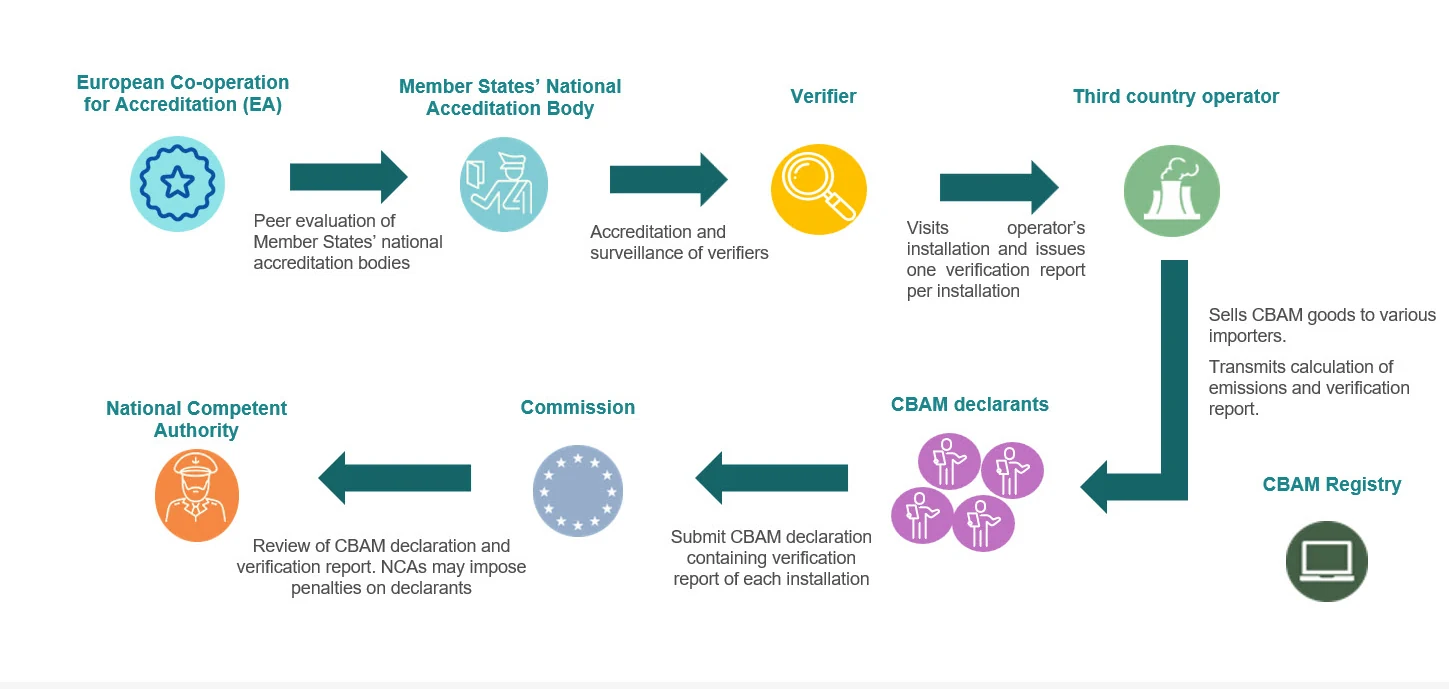
In the diagram, the accredited verifier visits the plant outside the EU and writes one report per installation. The operator sends its emissions and this report through the CBAM registry, where the authorised CBAM declarant takes them up in the declaration. The national authority may then check the declaration and penalise the declarant, solely responsible for its content.
The Commission publishes an Excel communication template, recommended but not mandatory. Its summary sheet brings together what the importer needs. The Commission's diagram below shows who produces each of these documents.
The operators' registry
The operator may register in the CBAM registry, on the Commission's portal reserved for plants outside the EU, for 5 years. Registration is recommended but optional, and it is not required in 2027: the plant can send its data directly. It does, however, protect the supplier. Through the registry, the importer sees only a summary of the operator's data, whereas outside the registry the importer must request and keep the full reports.
The importer remains solely responsible for the content of its declaration, verification report included. A verifier's error may lead to a penalty for the importer, which the national authority may reduce if the error comes from a third party. The process resembles the third-party verification of a Bilan Carbone® (the French carbon accounting method), with a different reference framework.
Fake verification offers
Only the plant that made the goods can supply verified emissions. A third party offering a verification report to an importer is, according to the Commission, probably a scam. As with the evidence required under the EU Deforestation Regulation, cost sharing and the obligation to pass on data are settled in the purchase contract, as explained in our article on the cost of CBAM.
5When do you need this data?
The timeline rests on a simple rule: for goods imported in 2026, only 2026 emissions count, verified in 2027, before the declaration due on 30 September 2027.
2026 imports
The reporting period for goods imported in 2026 is the year 2026, even if they were manufactured earlier. Without verified actual emissions for 2026, the default value applies, and no actual data is possible for goods manufactured before 1 January 2026. Accredited verifiers have been able to register in the registry since 1 September 2026. In the first year, they physically visit every plant.
Timeline for actual emissions data on 2026 imports
The 7 steps from January 2026 to December 2027, drawn to scale.
Sources: European Commission, CBAM verification page (October 2026); Regulation (EU) 2023/956, Articles 6, 20 and 22; Implementing Regulations (EU) 2025/2546 and 2025/2547.
The first verification reports are expected in January 2027, according to the Commission's verification page. As of 26 October 2026, the page announces a list of accredited verifiers but has not yet published it. The DGEC (in French) therefore advises importers to estimate the year's costs on default values.
2027 imports and beyond
From 2027, the mark-up rises to 20%, then to 30% in 2028. Actual data is therefore prepared for several years at once, with 3 points in mind:
- A plant already verified in one year may, under strict conditions, skip the physical visit in the following years, according to the Commission's FAQ.
- The quarterly advance of 50% of emissions, due from 2027, may be calculated on default values without the mark-up.
- Default values and their mark-ups will be reviewed by December 2027 at the latest, which may change the calculation for a given supplier.
The same data feed the scope 3 of the importer's Bilan Carbone®, its sustainability statement and its climate transition plan, where imported purchases often weigh heavily. European producers in the same sectors will find their obligations in our CBAM guide for manufacturers.
For us at Projet Celsius, the question to ask is not "default or actual?" for the whole company, but supplier by supplier. We rank plants by the gap between their likely intensity and their country's marked-up default value, using the year's customs declarations. Actual data is worth requesting first from the plants that are clearly more efficient, and from electric furnaces. For a plant close to or above its country's average, the default value remains the rational choice in 2026, to be reviewed before 2028.
6Key takeaways
- CBAM lets you choose, plant by plant and product by product, between the Commission's default value and the plant's verified actual emissions.
- Default values are marked up by 10% in 2026, 20% in 2027 and 30% from 2028, except fertilisers, marked up by 1%.
- On a tonne of Chinese coil, actual data saves €26 to €135 in 2026 depending on the plant, but costs more with a plant that emits more than the average.
- Only the supplier can have its emissions verified: without a verified 2026 report, the default value applies to the declaration due on 30 September 2027.
The CBAM cost per tonne, country by country and up to 2034, is detailed in our article on the cost of CBAM.
- European Parliament and Council, Regulation (EU) 2023/956 establishing CBAM, consolidated version as at 20 October 2025, Articles 6, 7, 8, 9, 10, 20 and 22 and Annex IV, EUR-Lex.
- European Commission, Implementing Regulation (EU) 2025/2621 on default values, 16 December 2025, and Implementing Regulation (EU) 2026/1740 replacing its Annexes I and IV, Official Journal of 31 July 2026.
- European Commission, Implementing Regulation (EU) 2025/2547 on the methods for calculating embedded emissions, 10 December 2025, Articles 7, 10, 11 and 15.
- European Commission, Implementing Regulation (EU) 2025/2546 on verification principles, recital 21.
- European Commission, Implementing Regulation (EU) 2025/2620 on the adjustment for free allocation and CBAM benchmarks, Annex, point 5.3.
- European Commission, CBAM Questions and Answers, update of 15 October 2026 (PDF), questions 1.15, 4.18, 4.24, 4.25, 5.10 to 5.13, 5.15, 5.17, 5.18 and 5.20.
- European Commission, Verification of CBAM emissions, timeline and diagram of the parties involved, accessed 26 October 2026.
- European Commission, Guidance No. 2, Quick guide for non-EU operators, 14 August 2026 (operators' registry, confidentiality, precursors).
- European Commission, CBAM certificate prices, €82.32 for the third quarter of 2026, published on 5 October 2026.
- Directorate-General for Energy and Climate (DGEC), CBAM page, updated 16 October 2026, and importer's practical guide, with the DGDDI (the French customs authority), 19 January 2026 (PDF). Both are in French.