

- 1A "net zero" target displayed to consumers calls for a plan verified by an independent expert.
- 2In France, the EmpCo rule awaits its law, but a misleading commitment can already be penalised.
- 3SBTi validates the target, and from 2027 whether a plan exists, but not whether it is feasible.
- 4Entrust the verification to a different firm from the one that wrote the plan.
Directive (EU) 2024/825, known as EmpCo (Empowering Consumers for the Green Transition), requires a company that writes "net zero by 2040" on its e-commerce website to be able to show a detailed and realistic plan. That plan is regularly verified by an independent third-party expert, whose conclusions are accessible to consumers. The rule has applied since 27 September 2026 in the countries that have transposed the directive. In France, it still awaits its law, and the French Consumer Code already penalises a misleading environmental commitment.
A climate target displayed to consumers calls for a plan verified by an independent expert
2 answers: the third party that examines your commitment, what it looks at and what it delivers.
The expected third party
Plan verification by an independent expert
Alongside. SBTi validation does not replace it: SBTi verifies neither the data nor the feasibility of the plan.
This expert is not the only third party that examines a climate commitment. A body recognised by the Science Based Targets initiative (SBTi) validates a target, a statutory auditor gives an opinion on the sustainability statement, and an assessor evaluates a strategy. These processes do not look at the same thing, and none of them replaces verification of the plan.
1Which third party reviews which climate commitment?
The word "verified" covers processes that have neither the same purpose nor the same rhythm, as the timeline in the next section shows. Before asking for a quote, you need to know which one the recipient expects: a consumer, an investor, a large corporate customer or SBTi.
Verification of a target announced to consumers
The EmpCo directive covers any claim about future environmental performance, for a product or at company level, including the transition to carbon neutrality. It does not designate a verifier: according to the European Commission's questions and answers of September 2026, a private auditor or a consultancy may fill that role if it meets the conditions of independence and competence. It is the only process that judges the realism of the plan itself, review after review.
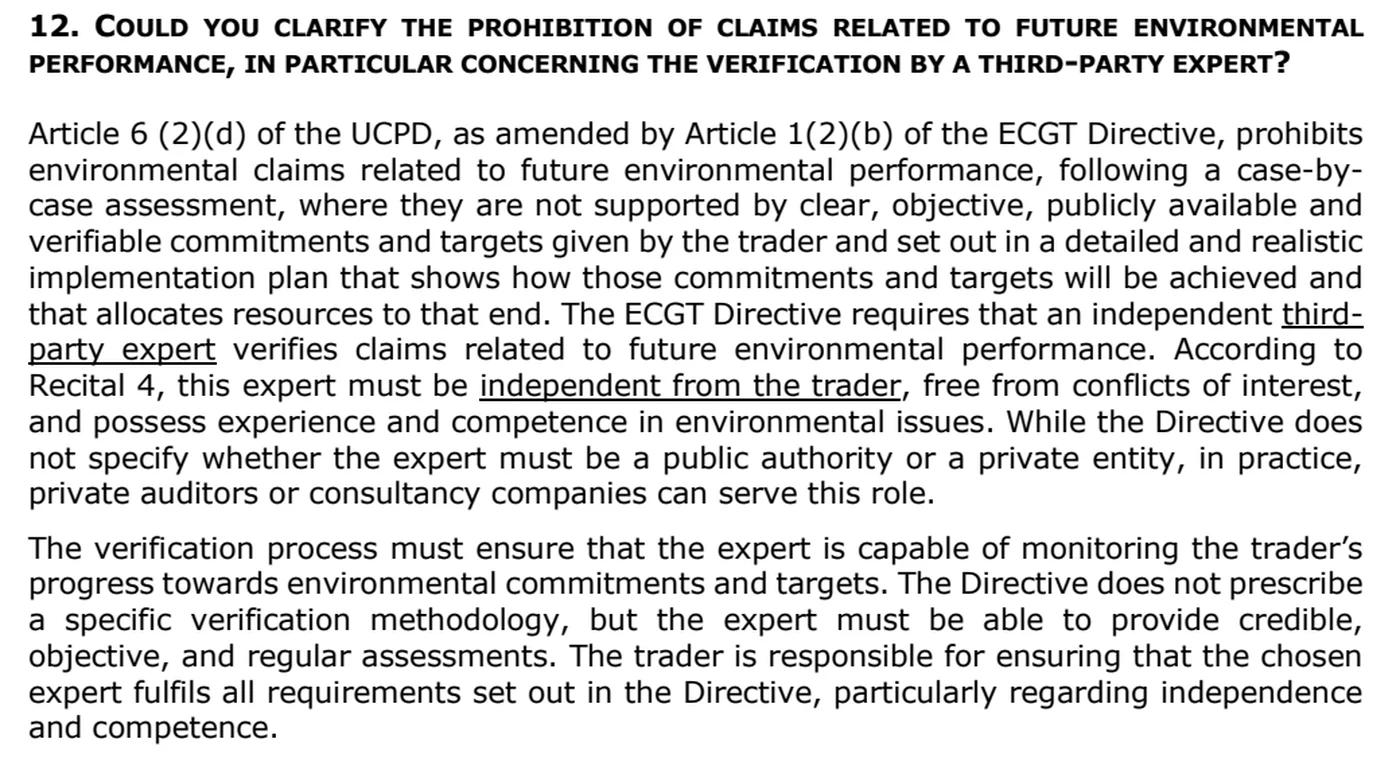
Question 12 of the Commission's questions and answers clarifies the EmpCo rule. The expert must be independent of the company, free of conflicts of interest and competent in environmental matters, and a private auditor or a consultancy may fill that role. The directive imposes no method, and it is for the company to check that the expert chosen meets the conditions. This document is not binding on the Commission: only the Court of Justice of the European Union interprets the text.
What SBTi validates
For an SBTi target, it is a validation body recognised by SBTi that checks compliance with the criteria of the net-zero standard, a process detailed in our article on SBTi targets for industrial small and medium-sized enterprises (SMEs). The standard is explicit: neither SBTi nor the validation body verifies the emissions data supplied by the company. Its version 2, published on 11 June 2026, applies from 1 February 2027, while version 1 remains open until the end of 2027. It adds 3 checks:
- SBTi will check that the company has a transition plan containing the required elements, without judging its quality, feasibility or compliance with the law, as the standard specifies.
- Category A companies, that is large companies and, in high-income countries such as France, medium-sized ones, will have their base-year inventory assured by an accredited third party, with at least limited assurance.
- An end-of-cycle assessment, carried out by the validation body within 12 months, will examine the progress reported, assured by a third party for category A.
Assurance of the sustainability statement
The sustainability statement of a company subject to the Corporate Sustainability Reporting Directive (CSRD), transition plan included, receives a limited assurance opinion every year. In France, it is issued by the statutory auditor or by a body accredited by Cofrac (the French accreditation body), according to Cofrac document INS INF 28 of March 2026. Once the Omnibus directive of 24 February 2026 has been transposed, by 19 March 2027 at the latest, the CSRD will cover only companies with more than 1,000 employees and €450 million in turnover. Our article on the CSRD for SMEs details the timeline.
Voluntary reviews
A company can also have its strategy assessed outside any obligation. The ACT initiative, launched in 2015 with ADEME (the French Agency for Ecological Transition) and CDP, offers sector-specific assessment methods carried out by an independent third party. An expert review, with no standard behind it, is used mainly to prepare for a validation or a claim. Verification of the emissions assessment itself, the basis of any plan, is a separate process, detailed in our article on third-party verification of a carbon footprint assessment (in French).
2When is verification of the plan mandatory?
Only one rule requires a climate plan to be verified by a third party, the EmpCo rule, and it does not cover every plan. The BEGES (bilan d'émissions de gaz à effet de serre), France's mandatory greenhouse gas emissions report, detailed in our BEGES guide, is not one of them. The cases break down as follows:
- A claim addressed to consumers about future performance, such as "net zero by 2040", must be backed by a plan regularly verified by an independent expert, where EmpCo has been transposed.
- The sustainability statement of a company subject to the CSRD receives a limited assurance opinion, which covers the published information, transition plan included.
- The transition plan attached to the BEGES has no verifier: the regional prefect and the president of the regional council check the consistency of the published reports.
- An SBTi target remains voluntary. Version 2 of the standard, applicable from 1 February 2027, will require category A companies to have their base-year inventory assured by an accredited third party.
The EmpCo rule is assessed case by case: a claim about the future is not prohibited in itself, it is prohibited if it is not substantiated. According to the Commission, a sustainability statement intended for investors falls outside the directive in principle, but a target that a company takes from it for an advertisement or its website comes within it. A product's carbon neutrality obtained through offsetting falls under another rule of the directive, the outright ban, detailed in our article on carbon neutrality.
Over a 5-year cycle: 2 SBTi checkpoints, 5 assurance opinions and 3 to 5 plan reviews
An example cycle. Shown as hollow markers, the reviews that are added when moving from a 2-year rhythm to an annual one.
Regular verification, every year or every 2 years
The directive says only that verification must be regular, without setting a period; the Commission cites an annual review or one every 2 years, and an additional review in the event of a significant change.
In France, pending the law
France was due to transpose the directive by 27 March 2026. It has notified the Commission of only 3 articles that already existed, and the Commission sent it a letter of formal notice on 28 May 2026. The bill adapting French law to EU law, which contains the transposition, was adopted by the Senate on 18 February 2026 and has not yet been examined by the National Assembly. Until then, the directive does not in itself create any new obligation for a French company.
Article L121-2 of the Consumer Code nonetheless already treats as misleading a practice that misleads as to the scope of the advertiser's commitments, in particular on environmental matters. The Paris Judicial Court thus held, at first instance on 23 October 2025, that the way TotalEnergies presented its carbon neutrality ambition for 2050 on its website was misleading. The EmpCo application timeline tracks the progress of the law, and enforcement and penalties have their own article.
3How to choose the expert who will verify your plan?
The directive calls for an independent third-party expert, and its recital 4 specifies 3 qualities: the expert is independent of the company, free of any conflict of interest, and has experience and competence in environmental matters. The Commission adds that it is for the company to ensure that the expert chosen meets these conditions.
Independence first
A firm that wrote the plan, quantified the levers or designed the campaign carrying the claim would be judging its own work, and has a conflict of interest in verifying it. The same logic applies to the carbon footprint assessment, as our article on verifying a carbon footprint assessment (in French) points out, and to the audit of claims. A company can entrust the writing to one firm and the verification to another.
The firm that wrote the plan is not in a position to verify it.
Questions to ask before signing
A verification quote is compared on 5 points, which should be written into the offer:
- The exact scope: which claims, media, targets and emissions scopes the expert will examine, so that its conclusions cover what is displayed.
- The method: the directive imposes none, so the expert states the criteria on which it judges the realism of the plan, the resources and the progress announced.
- The frequency: an annual review or one every 2 years, as the Commission suggests, and an additional review in the event of a significant change.
- The deliverable: conclusions written to be published, and the right to put them online, for example behind a QR code.
- The existing links with the company: consulting assignments, writing of the plan or of the communication, so that independence can be judged before signing.

No public price list sets the price of such a verification. It depends mainly on the number of targets and media to be covered, the quality of the plan and the frequency chosen.
4How does verification work, and how often?
The expert follows the plan from one review to the next, without rewriting it. The expert checks that the commitments are clear, objective, publicly accessible and verifiable, and that the plan behind them is detailed and realistic. That plan sets measurable, dated targets, including intermediate values, and the means of achieving them, such as the allocation of resources.
A review takes place in 4 stages, which the offer must describe:
- Scoping fixes the exact claim, the media where it appears and the targets covered, so that the conclusions relate to what the consumer reads.
- The document review tests the plan against its evidence: base-year emissions assessment, quantified levers, approved budgets, and indicators tracked since the base year.
- Interviews with the owners of the main levers check that the dates and budgets announced exist somewhere other than in the plan.
- The report links each finding to the requirement behind it and to a requested follow-up, then the company publishes the conclusions, and the next review starts from those follow-ups.
The frequency is not set: the directive says only that verification must be regular. Over a 5-year cycle, this verification overlaps with SBTi's milestones and the annual opinions on the sustainability statement, as the timeline above showed. The conclusions must be made available to consumers, and the Commission accepts that a QR code on the packaging or advertising material may link to the plan and the conclusions on the company's website.
The expert's report reads one line per point examined. The extract below, constructed for the article, shows the gaps that recur: levers that do not explain the whole target, resources that have not been approved, a base year that has not been recalculated, and a claim broader than the plan.
A verification report links each finding to a text and to a follow-up
Extract from a report on the plan of a fictional company: an example constructed for the article.
5What should you prepare before having your plan verified?
An expert works on evidence, and most delays come from a missing document. The file that goes through without back-and-forth brings together:
- The exact text of the claim and the list of media where it appears, website, packaging, advertising, so that the plan covers the same scope.
- The emissions assessment for the base year, with its method and scope, recalculated after any significant acquisition or disposal.
- The levers quantified in tCO2e, whose sum explains the target, each with an owner, a date and a budget.
- The management decision approving the plan and the resources, even as a range for the more distant years.
- The tracking of indicators since the base year, which will let the expert measure progress from one review to the next.

The plan itself is built with our article on the climate transition plan, which compares the requirements of the BEGES, the CSRD and EmpCo, and with the reduction levers of a carbon footprint assessment. A claim that is too broad is corrected before verification, using our list of banned environmental claims and our method for substantiating a claim.
For us, at Projet Celsius, a verification is prepared starting from the claim. The company first writes exactly what it wants to say, then checks that the plan supports it, scope by scope. A claim scaled back to what the plan demonstrates costs less than a plan inflated to fit a slogan. We build transition plans, and the rule of the trade that applies to a carbon footprint assessment applies to a plan: whoever wrote it does not verify it.
6Key takeaways
- EmpCo requires a future climate target displayed to consumers to rest on a plan regularly verified by an independent expert, since 27 September 2026 in the countries that have transposed it.
- In France, the transposition law awaits the National Assembly, but the Consumer Code already penalises a misleading environmental commitment.
- SBTi validation judges the target, and in version 2 the existence of a plan. Assurance of the sustainability statement judges the published information. Neither verifies the realism of the plan.
- The transition plan of the BEGES has no verifier, and the sustainability statement comes within EmpCo only if it is repeated in a commercial communication.
- The expert must be independent and competent, and must not have written the plan. The Commission cites an annual review or one every 2 years, with published conclusions.
To build the plan before having it verified, see the climate transition plan, and for the assessment that serves as its basis, Bilan Carbone®, the French carbon accounting method.
- European Parliament and Council, Directive (EU) 2024/825 of 28 February 2024, recital 4, Article 1 and Article 4, EUR-Lex.
- European Commission, questions and answers on Directive (EU) 2024/825, September 2026, questions 1 and 12.
- EUR-Lex, national transposition measures for Directive (EU) 2024/825, consulted on 17 October 2026.
- European Commission, letters of formal notice for failure to transpose, 28 May 2026.
- French National Assembly, bill containing various provisions adapting French law to EU law, legislative file, consulted on 17 October 2026.
- Consumer Code, Article L121-2, version in force since 28 May 2022, Légifrance. The Légifrance pages are in French.
- Paris Judicial Court, 34th chamber, judgment of 23 October 2025, case No. 22/02955, Greenpeace France, Les Amis de la Terre France and Notre Affaire à Tous v. TotalEnergies, text published by Notre Affaire à Tous.
- SBTi, Corporate Net-Zero Standard V2.0, June 2026, version history, sections A.1, A.2, B.4 and 1.1, criterion C7.
- Cofrac, INS INF 28, accreditation arrangements for the verification of sustainability statements, revision 2, March 2026.
- European Parliament and Council, Directive (EU) 2026/470 of 24 February 2026, known as Omnibus, Article 5, EUR-Lex.
- Environmental Code, Article L229-25, version in force since 3 May 2025, Légifrance.
- ACT initiative, ADEME and CDP, consulted on 17 October 2026.
- Cover photo: Aciarium, construction site for 2 electric furnaces at the voestalpine steelworks in Leoben-Donawitz (Austria), May 2026, Wikimedia Commons, CC BY-SA 4.0.


