
- 1No size threshold: an SME with 8 employees faces the same rules as a listed group.
- 2EmpCo regulates the claims companies make: the question is whether you have made a claim.
- 3B2B companies face fines and demands for evidence from clients subject to the CSRD.
- 4EU date: 27 September 2026, and France's DGCCRF already imposes penalties for misleading claims.
There is no list of companies affected by EmpCo (Empowering Consumers for the Green Transition) to consult. There are 2 criteria, neither related to company size: you address individual consumers and make environmental claims. If both apply, you are in scope. The test below establishes your position in 4 questions.
Does EMPCO cover you? Your verdict in four clicks
Four questions to assess your business: verdict, exposure level, first action and regulatory horizon. No size threshold applies.
Who do you sell to, directly or through an e-commerce channel?
Purely B2B companies are outside direct scope, but may be exposed through their clients.
This guide explains, in plain language, whether you are covered, what a claim is, the 2 decisive questions, the timeline and the sectors covered. For the abbreviation and the prohibited practices, see what is EmpCo.
1Consumer-facing environmental claims bring you into scope
As soon as you make an environmental claim to individual consumers, you are in EmpCo's scope. The message determines coverage, regardless of sector or company size.
The directive regulates claims
EmpCo regulates claims, rather than company categories: it prohibits particular wording (in French). You enter its scope as soon as you make a claim. The question to ask is therefore: have you already made an environmental claim?
B2B companies are also affected
Yes, but indirectly. A company that is 100% business-to-business (B2B) is not covered by EmpCo's blacklist, but it remains exposed to fines for misleading commercial practices, which Article L. 121-5 of the French Consumer Code extends to practices aimed at professionals. It also faces demands for evidence: its clients subject to the Corporate Sustainability Reporting Directive (CSRD) must report emissions from their value chain (its scope 3 (in French)), and public procurement bodies and clients request the same supporting documents. For a B2B company, the useful question is "are my clients exempt?", and the answer is no. In practice, a supplier of "recycled" material will have to substantiate that claim down to the technical data sheet, with traceability that also prepares for the arrival of the Digital Product Passport (in French).
2What an environmental claim means
The framework centres on the environmental claim, which Directive (EU) 2024/825 defines very broadly: any message suggesting an environmental benefit, whatever its form. This broad definition is deliberate: it covers both an explicit promise and the overall impression left with the consumer.
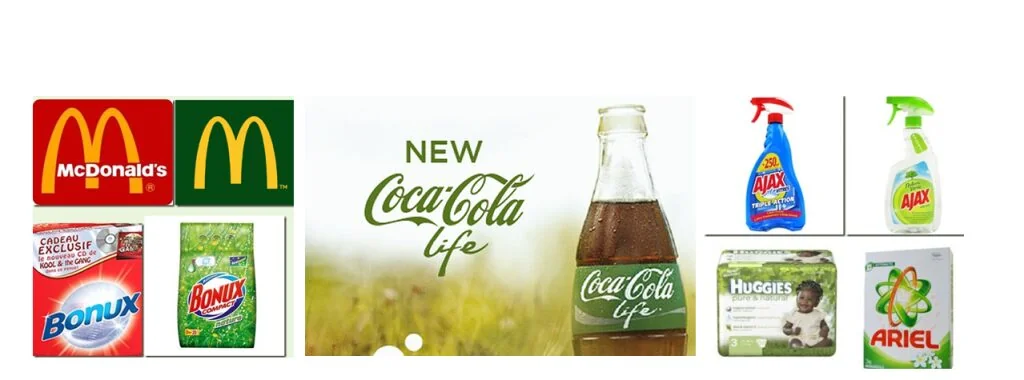
A word, a visual or a logo
- A word or phrase: "eco-friendly", "environmentally friendly", "carbon neutral".
- A visual: a leaf, a green background, a dominant colour evoking nature.
- A logo or name: a self-created label or even the brand or product name.
An implicit claim: a green leaf is enough
A claim does not need to be written. A stylised leaf on a bottle, entirely green packaging or a product range named "Nature": the visual cues act as a claim and are regulated in the same way as words. These visual cues often go unnoticed internally, even though they entail the same responsibility as a written statement.
32 criteria determine scope: consumers and environmental claims
Scope depends on 2 cumulative criteria, which must both be met:
- You address individual consumers (business-to-consumer, B2C): an online shop, a shelf display or advertising aimed at the public.
- Your message relates to the environment: a word, a visual or a label.
If either is missing, you are outside the direct scope. If both are met, you are in scope, regardless of company size.
The decisive criterion: the consumer
EmpCo falls under consumer law (Articles L. 121-2 onwards), whose purpose is to protect individuals dealing with a better-informed seller. A claim reaching a consumer may mislead them, which explains why it is regulated. In law, a "consumer" is a natural person buying outside their professional activity.
Why your size does not matter
There is no employee or turnover threshold, and this is deliberate. A consumer can be misled by a craft business just as by a multinational, so a threshold would allow small companies to mislead. A small or medium-sized enterprise (SME) with 8 employees faces the same rules as a listed group. This differs clearly from the CSRD, which will apply only above 1,000 employees and €450 million in turnover once the Omnibus is transposed. EmpCo has no such threshold: the claim made is all that counts.
4French enforcement already targets sectors with frequent claims
In practice, there is a single application date and sectors that are already under scrutiny.
The timeline in 3 dates
- 27 March 2026: deadline for transposition into French law, which was missed. The Commission sent France a letter of formal notice on 28 May 2026, along with 19 other States.
- 27 September 2026: application date set by the directive. In France, it awaits the transposing law, adopted by the Senate on 18 February 2026 and pending in the National Assembly.
- In the meantime: existing French law on misleading commercial practices and the AGEC law (France's Anti-Waste and Circular Economy Act) already impose penalties, and judges interpret it in the light of the directive.
From adoption to application
The Directive allowed 6 months between the transposition deadline and the application date. By 27 September 2026, France had still not transposed it.
Adoption of Directive (EU) 2024/825, published in the Official Journal of the European Union on 6 March 2024.
Deadline for transposition in all 27 Member States. France has not transposed it: the Commission issued a letter of formal notice on 28 May 2026.
EmpCo has applied since this date in countries that have transposed it. In France, the new prohibitions await the transposition law.
The 4 sectors most exposed to inspections
Every B2C sector making green claims is in scope, but 4 account for most DGCCRF inspections in France (the French consumer protection authority): more than 3,000 establishments visited, with serious breaches at more than 15%. These sectors have the highest concentration of claims and the weakest evidence bases:
Which sectors are at risk?
- Textiles (up to 40% non-compliance, the most inspected sector): "responsible", "recycled", "conscious". The only publicly available figure is the environmental cost (coût environnemental, also known as the French eco-score) from textile environmental labelling on Ecobalyse.
- Cosmetics (~36%): "natural", "clean", "natural origin", rarely substantiated (ISO 16128, life cycle assessment) before the campaign; see the cosmetics eco-design guide (in French).
- Consumer food products (~28%): "natural", "integrated farming" and the self-created label imitating certification. The food environmental labelling (in French) (in French) in preparation will provide the missing public framework.
- E-commerce: the platform is responsible for the claims it promotes; a "sustainable products" filter with no criteria, "carbon neutral delivery" (in French) and packaging claims regulated by the Packaging and Packaging Waste Regulation (PPWR) compound the risk.
5Our view at Projet Celsius
EmpCo places companies of every size under the same rule. In our work, we see the following effects:
- It extends risk down to micro-businesses, whereas the CSRD stopped at large organisations.
- It ultimately reaches everyone: demands for evidence pass back through the supply chain, including to suppliers.
- It changes the question: the only one that matters becomes "which of my claims are supported by evidence?".
Evidence is the decisive factor, and its depth must match that of the claim: a Bilan Carbone® assessment (in French) (the French carbon accounting method) for a climate claim, a multi-criteria life cycle assessment (LCA) (whose budget should be planned in advance (in French)) for a broad product claim. "Eco-friendly" used on its own also requires an officially recognised ecolabel. To screen your wording, the PIF method (Precise, Honest, Substantiated; Précise, Intègre, Fondée in French) provides the framework; this is precisely the evidence base we build.
6Key takeaways
- No size threshold: an SME with 8 employees faces the same rules as a listed group.
- EmpCo targets wording, not companies: the question is "have I made a claim?".
- B2B companies face both fines and demands for evidence: misleading practices between professionals, the CSRD, public procurement and clients.
- EU date: 27 September 2026, and the DGCCRF already imposes penalties: 4 sectors lead inspections (28 to 40% non-compliance).
EmpCo will apply to everyone, with no size threshold, as soon as the French law enters into force. The useful step is to take an inventory of your claims now. The greenwashing test identifies wording at risk; for the evidence method, see how to substantiate a claim (in French).