
- 1The Triman logo and the Info-tri remain mandatory in France until the EU label applies.
- 2The EU sorting label will apply not before end-2028, and probably around mid-2029.
- 3Packaging printed before the deadline remains sellable for 3 more years.
- 4At your next reprint, keep the Triman and reserve space for the material pictogram.
Household packaging sold in France currently carries 2 mandatory sorting markings. The Triman, France's sorting logo, a figure surrounded by arrows, signals that the packaging is to be sorted, and the Info-tri, the French sorting instruction panel, says where each of its components goes. The EU Packaging and Packaging Waste Regulation, known as the PPWR and applicable since 12 August 2026, provides for their replacement by a sorting label common to all 27 Member States. That replacement has no firm date yet, because the act that will design the new label has not been adopted.
Sorting markings on packaging sold in France, period by period
What the artwork must carry today, after the EU act, then at the deadline.
A 2026 or 2027 reprint keeps the Triman and Info-tri, and reserves space for one pictogram per component.
Sources: French Environmental Code, Art. L. 541-9-3 and R. 541-12-20; Regulation (EU) 2025/40, Articles 12 and 15; European Commission, C/2026/3084 and initiative 19243; pictograms: JRC, 2026, extract from figure ES 1, CC BY 4.0.
For a reprint, everything turns on 2 dates: the date the EU label becomes mandatory, and the date packaging printed before it can no longer be sold. The sections below establish these 2 dates text by text, then set out what to change on the artwork, and when.
1What must packaging sold in France carry today?
Since 1 January 2022, every product intended for households and covered by a French extended producer responsibility scheme (EPR) has carried sorting signage and information on how to sort it. The obligation comes from the 2020 anti-waste law (Article L. 541-9-3 of the French Environmental Code). Only one family is excluded: household packaging for beverages in glass. When a product's components are sorted differently, the instruction is given component by component: the pot, the seal, the carton.
The Triman
The Triman is defined by a decree of June 2021, in the annex to Article R. 541-12-17 of the Environmental Code: a mandatory pictogram, which the brand does not redraw. It is placed right next to the Info-tri, on the packaging itself in the case of household packaging, and a sticker is accepted (Article R. 541-12-21).
The Info-tri
The Info-tri is the sorting instruction drawn up by the producer responsibility organisation (PRO, éco-organisme in French), Citeo for packaging, and then approved by the ministers. It has been mandatory since 1 January 2022 on household packaging and graphic paper. The brand obtains its artwork files by joining the PRO, which also assigns it its unique identifier (identifiant unique, or IDU, also known as unique identification number or UIN). When the Info-tri changes, the brand has 12 months to apply it, and the Info-tri may give stock bearing the old version a sell-off period of up to 6 months (Article R. 541-12-18).
Small packaging
The surface area of the largest face determines what may be moved to a digital medium, such as a website or an app, instead of being printed (Article R. 541-12-21):
- Below 10 cm², and where no document is supplied with the product, both the Triman and the Info-tri may be provided digitally.
- Between 10 and 20 cm², only the Info-tri may be, and the Triman stays printed on the packaging.
- For cylindrical or spherical packaging, such as a lipstick tube, these thresholds rise to 20 and 40 cm².
A brand whose packaging carries neither the Triman nor the Info-tri faces an administrative fine of up to €15,000 for a legal entity and €3,000 for a natural person (Article L. 541-9-4 of the Environmental Code). According to the French ministry's FAQ on the Triman, this fine may be applied per product not marked. Inspections are carried out by France's fraud control authority (the répression des fraudes). These rules apply wherever the packaging was manufactured, as long as it is sold in France, so they also cover foreign sellers (see the EPR authorised representative).
2What does the PPWR sorting label require?
Article 12 of Regulation (EU) 2025/40 requires packaging to carry a label indicating its material composition, to make sorting easier for consumers. The label is based on pictograms, which the text requires to be easy to understand, including for persons with disabilities. It covers all packaging, household or not, with 2 exceptions:
- Transport packaging, except e-commerce packaging: the box that reaches an online shop's customer will therefore carry the label.
- Deposit-return packaging, which carries its own national label, which may be supplemented by a colour-coded EU label that the Member State may make mandatory.
One pictogram per material
The EU label will work by material: each component of the packaging will carry the pictogram for its material. The same pictogram will appear on collection bins (Article 13), so that sorting works by matching images, from one country to the next. The design has not been fixed yet. On 13 January 2026 the Commission's Joint Research Centre (JRC) published a technical proposal intended to inform the future act, without binding the Commission. It contains around twenty pictograms, from cardboard to coloured glass, with one colour per family, mandatory on bins and only recommended on packaging.
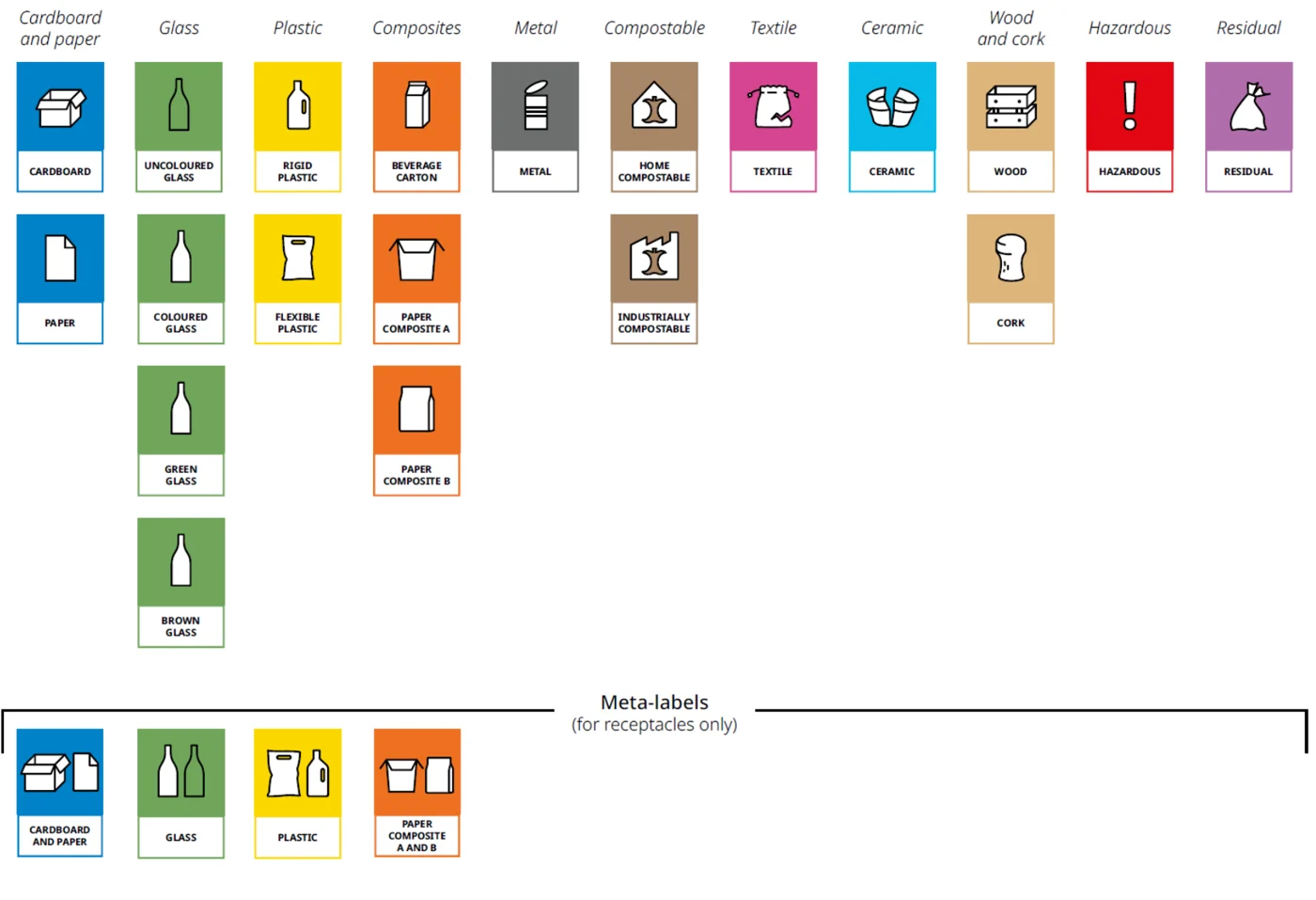
Around twenty pictograms, one per material, each with its own colour: cardboard and paper in blue, glass in green, plastic in yellow. The labels at the bottom, which group a whole family, are reserved for bins. This proposal has not been adopted: the final design will come from the implementing act.
Other markings
Article 12 also affects other areas of the artwork, each with its own logic:
- A sorting QR code remains optional: the brand may add one next to the label to show where each component goes.
- Reusable packaging will carry a "reusable" label and an information QR code from 12 February 2029 or 30 months after the act, whichever is later (PPWR reuse rules).
- Displaying recycled or bio-based content remains voluntary, but a brand that displays it will have to follow the EU format.
- Compostable packaging, such as a tea bag, will state on its label that it is compostable, that it is not suitable for home composting and that it is not to be discarded in the open.
- The symbol showing membership of an EPR scheme, such as the Green Dot (Point Vert), may only be displayed in a QR code or other digital marking (Article 12(9)). The Commission reads this as a ban on printed markings, without specifying the date from which it applies.
- The manufacturer's name, trade mark and postal address have had to appear on the packaging or in a QR code since 12 August 2026 (Article 15). Together with the batch number, this is what the Regulation already requires on the artwork.
- The Regulation prohibits any marking likely to create confusion with the harmonised label (Article 12(8)), which may cover in-house pictograms, in the same way as misleading environmental claims.
3When will the harmonised label become mandatory?
The text sets a rule with 2 limbs. The label applies to packaging placed on the market from 12 August 2028, or 24 months after the entry into force of the implementing act that defines it. Whichever date is later applies. The date of 12 August 2028 is therefore only a floor.
The text also refers to a second act, on the digital marking of composition, which the Commission is not treating as a priority. It nevertheless counts the 24 months from the act that sets the label and its pictograms. The French-language version of the Article says "au plus tard le 12 août 2028" (no later than), a clumsy wording contradicted by the English version ("whichever is the latest") and by the end of the sentence.
The act that sets the date
The Commission was due to adopt this act by 12 August 2026 (Article 12(6)). It has not done so. Its "Have your say" page No. 19243, published on 14 September 2026, plans adoption in the second quarter of 2027, and the draft act has not yet been published for comment.
Label application date depending on when the act takes effect
Act in force in January 2027 · fast scenario
Act in force in July 2027 · adoption planned for Q2 2027
Act in force in January 2028 · 6 months behind schedule
On the planned timetable, the label becomes mandatory around mid-2029. As the act was not in force at the end of October 2026, the 12 August 2028 floor will not be the date that applies.
Sources: Regulation (EU) 2025/40, Article 12(1), (6) and (12); European Commission, initiative 19243, October 2026. Date scenarios: Projet Celsius calculation.
The 12 August 2028 floor will not be the date that applies. As the act was still not in force at the end of October 2026, the deadline will fall at the end of 2028 at the earliest, even if it were adopted tomorrow. If it is adopted in spring 2027 as planned, the label will become mandatory around the middle of 2029, and each month of delay pushes the deadline back by the same amount. The exact date will only be known when the act is published in the Official Journal of the European Union.
Packaging already printed
The Regulation does not require stock to be destroyed. Packaging manufactured or imported before the date of application without the EU label may still be sold for 3 years (Article 12(12)). With application around mid-2029, packaging printed with the Triman would remain sellable until around mid-2032.
4Will the Triman logo disappear?
Yes, but not before the EU label. The Commission says so in its guidance document of 10 June 2026: after the date of application, Member States will not be allowed to keep their national labels alongside the harmonised EU labels. It asks for national measures to be repealed before that date, or adapted to allow for the transition. It adds that national sorting instructions found to be disproportionate must be repealed as soon as possible, without waiting for the EU label, which is its objection to the Triman.
This document is not binding, since only the Court of Justice interprets EU law, but it signals the position the Commission will defend.
In the meantime, French law has not changed. Article L. 541-9-3 and its decrees are the same as in 2022, and Article R. 541-12-20 only allows the Triman to be replaced by EU signage if that signage is of mandatory application. As long as the EU label is not, the Triman and the Info-tri remain required; after that, the Triman can be dropped without a new text, and only the Info-tri will need French law to be adapted.
The Commission's action against France
The Commission has contested the Triman since its letter of formal notice of February 2023. It sees it as an obstacle to the free movement of goods, disproportionate while the common label is pending, and criticises France for not notifying it of the law before its adoption. It decided to refer France to the Court of Justice on 17 July 2025, and the action was lodged on 26 March 2026 (Case C-249/26). The case is pending, and an infringement action does not suspend the law it targets: the Triman remains mandatory while the proceedings run.
Labels in other countries
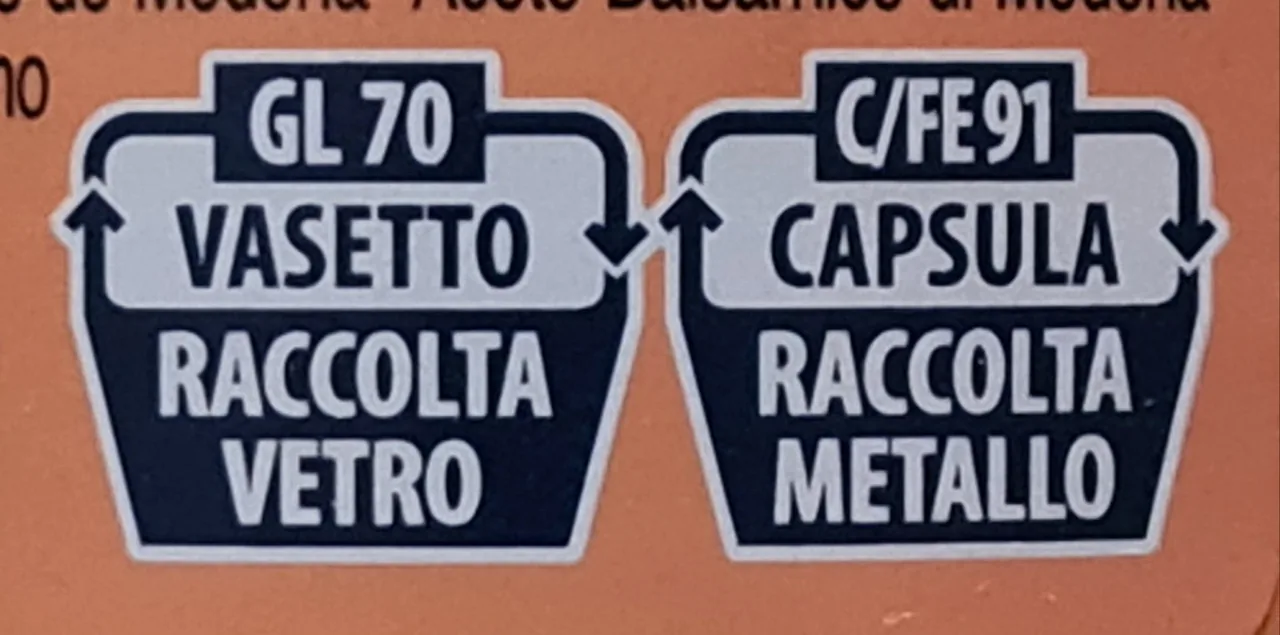
Italy has required, since 1 January 2023, an environmental label stating the material of each component, using the codes of Decision 97/129/EC ("PAP 20", "PET 1"). These codes lose their EU basis on 12 August 2028, the date on which the Regulation repeals the Decision. For a brand selling in several countries, the EU label will replace a patchwork of markings with a single one (packaging EPR in Europe).
5What should you change at your next reprint?
The answer depends on 2 things: the print date and how long the stock takes to sell. Packaging printed today for 2 years of sales will be sold out before the EU label becomes mandatory. Packaging printed in 2029 for 3 years of sales will almost certainly overlap with it.
Packaging printed with the Triman in 2026 or 2027 will remain sellable well after the EU label arrives.
A reprint in 2026 or 2027
As long as the act has not been adopted, the artwork keeps its French markings and prepares for what comes next:
- Keep the Triman and the latest version of the Info-tri, and check that it covers every separable component, seal and carton included.
- Remove the Green Dot if it is still on the artwork, since the Regulation only allows it in digital form, and check that the manufacturer's name and postal address are there.
- Do not create an "EU-style" material pictogram: the official design does not exist, and a symbol that could be confused with it will be prohibited.
- Reserve one area per component on the artwork, large enough for a material pictogram, so that the switch does not require redesigning the whole pack, and take the opportunity to review your eco-design choices.
What to check on a carton's artwork before reprinting it
The carton and the pouches will each carry the pictogram for their material. Reserve space for them, without drawing a home-made pictogram.
A reprint before the EU act keeps the Triman and Info-tri. It checks what is already required and reserves space for the pictograms to come.
Sources: French Environmental Code, Art. L. 541-9-3, R. 541-12-17 and R. 541-12-18; Regulation (EU) 2025/40, Articles 12 and 15. Packaging shown as an example, with no view on its compliance.
A reprint after the act
Once the act is published, the label design will be known and its date of application can be calculated to the day. Until that date, the Triman remains required in France. Artwork printed between these 2 dates may keep the Triman alone: manufactured before the deadline, it will remain sellable for 3 years afterwards. Adding the EU label at that stage only helps product references whose stock lasts longer, provided the act allows it to be applied before its deadline, which no text says yet.
At the deadline, the Triman can be replaced without a new text (Article R. 541-12-20). The Info-tri, which says where each component goes, will have to wait for French law to be adapted, on a date that is not known.
Take a cosmetics brand that reprints 200,000 cartons in March 2027 for 2 years of sales. Its cartons will be sold out by March 2029, before the likely date of application. Even if the act entered into force as early as January 2027, the deadline would fall in January 2029 and these cartons would remain sellable until January 2032. This reprint therefore keeps the Triman and the Info-tri, with no second set of printing plates.
What to check, product reference by product reference
A brand managing dozens of product references does not treat them all the same way, and this is the core of a PPWR compliance audit. For each one, you need to know the surface area of the largest face, the components and their materials, the Info-tri version printed, the countries of sale and stock turnover. This cross-check shows which artwork can wait and which must change at the next print run, and it overlaps with the inventory already required for the EU declaration of conformity.
At Projet Celsius, the question that decides a reprint is how long the stock will last. With a deadline that will not fall before the end of 2028 and 3 years to sell off stock, almost all 2026 and 2027 print runs will sell through. The 2 mistakes to avoid are remaking plates for a pictogram that has not yet been designed, and leaving an out-of-date Info-tri on a product reference that sells for 5 years.
We recommend taking an inventory of your artwork now, alongside the technical documentation evidence, and deciding product reference by product reference once the act is published.
6Key takeaways
- The Triman and the Info-tri have been mandatory in France since 1 January 2022, and remain so as long as the EU label does not apply.
- The EU label applies from 12 August 2028, or 24 months after its implementing act if that date is later, which will be the case.
- The act has not been adopted: the Commission plans it for the second quarter of 2027, which puts the likely deadline around mid-2029.
- Packaging printed before the deadline remains sellable for 3 years, so stock bearing the Triman does not have to be destroyed.
- At your next reprint, keep the French markings, remove the Green Dot and reserve space for one pictogram per component.
The full PPWR timeline places this deadline among the Regulation's other obligations.
- Regulation (EU) 2025/40 of 19 December 2024 on packaging and packaging waste (PPWR), OJ L of 22 January 2025, Articles 12, 13, 15, 67 and 71.
- European Commission, guidance document C/2026/3084 on Regulation (EU) 2025/40, OJ C of 10 June 2026, point 13.
- European Commission, "Have your say", initiative 19243 on harmonised labels, announced on 14 September 2026, consulted on 27 October 2026.
- Joint Research Centre (JRC), technical proposal for harmonised sorting labels, 13 January 2026.
- French Environmental Code, Article L. 541-9-3 (Triman and Info-tri), Article L. 541-9-4 (penalties) and Articles R. 541-12-17 to R. 541-12-21, in force on 27 October 2026. The Légifrance pages are in French.
- Ministry of Ecological Transition, FAQ on Triman signage (in French), 4 July 2023.
- Italy: decreto legislativo 3 aprile 2006, n. 152, art. 219, commi 5 e 5.2, Normattiva, version as at 8 October 2026.
- Citeo, Info-tri page (in French), consulted on 27 October 2026.
- European Commission, press release of 17 July 2025 on the referral of France to the Court; Case C-249/26, OJ C/2026/2510 of 11 May 2026.