
- 1One kilo of desflurane released counts as 2,590 kilos of CO2e over 100 years.
- 2Desflurane has been prohibited in the EU since 1 January 2026, unless medically necessary.
- 3Piped wall networks for nitrous oxide lose a large share of the gas purchased.
- 4Depending on the method, one bottle of desflurane weighs zero or close to a tonne of CO2e.
Since 1 January 2026, the EU F-gas Regulation has prohibited desflurane as an inhalation anaesthetic, except where no other anaesthetic can be used for medical reasons. According to the 2022 guidelines of the French Society of Anaesthesia and Intensive Care Medicine (SFAR), one hour of anaesthesia with desflurane is equivalent to 300 km by car, against 6.5 km with sevoflurane. The calculation assumes a car emitting 200 g of CO2e per km and rests on the warming potentials that SFAR uses.
The 4 anaesthetic gases and their weight in a Bilan Carbone®
Kilos of CO2e counted for 1 kilo of gas released into the air, over 100 years.
1 bottle of 240 mL, or 352 g, released into the air: 911 kgCO2e, close to a tonne.
It stays in the air for 14.1 years. Over 20 years, 1 kilo counts as 7,020 kilos of CO2e.
Prohibited as an anaesthetic in the European Union since 1 January 2026, unless medically necessary and justified in writing.
Sources: IPCC, 6th Assessment Report (2021), table 7.SM.7; Regulation (EU) 2024/573; SFAR (2022); densities from manufacturers' package inserts. Bottle mass x GWP: Projet Celsius calculation.
Nitrous oxide falls outside the regulation because it contains no fluorine. Kilo for kilo, it nonetheless warms the climate more than sevoflurane, and a large share is lost in hospital pipework before it reaches the patient. For a hospital's management, the question becomes one of accounting: how much do these gases weigh in the hospital's emissions report, and how should they be counted from one year to the next?
1Why do anaesthetic gases weigh so heavily on the climate?
An anaesthetic gas is barely transformed in the body. According to SFAR, the body metabolises 5% of sevoflurane and 0.05% of desflurane: the rest is exhaled unchanged, then vented outside by the theatre's scavenging system. The health-sector guide published by ADEME (the French Agency for Ecological Transition) makes the same assumption for CO2 and N2O: 100% of the gas purchased is counted as released into the air.
The weight of this released gas is measured by its global warming potential (GWP), which compares the effect of one kilo of a gas with that of one kilo of CO2, over 100 years by convention. This article uses the values of the Sixth Assessment Report of the IPCC (Intergovernmental Panel on Climate Change), published in 2021, the most recent, which the EU regulation also adopts. Others are still in circulation: those of the Fifth Assessment Report (2013), 265 for nitrous oxide, and those of a 2012 study, 2,540 for desflurane.
Halogenated agents
Desflurane, sevoflurane and isoflurane are halogenated agents, fluorinated ethers vaporised into the air the patient breathes. Their effect depends on their GWP and on their lifetime in the atmosphere: 14.1 years for desflurane, 1.9 years for sevoflurane, according to the IPCC. Worldwide, SFAR cites an estimate of 3.1 million tCO2e in 2014 for halogenated agents released, 80% of it from desflurane.
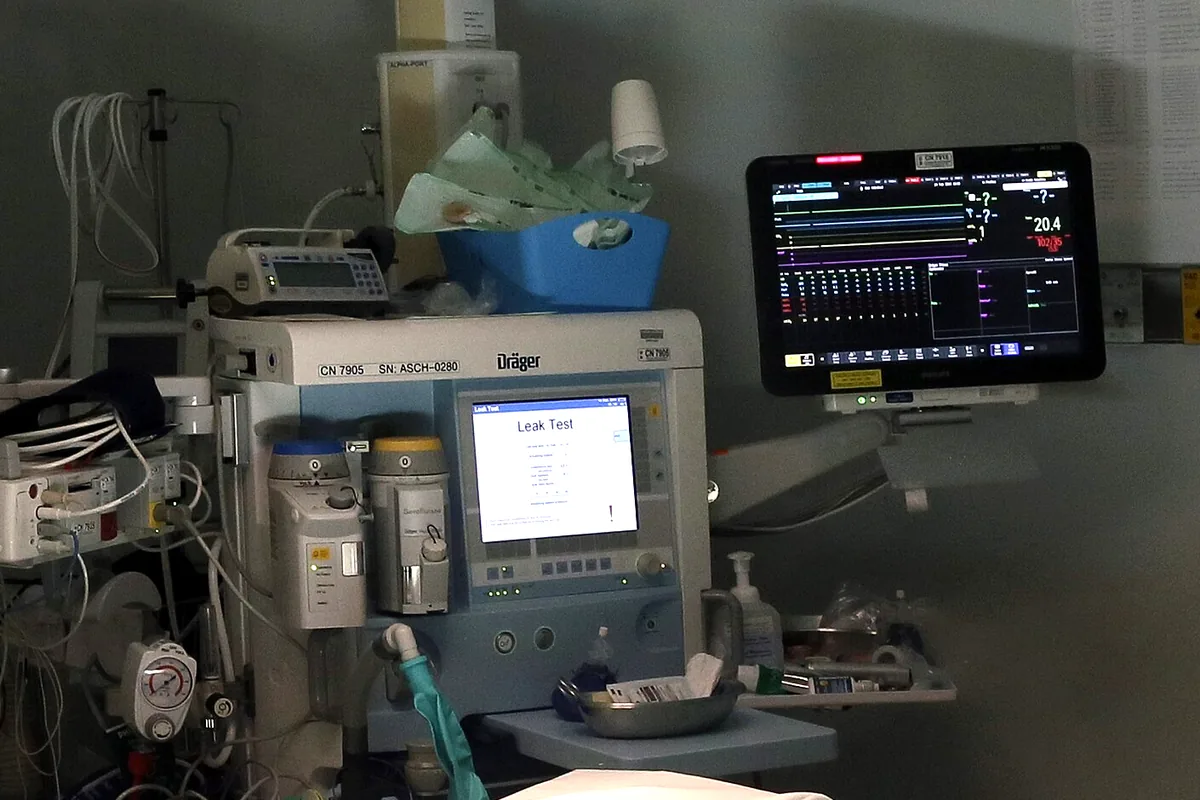
The choice of agent accounts for most of the gap between 2 hospitals. A study published in 2017 in The Lancet Planetary Health, covering 3 hospitals in Canada, the United States and the United Kingdom, found a ratio of 1 to 10 in their anaesthetic gas emissions. The difference came from a preference for desflurane. SFAR makes the same observation for an operating theatre: its halogenated agent emissions are divided by 10 when desflurane is removed from the formulary.
Nitrous oxide
Nitrous oxide, or N2O, warms 273 times more than CO2 and stays in the air for 109 years. Its GWP is therefore the same over 20 and over 100 years, whereas that of halogenated agents falls as the time horizon lengthens. Used as a carrier gas with oxygen, it also multiplies by 6 the CO2 equivalent of a sevoflurane anaesthetic, according to the work cited by SFAR.
2How should a hospital count anaesthetic gases in its carbon footprint?
This is the question on which published figures diverge most. Depending on the method, the same bottle of desflurane counts as zero or close to a tonne of CO2e, and the published shares of this item range from 15% to less than 1% of a hospital's footprint. A Bilan Carbone® (the French carbon accounting method) measures only what its boundary includes, and anaesthetic gases are a textbook case.
How much the item weighs
The 2019 ADEME sector guide states that anaesthetic gases may account for up to 15% of a hospital's emissions, a figure it takes from a 2018 document produced by an association. At AP-HP, the Paris public hospital system, the medical gases category amounts to 16,040 tCO2e in the 2024 assessment, or 0.83% of the total of 1,935,943 tCO2e, by our calculation.
The 2 figures do not measure the same thing. The 15% predates the decline of desflurane. The 0.83% combines anaesthetic gases with the oxygen and nitrous oxide mixture, CO2 and medical nitrogen, without breaking them down, and the category fell by a further 20% in 2025. Above all, the counting method changes from one document to another.
The official French rule
The regulatory emissions report, BEGES (bilan d'émissions de gaz à effet de serre), France's mandatory greenhouse gas emissions report, counts the gases set by the ministerial order of 25 January 2016: CO2, methane, N2O, HFCs, PFCs, SF6 and NF3, the 7 gases also covered by the GHG Protocol. N2O is on the list. Halogenated agents, on the other hand, are fluorinated ethers, not HFCs in the strict sense: they do not literally appear on the list. The 2019 ADEME sector guide draws a strict rule from this. It counts CO2 and N2O only, as direct fugitive emissions. It flags halogenated agents as potent greenhouse gases, without counting them.
The French regulatory method also requires 100-year GWPs updated on the basis of the latest IPCC data. When it was published, in 2022, it referred to the Fifth Assessment Report, of 2013, which gives 265 for N2O and 1,790 for desflurane. With these GWPs, a 240 mL bottle of desflurane weighs 629 kgCO2e, against 911 with the 2021 values. ADEME's Base Empreinte, the French public emission factor database, now offers both sets, 265 and 273 for N2O. This article uses the Sixth Assessment Report, the most recent, which the EU regulation also adopts.
How AP-HP in Paris counts them
AP-HP does the opposite: it counts halogenated agents, but under its purchases of goods, category 4.1 of the BEGES, the one that covers scope 3. It starts from the volumes ordered in its management software and applies British per-bottle factors, published in an appendix to its assessment. A 240 mL bottle of desflurane counts there as 893.06 kgCO2e, a 250 mL bottle of sevoflurane as 49.47 kgCO2e.
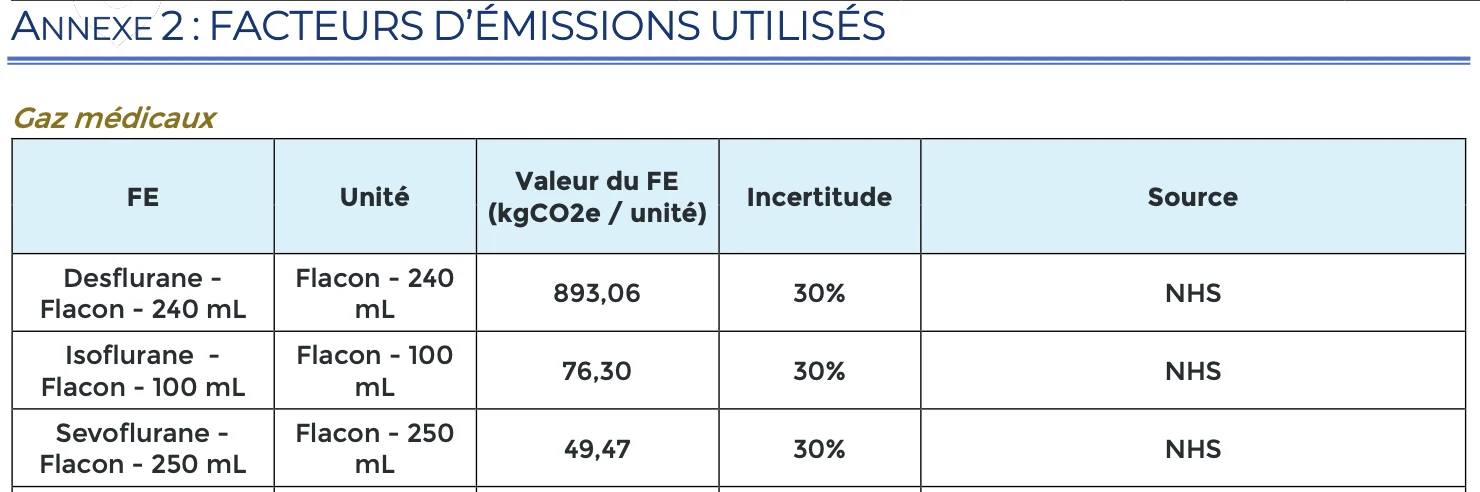
Appendix 2 of the AP-HP assessment gives 893.06 kgCO2e per bottle of desflurane, 76.30 for isoflurane and 49.47 for sevoflurane, with 30% uncertainty, based on the NHS. Nitrous oxide is counted at 265.43 kgCO2e per kilo, based on the French Base Carbone.
These factors can be reproduced by calculation. A 240 mL bottle of desflurane contains 351.6 g of gas, at the density of 1.465 given in the manufacturer's package insert. Multiplied by 2,540, these 351.6 g give exactly 893.06 kg. The NHS factors therefore rest on the GWPs published in 2012 by an atmospheric chemistry study, 2,540, 510 and 130, which SFAR also cites. They are neither those of the IPCC Fifth Assessment Report nor those of the Sixth. The AP-HP factor for N2O, 265.43 kgCO2e per kilo, comes from the French Base Carbone database and follows the Fifth Assessment Report.
What one bottle of anaesthetic weighs, by calculation rule
The same bottle of desflurane counts as zero, 629 or more than 900 kgCO2e depending on the rule. With the 2013 GWPs, sevoflurane even weighs more than with the 2021 ones.
Sources: ADEME, health-sector guide (2019); AP-HP, 2024 GHG assessment, appendix 2; Sulbaek Andersen et al. (2012); IPCC (2013 and 2021); manufacturers' package inserts. Projet Celsius calculation, 100% of the gas released.
The GWP set also changes the comparisons. With the 2021 IPCC values, the sevoflurane bottle weighs 74 kgCO2e, or 50% more than in the NHS factor, and 10% less than with the 2013 values. The figure of 18 times more emissions for desflurane than for sevoflurane, cited by AP-HP, is the ratio of the 2 NHS factors. With the 2021 GWPs, a bottle of desflurane weighs 12 times as much as a bottle of sevoflurane. Per hour of anaesthesia, the gap is much wider, because desflurane is administered at a higher concentration. It reaches 46 times according to SFAR, with the 2012 GWPs, and about 30 times with the 2021 values, by our calculation on the same assumptions.
Counting in kilos
There is therefore no single rule applied by everyone. A hospital may adopt a simple method and, above all, keep it from one year to the next, so that 2 successive assessments can be compared. It takes 4 steps:
- Record the quantities purchased during the year from the pharmacy, in bottles per product reference and in kilos of N2O, not in euros from the accounts.
- Convert the bottles into kilos using the density of each product: 1.465 g/mL for desflurane, 1.52 for sevoflurane, 1.496 for isoflurane.
- Multiply each mass by an IPCC GWP, assuming 100% of the gas is released: the 2021 values (2,590, 195, 539 and 273), or the 2013 values that many factors still use (1,790, 216, 491 and 265).
- Choose the category, direct emissions or purchases, then write it into the assessment's methodology and keep it from one year to the next, like the GWP chosen.
This method takes ADEME's rule for N2O, extends it to halogenated agents and states which GWP it uses, which makes it readable by an external verifier. The resulting figure then feeds into the establishment's transition plan: among the levers for reducing a carbon footprint, it is one of the few where a decision taken in theatre shows up from the following year.
3Desflurane: what does the 2026 EU ban change for hospitals?
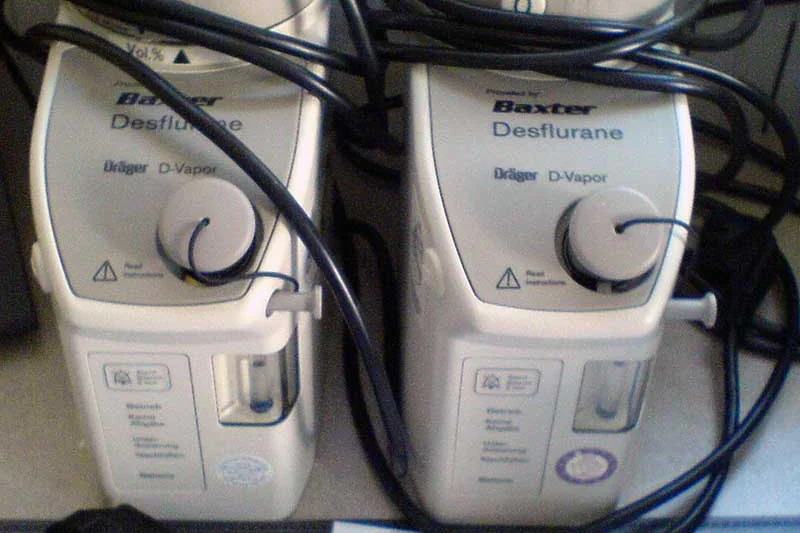
Regulation (EU) 2024/573, in force since 11 March 2024, also covers air conditioners and heat pumps. Its Annex II brings halogenated anaesthetics within its scope, but it restricts the use of desflurane alone, the agent with the strongest warming effect. Sevoflurane and isoflurane remain usable without conditions.
The provision and its derogation
Article 13(8) consists of 2 sentences. The first prohibits desflurane from 1 January 2026, except where its use is strictly necessary and no other anaesthetic can be used for medical reasons. The second sets the hospital's only obligation: it must keep evidence of the medical justification and provide it on request to the national authority or to the European Commission.
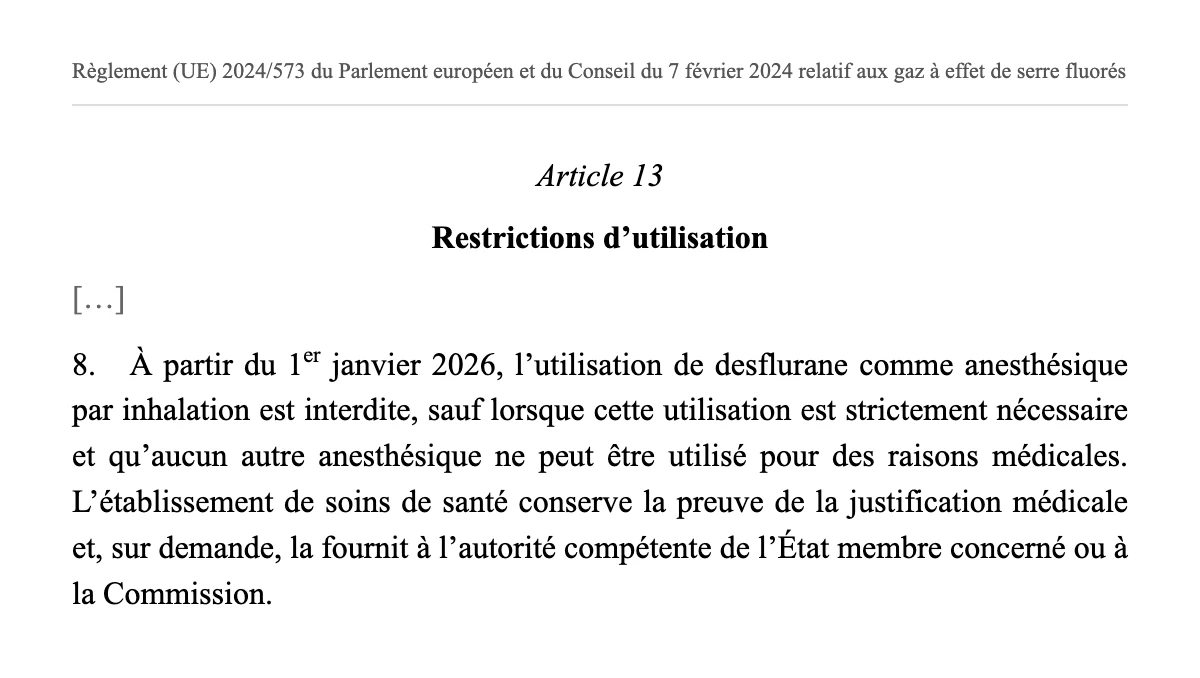
Paragraph 8 of Article 13 consists of 2 sentences: the prohibition and its only derogation, then the evidence the establishment keeps. Capture of the gas does not appear in it: it is mentioned only in recital 27, in the conditional.
The text goes no further. Recital 27 expresses the wish that any desflurane still used be captured, but only as something that should happen: no article requires capture in theatre. Article 4 prohibits the intentional release of a fluorinated gas where it is not technically necessary, without expressly referring to anaesthetic gases. Penalties are a matter for each Member State, which had to notify its rules to the Commission before 1 January 2026.
What evidence must be kept
The European Commission specifies the form of this evidence: a written medical justification, kept for 5 years, for example in the clinical record of the procedure. The doctor needs no prior authorisation. Nor does the hospital have anything to report, since the annual reporting under the regulation is aimed at producers, importers and exporters.
In practice, an establishment that keeps a few bottles must be able to explain, case by case, why sevoflurane or intravenous anaesthesia was not suitable. A list of indications approved by the anaesthesia team, and a line in the record of each patient concerned, make it possible to answer a request from the authority.
The English precedent
In the United Kingdom, NHS England, which runs the National Health Service in England, moved ahead of the European Union. The end of desflurane in routine practice was set for 1 April 2024 in its guidance on desflurane decommissioning, with an exception for certain long cranial neurosurgery procedures. It was the first time the English health service had given up a commonly used medicine because of its effect on the climate. The withdrawal happened in stages:
- Nearly 90 English NHS trusts had stopped using desflurane completely by the time of the March 2024 guidance.
- According to the NHS review of its 5 years of greener NHS work, published in September 2025, emissions from desflurane have fallen by 41 ktCO2e, or 98%, since 2019-2020.
4Nitrous oxide: why decommission piped networks?
In many hospitals, N2O does not reach the theatre in cylinders. It is stored in a manifold, a bank of linked cylinders, then distributed through pipework to the wall outlets in each theatre.
Leaks
The measurement that SFAR cites comes from Australia. A study published in 2022 compared, in a Melbourne hospital, the N2O leaving the manifold with the N2O administered to patients. According to SFAR, which cites it, leaks exceeded 75% of actual consumption. No French national measurement has been published.
The French Hospital Federation (FHF) called on 11 October 2024 for these networks to be shut down for good. Its 2 figures should be read with caution. According to the FHF, hospital N2O would generate more than 100,000 tCO2e a year in France: the conditional is the FHF's own, and the method is not published. Its figure of 80% leakage repeats the order of magnitude of the Australian study.
The path of nitrous oxide, from the manifold to the patient
With a piped wall network
With a cylinder in theatre, as SFAR suggests
Annual nitrous oxide orders at Royal United Hospitals Bath
In Bath, orders fell by a factor of nearly 150. These are volumes ordered, not a measurement of leaks, and no French national measurement has been published.
Sources: SFAR (2022), citing Seglenieks et al. (2022, Melbourne hospital); Royal United Hospitals Bath (February 2024) and NHS England.
SFAR, for its part, does not call for dismantling in its 2022 guidelines. It suggests preferring cylinders to piped supply, where N2O is still used. The statement that SFAR therefore calls for all existing networks to be dismantled is the FHF's, made in 2024.
Nitrous oxide leaking from a pipe warms the climate just as much as the nitrous oxide the patient breathes.
French hospitals that have shut off their networks
Several French hospitals have stopped supplying their networks and publish the results:
- Toulouse University Hospital (CHU de Toulouse) avoids about 1,000 tonnes of CO2 a year, or 36% of the emissions linked to N2O and its mixture with oxygen. The figure comes from its page on shutting off the networks, updated in March 2026.
- Pau hospital (centre hospitalier de Pau) stopped nitrous oxide in theatre on 18 April 2025, with its wall networks shut off, while keeping the oxygen mixture in cylinders in a few departments. It expects savings of nearly €5,700 a year.
- At AP-HP, dismantling the wall networks reduced piped N2O consumption by a factor of 3 between 2024 and 2025, according to its page on its Bilan Carbone®.
These figures, mostly drawn from volumes ordered, show the effect of the shutdown without measuring the leak itself. Across England, the NHS puts the N2O emissions avoided compared with 2019-2020 at more than 80 ktCO2e, in its 5-year review.
The main supplier is following suit. In a June 2025 press release, Air Liquide Santé France set itself the target of ending sales of the cylinder banks and large cylinders that supply medical N2O networks by the end of 2026. A hospital it supplies that keeps its network will have to rethink how the gas reaches the theatre.
5What do French anaesthetists recommend?
In September 2022, SFAR published, with the French Society for Hospital Hygiene and the French Society of Clinical Pharmacy, 17 recommendations to reduce the environmental impact of general anaesthesia. All are expert opinions with strong agreement, the lowest level of evidence in the method used.
Choice of agent and fresh gas flow
The recommendations on inhalational anaesthesia always apply where the clinical benefit for the patient is equal:
- Use sevoflurane in preference to desflurane or isoflurane for inhalational anaesthesia.
- Do not use nitrous oxide, and if it is used, prefer a cylinder to the pipeline network.
- Work at low fresh gas flow, between 0.5 and 1 litre per minute according to the definition used in the supporting rationale.
- Prefer the automated mode of anaesthesia ventilators, which reduces CO2-equivalent emissions by around 40% according to the rationale.
- Monitor the depth of anaesthesia, with the share of vapour in exhaled air, to consume less anaesthetic vapour.
Intravenous anaesthesia
SFAR does not rank intravenous anaesthesia with propofol above inhalation: it asks for the 2 to be used interchangeably. Propofol is not a greenhouse gas, but SFAR recognises its ecotoxicity for soil and water. Studies diverge on its carbon footprint:
- A 2012 study found propofol emissions nearly 10,000 times lower than those of desflurane, over its life cycle.
- A 2021 study, cited by SFAR, found it equivalent to sevoflurane delivered at the lowest flow, with 70% of vapours recaptured.
Vapour capture
On the capture and recycling of halogenated agents, SFAR makes no recommendation: the data did not allow these systems to be compared with conventional scavenging, either for safety or for the environment. At the end of 2022, only one system was available in France, according to the journal Risques & Qualité, and its efficiency had yet to be established.
For us at Projet Celsius, the gas item is the one that can be dealt with fastest in a hospital's footprint, and also the one that is counted least accurately. The useful question is how many kilos of each gas the hospital buys, with which GWP and under which category they are counted. The other theatre levers, such as the switch to reusable devices or the eco-design of care, require a life cycle assessment. This one is decided on a pharmacy order. We recommend extracting the quantities from the pharmacy, writing the method into the assessment, then comparing each year the N2O ordered with the N2O administered in theatre: the gap shows what the network loses.
6Key takeaways
- One kilo of desflurane released counts as 2,590 kilos of CO2e over 100 years, one kilo of nitrous oxide as 273, and that gas stays in the air for 109 years.
- In a Bilan Carbone®, a bottle of desflurane weighs from zero to close to a tonne of CO2e depending on the method and GWP chosen, which must be written down and kept stable.
- Desflurane has been prohibited as an anaesthetic in the European Union since 1 January 2026, unless medically necessary and justified in writing, evidence to be kept for 5 years according to the Commission.
- Piped wall networks for nitrous oxide lose a large share of the gas purchased, and Air Liquide aims to stop selling the cylinder banks that supply them at the end of 2026.
- SFAR recommends low-flow sevoflurane, without nitrous oxide, and puts intravenous anaesthesia on an equal footing with inhalation.
The weight of gases among a hospital's other categories, from medicines, whose carbon score is entering tenders, to energy, is set out in our article on a hospital's Bilan Carbone®.
- Regulation (EU) 2024/573 of 7 February 2024 on fluorinated greenhouse gases, Article 13(8), recital 27 and Annex II, Official Journal of the European Union, 20 February 2024.
- European Commission, F-gases in equipment and products, section Inhalation anesthetics - Desflurane, page updated on 14 October 2025, accessed on 27 October 2026.
- IPCC, Sixth Assessment Report, Working Group I, Chapter 7, Supplementary Material, Table 7.SM.7, 2021.
- SFAR, with SF2H and SFPC, Réduction de l'impact environnemental de l'anesthésie générale (in French), professional practice guidelines, September 2022.
- Fédération hospitalière de France, Appel à l'arrêt immédiat de l'approvisionnement des réseaux de protoxyde d'azote dans les établissements de santé (in French), 11 October 2024.
- NHS England, Desflurane decommissioning and clinical use, 26 March 2024; Five years of a greener NHS: progress and forward look, 24 September 2025.
- AP-HP, Bilan des émissions de gaz à effet de serre 2024 (in French), August 2025 (pp. 15, 28, 46 and 78); Le bilan des émissions de gaz à effet de serre de l'AP-HP, page updated on 26 October 2026; Les émissions carbone de l'AP-HP se stabilisent pour la première fois en 2025, October 2026.
- ADEME, Établissements sanitaires et médico-sociaux, guide sectoriel 2019 (in French), update carried out by ANAP and the Association Bilan Carbone, February 2020 (pp. 50-51).
- French Ministry of Ecological Transition and ADEME, Méthode pour la réalisation des bilans d'émissions de gaz à effet de serre, version 5 (in French), July 2022; ministerial order of 25 January 2016 on the greenhouse gases covered by emissions reports, text on AIDA (in French).
- US package inserts published on DailyMed: Suprane (desflurane), Baxter, density 1.465 at 20 °C; Ultane (sevoflurane), AbbVie, 1.520 to 1.525; Forane (isoflurane), Baxter, 1.496.
- IPCC, Fifth Assessment Report, Working Group I, Chapter 8, Appendix 8.A, Table 8.A.1, 2013.
- Sulbaek Andersen M. P. et al., Atmospheric chemistry of isoflurane, desflurane, and sevoflurane: kinetics and mechanisms of reactions with chlorine atoms and OH radicals and global warming potentials, Journal of Physical Chemistry A, 2012, 116(24), pp. 5806-5820.
- Vollmer M. K. et al., Modern inhalation anesthetics: potent greenhouse gases in the global atmosphere, Geophysical Research Letters, 2015.
- Seglenieks R. et al., Discrepancy between procurement and clinical use of nitrous oxide: waste not, want not, British Journal of Anaesthesia, 2022, 128(1), e32-e34.
- MacNeill A. J., Lillywhite R., Brown C. J., The impact of surgery on global climate, The Lancet Planetary Health, 2017, 1(9), e381-e388.
- Sherman J. et al., Life cycle greenhouse gas emissions of anesthetic drugs, Anesthesia & Analgesia, 2012, 114(5), pp. 1086-1090.
- CHU de Toulouse, Arrêt de l'alimentation des réseaux de protoxyde d'azote (in French), page updated on 17 March 2026; centre hospitalier de Pau, Arrêt du protoxyde d'azote (in French), 23 April 2025.
- Royal United Hospitals Bath, No laughing matter, 27 February 2024.
- Air Liquide Santé France, press release on decarbonising nitrous oxide (in French), June 2025.
- François-Talpaert C. et al., Anaesthesia and the environment: recovery and recycling of halogenated vapours (article in French), Risques & Qualité, 2022, 19(4), pp. 223-228.