
- 1An eco-designed care procedure has less environmental impact at equal quality and safety.
- 2Its impact is measured by a life cycle assessment expressed per procedure.
- 3The same switch to reusables gains or loses depending on the country's electricity.
- 4A protocol is proven with data from the healthcare facility that applies it.
A 1 g paracetamol tablet emits 38 grams of CO2e (CO2 equivalent) over its life cycle, from manufacture of the active ingredient to waste. The same dose given by IV infusion emits 310 to 628 grams, depending on the vial and the administration set, or 12 times more. These figures come from a life cycle assessment (LCA) published in 2024, based on prescriptions from 26 hospitals in the United States, the United Kingdom and Australia. For a patient who can swallow, the pain relief is the same.
The CO2e footprint of care, procedure by procedure
Each procedure at its published value, on a scale where each gridline multiplies by 10.
12 times the tablet for the same dose, because of the vial, the tubing and the administration set.
Davies et al., 2024, prescriptions from 26 hospitals in the United States, the United Kingdom and Australia.
A care procedure weighs from a few tens of grams to around thirty kilos of CO2e. These studies differ in scope and country: they are orders of magnitude, not a ranking.
Sources: Davies 2024, McAlister 2020, Spoyalo 2023, Galland 2026, Rizan 2023, Fehintola 2026 (peer-reviewed journals).
The scale above places each care procedure at the value published for it in a peer-reviewed journal, from a few tens of grams to around thirty kilos. Scopes differ from one study to another: these are orders of magnitude, not a ranking. The sections below start from the official definition and end with the limits of these figures.
1What is eco-design of care?
The French Ministry of Health defines an eco-responsible care procedure (soin écoresponsable) as a care procedure that, at equal quality and safety, has a lower impact on the environment. The definition appears in the ecological planning roadmap for the health system of December 2023. Eco-design of care is the process that leads there: reworking a care procedure, step by step, to reduce its impact without giving up anything on patient safety.
Later texts specify the definition without changing it. The first national framework for an eco-responsible operating theatre, published in 2025 by the Agence nationale de la performance sanitaire et médico-sociale (ANAP), France's national agency for health and social care performance, with 5 learned societies, requires quality, safety and appropriateness that are at least equal. The "Écoconception des soins" factsheet from the Haute Autorité de santé (HAS), France's National Authority for Health, dated 31 July 2026, adds health, economic and social impact. French hospital certification already requires the revision of care protocols to take it into account.
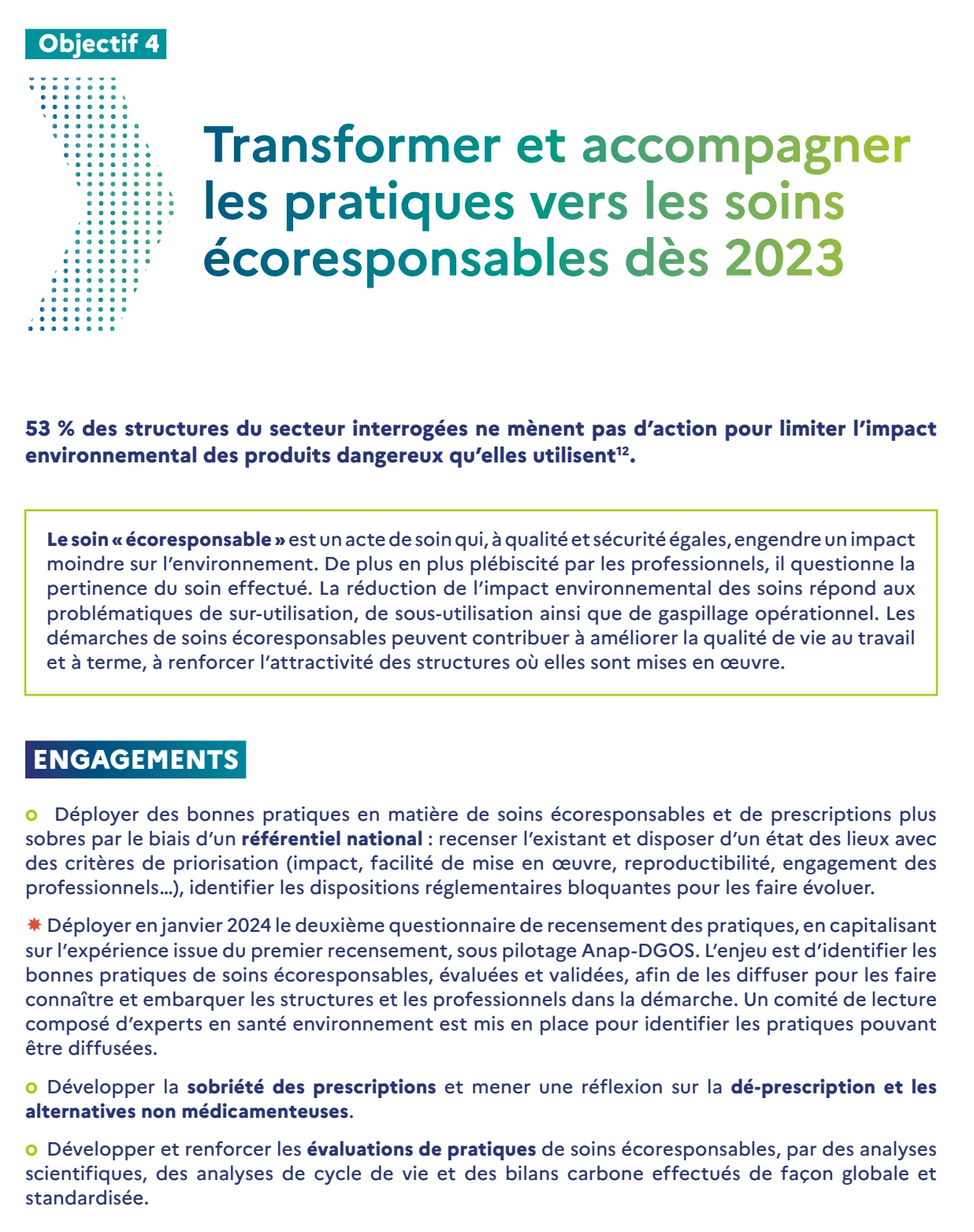
Objective 4 of the roadmap defines eco-responsible care at equal quality and safety. Its commitments include a national framework of good practice and assessments by life cycle assessment and "standardised" Bilan Carbone® assessments.
Sufficiency, appropriateness, eco-design
The ARS Provence-Alpes-Côte d'Azur, the French regional health agency for that region, sorts eco-responsible care into 3 tiers, which set the order in which to ask the questions:
- Sufficiency, through prevention and health promotion, reduces the demand for care. The ARS sums it up in one line: the least polluting care is the care that does not take place.
- Appropriateness means delivering the right, suitable care, no more and no less, avoiding the unnecessary test or prescription.
- Eco-design makes necessary care as low-impact as possible: purchasing, medical devices, medicines, energy, water, transport and waste.
2What does an eco-designed protocol change?
An eco-designed protocol reworks a routine care procedure, task by task, with a team that brings together care, infection control and logistics. It follows the logic of a product eco-design process, applied to a procedure. The first projects target care repeated every day and the operating theatre, where much of a hospital's equipment and energy is concentrated.
The bed bath
In April 2026 the ARS Provence-Alpes-Côte d'Azur launched a call for applications to roll out the eco-designed bed bath in volunteer facilities. The protocol rests on 5 levers:
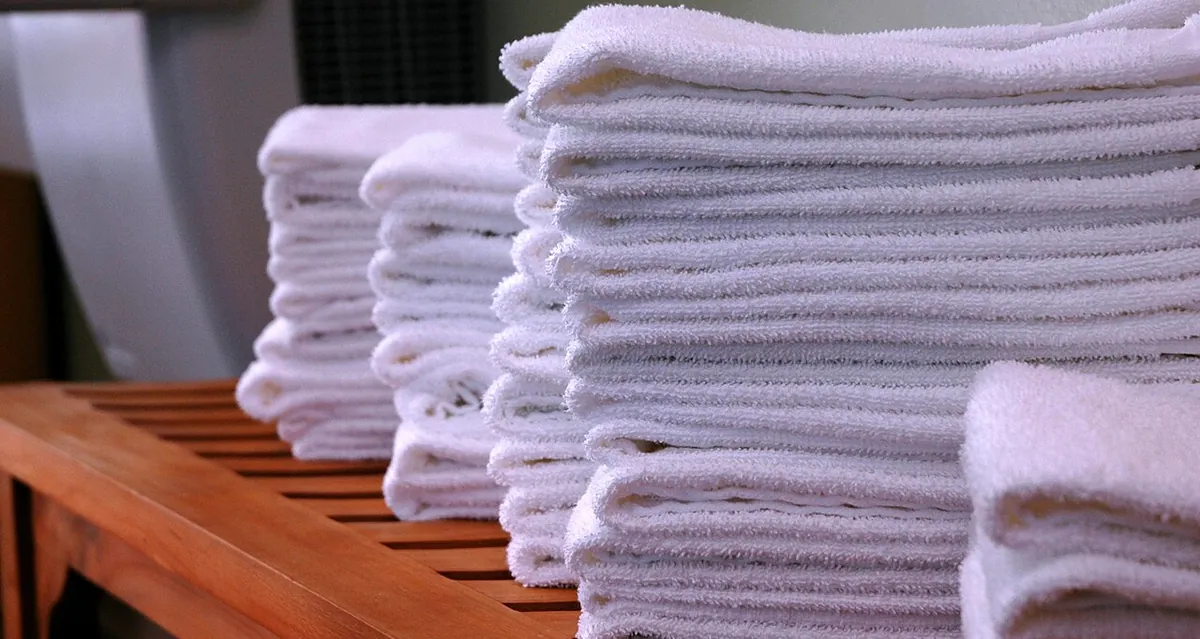
- Reusable washcloths and towels, where the infection control team approves them, in place of disposable materials.
- Proper use of disposable gloves, and incontinence pads chosen in the right size.
- Lower-impact hygiene products, free of endocrine disruptors.
- Careful management of water and energy, and a set order for bed baths within the ward.
- Workstation ergonomics, with materials laid out before the procedure.
The Salon-de-Provence, Vaison-la-Romaine and Avignon hospitals have already started. The ARS will count the consumables avoided, their carbon weight and the cost of the protocol, with a progress review in December 2026. No regional results have been published to date.
The ARS Hauts-de-France published, in June 2025, a life cycle assessment of the bed bath of an elderly patient at the Artois hospital group. The eco-designed bed bath emits 28% less on climate, or 0.61 kg of CO2e saved per bed bath, the equivalent of 8.5 km by car. The result on water is inconclusive.
One facility has published its own figures. The Larrazkena EHPAD, a French care home for dependent older people, which switched to the eco-designed bed bath in early 2024, reports 33,580 fewer towels and 28,385 fewer washcloths a year, and savings of €17,483 a year. These figures appear on a poster presented at a congress of the FHF, the French hospital federation, without a detailed calculation method.
The operating theatre
The ANAP national framework has 9 chapters, from anaesthesia to waste and energy. It complements regional initiatives such as the "Green bloc" label of the ARS Normandie, which announced more than €300,000 for 10 facilities in 2024. Anaesthetic gases, which according to the framework can account for up to half of the emissions of an operation, are a separate subject.
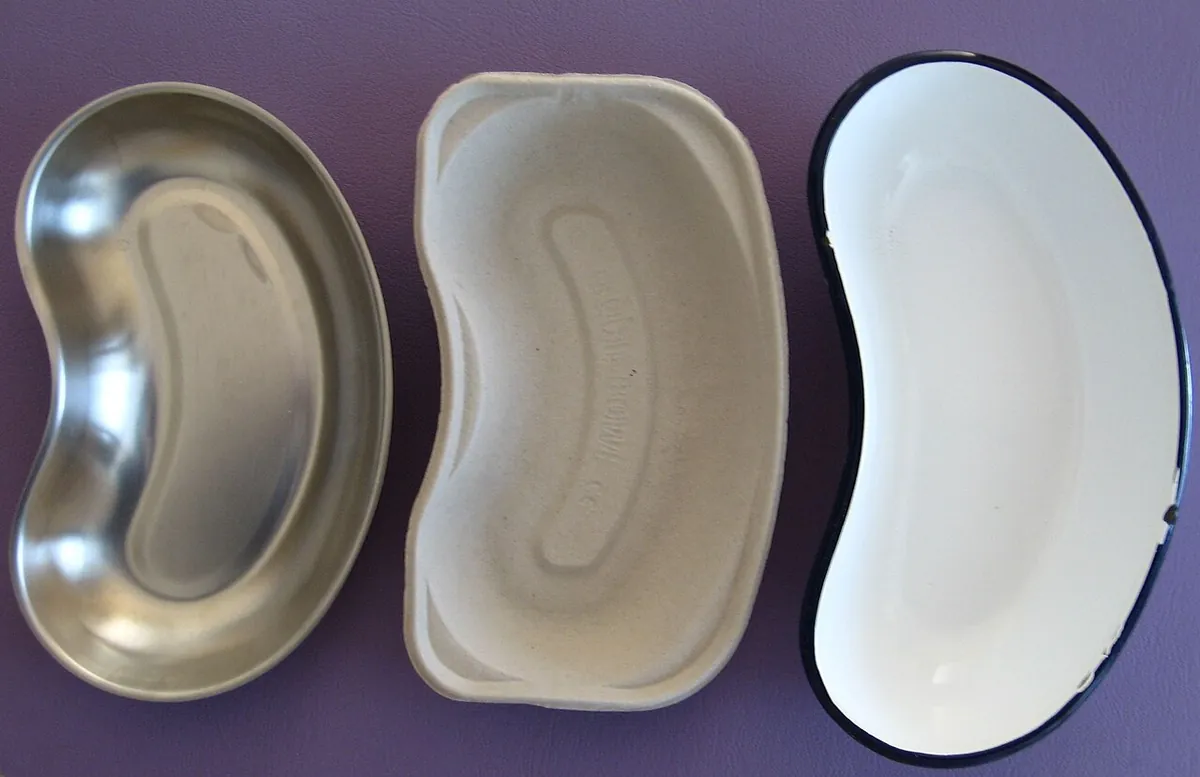
The framework publishes feedback from facilities. Clermont-Ferrand University Hospital (CHU) replaced 15,500 disposable cellulose trays with 125 reusable stainless steel trays, which avoids 391 kg of waste every year and has saved more than €8,000. Dieppe hospital puts the ventilation of its operating theatres on standby 60% of the time and has cut the energy it uses by 43%. Theatre waste follows its own streams, covered in our guide to healthcare waste.
IV infusion and blood tests
Rennes University Hospital has given nurses responsibility for switching from IV to oral administration for 18 molecules. In 2026 the protocol received the ecological transition award of the Fédération hospitalière de France (FHF). It is the principle of the paracetamol example at the start of this article, applied across a whole hospital. The eco-designed blood test is step 2 announced by the ARS Provence-Alpes-Côte d'Azur, if the bed bath succeeds.
3How is the impact of a care procedure measured?
The impact of a care procedure is measured by a life cycle assessment (LCA), under the ISO 14040 and 14044 standards. The study defines what it compares, takes an inventory of what the procedure consumes and emits, converts it into impacts, then interprets it, as for a first product LCA. The ministry's roadmap commits to developing these assessments, carried out on a comprehensive and standardised basis. Our article on the difference between an LCA and a Bilan Carbone® (the French carbon accounting method) sets out where the 2 tools sit.
The functional unit
Everything starts from the functional unit, the statement that says exactly what is being compared. For a care procedure, it is one procedure: "one 1 g dose" for paracetamol, "the products of one operation" for an English study of 5 common operations. For chronic care, the unit becomes the patient-year: in haemodialysis, 156 sessions of 4 hours.
The stages counted
The footprint of a procedure adds up everything the care mobilises, from the manufacture of consumables to their disposal. The diagram below follows a bed bath, step by step.
What the LCA of a bed bath counts, step by step
What is compared: one bed bath for a bedridden elderly patient, with the materials supplied by the hospital.
What the LCA counts: manufacture, divided by the number of washes
The reusable washcloth owes 80% of its impact to cotton, from growing to weaving.
Its manufacture is divided by 13 washes, the towel's by 80, according to the suppliers.
Source: ARS Hauts-de-France (French regional health agency), LCA of the bed bath at the Artois hospital group (GHT), June 2025 (not peer-reviewed).
For a reusable item, manufacture is divided by the number of uses, and each wash or sterilisation is counted at every cycle. That number is the most decisive assumption in any comparison between disposable and reusable, as for a medical device.
Indicators other than carbon
A full LCA tracks several impacts. The European Product Environmental Footprint (PEF) method counts 16, from water to mineral resources. The study keeps those that make up 80% of the total impact, as our guide to the PEF method explains. These studies are multiplying: the HealthcareLCA database listed 152 in 2022, covering 1,288 healthcare products and processes.
4How much does a care procedure weigh?
The opening scale gives the orders of magnitude. For eco-design, the most useful thing is to know what weighs most in each procedure: rarely the clinical act itself, more often the equipment around it, and sometimes the patient's journey.
Tests and treatments
For 5 common pathology tests measured in Melbourne, blood collection accounts for 60 to 95% of the footprint, far ahead of reagents and laboratory electricity. The authors conclude that reducing unnecessary tests is the most effective lever. In a Vancouver hospital, 76% of patients admitted for a simple surgical emergency had received unnecessary blood tests.
For treatments, the route of administration matters as much as the molecule: the vial, the tubing and the administration set make the difference in the paracetamol case. The weight of the medicines themselves is calculated with Ecovamed, and French hospitals are starting to score it in their tenders.
The consultation
For a consultation, the largest item is the patient's journey. At Bourg-en-Bresse hospital, in 2025, 88.7% of internal medicine patients came by car. Teleconsultation cut emissions by 75% where it was medically possible, but only 11.8% of patients met all the technical and acceptability conditions.
Dialysis and the operating theatre
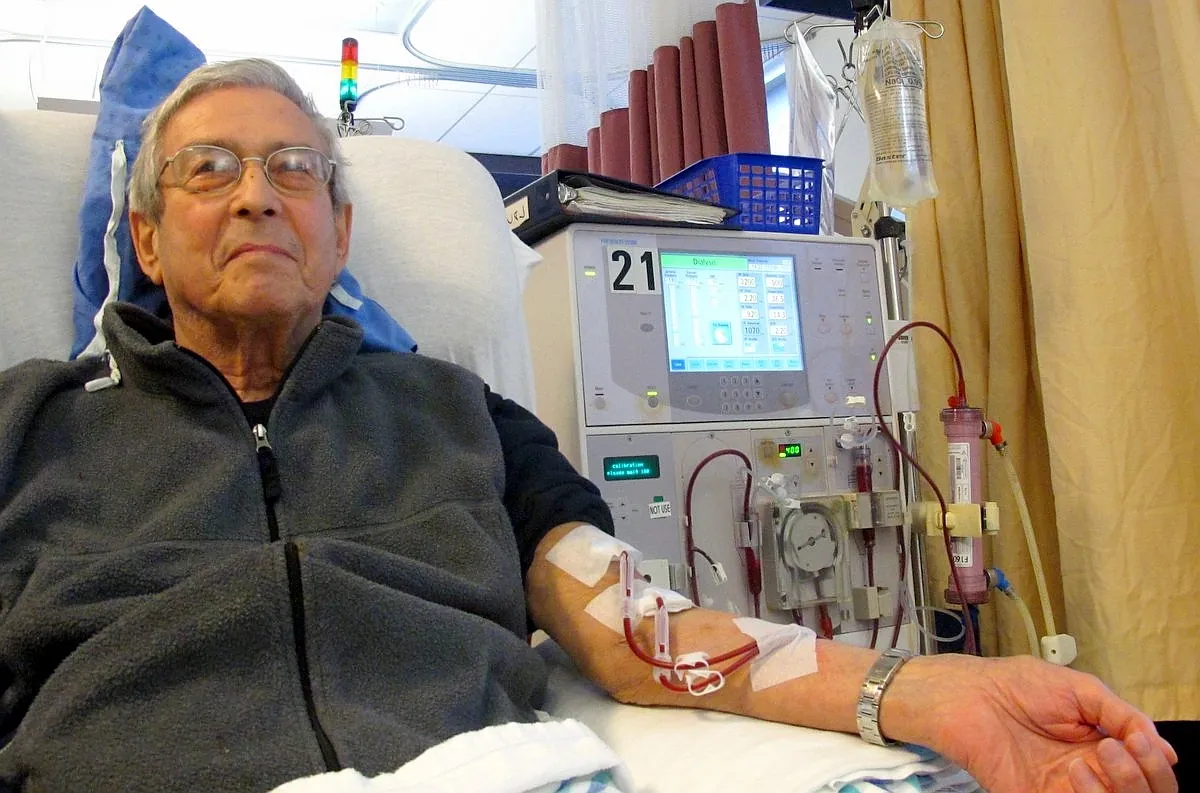
An LCA carried out in 4 European haemodialysis centres measured 1,829 to 4,894 kg of CO2e per patient per year. Patient transport ranges from 265 to 2,548 kg depending on the centre, and where public transport is an option, it is the first lever, ahead of consumables.
In the operating theatre, the footprint of an operation ranges from 6 to 814 kg of CO2e according to a review of 8 studies published in 2020. Across 5 common operations in England, the manufacture of single-use items accounts for 54% of the products' footprint, and reprocessing of reusables for 20%.
The analyses of the ARS Hauts-de-France also show that one clinical act can replace another. At Lille University Hospital, spinal anaesthesia emits 4.7 kg of CO2e, against 13.2 to 14.7 kg for general anaesthesia, for short day surgery. At Denain hospital, dressing without a kit emits 76% less than the disposable kit, and the reusable kit gains 23% on climate but uses 57% more fossil resources.
An unnecessary test weighs as much as a necessary one, and the lowest-emission care is often the care that is avoided.
5Does a figure from another country apply to a French hospital?
The figures on the scale come from Australia, the United Kingdom, the United States or European centres. They cannot be carried over as they stand to a French hospital, because of electricity, water and the quality of the studies.
The country's electricity
A 2017 study recalculated the anaesthetic equipment of an Australian hospital with 6 operating theatres. With Australian electricity, switching to reusables increased emissions by 9%, because washing and sterilisation use electricity. With the electricity mix of the United Kingdom and Europe, the same switch reduced them by 84%.
Country electricity and the effect of switching to reusables
The same Australian hospital with 6 operating theatres, recalculated with each country's electricity.
Washing and sterilisation use electricity: the more carbon-intensive it is, the less reusables gain. With a kWh 9 times less carbon-intensive than in the United Kingdom, France should gain from the switch, but no study has measured it.
Sources: McGain et al., British Journal of Anaesthesia, 2017 (effects); ADEME (French Agency for Ecological Transition), Base Empreinte, electricity, average mix (France 2024; other countries, IEA values from the late 2010s).
In the Base Empreinte of ADEME (the French Agency for Ecological Transition), the average French kWh weighs 52 g of CO2e in 2024, against 457 g for the United Kingdom and 841 g for Australia (International Energy Agency, or IEA, values from the late 2010s). Washing and sterilisation therefore weigh little there, and reusables should gain more clearly. This is an assumption, which no public LCA of a French care procedure has yet verified. At Nîmes University Hospital, the LCA of laryngoscope blades finds the reusable option ecologically preferable from 3 uses.
The full comparison, from the manufacturer's side, is covered in our guide to the LCA of a reusable medical device. For a ward, a result from abroad indicates a direction, and only the facility's own data show the size of the gain.
Water
Water often works in the opposite direction to carbon. A review of 27 LCAs published in 2023 concludes that reusables reduce most impacts, except water consumption. In the 2017 Australian hospital, switching to reusables more than doubled water use, from 34 to 91 m3 a year. An LCA that tracks only carbon does not see this, hence the value of a multi-criteria assessment.
The quality of the studies
Published studies are not all equal. The 2020 review of operations notes significant methodological limitations, and the 2023 review finds that, on average, only 64% of the expected transparency information appears in LCAs of healthcare products.
The analyses of the ARS Hauts-de-France are summaries of work, not peer-reviewed. Before reusing a figure, you should read its functional unit, its country and its method. For a study intended for the public, a critical review checks this work, by a panel or an expert depending on the use.
6Where to train in eco-design of care?
Public training courses in France mainly prepare leaders of the ecological transition, rather than specialists in the LCA of a care procedure. The main ones:
- France's School of Public Health (École des hautes études en santé publique, EHESP) runs an 18-day "Transition écologique en santé" (ecological transition in health) diploma, from 2 February to 16 September 2027. It costs €5,250, or €1,000 with ministry funding.
- The Association nationale pour la formation permanente du personnel hospitalier (ANFH), the French national association for the continuing training of hospital staff, supports facilities on eco-designed protocols. In 2026 it presented its Osmose platform, which it describes as a measurement and guidance tool dedicated to eco-design of care.
- The ANAP offers factsheets and training on eco-responsible care in its national resource centre, launched in November 2025.
The ministry's roadmap aimed for 6,500 managers in the French public hospital service to be trained in the ecological and energy transition from January 2025. To carry out an LCA yourself, our guide helps you choose an LCA training course, and a facility's mandatory greenhouse gas emissions report remains the management tool at its own scale.
At Projet Celsius, we see the first eco-design step as choosing which care procedure to measure. The one repeated most often, the bed bath, the blood test, the IV infusion, weighs more over a year than a rare, heavy procedure. We recommend a comparative LCA on 1 protocol, with the ward's own data (actual washes, laundry electricity, weighed waste), before rolling out 10. The cost of an LCA is decided on that scope, and an LCA on a small budget is often enough for a first protocol.
7Key takeaways
- Eco-design of care reworks a care procedure so that it has less impact on the environment, at equal quality and safety, according to the definition of the French Ministry of Health.
- It is measured by a life cycle assessment expressed per procedure, which counts equipment, washing, travel and waste.
- Published care procedures range from 38 g of CO2e for a paracetamol tablet to around thirty kilos for a dialysis session.
- The same switch to reusables gains or loses depending on the country's electricity, and often costs more water.
- A protocol is proven with data from the facility that applies it, not with a foreign study taken over as it stands.
To compare a reusable device with its disposable equivalent, see our guide to the LCA of a reusable medical device.
- French Ministry of Health, Planification écologique du système de santé, feuille de route (ecological planning of the health system, roadmap), December 2023, objective 4, p. 26.
- ANAP and the CERES collective, with the AFC, GRACE, SFAR, SF2H and SFPC, Premier référentiel national pour un bloc éco-responsable (first national framework for an eco-responsible operating theatre), 2025.
- Haute Autorité de santé, "Écoconception des soins" factsheet, version of 31 July 2026.
- ARS Provence-Alpes-Côte d'Azur, Soins écoresponsables, 2 October 2025, and Généralisation de protocoles écoconçus #1 La toilette, 7 April 2026, with its call for applications of 6 March 2026.
- ARS Hauts-de-France, 12 soins éco-conçus dans les Hauts-de-France, 16 June 2025: summaries of LCAs carried out by Primum Non Nocere (bed bath at the Artois hospital group, dressing at Denain hospital, anaesthesia at Lille University Hospital), not peer-reviewed.
- ARS Normandie, press release on the Green bloc label, 9 October 2024.
- Larrazkena EHPAD, poster "La toilette éco-conçue en EHPAD", 16th FHF Occitanie - Nouvelle-Aquitaine interregional congress.
- Fédération hospitalière de France, webinar on eco-design of care: tools and good practice (translated title), 2 July 2026.
- J. F. Davies et al., Environmental and financial impacts of perioperative paracetamol use: a multicentre international life-cycle assessment, British Journal of Anaesthesia, 2024.
- S. McAlister et al., The carbon footprint of pathology testing, Medical Journal of Australia, 2020.
- K. Spoyalo et al., Patient, hospital and environmental costs of unnecessary bloodwork, BMJ Open Quality, 2023.
- J. Galland et al. (Bourg-en-Bresse hospital), Reducing CO2 emissions from hospital consultations: potential and limits of teleconsultation in internal medicine (translated title), La Revue de médecine interne, 2026.
- A. Fehintola et al., What drives the environmental footprint of in-centre haemodialysis? A multicentre European life cycle assessment, Journal of Nephrology, 2026.
- C. Rizan et al., The Carbon Footprint of Surgical Operations: A Systematic Review, Annals of Surgery, 2020.
- C. Rizan et al., The carbon footprint of products used in five common surgical operations, Journal of the Royal Society of Medicine, 2023.
- F. McGain et al., Financial and environmental costs of reusable and single-use anaesthetic equipment, British Journal of Anaesthesia, 2017.
- M. Keil et al., The impact of switching from single-use to reusable healthcare products: a transparency checklist and systematic review of life-cycle assessments, European Journal of Public Health, 2023.
- N. Rouvière et al. (Nîmes University Hospital), Reusable laryngoscope blades: a more eco-responsible and cost-effective alternative, Anaesthesia Critical Care & Pain Medicine, 2023.
- J. Drew et al., HealthcareLCA: an open-access living database of health-care environmental impact assessments, The Lancet Planetary Health, 2022.
- ADEME, Base Empreinte, electricity, average mix: mainland France 2024; United Kingdom, United States and Australia based on the International Energy Agency; accessed on 26 October 2026.
- EHESP, brochure for the "Transition écologique en santé : agir et former" diploma, updated on 22 July 2026.