

- 1Since 22 August 2026, every hospital contract in France awarded on criteria scores the environment.
- 2The proof that holds up compares the 2 options per use, sterilisation included.
- 3The reusable option wins in 39 published comparisons out of 47, if its cycles are real.
- 4Measure the number of cycles at your customers before launching the study.
Since 22 August 2026, every new tender from a French public hospital must score at least one environmental criterion, in addition to price. For a manufacturer of reusable medical devices, whether instruments, operating theatre textiles or sterilisation containers, this is a chance to prove that the product outperforms single-use. The proof that holds up in front of a buyer is a comparative life cycle assessment (LCA), which relates the 2 options to the same use, washing and sterilisation included.
Of 4 uses of a comparative LCA, only public release requires a review panel
The study and its review are chosen according to what the result will be used for.
The tool above starts from what the result will be used for: a response to a tender, a sheet given to all customers and a published comparison do not call for the same review. The sections that follow start from the buyer's request and end with the file to prepare.
1What do hospital buyers ask for in 2026?
A public hospital buyer now scores bids on the environment, and the State is preparing a way to compare health products on their carbon footprint. These purchases weigh heavily in a hospital's carbon footprint assessment, where they count among the indirect emissions in its mandatory greenhouse gas emissions report (BEGES). The 2 developments converge on one question: how much does one use of your device emit, compared with the one it replaces?
The environmental criterion in public procurement
Article 35 of France's Climate and Resilience Act requires an environmental award criterion in public procurement, for any tender launched since 22 August 2026. The Legal Affairs Directorate of the French Ministry of the Economy considers that weighting the environment at at least 10% of the score may be a relevant practice. The details of the obligation are set out in our guide to responding to the environmental criterion of a public contract.
For a medical device, this criterion scores better when the bid states its footprint per use. Some buyers are already equipped for it. The "Medical devices" responsible procurement sheet, published in July 2024 by the Provence-Alpes-Côte d'Azur regional health agency (in French), asks buyers to compare single-use and reusable devices on total cost of ownership, sterilisation and disposal included. It also lists the criteria for the robustness of an LCA supplied by a bidder:
- It follows ISO 14040 and 14044 and covers the whole life cycle, from raw materials to end of life, including manufacturing, transport and use.
- It analyses several environmental impacts, including climate change, water consumption and mineral depletion, and not just carbon.
- It describes the data collection method clearly, so that the buyer can tell where each figure comes from and what it represents.
- It was carried out or reviewed by an external third party, that is, by someone who does not belong to the company selling the device.
- It leads to eco-design actions that reduce the measured impacts, a point the sheet also suggests scoring separately.
The carbon footprint method for medical devices
The health system ecological planning roadmap (in French), of December 2023, provided for a carbon footprint method for health products, starting with medicines and then medical devices. The method for medicines builds on Ecovamed, and some hospitals already score it, on a voluntary basis, in their tenders. For medical devices, the French Directorate General for Enterprise (DGE) put out for public consultation, from 3 August to 16 October 2026, a method specific to them.
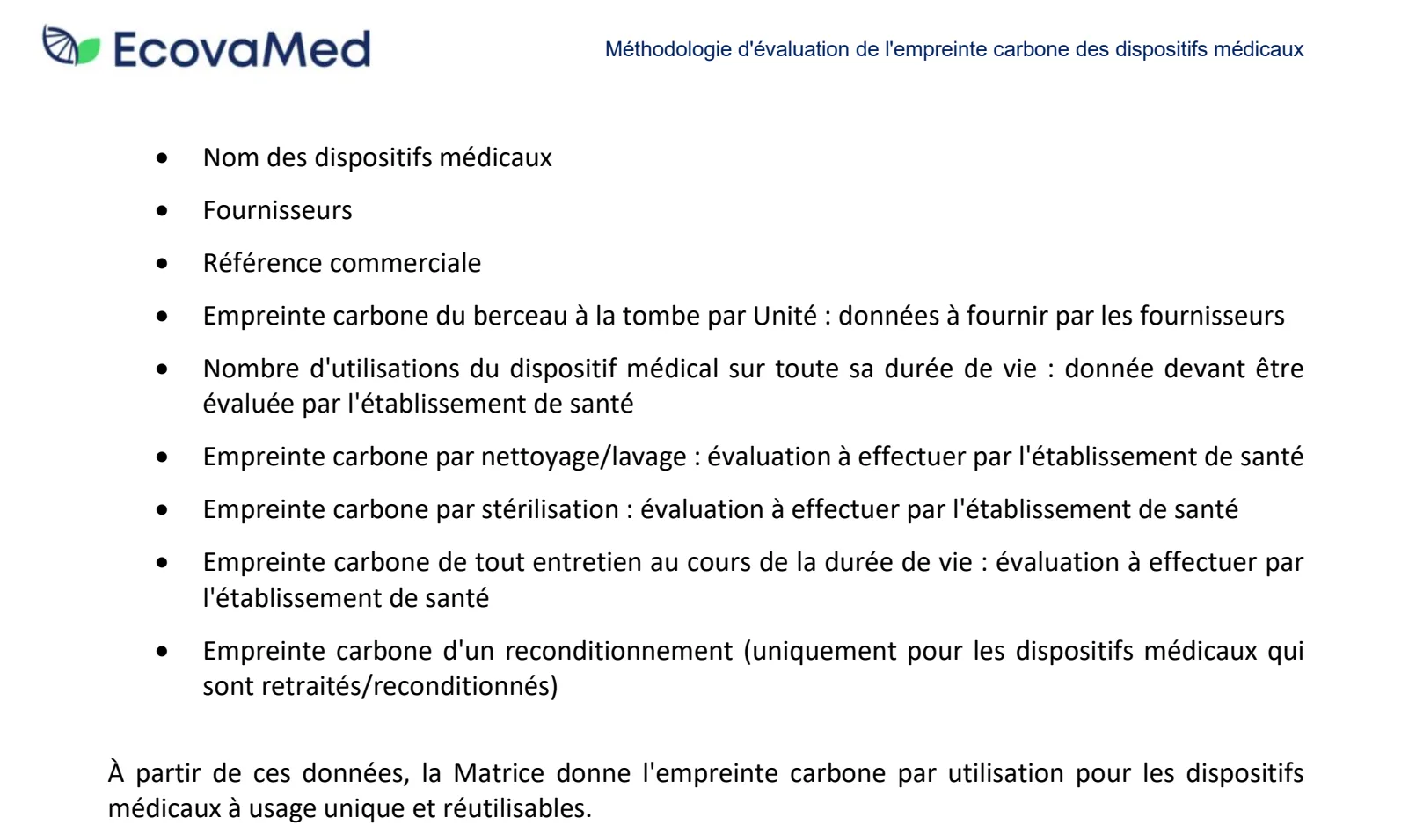
The draft separates the roles, as the page reproduced below shows: in the tab that compares single-use and reusable devices, 4 data items are to be assessed by the healthcare facility, from the number of uses to maintenance. The manufacturer supplies the footprint of its reference, from manufacturing to end of life, and the tool calculates the footprint per use of the 2 options. The text recommends a gap of at least 20% to judge a difference significant, and defers the verification rules to a later date.
2Which LCA stands up in front of a buyer?
A comparative LCA follows ISO 14040 and 14044, which require systems to be compared on the same function, measured by the same functional unit. The rest of the study rests on this choice.
The functional unit: one use, one procedure, one year
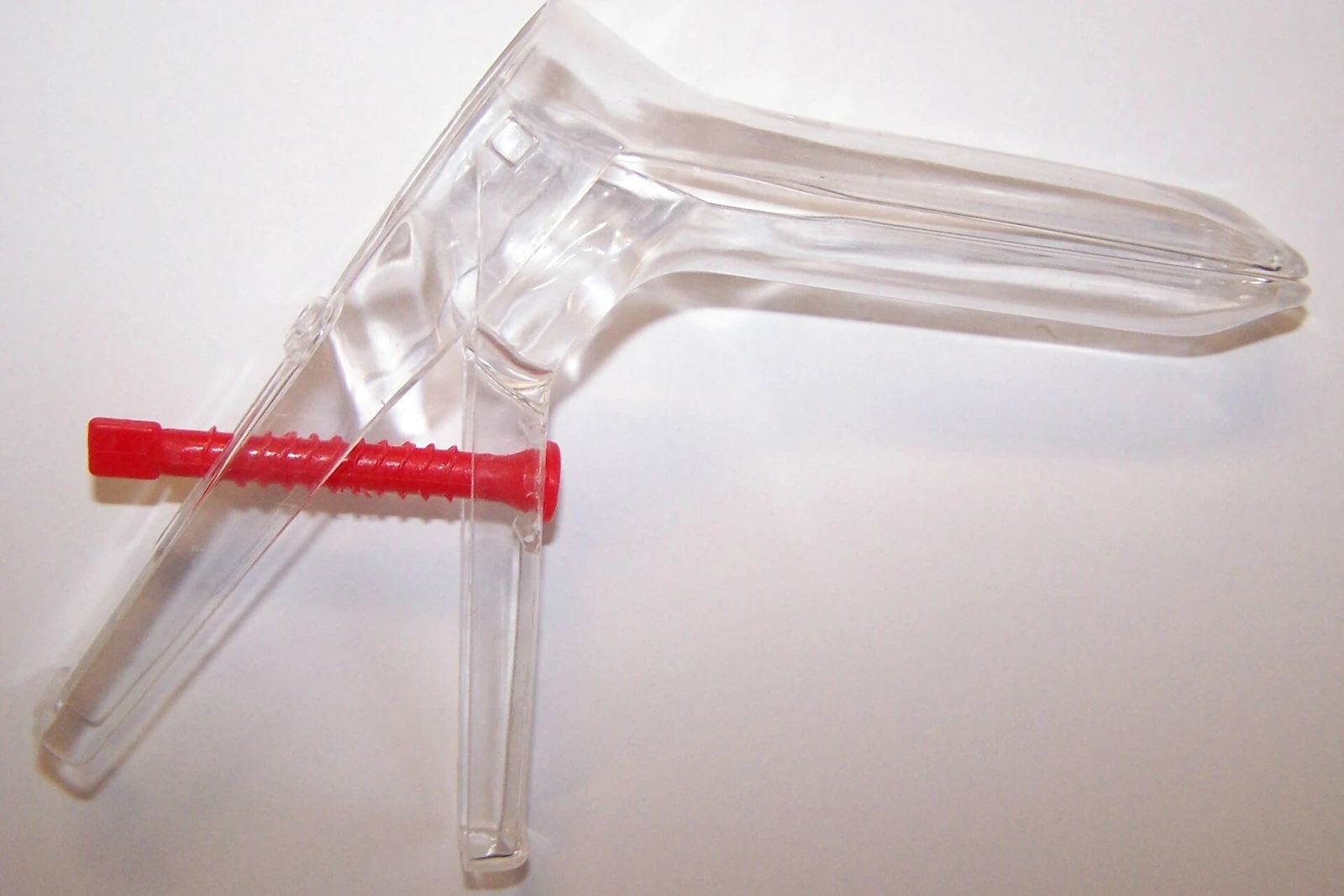
The functional unit describes the service delivered, not the object. A US study of vaginal speculums, published in 2020, thus compared 20 gynaecological examinations, carried out either with plastic speculums discarded after use or with a steel speculum sterilised between 2 patients. At Nantes University Hospital, a 2025 study of electrosurgical scalpels used one year of use in the operating theatre, or 3,987 procedures.
The choice of unit carries with it the number of reuses, which becomes the most influential assumption of the study. The report must justify it and vary it in a sensitivity analysis.
The steps to count
The 2 systems do not have the same steps, and the standard requires them to be compared with equivalent boundaries. In the diagram below, what matters is the loop: each step it contains is counted as many times as the device is used, and its data sits with the hospital, not the manufacturer.
The reusable device repeats 2 steps at every use, while single-use goes through each step only once
For each step: what is counted, who holds the data and the error that comes up most often.
What is counted
The electricity and water of the autoclave, and the sterilisation packaging: reusable container or sheets discarded after use.
Who holds the data
The central sterilisation department, for the cycles; the manufacturer of the container or packaging.
The common error
Forgetting the packaging sheets discarded at every cycle, which add to each use.
The critical review
ISO 14044 requires a review by a panel of at least 3 members, chaired by an independent expert, whenever a comparison between products is intended for the public. In that case it also prohibits combining the indicators into a single score after weighting. Such reviews remain rare in published studies: in a 2023 review of 27 LCAs of healthcare products, only 2 studies met the critical review criterion, even in part.
A study published in 2022 on Elis scrub suits shows what a reviewed comparison looks like. Commissioned and funded by the company, it was reviewed by a panel of 3 LCA experts. Its report shows both the climate gain, 31% fewer emissions over 4 years, and the increase in water consumption. Our article on the critical review of an LCA (in French) (in French) describes how a review proceeds.
3What do the published comparisons show?
The published studies lean clearly towards the reusable option. The University of Oxford systematic review, published in BMJ Open in December 2025, identified 47 direct comparisons: 39 conclude that the reusable option emits less, or 83%, often beyond a certain number of uses.
In the graphic below, each family is compared per use or per procedure. What to look at is the last line of each card: the condition that tips the result the other way.
In 5 published studies, the reusable option emits less per use, provided it is used often enough
1 family per photo: what the study compares, what it finds and what would change the result.
The result
1.8 kgCO2e per operation with reusable instruments with disposable parts, against 7.2 kgCO2e all-disposable.
UK public hospital, 2022 (Rizan and Bhutta)
What is compared
The instruments for a laparoscopic gallbladder removal: trocars, scissors and clip applier.
What changes the result
The reusable option comes out ahead as soon as its components are used more than 2 times. The study assumes 500.
What weighs on each side
The dominant items are not the same on each side. A review of studies on operating theatre equipment, published in 2021, shows that production accounts for a median of 88% of the footprint of a single-use item, and reprocessing for 68% of that of a reusable one. At Nantes University Hospital, 86% of the footprint of the reusable electrosurgical scalpels came from their sterilisation cycles.
For the manufacturer of a reusable device, manufacturing therefore most often weighs less than reprocessing. What decides the outcome happens at the hospital, in the sterilisation department. On the single-use side, disposal matters too: a soiled device goes into infectious healthcare waste, which is incinerated.
Cases where single-use comes out ahead
In the Oxford review, 6 comparisons favour single-use. Each has its own explanation, which lies in the country, the product or the study itself. Here are 3:
- In Denmark, in 2014, a disposable polyethylene bedpan emitted about 2 times less per use than a reusable bedpan, weighed down by its washing and disinfection. Incineration of the disposable one, with energy recovery, also worked in its favour.
- A reusable set for spinal surgery emitted more in a 2020 study funded by the manufacturer of the disposable set, which also included shorter operations with the disposable one.
- In a study published in 2023, a single-use flexible cystoscope emitted at least 33% less than the disinfection alone of a reusable cystoscope, a result its authors limit to the disinfection method studied.
The result of a comparative LCA depends less on the factory that makes the instrument than on the hospital that sterilises it.
4What tips a comparison?
A comparison tips mainly on 3 parameters, which the hospital knows better than the manufacturer: how it reprocesses the device, the electricity that powers its machines and the actual number of uses. A sound study tests them one by one in a sensitivity analysis and states the point from which the reusable option comes out ahead.
Reprocessing energy and machine loading
A 2022 study of sterilisation at an English public hospital modelled its washers and autoclaves, using a record of the machines' measured loading. In the graphic below, the reference bar is that hospital: everything that departs from it comes from the energy used for steam or from machine loading, never from the instrument itself. The same instrument, packed on its own rather than in a set, emits 2.8 times more per cycle, because a machine slot holds far fewer individually packed instruments than instruments arranged in a set.
Reprocessing a set of 29 instruments emits 0.4 to 6 kgCO2e depending on energy and loading
These parameters also vary from one country to another. In France, an autoclave cycle generally lasts 18 minutes at 134 °C, according to the June 2025 Shift Project report on medical devices (in French). Other European countries commonly run cycles of 3 to 5 minutes. By keeping one of its autoclaves permanently switched off, the Dax hospital cut its sterilisation energy consumption by 38% in 2024.
Electricity and water
The electricity that powers reprocessing can reverse a conclusion. For the anaesthetic equipment of an Australian hospital with 6 operating theatres, a 2017 study found 9% more emissions when switching to reusable equipment with local electricity. With the electricity mix of the United Kingdom and Europe, the same switch reduced them by 84%. Low-carbon French electricity works in favour of the reusable option.
Water often works the other way, which a multi-criteria LCA brings out and a simple carbon footprint assessment does not see. In the same Australian study, water consumption more than doubled, and Elis's reusable scrub suits weigh about 20 times more than their disposable equivalents on the water resource indicator. Our guide to LCA indicators describes these impact categories.
The actual number of reuses
The tipping point is the number of uses beyond which the reusable device emits less. In the families presented above, it ranges from a few uses to around a hundred cycles. The number used in the study must therefore be the one customers observe, not the one stated in the instructions for use.
The responsible procurement sheet gives the buyer a way to check it: the number of devices in service, divided by the number repurchased each year, gives their real lifetime. At Nantes University Hospital, 78 reusable scalpels were in service with their cable, and 20 were repurchased in one year to replace losses and breakages. Their real lifetime is therefore about 4 years, or about 200 procedures each at the pace of the year's 3,987 procedures, according to our calculation.
5Who can carry out the LCA, and who can review it?
The study calls for 2 roles, which cannot be held by the same person. The LCA practitioner builds the model; the reviewer, or the panel, checks that it is sound and that the conclusions go no further than the results.
The LCA practitioner
A good practitioner knows medical device LCA and hospital reprocessing, and knows how to collect data from suppliers of materials and components. The questions to put to them before the quote cover this ground:
- Which sterilisation data will you use: records from a partner facility, or an average value taken from a foreign database?
- How will you model the loading of the washers and autoclaves, and will you test a low loading in a sensitivity analysis?
- Which single-use product will you compare against, and will the buyer be able to recognise the reference it buys today?
- Which indicators will you track beyond climate, in particular water, to respond to a buyer who asks for a multi-criteria analysis?
The reviewer and their independence
The reviewer has neither carried out the calculation nor chosen its assumptions. For a response to a tender, the standard requires nothing and an external expert meets the buyer's criterion; for a published comparison, the panel is mandatory.
A review by a single expert costs, as an order of magnitude observed in 2026, between €3,000 and €5,000 excl. VAT, with no public price list. The price of an LCA varies more widely. Diag Éco-conception, an eco-design diagnostic run by Bpifrance (the French public investment bank) and ADEME (the French Agency for Ecological Transition), which includes a streamlined LCA, leaves €5,400 excl. VAT to be paid by a company with fewer than 50 employees. Under 250 employees, this remaining cost rises to €7,200 excl. VAT. Our guide to transition funding lists the other sources of funding.
Warning signs
Before signing and after receiving the study, 3 warning signs are reasons to hesitate:
- The quote promises to "certify" or "validate" that the reusable device is better, whereas the LCA may conclude the opposite and such a sentence becomes a claim that must be substantiated.
- The study reuses a percentage taken from a literature review instead of modelling the actual device and its reprocessing.
- The report gives neither a tipping point nor a sensitivity analysis on the number of uses, the energy of sterilisation or the electricity.
6What to prepare before launching the study?
An LCA of a reusable device moves at the pace of the hospital data. The manufacturer saves weeks by gathering the following items before the study starts:
- The device's bill of materials, with the mass and nature of each material, the place of manufacture and the delivery packaging.
- The number of cycles observed at customers, taken from sterilisation traceability records or from repurchases, and not only the number stated in the instructions for use.
- The reprocessing protocol from the instructions for use: pre-disinfection, washing, packing, type of sterilisation and number of devices per basket.
- The electricity, water and steam consumption of the washers and autoclaves of at least one partner facility, with the actual loading of the batches.
- The competing single-use reference, its weight, its packaging and its disposal route, ideally purchased and weighed.
The partner facility matters as much as the consultancy. A sterilisation department that opens its records gives the study the data that the buyer challenges least, since it comes from the buyer's own line of work. The eco-design practices that follow, such as lightening the sterilisation packaging or making the device easier to load, are then measured with the same model. Packaging also falls under the European rules on packaging for medical devices.
For us at Projet Celsius, the question that decides an LCA of a reusable device is the number of cycles. A number taken from the instructions for use does not stand up to a buyer who tracks repurchases. We recommend measuring this number at 2 or 3 customers, publishing the tipping point with the comparison, and having the study reviewed before any commercial use.
7Key takeaways
- Since 22 August 2026, every new tender from a French public hospital scores at least one environmental criterion, and the buyer can compare devices per use.
- The proof that holds up is a comparative LCA under ISO 14040 and 14044, which counts washing, packaging and sterilisation at every cycle.
- Published comparisons favour the reusable option in 39 cases out of 47, but not when reuses are few or the electricity is very carbon-intensive.
- The number of cycles used must be the one customers observe, and the tipping point must appear in the report.
- A comparison intended for the public requires a critical review by a panel of at least 3 members, and prohibits combining the indicators into a weighted score.
To place medical devices within the footprint of the healthcare system, see our guide to the carbon footprint of medical devices.
- Law No. 2021-1104 of 22 August 2021, known as the Climate and Resilience Act, Article 35 (environmental award criterion in public procurement). The Légifrance pages are in French.
- Legal Affairs Directorate, French Ministry of the Economy, practical sheets on environmental and social considerations (in French), July 2026.
- Directorate General for Enterprise, consultation on the methodology for evaluating the carbon footprint of medical devices (in French), 3 August to 16 October 2026 (methodological guide, draft).
- ISO 14044:2006, Environmental management, life cycle assessment, requirements and guidelines, clauses 4.2.3.7, 4.4.5, 6.1 and 6.3.
- A. Booth et al. (University of Oxford), The carbon footprints of single-use and reusable medical devices: a systematic review, BMJ Open, December 2025.
- J. Drew et al., Operating in a Climate Crisis: A State-of-the-Science Review of Life Cycle Assessment within Surgical and Anesthetic Care, Environmental Health Perspectives, 2021.
- M. Keil et al., The impact of switching from single-use to reusable healthcare products: a transparency checklist and systematic review of life-cycle assessments, European Journal of Public Health, 2023.
- C. Rizan et al., Minimising carbon and financial costs of steam sterilisation and packaging of reusable surgical instruments, British Journal of Surgery, 2022.
- C. Rizan and M. Bhutta, Environmental impact and life cycle financial cost of hybrid (reusable/single-use) instruments versus single-use equivalents in laparoscopic cholecystectomy, Surgical Endoscopy, 2022.
- H. J. Friedericy et al. (Leiden University Medical Centre), Reducing the Environmental Impact of Sterilization Packaging for Surgical Instruments in the Operating Room, Sustainability, vol. 14, 2022.
- A. Goubil et al. (Nantes University Hospital), Understanding and quantifying the environmental impact of sterile medical devices: a carbon footprint study of single-use electrosurgical scalpels and their reusable alternatives, BMJ Surgery, Interventions, & Health Technologies, 2025.
- B. Sørensen and H. Wenzel, Life cycle assessment of alternative bedpans, Journal of Cleaner Production, 2014.
- A. Leiden et al., Life cycle assessment of a disposable and a reusable surgery instrument set for spinal fusion surgeries, Resources, Conservation and Recycling, 2020.
- N. Rouvière et al. (Nîmes University Hospital), Reusable laryngoscope blades: a more eco-responsible and cost-effective alternative, Anaesthesia Critical Care & Pain Medicine, 2023.
- M. Pioche et al. (Hospices Civils de Lyon), Environmental impact of single-use versus reusable gastroscopes, Gut, 2024.
- E. Vozzola, M. Overcash and E. Griffing, An Environmental Analysis of Reusable and Disposable Surgical Gowns, AORN Journal, 2020.
- L. M. Donahue et al., A comparative carbon footprint analysis of disposable and reusable vaginal specula, American Journal of Obstetrics and Gynecology, 2020.
- Burguburu et al., Comparative life cycle assessment of reusable and disposable scrub suits used in hospital operating rooms, Cleaner Environmental Systems, 2022 (study commissioned by Elis).
- F. McGain et al., Financial and environmental costs of reusable and single-use anaesthetic equipment, British Journal of Anaesthesia, 2017.
- M. Baboudjian et al., Life Cycle Assessment of Reusable and Disposable Cystoscopes, European Urology Focus, 2023.
- The Shift Project, Décarbonons les industries des dispositifs médicaux, rapport final (in French), June 2025, pp. 125 and 134.
- ARS Provence-Alpes-Côte d'Azur (regional health agency), responsible procurement sheet "Dispositifs médicaux" (in French), July 2024.
- Ministry of Health, Planification écologique du système de santé, feuille de route (in French), December 2023, p. 20.
- Ministerial order of 22 July 2026 implementing Decree No. 2025-895 of 4 September 2025 on the trial of reprocessing certain single-use medical devices.
- Bpifrance, Diag Éco-conception (in French), page consulted on 17 October 2026.
- ISO 14071:2024, Life cycle assessment, critical review processes and reviewer competencies.


