

- 1The medicines carbon score is expressed per pack, per unit and per dose.
- 2A method other than the DGE's may make a bid irregular when the tender documents cite the score.
- 3The buyer compares the footprint increased by its uncertainty, which is why real data matter.
- 4Ask your active ingredient suppliers early for their footprint, verified by a third party.
Since 22 August 2026, every French public procurement contract (marché public) that is awarded on criteria must include one that concerns the environment, and the medicines that hospitals put out to tender are no exception. For these purchases, the French Ministry of Health recommends a specific criterion, the medicines carbon score (score carbone médicament): the carbon footprint of one pack, calculated with the public methodology of the Directorate-General for Enterprise (DGE) and checked by a third-party verifier. The pharmaceutical company that responds therefore submits a figure for each presentation (each strength and pack size of a medicine), its uncertainty, and the documents that allow the third-party verifier to check that the method has been followed.
A score per presentation, increased by its uncertainty and verified by a third party
3 answers on the tender, the molecule and the stage of the calculation give the method, the documents, the verification and the time needed.
The DGE method, and no otherAny other method could make the bid irregular.
1 footprint per presentation (CIP code) in kgCO2e per pack, per unit and per daily dose, increased by its uncertainty.
A third-party verifier chosen by the buyer checks the data during the analysis of bids, until the accredited third-party route is in place.
5 years of validity, to be recalculated if the footprint varies by more than 10% by then.
The first question decides everything else: if the tender documents cite the medicines carbon score, that method, and that method alone, is the one to apply. The sections that follow start from the buyer's request and end with the file to submit.
1What does the buyer ask for, and why?
The request comes from 2 texts that complement each other: a law that obliges all public buyers, and an information note from the Ministry of Health that gives them a tool specific to medicines.
An environmental criterion in every contract
Article 35 of France's Climate and Resilience Act requires an environmental award criterion and an environmental performance condition for every consultation launched since 22 August 2026. EU procurement law allows buyers to set environmental award criteria; the French law makes one compulsory. The Legal Affairs Directorate of Bercy, the French Ministry of the Economy, recommends weighting this criterion at at least 10% of the score, so that it affects the ranking. The detail of these 2 obligations is set out in our guide to responding to the environmental criterion of a public contract.
Hospitals often buy through joint purchasing structures, regional groups or national operators such as UniHA and Resah (the French hospital buyers' network), which place contracts on behalf of many establishments. A carbon criterion written into one of these contracts applies to all the volumes it covers.

The medicines carbon score, the ministry's tool
The Ministry of Health's information note of 29 October 2025 encourages establishments with an in-house pharmacy (pharmacie à usage intérieur) to score bids on this score. Use of the score remains voluntary and applies first to 18 priority molecules, from paracetamol to morphine. The note proposes a weighting of 10%, given as an example, together with a clause in the technical specifications (cahier des clauses techniques) explaining the method.
It also contains the sentence that matters most to a pharmaceutical company: if the tender documents mention the medicines carbon score, presenting the results of another method could make the bid irregular. The list of the 18 molecules and the origin of the method are detailed in our article on Ecovamed and the carbon score of medicines.
When the tender documents cite the medicines carbon score, a life cycle assessment (LCA) carried out with another method may make the bid irregular, even if it complies with the standards.
What buyers already ask for
The item is a heavy one. According to The Shift Project, a French think tank, cited by the DGE guide, purchasing medicines accounted for 29% of the footprint of the French healthcare system in 2020, or 14.5 million tonnes of CO2 equivalent. In a hospital's carbon footprint assessment, these medicines fall under purchases, which the hospital BEGES (bilan d'émissions de gaz à effet de serre, France's mandatory greenhouse gas emissions report) also counts.
UniHA, the cooperative purchasing operator of public hospitals, states in its 2025 activity report (in French) that it was the first national operator to require an LCA among the selection criteria of a tender. For a 2025 contract, it reports 40 carbon LCAs submitted with the bids. It expects 130 certified ones during the first performance period of the contract, once the contractor has been chosen.
2What does the score that the buyer reads contain?
The score is calculated for each presentation, under rules that leave little room for interpretation.
A footprint per pack, per unit and per dose
The DGE methodological guide (in French), updated on 24 July 2025, applies ISO 14067 (the ISO standard for product carbon footprints) and the GHG Protocol to a streamlined LCA of the medicine, from raw material extraction to end of life. It asks for one footprint per CIP code (the French identifier of a medicine presentation), that is, per presentation: each strength and each pack size has its own.
Each result is expressed in kgCO2e (kilograms of CO2 equivalent) per pack, per common dispensing unit (UCD in French: a tablet or an ampoule) and per defined daily dose (DDD) of the World Health Organization (WHO) where one exists. It is split into upstream, from raw materials to the factory gate, and downstream, from transport to the pharmacy to end of life. The data cover at least 12 months.
A result increased by its uncertainty
The method rates the quality of each piece of data from 1 to 5, from direct measurement to spend-based factor, and derives an overall uncertainty from it. The figure used adds this uncertainty to the footprint. A low but poorly documented footprint can thus lose out to a slightly higher footprint that is better evidenced.
The graphic below reproduces the example result published in the guide. At the bottom, each line shows what the origin of the data for an ingredient or a packaging item costs in uncertainty.
The buyer compares the footprint increased by its uncertainty: 0.518 kgCO2e per pack becomes 0.690
The example result published by the DGE, then the uncertainty of an ingredient according to the origin of its data.
For the production footprint, the guide rates an uncertainty of 10 to 20% as excellent, and 20 to 45% as satisfactory. Above 45%, it asks for the assessment to be refined.
Valid for 5 years
A footprint is valid for 5 years. If the supply chain or the production facilities change and cause the footprint to vary by more than 10%, it must be recalculated and submitted again. The guide also asks for an update when the emission factor of the active ingredient varies by more than 20%.
3Who can do the calculation, and who verifies it?
The calculation and the verification are 2 separate professions, and the ministry's note does not entrust them to the same players.
The calculation: the pharmaceutical company and its suppliers
The guide addresses the whole chain, down to the carbon data of suppliers. The ingredient manufacturer calculates the factor for its product, the manufacturer of the medicine calculates the footprint of the pack from these factors, and the operator (exploitant, the company that markets the medicine) consolidates everything in the Excel matrix published by the DGE. For an active ingredient, the factor provided by a supplier must have been verified by a third party.
A pharmaceutical company may do this work in-house or entrust it to an engineering consultancy. The guide already asks for the sector expertise of any provider that calculated a supplier's data to be checked, and the same criterion applies to the calculation of the medicine. Before signing a quote, check 4 points:
- The provider has already carried out LCAs or product carbon footprints under ISO 14067, and can read the chapters of a marketing authorisation (MA) dossier.
- It has the databases that the guide requires, ecoinvent version 3.10 or later and Exiobase for spend-based factors, and knows when each applies.
- It goes back to the suppliers of the active ingredient, often outside Europe, rather than applying the matrix's default values straight away.
- It will not be able to verify its own calculation, since the note entrusts the check to a third-party verifier.
The verification: a third party, during the analysis of bids
The note provides for an institutional route: the pharmaceutical company will have its score validated by an accredited third-party verifier, at its own expense. Announced for the first half of 2026, this route had no published arrangements by mid-October 2026 on the Ministry of Health's ecological planning page (in French), where they are due to appear. In December 2025, the DGE was mentioning an approval prepared with Cofrac (the French national accreditation body, the counterpart of UKAS in the United Kingdom) and announced for summer 2026, according to achat-logistique.info (in French), for a verification modelled on a financial audit.
Until this route is in place, the results are certified by third-party verifiers whom the buyer chooses, or by the buyer itself, during the analysis of bids. The check ends with an attestation of conformity, and the extract of the note reproduced below sets its conditions.
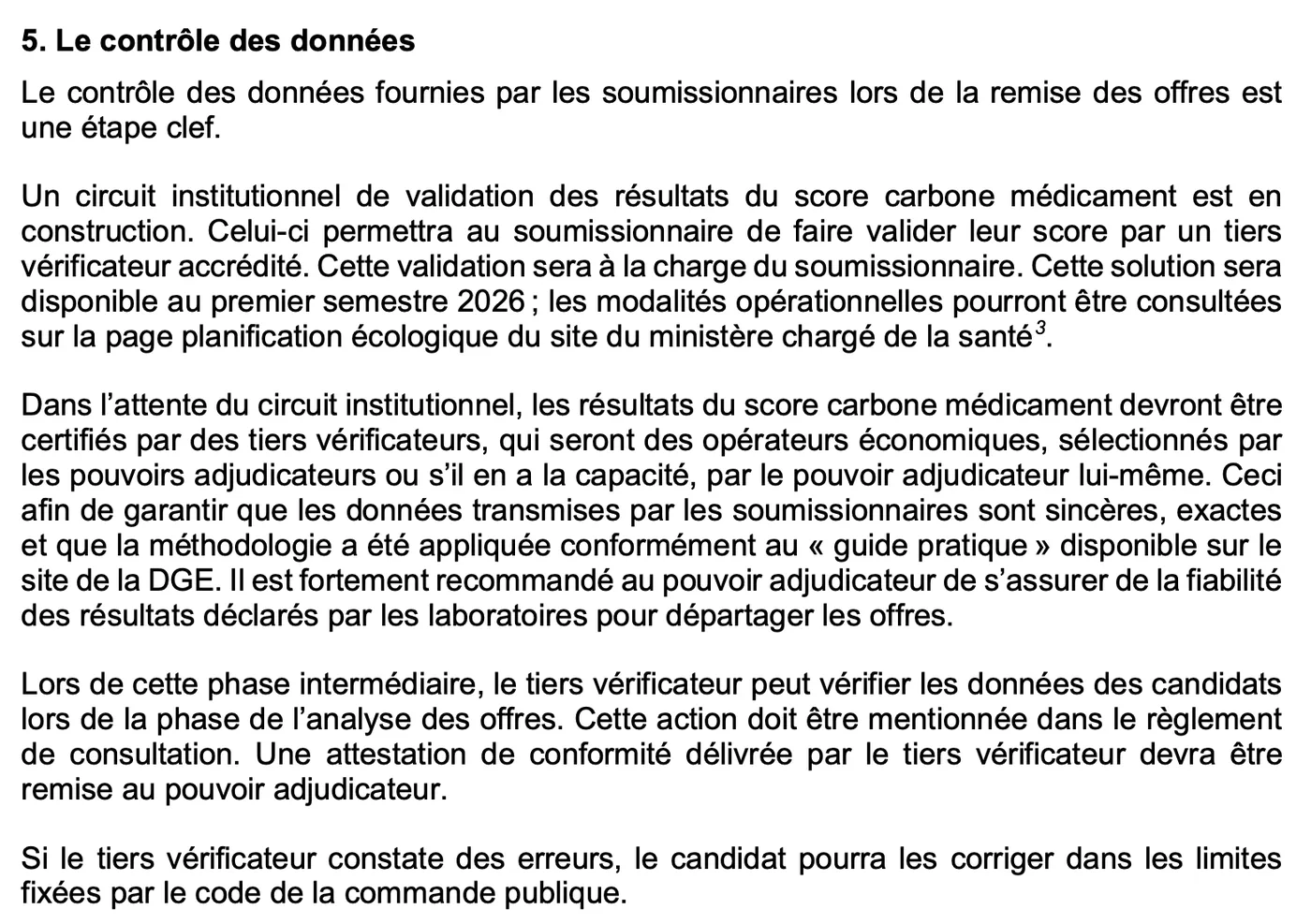
The paragraph that sets out the verification of the score. In time, an accredited third-party verifier, paid for by the pharmaceutical company, validates the score. In the meantime, third parties chosen by the buyer check the data during the analysis of bids and issue an attestation of conformity. The note does not yet say who will accredit these third parties.
The verifier checks that the data are truthful and accurate, and that the method has been applied as set out in the DGE guide. This is the principle of any third-party verification (in French) (in French), as with an FDES (the French format of environmental product declaration for construction products) and its approved verifier or the critical review of an LCA (in French) (in French).
4How long does it take, and what should you prepare?
The timetable depends mainly on suppliers: a pharmaceutical company controls its own plants, but rarely the data of those who synthesise its active ingredients.
The documents in the file
The guide lists in an annex the documents that the verifier asks for every time:
- The chapters of the MA dossier that name the active ingredients, their suppliers, the manufacturing sites and the synthesis scheme.
- The footprint reports of the ingredients and packaging, calculated for the purpose, compliant with the GHG Protocol or ISO 14067, with the source of each emission factor.
- Supplier attestations, giving for each product the footprint, the year of the data, the standard followed and the databases with their version.
- The emissions assessment of the formulation and packaging sites, drawn up under the GHG Protocol, the regulatory BEGES or Bilan Carbone® (the French carbon accounting method).
- A short report on allocation keys, machine hours or number of packs per medicine, with the source of this data and the calculation.
Depending on the case, the verifier may also ask for ingredient purchase invoices, extracts from the enterprise resource planning (ERP) system on stocks and consumption, and the weight of each packaging item. In the graphic below, the card for each block also states what the matrix applies when the document is missing.
5 blocks of documents, and a default value for each missing document
For each life cycle stage, the documents the DGE guide asks for and what the matrix applies without them.
The active ingredient: chemical or biological synthesis, often outside Europe
Documents to provide
- The chapters of the MA dossier: suppliers, site addresses, synthesis scheme.
- The supplier's footprint report, compliant with the GHG Protocol or ISO 14067 and verified by a third party.
If the document is missing
An unknown origin is counted as China, and each unmeasured item adds its uplift: up to +31% on the active ingredient.
Lead times
For a molecule that is not on the list of 18, the note recommends that buyers allow 3 to 6 months between the announcement of the criterion and the submission of bids, so that all candidates have time to calculate. For the 18 molecules on the list, the note has allowed this criterion since the first quarter of 2026 without any particular lead time. The score is therefore prepared before the contract notice (the public call for competition).
Most of the time goes into obtaining the data from active ingredient suppliers, then into having it verified. An emissions assessment already done on the manufacturing site, such as a BEGES or an industrial site carbon footprint assessment, shortens the timetable, since it provides the manufacturing share.
Cost
No public price list exists for a medicines carbon score or for its verification. The calculation is at the pharmaceutical company's expense, and so will be the verification in the announced institutional route. In the meantime, the note leaves the choice of the third-party verifier to the buyer. The cost depends mainly on the number of presentations to calculate and on the share of supplier data already available, and the ranges for a full LCA do not apply as they stand. A footprint that has been calculated and verified then serves for all contracts during its validity period, and feeds the Scope 3 of the hospital customers.
5Which mistakes lose points?
The rules of the guide are precise, and most points are lost through data left at its default value or a shortcut that the method refuses.
Items left at default values
When the manufacturer of an active ingredient has not measured certain items, the matrix adds flat-rate uplifts to its footprint, which accumulate:
- Direct process emissions, such as thermal oxidation of solvents or the site's wastewater treatment plant, increase the footprint of the active ingredient by 2%.
- Leaks of refrigerant gases from the plant's chillers and air conditioning systems also add 2% to the footprint of the active ingredient.
- Purchases of indirect goods and services, such as maintenance or IT, are counted through a flat-rate uplift of 10%.
- Capital goods, that is, the construction of the plant and the year's investments, are counted through another uplift of 10%.
- The transport of raw materials to the plant adds 5%, and staff commuting adds a further 2%.
Left entirely at their default values, these items increase the footprint of the active ingredient by 31%, before the uncertainty is even applied. A supplier that has carried out the full emissions assessment of its site replaces them with its real values.
Shortcuts that the method refuses
Other losses come from the calculation rules themselves, which the verifier checks one by one:
- An input whose origin is left unknown is counted as made in China, with the emission factors that correspond to that origin.
- A generic chemical factor applied kilo for kilo to a complex active ingredient is prohibited, because it greatly underestimates emissions.
- Ingredients and packaging calculated with spend-based factors must not exceed 25% of the footprint, failing which a precise calculation becomes mandatory.
- The factor of a European supplier does not apply to the whole active ingredient when most of the volumes come from Asia: the average is weighted by supplier.
For an injectable, the administration equipment also counts. The guide imposes 0.9 kgCO2e per infusion for the devices and their waste, and 2 kgCO2e when the bag is prepared by the hospital pharmacy. A single infusion thus weighs more than the total footprint of the pack used as the guide's example, 0.518 kgCO2e. For medical devices themselves, the DGE has put a method of the same kind out to consultation until 16 October 2026.
What the score does not say
The score counts the climate only. The guide rules out using it to communicate on the overall environmental performance of the medicine, which would make it an environmental claim that regulations govern. It also excludes patient travel, and packaging remains subject to its own rules, such as the EU packaging regulation (PPWR).
For us, at Projet Celsius, a medicines carbon score is prepared like a pharmaceutical dossier: each figure refers to a document, and each default value is a written choice. We recommend starting with the 2 or 3 presentations that weigh most in hospital sales, and asking the active ingredient suppliers straight away for their verified footprint. Having the first calculation reviewed by a third party before the first call for tenders avoids discovering errors during the analysis of bids, when the Public Procurement Code (code de la commande publique, which transposes the EU procurement directives) limits what can be corrected.
6Key takeaways
- Since 22 August 2026, every contract awarded on criteria carries an environmental criterion, and the ministry recommends the medicines carbon score for the purchase of medicines.
- When the tender documents cite this score, only the DGE's public method is admissible without the risk of an irregular bid.
- The score is calculated per presentation, per pack, per unit and per dose, and the figure used is increased by its uncertainty.
- A third-party verifier attests the conformity of the calculation, and the pharmaceutical company prepares for them the documents from its MA dossier, its suppliers and its sites.
- Missing data is costly, with up to 31% uplift on the active ingredient, then the uncertainty on top.
For the hospital that receives these scores, the medicines item of its carbon footprint assessment is calculated as described in our article on Ecovamed.
- Ministry of Health, DGOS and DGCS, information note No. DGOS/CABINET/DGCS/PNRR/2025/153 of 29 October 2025 (in French) on the arrangements for implementing the public methodology for the carbon footprint of medicines, Bulletin officiel, with its annex (list of the 18 molecules).
- Directorate-General for Enterprise and Ecovamed, Méthodologie d'évaluation de l'empreinte carbone des médicaments (in French), practical guide and assessment matrix, published on 5 February 2025, updated on 24 July 2025.
- Decree No. 2022-767 of 2 May 2022 containing various amendments to the Public Procurement Code, Article 11: 21 August 2026 for its regulatory provisions, Journal officiel (the French official gazette) of 3 May 2022. The Légifrance pages are in French.
- Legal Affairs Directorate, practical sheets on environmental and social considerations in public procurement (in French), including the yes/no sheet on Article 35 of the Climate and Resilience Act, July 2026.
- UniHA, 2025 activity report (in French), March 2026, p. 14 (PDF).
- The Shift Project, *Décarboner la santé pour soigner durablement* (in French), final report v2, 2023, cited by the DGE guide (figure 1).
- Achat-logistique.info, Score carbone des médicaments : nouvelle méthodologie et tiers vérificateur (in French), 9 January 2026, on the webinar of Anap (the French national agency for healthcare performance support) with the DGE and the DGOS.
- Directorate-General for Enterprise, consultation on the methodology for assessing the carbon footprint of medical devices (in French), from 3 August to 16 October 2026.


